Six people, one fire, and everyone wants coffee before anyone wants to talk. A pour-over serves one person at a time while the rest stand around a cold picnic table. A percolator sits in the coals, mutters to itself, and hands you a full pot in the time it takes to find the mugs.
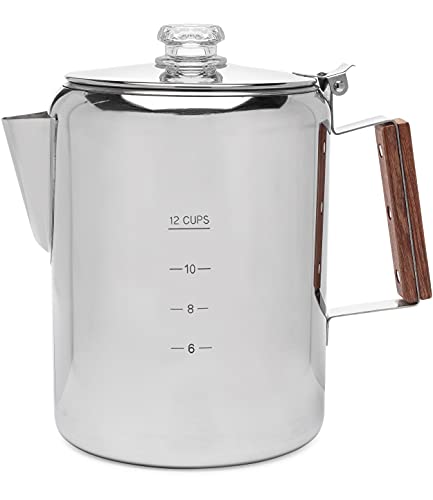


What separates a good camp percolator from a bad one is short: metal that survives a fire, a handle you can grab without a glove, a basket that keeps grounds out of the cup, and a capacity that plainly matches your group. That last one trips up more people than the rest combined, for a reason we will get to immediately.
At a glance
| Product | Standout feature | Price tier | Link |
|---|---|---|---|
| COLETTI Bozeman (12 cup) | Best seller here; stainless throughout, no aluminum or plastic | Premium | |
| COLETTI Classic (blue enamel, 12 cup) | Twice kiln-hardened enamel over heavy-gauge steel; filters included | Mid-range | |
| Primula Today Aluminum (9 cup) | Fast, even heat; works on every stovetop type; cheapest by far | Budget | |
| KingCamp Percolator (9 cup) | 304 stainless with a wood handle and insulated knob; 3 to 5 minute brew | Mid-range | |
| STANLEY Hold Tight (6 cup) | Silicone cool-grip handle, dishwasher safe, lifetime warranty | Premium | |
How to choose a camping percolator
A “cup” is not a cup, and this matters most for groups
Read the fine print on a 12-cup percolator and you find it holds 60 fluid ounces. That is 5 fluid ounces per so-called cup, which is a demitasse, not a mug. Fill a normal camp mug and you are pouring 10 to 12 ounces. So a 12-cup pot is really about five decent mugs, a 9-cup pot is three or four, and a 6-cup pot is two large ones. Size your pot against mugs, not against the number on the box, or you will be brewing twice while the eggs go cold. For four or more people who all drink a full mug, start at 12 cups and do not look back.
Stainless, enamel, or aluminum
Stainless steel is inert, shrugs off a dropped pot, cleans with a rinse, and does not care about the acid in coffee. It is the default for good reason and it is what the top seller here uses throughout, internal components included. Enamel over heavy steel gives you the same toughness plus the look, and it is genuinely durable when the coating is fired properly; the vulnerability is chipping, and a chip is where rust starts. Aluminum is the cheap and cheerful route: it heats fast and spreads heat evenly, which is a real advantage on a fussy stove, but it is soft, it dents, and it reacts more with acidic brews over time.
The handle is a safety feature
Metal parts get hot when brewing. That is not marketing caution, it is the whole design: you are putting a metal pot in a fire. Look at what you will actually grab. A silicone handle stays cool enough to lift a full pot bare-handed. A wooden handle does much the same and looks the part. Bare steel needs a glove or a cloth every single time, which is fine until you are doing it in the dark.
Grind coarse, and watch the glass
Percolators fail on grind more than on hardware. Too fine and the grounds slip through the basket and circulate, giving you silt in the cup and a harsh, over-extracted brew; too coarse and there is not enough resistance to build a proper cycle. Coarse, roughly like sea salt, is the target. Then watch the glass knob on the lid. When the liquid bubbling up turns a steady mid-brown, it is done, generally somewhere around seven to ten minutes of active percolating. Leaving it to hammer away for another five minutes is the actual reason percolator coffee has a bitter reputation. It is not the method; it is the walking away.
Fire, stove, and the induction trap
Most percolators are happy on gas, on a grill, or straight in the coals. Induction is the exception, and it catches people out: a stainless pot only works on induction if its base is magnetic, and several camp percolators are not. The COLETTI Bozeman explicitly does not work on induction and the company sells a separate induction version for that job. If your kitchen hob is induction and you want one pot for home and camp, check that before ordering, not after.
Filters, sediment, and cleanup
No percolator needs a paper filter to function. A disc in the basket is optional and does two things: it keeps fine particles out of the pot, and it lets you lift the spent grounds out in one piece instead of scraping them into a bin bag. On a trail, that second point earns its keep. A stainless pot rinses clean in a stream; enamel does too. Only one pot here is dishwasher safe, which matters when the trip ends and the pot comes home dirty.
COLETTI Bozeman Percolator (12 cup)
The best-selling percolator in this comparison, and the 12-cup size is the one that suits a group: 60 fluid ounces, or roughly five full mugs. The pitch is refreshingly narrow. No aluminum, no plastic, just stainless steel from the body to the internal components, so nothing reactive touches the brew and nothing melts if the pot ends up closer to the flames than you planned. There are no fragile parts to baby, it rinses out on the trail in seconds, and the steady heat of percolation pulls a deep, strong cup out of a coarse grind. A one-year warranty backs it, from a veteran-owned company. The one thing to check before you buy: it does not work on induction.
Pros
- Best seller of the percolators compared here
- Pure stainless steel throughout, no aluminum and no plastic
- 12 cups equals 60 fluid ounces, the right size for a group
- No fragile parts; built for demanding trails
- Rinses clean quickly with no fuss
- One-year warranty
Cons
- Does not work on induction stoves; a separate model covers that
- Metal parts get hot when brewing, so keep a cloth handy
- Priciest option here
Best for: groups of four or more, and anyone who wants one pot to last decades of campfires.
COLETTI Classic Percolator (blue enamel, 12 cup)
The one that looks like camp coffee is supposed to look, without being a museum piece. Heavy-gauge steel, kiln-hardened twice at around a thousand degrees Fahrenheit, finished in blue enamel, with stainless steel internal components so the coffee itself never touches anything reactive. Brewing is the usual ritual: grind, add hot water, set it on a grill, a stovetop, or straight over the fire. A pack of medical-grade filters comes in the box, not because you need them but because lifting the grounds out in one piece beats scraping. Also offered in an 18-cup size if 60 fluid ounces still leaves people waiting.
Pros
- Heavy-gauge steel, twice kiln-hardened, with a proper enamel finish
- Stainless internal components; no aluminum or plastic
- Filters included for cleaner cups and one-piece cleanup
- Works on a grill, a campfire or a stovetop
- An 18-cup version exists for bigger groups
Cons
- Enamel chips if dropped, and chips are where rust begins
- Bare handle needs a cloth or glove when full
- Heavier than a plain steel pot of the same volume
Best for: campers who want the classic look and the toughness to back it, plus a bigger-size option in the same family.
Primula Today Aluminum Percolator (9 cup)
A fraction of the price of everything else here, and it does the job. Aluminum conducts heat fast and spreads it evenly, which is exactly what you want on a wobbly camp stove where one burner ring is doing all the work. Fill the lower chamber, load the filter with grounds, set it on the heat, and within minutes it is bubbling. It runs on electric, ceramic, gas and propane stovetops, and it is equally at home on a grill or a campfire, so it covers the widest range of heat sources in this group. Primula are refreshingly upfront that grind and tamping matter: too coarse, too little coffee, or loose grounds and you will not build proper pressure.
Pros
- Cheapest percolator here by a wide margin
- Aluminum heats fast and distributes heat evenly
- Works on electric, ceramic, gas and propane, plus grills and campfires
- Nine cups covers a small group
- Simple, compact and light to pack
Cons
- Aluminum is softer than steel; it dents and reacts more with acidic coffee
- Fussier about grind and tamping than the steel pots
- Nine cups is only three or four real mugs
Best for: occasional campers, a spare pot for the van, and anyone testing whether percolator coffee suits them before committing.
KingCamp Percolator (9 cup)
Food-grade 304 stainless steel with a wooden handle, an insulated glass knob and a pointed spout that actually pours where you aim it. The wood is the point: it lets you lift a hot pot off the fire without hunting for a cloth, and it does not conduct the way a bare steel handle does. KingCamp quote three to five minutes on most outdoor stoves and rate it at nine cups, which they plainly describe as serving two to three people. A stainless internal basket is included to keep fine grounds out of the pot. It doubles as a kettle for tea, which is worth something when pack space is tight.
Pros
- 304 stainless steel, easy to clean and stands high temperatures
- Wood handle and insulated glass knob for safe, comfortable lifting
- Pointed spout pours accurately
- Stainless internal basket keeps finely ground beans out of the cup
- Brews in roughly three to five minutes; doubles as a kettle
Cons
- Nine cups serves two to three people, so not a big-group pot
- Wooden handle needs drying and will not love being left in the rain
- No paper filters supplied
Best for: couples and pairs, van and cabin kitchens, and anyone who wants a pot they can grab bare-handed.
STANLEY Hold Tight Percolator (6 cup)
The smallest pot here at 1.1 quarts and six cups, and the most carefully finished. A silicone handle keeps a safe temperature over an open flame or a stovetop, so you can lift a full pot without a glove, which is the detail you appreciate at dawn. The interior stainless basket holds the grounds, and unlike the rest of this group it is fully dishwasher safe, so the pot that came home black from a fire goes in a machine rather than a sink. Stanley have been making outdoor drinkware for over a century and back it with a lifetime warranty. Its limitation is plain arithmetic: six cups is roughly two large mugs.
Pros
- Silicone cool-grip handle stays safe over open flame
- 100% dishwasher safe, the only pot here that is
- Interior stainless basket keeps grounds contained
- Lightweight and easy to carry for hiking and backpacking
- Lifetime warranty; BPA-free stainless construction
Cons
- Six cups is about two full mugs; wrong tool for a group
- Premium price for the smallest capacity here
Best for: solo trips, pairs, and backpackers who want one bombproof pot for life.
The verdict
Best overall: COLETTI Bozeman, 12 cup. It outsells the rest of this group and it is the one built for the job in the title: 60 fluid ounces of coffee, all-stainless construction with nothing reactive or meltable in the path, no fragile parts, and a rinse-and-go cleanup. Check your hob first if you want it indoors too, because induction is its one blind spot.
Best value: Primula Today Aluminum, 9 cup. It costs a fraction of everything else and still brews on any heat source you can find, campfire included. Aluminum will not last like steel and nine cups is a small-group pot, but as a first percolator or a spare for the van it is hard to argue with.
Best premium: STANLEY Hold Tight, 6 cup. Cool-grip handle, dishwasher safe, lifetime warranty, and the sort of finish that survives being thrown in a pack for twenty years. Buy it for one or two people. For a crowd, the COLETTI Classic gives you the same 12 cups as the Bozeman with the enamel looks, and an 18-cup version if the group keeps growing.
FAQ
How many people does a 12-cup percolator actually serve?
About five, if everyone drinks one full mug. Percolator cups are 5 fluid ounces, so 12 of them is 60 fluid ounces total, while a normal camp mug holds 10 to 12. A 9-cup pot is three or four mugs and a 6-cup pot is two. Size against mugs and you will not be brewing a second pot.
What grind should I use in a percolator?
Coarse, roughly the texture of sea salt. Fine grounds slip through the basket, circulate in the pot and over-extract, which gives you silt in the cup and a bitter, harsh brew. Grind too coarse and the water passes too freely to build a proper percolating cycle. If your pot came with optional filter discs, they help keep fines out and make cleanup a single lift.
Why does percolator coffee taste bitter?
Almost always because it perked too long. Percolation recycles the same water through the grounds repeatedly, so extraction keeps climbing until you stop it. Watch the glass knob on the lid: once the liquid runs a steady mid-brown, usually about seven to ten minutes of active percolating, pull it off the heat. Walking away is what ruins it, not the method.
Can I use a camping percolator on an induction hob?
Only if the base is magnetic, and many are not. This catches people out who want one pot for the kitchen and the campsite. The Bozeman here states plainly that it does not work on induction, and COLETTI sell a separate induction model for that. Every pot here is fine on gas, on a grill, or directly in a campfire.
Is stainless steel worth it over aluminum?
For a pot that lives in fires, generally yes. Stainless is inert with acidic coffee, resists dents, and cleans with a rinse. Aluminum’s advantage is real though: it conducts heat faster and more evenly, and it costs a fraction as much. If you camp a few times a year, aluminum is plenty. If the pot is going to see a decade of coals, buy the steel.
This article may contain affiliate links; see our Affiliate Disclosure.