A headtorch turns every face it meets into a wince and leaves the rest of the campsite black. Thirty feet of warm string lights strung along the awning does the opposite: you can find the kettle, read a card, see who is talking, and still watch the stars.
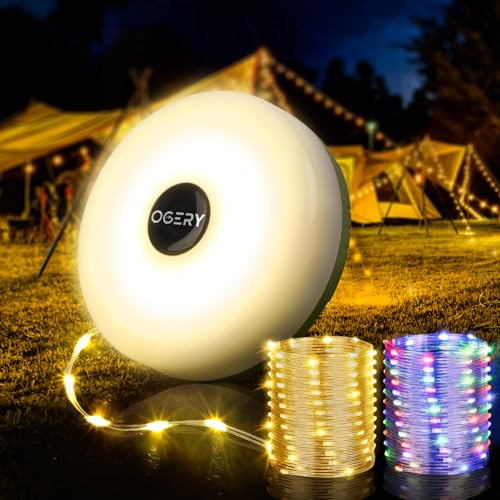


Camp string lights have quietly converged on one clever design: a hand-crank reel that swallows thirty-odd feet of wire in half a minute and doubles as a lantern when the string stays in. What separates them is how the power gets in, how long it lasts, and whether the light is warm enough to sit under. The five below cover a first set for weekend tent trips, an RV awning that runs every night, and a festival pitch with no outlet in sight.
At a glance
| Product | Standout features | Price tier | Link |
|---|---|---|---|
| OGERY 4-in-1 Camping String Lights | 32.8 ft on a crank reel; 8 modes; lantern, work light, and torch in one; 7.4 oz | Budget | |
| OGERY Solar Camping String Lights | 49.2 ft; 5400mAh doubles as a phone power bank; solar and USB-C; 11 modes | Premium | |
| KUQIHUG Camping String Lights | 32.8 ft reel; up to 30 hours on string-only; 3-in-1; lightest on the wallet | Budget | |
| TuoPuLife Solar Camping String Lights | 39.4 ft, 150 warm LEDs; remote control; 4/6/8-hour timer; solar and USB-C | Mid-range | |
| Joomer Fairy String Lights | 33 ft of bendable copper wire; 100 LEDs; 13 modes; timer; cheapest here | Budget | |
How to choose camping string lights
Solar is a top-up, not a power plan
The panel on a light this size is a few square inches, and a few square inches of silicon collects a trickle. TuoPuLife is refreshingly specific about the gap: eight hours in sun to fill the battery, against four hours from USB-C. That is a panel doing roughly half the work of a cable, and only in direct sun with the unit turned to face it.
This is not a reason to skip solar, but a reason to understand it. Solar keeps a light topped up across a long trip with no power. Arrive with the battery already charged from a wall, take the sun as a bonus, and solar earns its place. Expect it to be the primary supply and you will spend the evening in the dark.
The reel is the feature you will use every single time
Thirty feet of thin wire tangles into a bird’s nest with astonishing speed. Almost every camp light here answers that with a hand-crank reel: turn the handle, the string winds itself in, and the whole thing packs down to something the size of a small tin. The claims sit around twenty to thirty seconds, and it is the difference between packing up and unpicking knots by torchlight.
The one exception here is bare copper wire, which has no reel at all. It is thinner, prettier, and bends into any shape you like. It also has to be wound by hand, and it stays wound only if you are careful.
Read the runtime as a range, and find the string-only number
Every listing quotes something like “5 to 12 hours”, which is fair but nearly useless without the mode attached. That spread is the difference between running a bright work light and running the decorative string. The number worth hunting for is the string-only figure, because that is how the light will actually be used at night. KUQIHUG publishes it outright: up to 30 hours on the string alone from the same 2000mAh cell that lasts five hours on full beam.
Battery capacity is the other half. 2000mAh is the common size and covers a weekend of evenings. 3600mAh and 5400mAh cells run multiple nights, and a 5400mAh unit carries enough to put a meaningful charge back into a phone.
Warm white, RGB, or both
Warm white is what makes a campsite feel like a room. RGB flash and breathing modes look great in the product photos and get used roughly twice, usually by children, before everyone settles back on warm. Take color as a bonus rather than a reason to choose, and check that the warm mode can run on its own.
Some units add cool white for a genuinely useful second job: cool light reads better for cooking, fixing a pump, or finding something in a bag, while warm light is for sitting under.
OGERY 4-in-1 Camping String Lights
The best seller of the group by a wide margin, and the design everyone else is copying. Four tools live in one 7.4-ounce puck: 32.8 ft of string light, a camping lantern, a work light, and a flashlight. Eight modes split five and three, running from warm string light through RGB alternate flash and breathing to a combined lantern-plus-warm-string setting and a strong beam. A crank handle winds the whole string back in, and magnets plus a hanging loop stick it to a tent pole, an awning rail, or the roof of a car boot.
The 2000mAh battery fills in about five hours over USB and runs five to twelve depending on how hard you push it. That is a weekend of evenings on the string, less if the work light does real work. Nothing here is exotic, and that is rather the point: it is light, it packs itself away, it costs very little, and it covers four jobs that would otherwise be four objects in the bag.
- Pros: Best-selling design in the category; only 7.4 oz; genuine 4-in-1 with lantern, work light, and torch; crank reel packs it away in seconds; magnet and hook mounting; battery level indicator; very low cost.
- Cons: 2000mAh is the smallest cell here, so multi-night trips need a power bank; the RGB modes are novelty; no solar; waterproofing is described rather than rated.
Best for: A first set for weekend tent and car-camping trips, where light weight and quick packing beat runtime.
OGERY Solar Camping String Lights
The same idea scaled up until it becomes a different product. 49.2 ft of string, the longest here, in both warm white and cool white. Eleven modes, split as seven functional settings for the lantern and flashlight and four decorative patterns for the string, each on its own button so you are not cycling through color effects to reach a work light. And a 5400mAh battery that runs up to twenty hours and doubles as a USB power bank for a phone or tablet.
That last part is what justifies the price. On a trip without power, a light that also refills a phone replaces something else in the bag. Solar and USB-C both charge it, and an indicator glows green when the panel is collecting. The cost is weight: 1.68 pounds, more than three times the little OGERY, which is nothing in a car and noticeable in a pack. Rain protection is stated as light rain and splashes, so shelter the body.
- Pros: Longest string here at 49.2 ft; warm and cool white; 5400mAh runs up to 20 hours and charges a phone; solar plus USB-C; separate buttons for functional and decorative modes; solar charging indicator.
- Cons: 1.68 lb, by far the heaviest, so backpackers should look elsewhere; solar tops up rather than fills; light rain and splashes only, not a downpour; priciest pick here.
Best for: Multi-night trips with no outlet, and anyone who wants one object that lights the camp and charges a phone.
KUQIHUG Camping String Lights
The cheapest way into the reel design, and it publishes the number its rivals bury. Same 7.4-ounce body, same 32.8 ft of RGB string, same eight modes across five and three, same 2000mAh cell charging in about five hours. Where the others stop at “5 to 12 hours”, KUQIHUG adds the figure that matters: up to 30 hours running the string lights alone. That is three or four long evenings of ambient light from a single charge.
It is billed as 3-in-1 rather than 4-in-1, combining lantern, work light, and string, and the ABS and PC body is built for humid conditions and hangs on tents, RV awnings, or a tree. This is openly the same reference design sold under a dozen names, which is worth knowing rather than worrying about: the tooling is proven, and the brand on the case mostly determines the price.
- Pros: Lowest-cost reel light here; publishes a real string-only runtime of up to 30 hours; 7.4 oz; quick-storage reel; RGB and warm modes; battery indicator; hangs anywhere.
- Cons: 3-in-1, so no separate flashlight mode; 2000mAh; no solar; a re-badged reference design, so support depends on a small brand; waterproofing described, not rated.
Best for: The lowest spend that still gets a reel, a lantern, and multiple nights of string light.
TuoPuLife Solar Camping String Lights
The one you control from a camp chair. A remote handles brightness and mode without getting up, and a timer shuts the lights off after four, six, or eight hours, which means falling asleep with them on stops being a waste. 39.4 ft carries 150 warm white LEDs, a denser run than most, and a 3600mAh battery gives about eight hours at full brightness and considerably longer turned down through the three brightness levels.
TuoPuLife is also the most accurate listing in this group about solar, stating eight hours of sun against four hours on USB-C rather than implying the panel does everything. Five modes cover constant on, flash, breathing, SOS, and a combined string-plus-lantern setting, and a USB port handles emergency phone charging. Everything is warm white, with no cool option and no color, which is either the point or a limitation depending on who is asking.
- Pros: Remote control and a 4/6/8-hour timer, unique here; 150 warm LEDs over 39.4 ft; 3 brightness levels; 3600mAh with about 8 hours at full brightness; solar and USB-C; emergency phone charging; 30-second crank storage.
- Cons: Warm white only, no cool or color modes; five modes, the fewest here; a remote is one more thing to lose in a tent; solar needs eight hours of real sun.
Best for: RV awnings and long stays, where a timer and a remote get used every night.
Joomer Fairy String Lights
Not a camp lantern at all, and the cheapest thing here by a distance. This is 33 ft of ultra-thin bendable copper wire carrying 100 warm white LEDs at four-inch spacing, with a 360-degree viewing angle and no reel, no lantern, and no flashlight. What it does instead is disappear. Wrap it round a tent pole, a gazebo frame, a bed frame at home, and the wire vanishes while the light stays, which no chunky reel unit can manage.
Thirteen modes cover steady, flash, fade, and twinkle, there is a 4/6/8-hour timer, and it runs from its own rechargeable battery or straight off a power bank, laptop, or adapter, so a big power bank can keep it lit all night. Three-wire construction adds some durability to what is still fine copper. Judge it as decoration that happens to be portable rather than as camp lighting, and it is excellent value.
- Pros: Cheapest pick here; bends into any shape and hides against a frame; 100 LEDs at close spacing for an even glow; 13 modes; 4/6/8-hour timer; runs off a power bank or any USB supply as well as its own battery.
- Cons: Decorative only, with no lantern, work light, or torch; no reel, so it must be wound by hand and will tangle; thin copper wire is the most fragile design here; warm white only.
Best for: Atmosphere on a tight budget, and anyone who wants lights that also suit a bedroom or a patio.
The verdict
Best Overall: OGERY 4-in-1 Camping String Lights. The category’s best seller, and the balance is right: 7.4 oz, four tools, a reel that packs it in seconds, and a price low enough that a second set is easy. The battery is small, and for weekend trips that never becomes a problem.
Best Value: KUQIHUG Camping String Lights. The same reel design for less, and the only listing willing to publish the string-only runtime of up to 30 hours. Give up the separate flashlight mode and nothing else is missing.
Best Premium: OGERY Solar Camping String Lights. 49.2 ft, warm and cool white, solar and USB-C, and a 5400mAh battery that charges a phone. For several nights away from a socket it does two jobs properly. Carry it in a car, not on your back.
For a timer and a remote, the TuoPuLife Solar is the only pick here with either, and both get used nightly on a long stay.
FAQ
Will solar alone keep these running?
Rarely, and not on a short trip. The panels are small, and the one listing that publishes figures needs eight hours of direct sun to do what a USB-C cable does in four. Charge from a wall before leaving, and use solar to slow the decline rather than reverse it. On a long trip in open sun it genuinely extends things; under tree cover it will not.
Can I leave them out in the rain?
The wire and LEDs are sealed and cope with weather. None of these publish an IP rating, though, and the most careful listing says light rain and splashes. The reel body holds the battery and the charging port, so hang that part under an awning or inside the porch of a tent and let the string take the weather.
How long do they actually last on one charge?
It depends entirely on the mode, which is why every listing quotes a range. Running a bright lantern or work light, expect around five hours from a 2000mAh unit. Running the string lights alone, the same battery can stretch to around thirty. Larger 3600mAh and 5400mAh cells roughly double and triple that, and the 5400mAh unit also has enough to charge a phone.
Are the RGB modes worth paying for?
Not on their own. Color flash and breathing modes are fun for an evening and then almost everyone settles on warm white and leaves it there. They cost nothing extra on these units, so take them if they come, but do not choose a light for them. Cool white is the more useful second color, since it makes cooking and repairs easier.
Why do so many of these look identical?
Because they are. The 32.8 ft crank-reel light with eight modes, a 7.4-ounce body, and a 2000mAh battery is one reference design sold under many brand names, which is why the specifications and even the phrasing match across listings. That is not a warning: the design works and it is well proven. It does mean the badge mostly sets the price, so compare on the numbers that differ, like the string-only runtime.
This article may contain affiliate links; see our Affiliate Disclosure.