Ninety minutes of navigation, a podcast and a hotspot will drain a phone faster than the socket in most cars can refill it. The old 5W lighter adapter is not charging your phone so much as slowing down the rate it dies. A Power Delivery charger reverses that maths, and it costs about the same as a tank of nothing.



Every charger here supports USB Power Delivery, the standard that lets a phone and a charger negotiate a higher voltage instead of trickling along at 5V. What separates them is how the advertised wattage is divided between ports, whether a cable comes in the box, and whether they can also wake up a laptop. That last one matters more than it sounds, and it is where the price differences live.
At a glance
| Product | Standout features | Price tier | Link |
|---|---|---|---|
| KENHAO 67W 3-Port Car Charger | Best seller; PD 37W plus QC 30W; USB-C cable included; two-year replacement | Budget | |
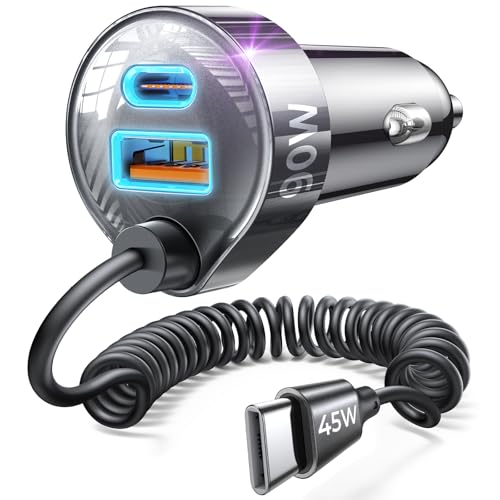
| LISEN 90W Retractable Car Charger | Built-in 45W coiled cable that retracts; three devices at once; UL certified | Mid-range | |
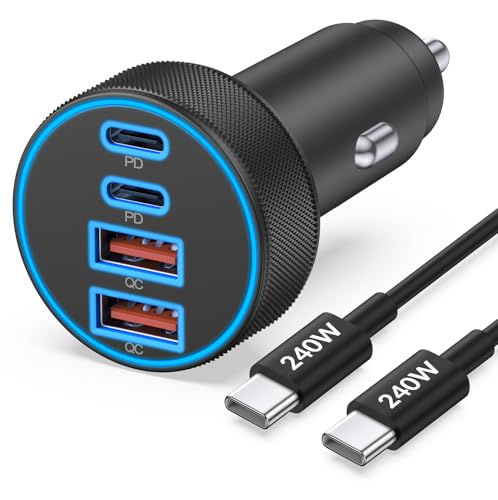
| JUNVANG 90W 4-Port Car Charger | Four ports: two USB-C, two USB-A; 240W rated cable included | Budget | |
| Anker 167.5W 3-Port Car Charger | 100W USB-C port charges laptops; 45W second port; 18-month warranty | Premium | |
| UGREEN 130W Car Charger | 45W PPS port for Samsung’s fastest mode; scratch-resistant body; soft LED | Mid-range | |
How to choose a USB-C car charger
The big number on the box is a sum, not a speed
This is the one thing worth understanding before anything else. A “90W” charger usually means two USB-C ports rated 45W each. A “167.5W” charger means 100W on the first port, 45W on the second and 22.5W on the USB-A. A “200W” model means 100W plus 100W plus 60W. Your phone plugs into one port and receives that port’s rating, never the total. So a 90W charger and a 67W charger may deliver almost identical speed to a single phone, because what counts is the per-port figure buried in the bullet points. Read for the breakdown, and ignore the headline unless you genuinely intend to fill every port.
Ports share, and the split changes when you add a device
Plug in a second device and many chargers redistribute power, dropping the first port to make room. That is normal and safe, but it means the fast charge you measured alone is not what you get with a passenger plugged in too. Chargers that publish a fixed rating per port are being straight with you. If a listing only quotes a total and never explains the division, assume the split is aggressive.
PD, QC and PPS are three different things
Power Delivery is the open USB-C standard, and it is what iPhones, iPads, MacBooks and most modern Android phones use to charge quickly. Quick Charge is Qualcomm’s older scheme, generally living on the USB-A port, and it is why these chargers still include one. PPS is the extra layer that lets a charger fine-tune voltage in small steps, and Samsung’s Galaxy phones need it to reach their top charging speed. If you carry a Galaxy, look specifically for PPS rather than assuming a high wattage covers it.
Your car’s socket sets the real ceiling
A 12V accessory socket is protected by a fuse, typically somewhere between 10 and 15 amps, which caps the whole socket at roughly 120W to 180W regardless of what the charger claims. A 200W charger cannot conjure power the circuit will not pass. This is not a reason to avoid high-wattage models, since headroom means each port runs cooler and closer to its rating, but it does mean the biggest number on the shelf will not translate into proportionally faster charging. Worth checking too whether your socket stays live with the ignition off, since some do and some do not.
The cable can quietly throttle everything
USB-C cables carry a chip that declares how much current they can handle. A basic cable is rated at 3A, which caps you at about 60W no matter how capable the charger is. Anything above that needs a 5A cable, and the 240W rating you see quoted is the top tier. This trips people up constantly: they buy a 100W charger, use the cable that came with their old phone, and never get above 60W. Three of the chargers here include a cable, and the UGREEN explicitly does not, so budget for one if you go that way.
Certification is worth the two seconds it takes to check
This is a device that sits in a hot car, connected to your vehicle’s electrical system, drawing serious current. UL, CE, FCC and RoHS marks mean someone independent tested it. Protection against over-current, over-voltage, overheating and short circuits should be listed explicitly, and flame-retardant housing is a reasonable thing to want. All five here list multiple protections; the ones that name their certifications are giving you more to go on.
KENHAO 67W 3-Port Car Charger
The runaway best seller of this group, and the reasons are unglamorous and completely sound. Sixty-seven watts splits into a 37W Power Delivery port and a 30W Quick Charge USB-A, which is more than enough to fast-charge any phone made this decade and to keep a tablet topped up alongside it. A USB-C cable is in the box, so it works the moment you unwrap it, and the replacement warranty runs two years, longer than the 18 months offered by the premium option here. It will not charge a laptop at any speed worth having, and the plastic body is what it is. As a phone charger for a commute, nothing here is better value.
Pros
- By far the strongest seller of this group
- 37W PD and 30W QC, plenty for any phone
- USB-C cable included in the box
- Two-year replacement, the longest term here
- Three ports at the lowest price
Cons
- 37W is too little for serious laptop charging
- No PPS listed, so Galaxy phones will not hit top speed
- Plastic housing rather than metal
Best for: phones and tablets on a daily commute, at the lowest sensible outlay.
LISEN 90W Retractable Car Charger
The built-in cable is the whole idea, and it is a better idea than it first appears. A 45W coiled lead extends to five feet, reaches the back seat, then snaps back into the body when you let go, so there is no loose cable pooling in the center console and nothing to forget at home. Two more ports handle a second phone and a set of earbuds, which is where the 90W total gets spent. LISEN lists UL, CE, FCC and RoHS certification, and a soft light ring around the ports means you can find them at night without a torch. The catch is inherent to the design: a fixed cable is a fixed connector, and if it ever frays the whole unit goes with it.
Pros
- Retractable 45W cable reaches the back seat and tidies itself
- Three devices at once
- UL, CE, FCC and RoHS certified
- Ambient light ring for night use
- Sits flush and looks tidy in the socket
Cons
- Built-in cable cannot be replaced if it wears out
- The listing notes older iPhones need their own cable
- 45W maximum rules out heavy laptop charging
Best for: anyone tired of cable clutter, and cars where passengers in the back need a charge.
JUNVANG 90W 4-Port Car Charger
Four ports is the answer to a full car. Two USB-C and two USB-A mean a driver, a navigator and two people in the back all get a connection, with no negotiating and no one holding a dead phone at the destination. Power Delivery reaches 45W and Quick Charge 45W, so the fast ports are genuinely fast rather than four slow ones dressed up as a feature. The included cable is rated at 240W, which is the top tier and means it will never be the bottleneck, and the listing quotes a 40,000-bend life. Sharing 90W across four ports does mean speeds drop when everything is occupied, which is arithmetic rather than a defect.
Pros
- Four ports, the most here, at a budget price
- 240W rated cable included, so no cable bottleneck
- 45W PD and 45W QC on the fast ports
- Works with 12V and 24V systems, so trucks are covered
- Mixed USB-C and USB-A suits older devices
Cons
- Speed falls noticeably with all four ports in use
- No certifications named in the listing
- Little-known brand with no stated warranty length
Best for: family trips and rideshare driving, where the problem is port count rather than speed.
Anker 167.5W 3-Port Car Charger
This is the only charger here that takes a laptop as a real device rather than a rounding error. The first USB-C port delivers a full 100W, enough to take a 16-inch MacBook Pro from empty to half charged in under an hour, which turns a car into a workspace in a way a 45W port never will. The second USB-C runs at 45W for a phone and the USB-A adds 22.5W, and Anker publishes each figure rather than hiding behind the total. It stays small despite the output, a 3.3-foot USB-C cable is included, and the 18-month warranty comes with support that actually answers. You pay roughly triple the budget options for it.
Pros
- 100W port genuinely charges laptops at speed
- Per-port ratings published plainly: 100W, 45W, 22.5W
- Cable included
- Very compact for the output
- Established brand with 18-month warranty and real support
Cons
- Costs about three times the budget picks
- Your car’s fuse may cap the full output anyway
- Overkill if you only ever charge a phone
Best for: working from the car, or anyone who needs a laptop charged between appointments.
UGREEN 130W Car Charger
UGREEN is the pick for a Galaxy in the cupholder. The second USB-C port supports 45W PPS, the fine-grained charging mode Samsung’s flagships need to hit their advertised speed, and plenty of higher-wattage chargers skip it entirely. The 130W total spreads across enough ports for a laptop, a phone and a handheld console, and the scratch-resistant body plus a soft blue port light are the sort of details a company with a real design team adds. One thing to plan for: no cable is included, and with 45W PPS on the table a basic 3A lead will cap you at 60W and quietly undo the reason you bought it.
Pros
- 45W PPS port unlocks Samsung’s fastest charging
- 130W total across multiple devices
- Scratch-resistant housing, soft port light for night
- Handles 12V and 24V sockets
- Established brand with a design track record
Cons
- No cable in the box, and a cheap one will throttle it
- Per-port breakdown beyond the PPS figure is not published
- Lowest sales ranking of the five
Best for: Samsung Galaxy owners, and mixed device loads that include a laptop.
The verdict
Best Overall: KENHAO 67W 3-Port Car Charger. The clear best seller, and the right answer for the great majority of drivers. Its 37W Power Delivery port fast-charges any phone, the USB-A handles a passenger, the cable is included and the two-year replacement outlasts the warranty on chargers costing three times as much.
Best Value: JUNVANG 90W 4-Port Car Charger. Four ports and a 240W rated cable for a budget-tier price is more capability per pound than anything else here. Speeds drop with every port filled, but if the problem is four people and one socket, this solves it outright.
Best Premium: Anker 167.5W 3-Port Car Charger. The only one with a true 100W port, which makes it the only one that charges a laptop properly. Real per-port figures, a cable in the box and a brand that stands behind it. Worth it if a laptop ever needs power on the road, and unnecessary otherwise.
Frequently asked questions
Will a 90W charger charge my phone twice as fast as a 45W one?
No. That 90W is almost always two 45W ports added together, so a single phone sees 45W either way. Phones also have their own ceiling, commonly somewhere between 20W and 45W, and will not draw more than they accept regardless of what is offered. The per-port rating and your phone’s limit decide the speed, not the number on the packaging.
Can a car charger damage my phone or my car?
A properly built one will not. Modern phones and chargers negotiate voltage before any real current flows, and every model here lists protection against over-current, over-voltage, overheating and short circuits. The risk sits with uncertified no-name units. Look for UL, CE, FCC or RoHS marks, and if a charger runs hot enough to be uncomfortable to hold, stop using it.
Why is my fast charger charging slowly?
The cable is the usual culprit. A standard 3A USB-C cable caps at roughly 60W whatever the charger can do, and reaching higher needs a 5A cable. After that, check you are in the right port, since the highest-rated port is often only one of them, and check that nothing else is plugged in sharing the budget. Heat matters too: a charger baking in a sunlit car will throttle itself deliberately.
Do I need PPS?
Only for Samsung Galaxy phones, which need it to reach their advertised fast-charge speed. Everything else, iPhones included, charges at full pace on plain Power Delivery. If you carry a Galaxy, PPS is worth seeking out specifically, because plenty of high-wattage chargers do not offer it.
Is it safe to leave the charger plugged in all the time?
Generally yes, though it depends on your car. Some sockets cut power with the ignition and some stay live, and a charger left in a live socket draws a small standby current that can matter on a car left parked for weeks. If yours stays live and the car sits for long stretches, pull the charger out. Otherwise leaving it in is fine.
This article may contain affiliate links; see our Affiliate Disclosure.