A camera strap has one job, which is not dropping several thousand pounds of camera onto concrete. So it is worth noticing that exactly one brand in this search publishes what its strap can hold: 200 pounds per connector, stated twice. Everyone else describes their material as durable and moves on. The strap is the only thing between your lens and the pavement, and five listings here will not tell you what it is rated for.


At a glance
| Strap | Length, mount and load rating | Price tier | Link |
|---|---|---|---|
| WANBY Canvas | 28in fixed. Elastic neck section. Cheapest | Budget | |
| K&F Rope (black) | 100cm. 60 grams; the only weight published | Budget | |
| K&F Rope (green) | The same rope, in green, for more | Budget | |
| Waka Rapid | 20.8-31.5in, tripod screw. A safety tether | Mid-range | |
| Peak Design Cuff | A wrist strap, not a neck one. 200lb rated | Premium | |
| Peak Design Slide | 39-57in, 200lb, sling or shoulder or neck | Premium | |
How to choose
A sling needs 50 inches. One strap here calls 31 a sling
Check the length before anything else, because the words are being used loosely. A sling goes over your head and across your body, which needs somewhere around 50 inches. A neck strap hangs the camera on your chest, which needs about 30. One strap here adjusts from 20.8 to 31.5 inches and describes itself in its own title as a shoulder sling strap, and 31.5 inches will not cross a torso. Another runs 39 to 57 and genuinely converts. The numbers and the nouns do not agree.
Where it attaches decides whether you can use a tripod
This is the fork nobody names. Some straps use the little lugs on the sides of your camera, which leaves the tripod socket underneath free. Others screw a quick-release plate into that tripod socket, which is faster to detach and means you cannot mount a tripod without taking the strap off first. If you shoot handheld, the socket mount is quicker. If a tripod ever comes out of the bag, it is a fight you will have every time.
The plate can unscrew, and one brand plans for it
A strap that screws into your tripod socket is held on by one thread, and threads work loose. Waka is the only listing here that acknowledges this and fits a secondary safety tether specifically to catch the camera if the main connection lets go. It also uses a stainless screw rather than a plastic one. That is a company designing around its own failure mode rather than describing its material as durable, which is what everyone else does.
Weight matters because it is added to a camera
You are already carrying something heavy; the strap should not be part of the problem. Exactly one strap here publishes its weight, at 60 grams, and makes the obvious argument: a light strap adds nothing to what is already round your neck. Everybody else describes comfort through padding, which is the other approach, and it works but it costs bulk. Sixty grams of rope or a padded neoprene shoulder pad are two different philosophies and only one of them is measured.
Smooth on one side, grippy on the other
This is the cleverest idea in the search and one strap has it: webbing that is smooth on one face so it glides over your coat when you lift the camera, and grippy on the other so it stays put on your shoulder while you walk. Those are two contradictory requirements and reversing the strap solves both. Everything else here picks one, usually grippy, which is why cheap straps stay on your shoulder and then drag when you try to shoot.
A wrist strap is a different product
One item in this search is not a neck or shoulder strap at all. It wraps your wrist like a bracelet, cinches tight if the camera drops, and disappears when you are not using it. For a small camera it is arguably better than anything else here, because nothing is hanging on you. For a heavy body and a long lens it does nothing for your neck because your neck was never involved. Know which you are buying.
WANBY Canvas
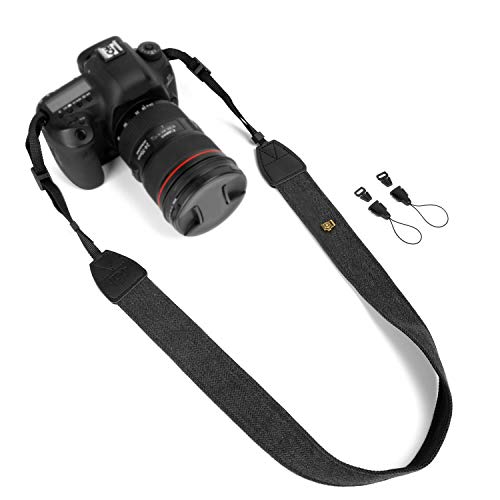
The cheapest strap here and it has one genuinely good idea: an elastic section where the strap crosses your neck, so the camera stops bouncing on every step and the load spreads over a moment instead of arriving all at once. There is an anti-slip layer inside so it does not walk off your shoulder. It is cotton canvas and PU leather with nylon and plastic quick-release fasteners, and it publishes its dimensions: 28 inches long and 1.5 inches wide, which is a neck strap.
Pros:
- The cheapest strap in this search
- An elastic neck section; the camera stops bouncing
- Anti-slip inner layer; publishes length and width
- Uses the camera’s lugs, so the tripod socket stays free
Cons:
- 28 inches; a neck strap and nothing else
- No load rating published
- Plastic fasteners on a heavy camera
Best for: a light camera round your neck, for the price of a coffee.
K&F Rope (black)
Sixty grams, which is the only strap weight published in this search, and it is the whole argument: your camera is already heavy, so the strap should be nothing. It is a meter of nylon rope with metal O-rings at both ends that clip to standard strap lugs, so your tripod socket stays clear. It rolls up into a pocket when you are not using it, which no padded strap does. K&F sells the identical rope in another color for more money, so check both.
Pros:
- The only published weight here, at 60 grams
- Metal O-rings onto the lugs; tripod socket stays free
- Rolls up and pockets; no bulk when stored
- A meter long; enough for neck or a short sling
Cons:
- No padding at all; rope on a bare shoulder
- No load rating published
- The same rope costs more in green
Best for: a strap that adds nothing, on a light camera.
K&F Rope (green)
The identical rope in green, at a higher price, from the same brand with the same specification: a meter of wear-resistant nylon on double-ended metal O-rings that fit most camera strap loops. Same rolling storage, same lug mounting, same lack of padding. Nothing separates it from the black one except which photograph you are looking at and what you pay. If green is what you want, that is the cost of green, and it is worth knowing the number before you decide.
Pros:
- Identical specification to the cheaper black version
- Metal O-rings; fits most camera strap loops
- Wear-resistant nylon; rolls up for storage
- Leaves the tripod socket free
Cons:
- Costs more than the same rope in black
- No padding, and no load rating
- A thinner listing than its own sibling
Best for: green, if it is worth the difference to you.
Waka Rapid
The only strap here designed by somebody who has thought about what happens when it fails. It screws a quick plate into the tripod socket with a stainless steel screw, and then adds a separate safety tether to catch the camera if that connection ever lets go, which is the real admission nobody else makes. The neoprene shoulder pad spreads the weight and carries a zip pocket for spare batteries and cards. And it warns you to push the slider into its locking slot after adjusting.
Pros:
- A safety tether for when the main connection fails
- Stainless screw on the quick plate, not plastic
- Zip pocket on the shoulder pad for batteries and cards
- Warns you to lock the slider after adjusting
Cons:
- Occupies your tripod socket; a tripod means unbolting it
- Its title says sling; 31.5 inches will not cross a torso
- No load rating published
Best for: handheld shooting, from the strap that plans for failure.
Peak Design Cuff
Not a neck strap: a wrist strap that lives on your arm like a bracelet when the camera is down, and cinches automatically the moment the camera starts to fall. That is a genuinely different answer to the same problem, and for a small body it may be the better one, because nothing hangs on you at all. It uses the same Anchor Link connectors as its bigger sibling, each rated over 200 pounds, and it is universally compatible with cameras, binoculars and rangefinders.
Pros:
- Publishes a 200 pound rating per anchor
- Cinches tight automatically during a drop
- Wraps your wrist as a bracelet; nothing hanging on you
- Quick release; works across cameras and binoculars
Cons:
- A wrist strap; it does nothing for your neck or shoulder
- Not for a heavy body with a long lens
- Expensive for what it is
Best for: a small camera you carry in your hand anyway.
Peak Design Slide
The only strap here that publishes what it holds, at over 200 pounds per anchor, and the only one that solves the contradiction at the heart of a strap: it is smooth on one face so it glides over your coat when you raise the camera, and grippy on the other so it stays on your shoulder while you walk. Reverse it to choose. It runs 39 to 57 inches on dual quick-adjusters you work with one finger, so it genuinely converts between sling, shoulder and neck, and it is padded inside the webbing rather than on top of it.
Pros:
- Publishes a 200 pound rating per anchor; nobody else does
- Smooth one side to glide, grippy the other to stay put
- 39 to 57 inches, adjusted one-handed; a genuine sling
- Padding inside the webbing; no added bulk
Cons:
- By far the most expensive strap here
- No weight published, unlike the rope
- Anchors need fitting before the first use
Best for: one strap that is a sling, a shoulder strap and a neck strap.
The verdict
One brand publishes a load rating and the rest say durable. Check the length against the noun, because a strap here calls 31 inches a sling. And decide whether it hangs off the lugs or bolts into your tripod socket, because that choice comes back every time the tripod does.
Best overall: Waka Rapid. It is the only strap here whose designer clearly asked what happens when this fails, and then fitted a separate safety tether to catch the camera if the quick plate lets go. The screw is stainless rather than plastic, the neoprene pad spreads the weight, there is a zip pocket for batteries on the shoulder, and it even warns you to lock the slider after adjusting. Just know it takes your tripod socket, and its 31.5 inch maximum is a neck length whatever the title says.
Best value: K&F Rope in black. Sixty grams, the only strap weight published in this search, and the argument is simply correct: the camera is heavy enough already. A meter of nylon on metal O-rings that clip to your lugs, leaving the tripod socket free, and it rolls into a pocket when you are not using it. There is no padding, so this is for a light body. Buy the black; the identical rope costs more in green.
Best premium: Peak Design Slide. The only strap that tells you what it holds, at over 200 pounds an anchor, and the only one that solves the real problem: smooth on one side to slide over your coat as you lift the camera, grippy on the other to stay on your shoulder as you walk. Thirty-nine to fifty-seven inches on one-finger adjusters means it is a sling, a shoulder strap and a neck strap depending on the minute.
FAQ
How much weight should a strap hold?
More than you would think, and only one brand here will say: over 200 pounds per connector. Everyone else calls their material durable and leaves it there. It is the one specification the product exists for.
What length do I need?
About 30 inches for a neck strap and around 50 for a sling that crosses your body. One strap here adjusts to 31.5 inches and calls itself a sling in its own title, which it is not. Another runs 39 to 57 and genuinely converts.
Lugs or tripod socket?
If you ever use a tripod, use the lugs, because a strap bolted into the tripod socket has to come off first, every time. Socket-mounted plates detach faster and are held on by one thread, which is why one strap here adds a safety tether.
Is a padded strap more comfortable?
It is one answer. The other is weight: one strap here publishes 60 grams and argues that nothing on your neck beats padding on your neck. A neoprene pad spreads the load and adds bulk; rope adds nothing and spreads nothing. It depends on the camera.
Why does one side of a strap slide?
Because you want two opposite things. A strap should glide over your coat when you raise the camera and grip your shoulder when you walk. One strap here is smooth on one face and grippy on the other and you reverse it. Everything else picks one and lives with it.
This article may contain affiliate links; see our Affiliate Disclosure.