Two pots in this search quote their capacity and then add a note nobody else bothers with: that figure is the pot at 80 percent full, not to the brim. They are both Tokoname clay pots made in Japan, and they are telling you what a kyusu actually holds in use, because you never fill one to the top. Everyone else quotes the brim and then converts it into people. The real number is smaller and it is the one you will pour.




At a glance
| Teapot | Capacity, filter and origin | Price tier | Link |
|---|---|---|---|
| TEANAGOO Small | 250ml. Stainless basket. Cheapest here | Budget | |
| Waraku Fuuka | 260cc at 80% full. Tokoname, unglazed | Budget | |
| Mino Ware | 320ml. Made in Japan. Full dimensions | Budget | |
| TEANAGOO Large | 625ml. Calls itself Japanese and Chinese | Budget | |
| Fusen L161 | 350cc at 80% full. Tokoname Youhen. Best seller | Mid-range | |
| Yamakiikai L339 | 15.6oz, Tokoname, handmade. Zero bullets | Mid-range | |
| Asayu Japan | 360ml. A mesh named for the tea it suits | Premium | |
How to choose
The stated capacity is not what it holds
Two Tokoname pots here publish the same real footnote: the capacity quoted is the pot at 80 percent, because that is where you actually fill a kyusu. Any higher and the lid displaces tea and it runs down the side when you pour. So 350cc means 350cc of tea in your cups, not 350cc to the brim. Every other pot here quotes the full volume and leaves you to discover the difference. When a maker publishes the smaller number, that is not a weaker pot, it is a more careful one.
Serves four people is not a measurement
Three pots here convert milliliters into people and the sums do not agree with each other: 250 milliliters is two people, 360 is one to three, and 625 is four. That is 125, 120 and 156 milliliters a head. None of them is a Japanese teacup, which holds far less, so these figures assume mugs. Read the milliliters and divide by the cups you actually own. The people number tells you nothing about the pot and quite a lot about who wrote the bullet.
The filter is the pot, or a basket dropped into it
This is the real fork. TEANAGOO fits a removable stainless steel strainer with a wide mouth so you can swap the leaves out, which is a Western infuser in a kyusu-shaped pot and is genuinely convenient. Asayu instead describes a fitted mesh it names, and names the teas it is cut for: sencha and kukicha. The three Tokoname clay pots here describe no separate filter component at all. That silence is a design, not an omission, and it matters most for small-leaf green tea.
Unglazed clay must never meet a dishwasher
One pot here translates its own Japanese name and tells you what it is: yakishime, unglazed. Its maintenance line is one sentence long, rinse with warm water and air dry. Unglazed Tokoname clay is porous, so it takes on detergent the way it takes on tea, and the tea is the point: the pot seasons over years. Two pots here say all parts are dishwasher safe, and both are glazed ceramic where that is fine. Match the cleaning to the clay.
It is not a kettle, and one brand shouts it
TEANAGOO puts a warning in both its listings, in capitals with a typo: this is not a boil kettle, do not put it on the stove directly. It is the only brand here that says so, and it says so because people do it. A kyusu is a steeping vessel; you boil water somewhere else, let it cool to the right temperature for the leaf, and pour it in. Direct flame on thin ceramic is how a good pot becomes two pieces.
The best pots have the shortest listings
There is a pattern on this page worth noticing. One Tokoname pot has a single bullet, giving its capacity and the 80 percent caveat. Another has no bullets at all, and puts everything in its title: the kiln, the ware, the volume, the pattern, the fact it is handmade in Japan. The pots with five bullets of marketing about gift boxes and unique glazes are the ones that also mention being half handmade. In this category, silence tends to be confidence.
TEANAGOO Small
The cheapest pot here and the most practical for someone starting out: 250 milliliters, a proper side handle that is hollow so it stays cool, a drip-less spout, and an extra-fine stainless strainer with a wide mouth so changing the leaves takes a second rather than a spoon and patience. The bronze glaze and hand-made spiral stripes mean no two are quite alike. It is BPA, plastic and lead free, all parts go in the dishwasher, and TEANAGOO describes it as half handmade.
Pros:
- The cheapest kyusu-style pot here
- Removable stainless strainer with a wide mouth for changing leaves
- Hollow side handle stays cool; drip-less spout
- Dishwasher safe; BPA, plastic and lead free
Cons:
- Half handmade, in its own words
- Quotes brim capacity, not a working figure
- A basket in a kyusu shape rather than a kyusu filter
Best for: two cups, conveniently, without ceremony.
Waraku Fuuka
A Tokoname clay pot that translates its own name for you: Morimasa yakishime maru sawayaka kyusu, an unglazed round refreshing teapot. Unglazed is the important word, because that is the clay that seasons with tea over the years and gives Tokoname its reputation. It publishes everything and no marketing: 260cc at 80 percent full, 6.3 by 5.3 by 3.15 inches, 0.66 pounds, and a maintenance line that is one sentence long. Rinse with warm water, air dry. That is the whole care instruction and it is correct.
Pros:
- Genuine unglazed Tokoname clay, and it says so in translation
- Publishes its working capacity at 80 percent full
- Publishes dimensions and weight; no marketing at all
- Correct care in one sentence: warm water, air dry
Cons:
- Never goes in a dishwasher; unglazed clay takes detergent
- 260cc; a small pot, plainly stated
- No filter component described
Best for: unglazed clay that improves with every brew.
Mino Ware
Mino ware rather than Tokoname, which is a different Japanese pottery tradition and a different look, and this listing is the best-documented on the page: 3.1 inches tall, 4.5 wide with the handle, 320 milliliters, ceramic, origin Japan, all in one bullet. It states plainly that no lead or cadmium is used and that it is produced in Japan. It has an infuser, comes in five colors designed to match Japanese teacups, and it arrives wrapped in bubble wrap in a plain box.
Pros:
- Publishes height, width, capacity, material and origin together
- States no lead or cadmium, and where it is made
- Five color variations to match teacups
- Carefully packaged; genuinely made in Japan
Cons:
- Its infuser is mentioned but never described
- Quotes brim capacity, unlike the Tokoname pots
- Mino ware, not Tokoname, whatever the search implies
Best for: Japanese pottery with every number published.
TEANAGOO Large
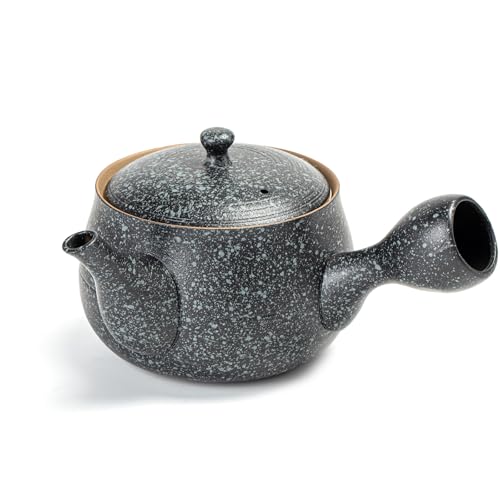
The biggest pot here at 625 milliliters, which TEANAGOO calls four people, on the same hollow cool side handle and drip-less spout as its smaller sibling, with the same swappable stainless strainer. The rock black glaze is sprayed over hand-made spiral stripes so each pot is genuinely different. Read the title slowly though: it offers Japanese Kyusu and Chinese Tea Pots in the same breath, and the bullets describe a Japan Kyusu shape. Shape is doing some work in that sentence.
Pros:
- The largest pot here at 625ml
- Swappable stainless strainer with a wide mouth
- Hollow cool handle; drip-less spout; dishwasher safe
- Sprayed rock glaze over spiral stripes; each one differs
Cons:
- Its own title calls it Japanese and Chinese at once
- Describes a kyusu shape rather than a kyusu
- Four people assumes mugs, not Japanese cups
Best for: a table of people, from a pot that says shape.
Fusen L161
The best-selling teapot in this search and its entire listing is one bullet: capacity 11.8 fluid ounces, 350cc, and that will be 80 percent at full capacity. That is all. What the title carries is the rest: Tokoname, the kyusu clay, and Youhen, which is the kiln effect where the flame itself marks the surface, so no two pots come out alike. It is not describing itself because in this tradition the ware and the kiln are the description. The one number it gives you is the real one.
Pros:
- The best-selling teapot in this search
- Tokoname clay, the ware kyusu is famous for
- Youhen kiln finish; every pot marked differently by the flame
- Its single bullet is the fair 80 percent capacity
Cons:
- One bullet; no dimensions, weight or care instructions
- No filter component described
- You are buying the tradition, not a specification sheet
Best for: a real Tokoname kyusu, from the pot most people buy.
Yamakiikai L339
No bullets at all. Not a sparse listing, an absent one, and the title does the whole job: Yamakiikai, a Tokoname maker, handmade clay, 15.6 fluid ounces, the Shunjuu scarlet crest pattern in black, from Japan. That is how traditional Japanese pottery has always been sold, by kiln and maker and pattern name, and it assumes you know what those words buy. At 15.6 ounces it is the largest clay pot here. Everything else, including how to look after it, you find out from the maker or from the pot.
Pros:
- Tokoname, handmade, from Japan; named maker and pattern
- 15.6 fluid ounces; the largest clay pot here
- Sold the traditional way: kiln, maker, pattern
- No marketing whatsoever
Cons:
- Not one bullet; no care, dimensions or capacity caveat
- Assumes you already know what Tokoname means
- No filter component described
Best for: someone who already knows what they are buying.
Asayu Japan
The only pot here that names its filter and then names the tea it was cut for: a precision-woven Sawayaka mesh that keeps water moving while holding back even the smallest leaves, made for sencha and kukicha. That is the specification that matters, because sencha leaves are small and fine and a coarse strainer lets them through while a tight basket stops them opening. It is 360 milliliters in a glossy green Midoriyu glaze, in the traditional yokode side-handle form for controlled pouring of green tea.
Pros:
- The only filter here matched to a named tea
- Precision mesh that flows freely and still holds fine leaves
- Traditional yokode side-handle form for controlled pouring
- 360ml; glossy Midoriyu glaze; stable heat retention
Cons:
- The most expensive pot on this page
- Quotes brim capacity rather than a working figure
- Serving one to three people is a wide range
Best for: sencha, from the pot that mentions sencha.
The verdict
The Tokoname pots quote what they hold at 80 percent full and let their kiln do the talking. The others quote the brim and convert it into people, on sums that disagree with each other. The filter is the fork: a swappable basket is convenient, a fitted mesh cut for sencha is the point of a kyusu, and unglazed clay never sees a dishwasher.
Best overall: Fusen L161. The best-selling teapot in this search and the entire listing is a single bullet, which tells you where the confidence is. It is Tokoname clay with a Youhen kiln finish, so the flame marked your pot and nobody else’s the same way. And that one bullet is the real one: 350cc is what it holds at 80 percent, which is where you actually fill a kyusu, not what fits to the brim.
Best value: TEANAGOO Small. The cheapest pot here and the easiest to live with: a hollow side handle that stays cool, a drip-less spout, and a wide-mouthed stainless strainer you can lift out and refill in seconds. Everything goes in the dishwasher. It describes itself as half handmade, and its own larger sibling calls the same design both Japanese and Chinese in one title, so take the tradition lightly and enjoy the pot.
Best premium: Asayu Japan. The only pot on this page that names its mesh and then names what the mesh is for, which is sencha and kukicha, and that is the specification a kyusu lives or dies on. Small green tea leaves need a filter fine enough to hold them and open enough to let the water run, and this is the one listing that claims to have thought about both. Glossy Midoriyu glaze, traditional side handle, 360 milliliters.
FAQ
Why do two pots quote capacity at 80 percent?
Because that is where you fill a kyusu. Any higher and the lid displaces tea and it runs down the outside as you pour. The Tokoname makers publish the working figure and everyone else publishes the brim, so the smaller number is the more useful one.
How many people does a kyusu serve?
Fewer than the listings say. Three pots here work out at 125, 120 and 156 milliliters a head, which assumes mugs rather than Japanese teacups. Read the milliliters and divide by the cups you own.
Can I put it in the dishwasher?
Only if it is glazed. Two pots here say all parts are dishwasher safe and both are glazed ceramic. The unglazed Tokoname pot gives you one line instead: rinse with warm water and air dry. Unglazed clay is porous and takes on detergent the way it should take on tea.
What is the difference between the filters?
One brand fits a removable stainless basket with a wide mouth, which is convenient and is a Western infuser in a kyusu shape. One names a fitted mesh and the teas it suits. And the clay pots describe no filter at all, which in that tradition is deliberate.
Can I put a kyusu on the hob?
No. One brand warns you in capitals, presumably because people try. Boil the water elsewhere, let it cool to the right temperature for your leaf, and pour it in. A kyusu steeps; it does not heat.
This article may contain affiliate links; see our Affiliate Disclosure.