Search for a hard bike case against a soft one and you get six soft bags. Not one molded shell in the lot. So the comparison the search wants cannot be made here, and the one that can is more useful anyway: exactly one of these six publishes its own weight, at 9.5 kilograms. That number is what your airline charges you on, and five out of six would rather you found it out at the check-in desk.



At a glance
| Bag | Fabric, fit and the number that matters | Price tier | Link |
|---|---|---|---|
| 840D Folding | 840D, 8000mm water rating. Fits by tire size | Budget | |
| KEMIMOTO | 900D PU. The best seller. Folds into a bar bag | Budget | |
| VEVOR | 37-42in wheelbase, road only. TSA lock | Mid-range | |
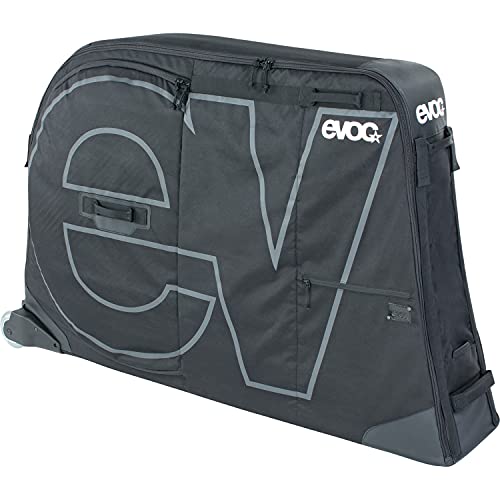
| EVOC 280L Gray | 126cm wheelbase. Stabilizer bar for the wheels | Premium | |
| EVOC 285L Black | Same price, 5L more, and a polycarbonate block | Premium | |
| SCICON Aerocomfort | 9.5kg published. No tools needed to pack it | Premium | |
How to choose
The empty weight is what the airline charges you
Most airlines price bikes by weight, and the case is a large part of it. Exactly one bag here publishes its own: 9.5 kilograms empty. Put a road bike of around 8 or 9 kilograms inside and you are at roughly 18 before you add a helmet, and the standard limit is usually 23. That is a real margin and it is arithmetic you can only do with a number. The others describe themselves as light and lightweight, which is not a number and will not help you at the desk.
Wheelbase, not tire size, decides whether it fits
Two bags here quote what they take by wheelbase, which is the axle-to-axle length of your bike and the measurement that actually matters. One takes up to 126 centimeters, which covers a mountain bike. Another takes 94 to 106, which is a road bike and says so in its own title. The two cheap bags instead quote a tire size of 26 to 29 inches, which tells you about your wheels and nothing at all about how long your frame is. Measure axle to axle first.
How much of the bike do you have to take apart?
This is the difference between a trip and a project. One bag needs only the wheels off, with no tools required, so you can rebuild it in a hotel room with your hands. One wants wheels and pedals. One wants wheels, handlebars and seat for a mountain bike. And one wants the front wheel and the handlebar, kept vertical. Read that line before the price, because the bag that packs fastest is the bag you will actually travel with rather than dread.
Higher denier is not more waterproof
Denier measures how heavy the threads are, not how much water they stop, and this page proves it. The 900D bag calls itself water-resistant and leaves it there. The 840D bag, made of lighter thread, publishes a hydrostatic rating of 8000 millimeters, taped seams and double stitching, plus an SPF above 70 for the sun. Lower denier, better documented waterproofing, because the coating does that job and not the weave. Read for the coating and the water column, not the D number.
Bent discs and spokes are what actually happens
Baggage handlers stack things, and the pressure lands on the wheels through the side of the bag. EVOC is the only brand here that names the consequence and engineers for it: a stabilizer bar in each wheel compartment to spread that pressure so spokes and brake discs are not bent, plus a reinforced fork support and a plate in the base. Everyone else separates the wheels from the frame, which stops scratches. Only one addresses the load coming through the outside.
A TSA lock is a real thing here
Unlike most travel products that claim TSA approval, a TSA-approved lock is genuinely a standard: it has a master keyway so security can open it without cutting it off. One bag here fits one, and another puts TSA in its product name. On a case holding several thousand pounds of bicycle that goes into a hold, that matters, because the alternative is a cut lock and an open bag for the rest of the journey.
840D Folding
The cheapest bag here and the best-documented fabric on the page: 840D Oxford with a triple nano coating inside so the lining will not scratch the frame, taped seams, double stitching, an 8000 millimeter water column and SPF above 70. That is a real waterproofing figure and nobody else publishes one. It separates the wheels from the frame, has an accessories pocket and a drawstring storage bag, and it warns you off sharp ornaments and tells you to measure your bike first. Its warranty bullet says one year and then two.
Pros:
- The only published water column here, at 8000mm
- Taped seams, double stitching and SPF above 70
- Smooth inner coating so it will not scratch the frame
- Tells you to measure your bike and avoid sharp fittings
Cons:
- Its warranty bullet says one year and then says two
- Quotes tire size, not wheelbase
- Needs the front wheel and handlebar off
Best for: weatherproofing you can actually check, cheaply.
KEMIMOTO
The best-selling bag in this search and the cleverest idea on the page: it folds down to about 15 by 8 inches and becomes a handlebar bag, so the case rides with you rather than waiting in a hotel. That solves the one-way trip. It is 900D Oxford with a PU coating, has a dedicated tire compartment and three straps to stop the bike shifting, and a front pocket for cards and tools. It publishes both unfolded and folded dimensions. Road bikes need only the front wheel off.
Pros:
- The best seller in this search
- Folds into a handlebar bag; the case travels with you
- Publishes both unfolded and folded dimensions
- Dedicated tire compartment and three fixing straps
Cons:
- Quotes tire size rather than wheelbase
- Water-resistant, with no water column published
- Mountain bikes need wheels, handlebars and seat off
Best for: riding one way and packing the bag you carried.
VEVOR
The first bag here that quotes a wheelbase, and it does it plainly: 37 to 42 inches, which is a road bike, and its title says road bike. That is a proper fit statement rather than a tire size. It comes with a full set of protectors for the saddle, handlebars, chain, top tube, forks and side handles, two dedicated wheel compartments and a chain tool pouch. There are rolling wheels, a cushioned handle, and a genuine TSA-approved lock on a dual zipper.
Pros:
- Quotes a real wheelbase range, and matches it to road bikes
- A genuine TSA-approved lock on a dual zipper
- Protectors for saddle, bars, chain, top tube and forks
- Two wheel compartments plus a chain tool pouch
Cons:
- 106cm ceiling; a mountain bike will not fit
- No weight or fabric denier published
- Needs wheels and pedals off
Best for: a road bike, locked, with everything padded.
EVOC 280L Gray
The engineering answer to what actually goes wrong. Each wheel compartment carries a stabilizer bar whose job is to spread pressure coming from outside the bag, so spokes and brake discs are not bent by whatever gets stacked on top. That is the failure nobody else on this page names. Add a reinforced fork support with extra padding, a plate in the base, an extra-wide chassis and gliding wheels. It takes a 126 centimeter wheelbase, which covers everything from cross country to downhill.
Pros:
- Stabilizer bars against bent spokes and discs; unique here
- 126cm wheelbase; takes mountain bikes as well as road
- Reinforced fork support and a plate in the base
- Extra-wide chassis with replaceable gliding wheels
Cons:
- No weight published, on a bag sold as light
- Its black sibling costs the same and lists more
- Among the most expensive bags here
Best for: the wheels arriving straight, on any bike.
EVOC 285L Black
The same bag at the same price with the same word-for-word bullets, and two things in its title that the gray one does not mention: a molded polycarbonate bike block and skate wheels. A rigid block is the closest thing to a hard case in this entire search, holding the fork so the frame is not carrying the load. It is also listed at 285 liters against the other’s 280. Same rank, same money, one title carrying more. Read both before you pick a color.
Pros:
- A molded polycarbonate block; the only rigid part here
- 285L against the gray version’s 280, for the same price
- Same stabilizer bars, fork support and base plate
- Skate wheels named in the title
Cons:
- Its bullets are identical to the gray one; the block is only in the title
- No weight published
- Among the most expensive bags here
Best for: the EVOC build, in the listing that mentions the block.
SCICON Aerocomfort
Five bullets and two of them are worth the whole page. The first is a weight: 9.5 kilograms, the only one published in this search, and the number your airline will price. The second is three words: no tools required. You take the wheels off, the bike goes in, the bars and the seat stay where they are, and at the far end you put the wheels back on with your hands. External dimensions are published at 117 by 97 by 54 centimeters, and it handles disc or rim brakes.
Pros:
- The only published empty weight here, at 9.5kg
- No tools required; wheels off and ride at the far end
- Publishes its external dimensions exactly
- Ready for disc or rim brakes; two inner wheel pockets
Cons:
- The most expensive bag on this page by a distance
- Five bullets; no fabric, wheelbase or protection detail
- Road bikes only, by its own title
Best for: flying often, with a spanner-free rebuild at the hotel.
The verdict
There is no hard case in this search, so the hard-versus-soft question is unanswerable here. What is answerable: the empty weight decides your airline fee and one bag in six publishes it, the wheelbase decides whether the bike fits and only two quote it, and how much you must dismantle decides whether you ever use the thing.
Best overall: EVOC 285L in black. It is the only bag here that names what actually happens to bikes in a hold and builds against it: stabilizer bars in each wheel compartment to spread the pressure that bends spokes and warps brake discs, a reinforced fork support and a plate in the base. Its 126 centimeter wheelbase takes a mountain bike as well as a road bike, and its title is the one mentioning the molded polycarbonate block.
Best value: KEMIMOTO. The best seller in this search, at a fraction of what the serious bags cost, with a dedicated tire compartment, three fixing straps and 900D PU-coated Oxford. The idea that earns it is the fold: it packs down to about 15 by 8 inches and becomes a handlebar bag, so you can ride one way and still have the case with you at the other end.
Best premium: SCICON Aerocomfort. Two of its five bullets justify the price. It publishes 9.5 kilograms, the only weight in this search and the number your airline actually charges on. And it needs no tools: wheels off, bike in, and at the far end you rebuild it with your hands in a hotel room, which is the difference between flying with a bike often and doing it once.
FAQ
Which of these is a hard case?
None. Every product in this search is a soft bag. The closest is a molded polycarbonate block inside one of them, which holds the fork so the frame is not carrying the load. If you want a rigid shell, this search will not find you one.
Why does the empty weight matter?
Because most airlines charge bikes by weight. One bag here publishes 9.5 kilograms; a road bike adds 8 or 9 more, and the usual limit is 23. That is the arithmetic that decides your fee, and five of six bags leave you to discover it at the desk.
Will my bike fit?
Measure the wheelbase, axle to axle. Two bags here quote one: 126 centimeters takes a mountain bike, 94 to 106 is road only. The cheap bags quote a 26 to 29 inch tire size, which tells you about the wheels and nothing about the frame.
How much do I have to dismantle?
It varies more than the price does. One bag needs the wheels off and no tools at all. One wants wheels and pedals. One wants wheels, handlebars and seat. That line decides whether packing is ten minutes or an evening.
Is a higher denier fabric more waterproof?
No. Denier is thread weight; the coating does the waterproofing. The 900D bag here says water-resistant and stops. The 840D bag publishes an 8000 millimeter water column, taped seams and SPF above 70. The lighter fabric has the better documented protection.
This article may contain affiliate links; see our Affiliate Disclosure.