Here is the fastest way to sort this category. Take the peak wattage on the box and divide it by the RMS figure buried below. One speaker here quotes 400 watts and delivers 60. Another quotes 200 and delivers 100. The one shouting the biggest number is the weakest speaker on the page, and that ratio tells you more about a brand than any of the adjectives do.


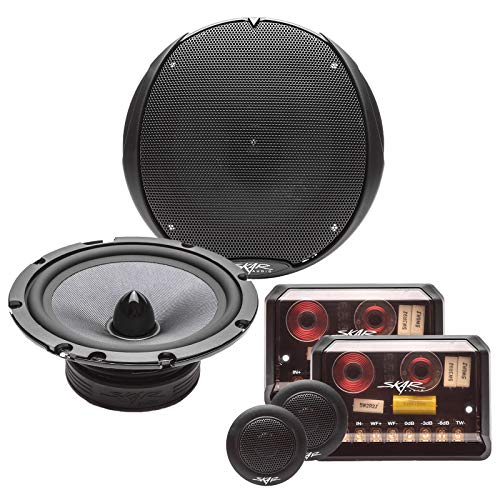
A component system separates the tweeter from the woofer so you can mount the treble up near your ears and the bass down in the door, and feeds each through a crossover that sends it only the frequencies it can handle. That separation is the whole reason to buy one. It is also the thing several of these listings are strangely vague about.
At a glance
| System | Standout feature | Price tier | Link |
|---|---|---|---|
| Hifonics Zeus ZS65C | Cheapest here; a 12 dB inline crossover | Budget | |
| Pyle | Flush or surface mount; publishes dimensions | Budget | |
| DS18 S65C | Complete kit; neodymium tweeters and grills | Budget | |
| ORION Cobalt CB65C | Second-best seller here; butyl surround | Mid-range | |
| ORION XTR65.SC | Most expensive; the biggest peak figure | Premium | |
| Skar Audio TX65C | The only one publishing sensitivity | Not listed | |
How to choose a component speaker system
Peak watts is the number that means least
Peak power is what a speaker survives for an instant before something lets go. RMS is what it handles continuously, which is to say what it does while you listen to music. Line them up and the pattern is stark. Hifonics quotes 400 watts maximum and 60 watts RMS, a ratio near seven to one. ORION’s Cobalt quotes 280 peak against 70 RMS, four to one. Skar quotes 200 peak against 100 RMS, two to one. Pyle quotes 360 maximum and no RMS figure at all. The speaker with the smallest headline has the strongest real rating on this page, and that is not a coincidence.
Sensitivity is the audiophile number, and almost nobody prints it
Sensitivity says how loud a speaker plays for a given watt, and it decides whether your head unit can drive it or whether you need an amplifier. It is the first specification anyone serious looks at, and exactly one brand here publishes it: Skar, at 89 dB. The same listing gives a frequency response of 50 Hz to 25,000 Hz. Everyone else leads with wattage and stays quiet about the two figures that describe how the thing actually sounds. On a page titled for audiophiles, that silence is the finding.
Watch for listings that say coaxial and component in the same breath
These are opposite designs. A coaxial mounts the tweeter in the middle of the woofer as one unit. A component separates them so the tweeter goes high near your ears and the woofer stays in the door, which is the entire point and the reason component systems cost more. Both ORION listings here describe themselves as component systems in the title and then repeatedly call the product coaxial car speakers in the feature text. One title manages both words at once. Read the box contents rather than the marketing, and confirm before ordering.
Check what is actually in the box
A real component system is six pieces: two woofers, two tweeters, two crossovers. DS18 lists exactly that, plus grills. Pyle lists two mid-woofers, two tweeters and two crossover networks. Hifonics includes an inline crossover, tweeter mounting hardware and grills for the midwoofers. That specificity is worth more than any adjective. Note too that a search for component systems will surface crossovers and tweeters sold on their own; those are parts, not systems, and they will not give you sound on their own.
Crossover quality is where cheap systems save money
The crossover decides which frequencies reach which driver, and a steeper slope keeps the tweeter safe from bass it cannot handle. Hifonics is the only brand here quoting a slope, a 12 dB inline crossover, which is the ordinary entry-level answer and at least an answer. DS18 supplies proper passive two-way crossovers rather than inline filters. Where a listing mentions crossovers without describing them, assume the simplest possible part.
Surrounds and tweeter materials are real, if secondary
Butyl rubber surrounds outlast foam in a car door, where heat and damp destroy things, and ORION and Pyle both use them. Tweeter material shapes the treble: silk domes, on the Skar, are gentler and less fatiguing on long drives; DS18’s neodymium tweeters use a stronger magnet in a smaller body, which helps where mounting depth is tight. None of these choices is wrong. All of them are easier to check than a peak wattage claim.
Hifonics Zeus ZS65C
The cheapest system here, and the most instructive listing on the page. It leads with 400 watts maximum, which is the biggest headline of any speaker in this roundup, and then states an RMS power handling of 60 watts, which is the lowest real figure here. Both numbers are true and only one describes listening to music. What you do get for the money is a genuinely complete kit: a 12 dB inline crossover, all the tweeter mounting hardware and grills for the midwoofers, on a moisture-resistant rubber surround that will survive a car door. Hifonics also quotes its crossover slope, which nobody else manages.
Pros:
- Cheapest system on this page
- Quotes its crossover slope; the only brand that does
- Complete kit: crossover, tweeter hardware, grills
- Moisture-resistant rubber surround suits a door
Cons:
- 60 watts RMS; the weakest real rating here
- The 400 watt headline is nearly seven times the real figure
- No sensitivity or frequency response published
Best for: a complete first upgrade, ignoring the number on the front.
Pyle
The one that solves the fitting problem. It mounts flush or on the surface, and it publishes exact dimensions for both configurations, which sounds dull until you are lying under a dashboard discovering that a speaker is a quarter inch too deep. Nobody else here gives you that. The kit is complete with two mid-woofers, two tweeters and two crossover networks, and the non-fatiguing butyl rubber surrounds pair with a high-temperature voice coil to keep distortion down in a hot door. The 360 watt maximum comes with no RMS figure at all, which leaves the most important number missing.
Pros:
- Flush or surface mount, with dimensions published for both
- Complete kit: woofers, tweeters and crossovers
- Butyl rubber surrounds; high-temperature voice coil
- The only brand here solving the depth question
Cons:
- No RMS rating published anywhere; only a 360 watt maximum
- No sensitivity or frequency response either
- Sells poorly against everything else here
Best for: a car where the mounting depth is the real problem.
DS18 S65C
The most complete box here, and the clearest about it: two woofers, two 1.5 inch tweeters, two passive two-way crossovers and a grill for each woofer. Those are proper passive crossovers, not inline filters, which is a real step up at this price and the part cheap systems usually skimp on. The tweeters use neodymium, a stronger magnet in a smaller housing, which helps where there is no depth to work with and keeps the treble accurate. The grills matter more than they sound in a door that takes kicks. Four ohm nominal impedance suits almost any amplifier.
Pros:
- Proper passive crossovers, not inline filters
- Grills included for both woofers
- Neodymium tweeters; compact and accurate
- States exactly what is in the box
Cons:
- No sensitivity or frequency response published
- 200 watts quoted without a clear RMS breakdown
- Sells modestly against the ORION and Skar sets
Best for: the most parts in the box for the least money.
ORION Cobalt CB65C
The second best-selling system here, and a fair one on the numbers: 280 watts peak against 70 watts RMS, a four to one ratio that is neither the best nor the worst on this page. A butyl rubber surround handles the heat and damp of a door, the two-way design splits a dedicated woofer from a tweeter, and four ohm impedance keeps it easy to drive. The oddity is the listing itself, which sells a component system in the title and then calls the product coaxial car speakers in the body more than once. Those are different designs. Confirm which you are getting before you order.
Pros:
- The second best-selling system here
- Butyl rubber surround; built for a car door
- Publishes both peak and RMS plainly
- Four ohm impedance suits most amplifiers
Cons:
- The listing calls it coaxial and component in the same breath
- 70 watts RMS against a 280 watt headline
- No sensitivity or frequency response given
Best for: a popular mid-price set, once you have confirmed the design.
ORION XTR65.SC
The most expensive system here and the biggest peak figure at 340 watts. It is built the way the Cobalt is, with a butyl rubber surround for a door’s heat and damp, a dedicated woofer paired with a tweeter, four ohm impedance and a wide quoted frequency range, in ORION’s higher XTR line. The same confusion applies and rather more loudly: this title contains the words coaxial and component together, and the feature text calls it a coaxial speaker. At this money you are entitled to know which design you are buying, so check the box contents before ordering rather than after.
Pros:
- ORION’s higher XTR line; 340 watts peak
- Butyl rubber surround for door conditions
- Wide quoted frequency range; four ohm impedance
- Straightforward installation
Cons:
- Most expensive system here
- The title itself says both coaxial and component
- No sensitivity published, at the top price on this page
Best for: ORION’s better line, if the listing questions do not put you off.
Skar Audio TX65C
The best-selling system here and the only one that talks like a speaker company. It publishes sensitivity, 89 dB, which tells you how loud it plays per watt and whether your head unit can drive it. It publishes a frequency response of 50 Hz to 25,000 Hz. And its power figures are 200 watts peak against 100 watts RMS for the pair, a two to one ratio, where rivals stretch to seven. A one inch silk dome tweeter gives an easier treble on a long drive, and a 1.25 inch copper voice coil on a ferrite magnet does the work below. The listing carries no price, so check that first.
Pros:
- The best-selling system on this page
- The only one publishing sensitivity and frequency response
- 200 watts peak to 100 RMS; the real ratio here
- Silk dome tweeter; easier treble over a long drive
Cons:
- No price shown on the listing; check before ordering
- 200 watts peak is the smallest headline here
- No grills mentioned, unlike DS18 and Hifonics
Best for: anyone who reads sensitivity before wattage.
The verdict
One rule covers this whole page: divide the peak figure by the RMS figure. The lower that ratio, the more accurate the brand. Seven to one is marketing; two to one is a speaker company.
Best overall: Skar Audio TX65C. The best seller here and the only one on this page that publishes the numbers an audiophile would ask for first: 89 dB sensitivity and a 50 Hz to 25,000 Hz response. Its power claim is 200 watts peak to 100 RMS, the tightest ratio here by a distance, and the silk dome tweeter is the gentler choice on a long drive. It has the smallest headline figure and the strongest real one. Check the price before ordering, as the listing does not show it.
Best value: DS18 S65C. The fullest box for the least money: two woofers, two neodymium tweeters, two proper passive crossovers and a grill for each woofer. Passive crossovers rather than inline filters is a genuine step up at this price, and it is exactly where cheap systems normally cut. Like almost everyone here it will not tell you its sensitivity, and everything it does list is in the box.
Best premium: ORION XTR65.SC. The top of this page on price, in ORION’s better XTR line, with a butyl rubber surround built for the heat and damp of a door and a 340 watt peak figure. Buy it with your eyes open: the title says coaxial and component together and the description calls it coaxial, and those are opposite designs. Confirm the box contents before ordering, not after.
FAQ
What is the difference between component and coaxial?
A coaxial puts the tweeter in the center of the woofer as one unit. A component separates them, so the tweeter mounts high near your ears and the woofer stays in the door, fed through a crossover. That separation is what you are paying extra for. Watch the ORION listings here, which use both words for the same product.
Why does the 400 watt speaker have the worst rating?
Because 400 watts is peak, what it survives for an instant, and 60 watts is RMS, what it handles while you play music. The Hifonics ratio is near seven to one. Skar’s is two to one, at 200 peak and 100 RMS. Divide one by the other and the ranking sorts itself out.
What sensitivity should I look for?
Higher means louder per watt, which decides whether a head unit can drive the speakers or whether you need an amplifier. Skar publishes 89 dB and is the only brand here that publishes anything. If sensitivity matters to you, that narrows this page to one.
Do I need an amplifier?
It depends on sensitivity and on your RMS figures, which is why both matter more than peak power. A 60 watt RMS speaker driven hard by a head unit is working near its limit. Without published sensitivity on most of these, that question is hard to answer before you buy, which is itself a reason to prefer the brand that answers it.
Why do search results show crossovers and tweeters on their own?
Because they are sold as parts, and they sit in the same listings. A crossover alone or a pair of tweeters alone will not give you sound; a component system is six pieces, two woofers, two tweeters and two crossovers. DS18, Pyle and Hifonics each list what is in the box, which is the check worth making.
This article may contain affiliate links; see our Affiliate Disclosure.