One kit in this search sells a sanding kit in its box and says so in its contents list. Another kit reproduces that first kit’s bullet points word for word, including the promise that no power tools are required, and then lists its own contents as two bottles, a towel and a sponge. It kept the sentence. It dropped the abrasive. And in the one bullet it did rewrite, the copy-paste seam shows: a missing space where the new text was pushed in.




At a glance
| Product | Does it include an abrasive? | Price tier | Link |
|---|---|---|---|
| POLIXEL Spray | No. Says so proudly. Cheapest here | Budget | |
| 3M 39194 | Yes. 1000 and 3000 grit, plus clear coat | Budget | |
| Spray Kit (no brand) | No. Calls sanding “damaging” | Budget | |
| CERAKOTE Ceramic | Yes. Sanding kit at step 2, ceramic at step 3 | Mid-range | |
| QIFOR | No. Copies the bullets of a kit that does | Mid-range | |
| Chemical Guys | A compound, sold as “without harsh abrasives” | Premium | |
| 3M Ultra 2-Pack | Yes. 500, 800 and 3000 grit. Two kits | Premium | |
How to choose
The layer that turned yellow is the protective layer
A headlight leaves the factory as clear plastic with a thin coating on the outside to take the sunlight. That coating is the sacrificial part. Years of sun break it down, and what you are looking at when a lens goes cloudy and yellow is the failed coating and the hazed plastic just under it. That matters for one reason: the damage is a physical layer sitting on the surface of the lens, not a stain sitting on top of it.
Which is why four of these kits contain sandpaper
Once you know the problem is a layer, the fix follows. Take the ruined material off, refine the surface you just cut, then put a new coating on to replace the one the sun destroyed. That is exactly what the abrasive kits here describe. One sells sanding discs in three grades, 500 to knock the oxidation off, 800 to clean up the 500’s scratches, 3000 to polish out the 800’s, then two clear coats. Another does it in two grades and a coat. A third does it in wipes, a sanding kit and a ceramic. Same three moves in every one.
And why six of them do not
The other six are sprays. Shake, spray, wipe, done in minutes, no tools, no dust. One of them puts the pitch plainly: no grinding, no sanding, and no damaging removal of your headlight’s protective layer. Read that last part again. The protective layer is the thing that has already failed. It is what turned yellow. Selling you on not removing it is selling you on leaving the problem in place, and it is phrased as though that were a kindness to your car.
One listing is a copy of another, and the seam shows
Set the ceramic kit and one of the sprays side by side. Two of the spray’s bullets are the higher-priced kit’s bullets word for word, ceramic bonding claim and all, right down to the promise that no tools are required that could damage your headlights or paint. Then look at the contents bullet, the one they had to rewrite. The original lists oxidation wipes, a sanding kit and ceramic wipes. The copy lists a removal solution, a plating solution, a towel and a sponge, and it reads “includesOne bottle” with the space missing where the old text was cut out. The sentence about not needing power tools was written for a kit that includes sandpaper. It now sits on a kit that has none.
Compound is an abrasive; the word doing the work is “harsh”
One kit here bridges the two camps, and its wording deserves a slow read. It ships a restoration compound and says its formula works to clean, restore and protect without harsh abrasives. A polishing compound is an abrasive, just a very fine one, suspended in a paste instead of glued to a disc. The claim is not false. It is a claim about the word harsh. Take it as a mild abrasive that works by hand or machine, because that is what it is, and it is a reasonable middle for light hazing.
The drill is optional and the coating is not
Two of the abrasive kits mention a household drill, and both take it as a convenience: one says use with or without, and the other includes a foam pad and does not require one. What is never optional is the last step. Every abrasive kit here finishes with a clear coat or a ceramic, and skipping it leaves you with bare, freshly sanded plastic and no sun protection at all, which will haze again faster than the original did. Sanding without coating is worse than doing nothing.
Note the size of the promise against the size of the bottle
One spray states it is safe, fast and permanently effective. Permanent, for a bottle you wipe on in minutes and a lens that lives outdoors in ultraviolet light for the rest of its life. Elsewhere on the same page a serious kit makes a narrower claim and puts a bound on it, and the ceramic kit ties its promise to how long you own the vehicle rather than to forever. When a cheap product uses a bigger word than an expensive one, the word is the product.
POLIXEL Spray
The cheapest thing in this search by a comfortable margin, and the most upfront of the sprays about what it is: a non-abrasive formula with no abrasive particles that works chemically to dissolve oxidation rather than sanding or grinding, safe on plastic, polycarbonate and resin glass with no risk of scratching. It leaves a transparent layer against sun and acid rain, and works on fog lights, taillights and indicators too. It is a cleaner and a coating, described accurately as a cleaner and a coating, and it never claims to cut anything away.
Pros:
- The lowest price on this page by some distance
- Real about being non-abrasive; no risk of scratching
- Works on fog lights, taillights and indicators too
- Three steps, no tools, done in minutes
Cons:
- No abrasive, so the hazed layer stays on the lens
- Little use against heavy oxidation
- The coating is doing all the work here
Best for: a light clean and a quick coat, at the lowest price here.
3M 39194
The cheapest kit here that actually cuts, and the only listing on the page that names what it is saving you from: replacing the lens. Inside are a 1000 grit refining disc and a 3000 grit refining disc at three inches each, two clear coat wipes, a foam pad and a glove. That is remove, refine, seal, in the smallest box anyone sells it in. It starts at 1000 rather than 500, so it is a kit for haze and yellowing rather than for a lens that has gone properly chalky.
Pros:
- A real two-stage abrasive at the lowest kit price here
- Two clear coat wipes; the sealing step is included
- Foam pad and glove supplied; drill optional
- The only listing that names the alternative
Cons:
- Starts at 1000 grit; heavy oxidation wants coarser
- Enough material for one pair of lights
- Wipe-on clear coat rather than a ceramic
Best for: a proper job on moderate haze, cheaply.
Spray Kit (no brand)
A 120ml bottle, a microfiber towel and a coating liquid, and the listing that frames the whole argument for you: no grinding, no sanding, and no damaging removal of your headlight’s protective layer. It is a tidy sentence and it inverts the problem, because the protective layer is precisely what the sun already destroyed. It also calls itself permanently effective. The instructions are genuinely careful, insisting you apply the coating in one direction only and never scrub back and forth, which is good advice for any coating.
Pros:
- Fast; spray, wait, wipe, and you are done
- Clear three-step instructions with a real warning in them
- Works on plastic and glass lenses alike
- Budget price and no tools at all
Cons:
- Frames not removing the failed layer as a benefit
- Claims to be permanently effective
- No abrasive; heavy oxidation stays where it is
Best for: speed, if the haze is mild and you know what you are buying.
CERAKOTE Ceramic
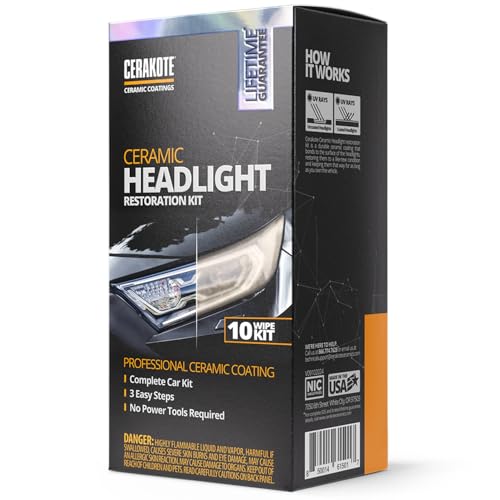
The complete job with nothing to plug in. Eight oxidation removing wipes take the loose material off, a supplied sanding kit deals with the deep oxidation the wipes cannot reach, and two ceramic coating wipes chemically bond a new ultraviolet barrier onto the lens. Three steps, about half an hour, and no tool that could bite into your paint. Its promise is tied to how long you own the vehicle, which is a bounded promise rather than an infinite one, and it is the only kit here that pairs a real abrasive with a ceramic rather than a clear coat.
Pros:
- All three steps covered: remove, sand, seal
- Ceramic coating bonds a new UV barrier on
- No power tools; nothing that can damage paint
- Promise bounded to your ownership of the vehicle
Cons:
- Does not publish its sanding grits, unlike the 3M kits
- Costs more than the two-grit kit above it
- Hand sanding takes longer than a drill would
Best for: the full three-step job with no tools in the house.
QIFOR
A 6.09oz yellowing removal solution, a 0.34oz crystal plating solution, a towel and a sponge. Two of its bullets are the ceramic kit’s bullets reproduced exactly, including the ceramic bonding claim and the line about no tools that could damage your headlights or paint, which was written for a box containing sandpaper. The contents bullet is the one they rewrote, and it shows: “includesOne bottle”, with the space gone. Its own description bullet then says the fluid is designed to provide a yellowed finish, which is a wording slip in the worst possible place.
Pros:
- Two solutions, towel and sponge; nothing to buy
- Publishes both bottle volumes
- Simple spray, wipe and air-dry method
Cons:
- Two bullets are another kit’s, word for word
- Contents bullet still carries the copy-paste seam
- No abrasive at all, despite the borrowed tool language
Best for: nothing the other sprays do not do more plainly.
Chemical Guys
The middle path, and a well-made one: a restoration compound to remove oxidation, haze and discoloration, then a ceramic to leave a protective layer against sun and road grime, with a microfiber and applicator in the box. It works by hand or by machine, which is a genuinely useful option. Its listing says the formula works without harsh abrasives, and a compound is an abrasive, so read that as a mild one. For light to moderate hazing that is the right tool, and it comes from a detailing brand that knows what it is doing.
Pros:
- Compound plus ceramic; both steps in one kit
- Works by hand or by machine, your choice
- Microfiber and applicator included
- Also usable on taillights and clear plastic trim
Cons:
- “Without harsh abrasives” describes a mild abrasive
- No graded sanding for a badly gone lens
- Among the higher prices here
Best for: light haze, without going near sandpaper.
3M Ultra 2-Pack
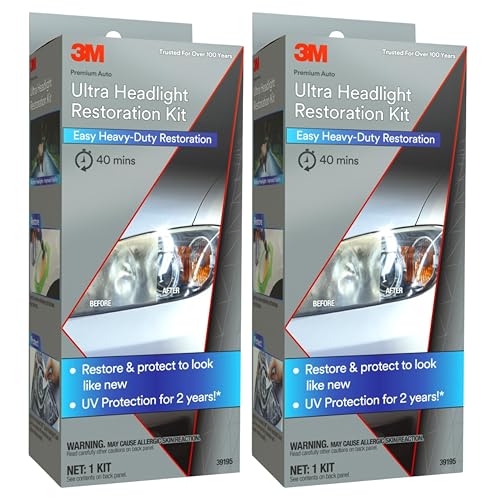
The most complete abrasive ladder in the search, twice over. Each kit carries a disc pad holder, six 500 grit discs, four 800 grit discs, one 3000 grit refining disc and two clear coats, and there are two kits in the box. Coarse to cut the oxidation off, medium to erase the coarse scratches, fine to polish out the medium ones, then seal. That progression is what separates a lens that comes out clear from one that comes out cloudy in a new way. Masking tape is included, and a household drill is optional.
Pros:
- Full 500, 800 and 3000 grit progression published
- Two complete kits; enough for two vehicles
- Two clear coats per kit; sealing well covered
- Masking tape included; drill optional
Cons:
- The highest price on this page
- Most work of anything here; it is a proper job
- A drill makes it much easier, and is not included
Best for: badly gone lenses, and a spare kit on the shelf.
The verdict
Yellowed headlights are a failed surface layer, not a stain, so the kits that work take the layer off, refine what is underneath, and seal it back up. Four here do that. Six spray something on instead, and one of the six borrowed its promises from a kit that sands, missing space and all.
Best overall: CERAKOTE Ceramic. The only kit that pairs a real abrasive with a ceramic rather than a clear coat, and it does all three steps without a tool in the house: wipes for the loose oxidation, a sanding kit for the deep stuff, ceramic to bond a new sun barrier on. Half an hour, ten wipes, nothing spinning near your paint. Its promise is bounded to how long you own the car, which is a promise with an edge on it rather than the word permanent.
Best value: 3M 39194. The cheapest kit on this page that removes anything, with 1000 and 3000 grit discs, two clear coat wipes, a foam pad and a glove. Remove, refine, seal, all of it, for less than most of the sprays cost. It starts at 1000 grit, so it is the right call for haze and yellowing rather than a chalky lens, and it is the only listing here that bothers to name what you are avoiding.
Best premium: 3M Ultra 2-Pack. Six 500 grit, four 800 grit and one 3000 grit disc per kit, plus two clear coats, and two kits in the box. That grit ladder is the most complete in the search and it is what a badly oxidized lens needs, because each grade exists to erase the scratches the last one left. Most work of anything here, and the only kit that leaves you a spare.
FAQ
Why do headlights turn yellow?
They leave the factory with a thin protective coating over clear plastic, and sunlight breaks that coating down over years. The cloudiness is the failed coating plus the hazed plastic just beneath it, so the damage is a physical layer on the lens surface rather than dirt sitting on top.
Do the spray-on kits work?
They clean and they coat. They contain no abrasive, so the hazed layer stays on the lens. One markets that as not removing your headlight’s protective layer, which reads well until you remember that layer is the thing that failed. For mild haze a spray helps; for real oxidation it cannot reach the problem.
Why do the sanding kits have three grits?
Each grade cleans up after the one before it. 500 cuts the oxidation away and leaves scratches, 800 removes those and leaves finer ones, 3000 polishes those out. Skip a step and the scratches from the coarse disc stay in the lens, which is its own kind of cloudy.
Can I skip the clear coat?
No. Sanding takes the ruined sun protection off and leaves bare plastic, which will haze again faster than the original did. Every abrasive kit here finishes with a clear coat or a ceramic, and that final step is the part that lasts.
Do I need a drill?
Not necessarily. One kit includes a foam pad and needs no tools at all, and the biggest kit says use with or without a common household drill. A drill mostly saves your arm on a badly gone lens.
This article may contain affiliate links; see our Affiliate Disclosure.