Every dehydrator in this search advertises its size in trays. Only two of the ten say how big a tray is, and they are from the same brand, and they do not agree with each other. One fits 6.5 square feet across six trays. The other fits 3.1 square feet across five. Work it through and the first brand’s tray is about three quarters larger than its own smaller tray. The number everybody sells you on turns out not to be a unit of anything.



At a glance
| Product | Drying area published? | Price tier | Link |
|---|---|---|---|
| Model 904 | No. And no hot air below about 122 degrees F | Budget | |
| Elite Gourmet EFD319 | No. Claims two opposite fan layouts | Budget | |
| Cosori 5-Tray | No, but it publishes tray diameters | Budget | |
| PSIIDAN 8-Tray | No, but it publishes its own dimensions | Mid-range | |
| Magic Mill 7-Tray | No. Stainless inside, outside and trays | Mid-range | |
| Cosori 6-Tray | Yes. 6.5 sq ft, the only big number you can check | Premium | |
| Magic Mill 10-Tray | No. Most trays here, area unknown | Premium | |
How to choose
A tray is not a unit of measurement
Large capacity is the whole search, and tray count is how every listing here answers it. Two products publish an actual area. One puts 6.5 square feet across six trays, which works out near 1.08 square feet each. The other puts 3.1 square feet across five, which is about 0.62 each. Same brand, same catalog, and one tray is about three quarters bigger than the other. If a tray can mean either of those things, counting them tells you nothing.
The brand with the biggest number says it out loud
The six-tray machine’s first bullet is not shy about this: it says it is 27 percent larger than standard seven-tray models. That is a manufacturer telling you, in its own advertisement, that six of its trays beat seven of everybody else’s. It is the single most useful sentence in this search, and it only works because the same listing publishes the square footage to back it up. Every rival claim on this page is a tray count with nothing behind it.
Which means ten trays might be smaller than six
Run the arithmetic on the biggest machine here. Ten stainless trays, top price, no area published anywhere. If its trays are the size of the small published tray, ten of them come to about 6.2 square feet, which is less than the six-tray machine. If they are the size of the large one, it is closer to eleven. Those are wildly different products and the listing does not let you tell which one you are buying. That is not a reason to avoid it; it is a reason to know what you are not being told.
Three of these cannot reach the jerky temperature the others cite
Look at the ceilings and they fall into groups: three stop at 158 degrees F, two reach 165, two reach 167, and three reach 176. Two listings here make the case themselves. One argues its 165 ceiling makes for safer beef jerky than a 158 machine. Another states plainly that 165 degrees F is the recommended figure for jerky. Take those claims at face value and the three machines that stop at 158 cannot get there at all, which matters only if jerky is why you are buying, and it usually is.
One machine tells you its dial is partly decorative
The cheapest unit here has a range of 95 to 158 degrees F and then adds a note: hot air will only be produced at temperatures above approximately 122 degrees F. So the bottom 27 degrees of its dial run the fan and no heat. Herbs, flowers and delicate fruit are exactly what you dry down there. It is a genuinely real disclosure and it is buried in a note at the end of a bullet, and it means the machine has a narrower working range than the one printed on it.
Rear fan or base fan, and one listing claims both
There are two layouts. A rear-mounted fan blows across the trays horizontally, which is why those listings all promise you never have to rotate anything. A base-mounted fan blows up through a stack, which is cheaper and tends to dry the bottom faster than the top. One machine here advertises horizontal airflow with no tray rotation required in one bullet, then describes a base-mounted fan circulating air in another. Those are the two competing designs, and it is a stackable round-tray unit, so the base fan is the true description.
Low wattage and a long timer go together plainly
Wattage here runs from 250 to 650, and the lowest-powered machine is also the only one offering a 72 hour timer instead of the usual 48. That pairing is not a coincidence and it is not a trick: less heat means longer drying, so it gives you the hours to finish. It is a small piece of clarity worth noticing in a category where most listings quote the big number and skip the consequence.
Model 904
The cheapest machine in this search, with five removable racks at 11.4 by 7.5 inches, a 0.79 inch gap between layers, a slide-out tray, overheat protection and a 400W fan. It is also the most candid listing here, because it admits the thing nobody else would: its range runs from 95 to 158 degrees F, but hot air only appears above roughly 122 degrees F. Everything below that is a fan moving room-temperature air, and that lower band is where herbs and delicate fruit live.
Pros:
- The lowest price on this page
- Publishes tray size and the 0.79 inch layer gap
- Discloses its real heating threshold, unprompted
- Overheat protection; BPA-free racks; slide-out tray
Cons:
- No hot air below about 122 degrees F, by its own note
- 158 degrees F ceiling; short of the cited jerky figure
- No drying area published
Best for: occasional drying, at the lowest price, eyes open.
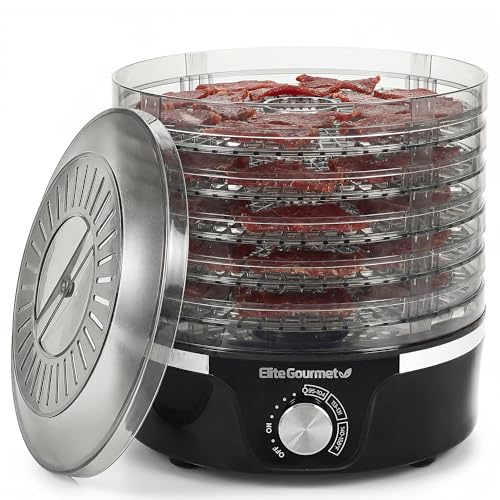
Elite Gourmet EFD319
Five clear 11.4 inch trays that stack from 8.5 to 10.75 inches tall, so thicker cuts get their own headroom, on a 350W heater with a 95 to 158 degrees F range. The transparent trays are the good idea here: you watch progress without lifting the lid and dumping the heat. It is ETL listed with a one-year warranty and US support. Its bullets do claim horizontal airflow needing no tray rotation and a base-mounted fan circulating air, which are the two opposite layouts, and the base fan is the one that matches the machine.
Pros:
- Clear trays; check progress without losing heat
- Stack height adjusts from 8.5 to 10.75 inches
- ETL listed, one-year warranty, US-based support
- Dishwasher-safe trays and lid; small footprint
Cons:
- Claims horizontal airflow and a base fan in one listing
- 158 degrees F ceiling; below the cited jerky figure
- No drying area published
Best for: watching fruit dry without opening the lid.
Cosori 5-Tray
The one that makes the temperature argument for the whole page. Its opening bullet sets its 165 degrees F ceiling against a 158 machine and says the higher figure means safer beef jerky, adjustable in single degrees from 95 up, with a 48 hour timer in half-hour steps. Five BPA-free trays at 12.2 inches outside and 11.6 inside, expandable to seven, with adjustable heights for thick cuts. Under 47 dB, and it takes a swipe at rivals with fragile clear shells while claiming solid material for itself.
Pros:
- 165 degrees F ceiling clears the cited jerky figure
- Single-degree control; 48h timer in 30-minute steps
- Expandable from five trays to seven
- Publishes tray diameters; under 47 dB
Cons:
- No drying area published, unlike its bigger sibling
- 350W; slower than the 600W machines
- Plastic trays where the pricier models use steel
Best for: jerky on a budget, with room to grow to seven trays.
PSIIDAN 8-Tray
Eight stainless trays on a 650W motor, up to 167 degrees F and 48 hours, in a 13.00 by 13.31 by 12.01 inch box it is willing to measure for you. Dual-layer insulation keeps the outside cool, there is an interior light so you can check progress through the door without opening it, and auto shut-off ends the cycle. A mesh tray for nuts and seeds and a drip tray for fruit leather are in the box. Another listing in this search describes the same specification almost line for line at a much higher price.
Pros:
- Eight stainless trays at a mid-range price
- 650W and a 167 degrees F ceiling; clears the jerky figure
- Publishes its outside dimensions
- Interior light, dual-layer insulation, auto shut-off
Cons:
- No drying area published; eight trays of unknown size
- Claims silent and ultra-quiet without a decibel figure
- No keep-warm function
Best for: the most stainless trays for mid-range money.
Magic Mill 7-Tray
The best-built machine here on the evidence of its own listing: stainless exterior, stainless interior and stainless trays, with no plastic walls anywhere. A 600W rear fan pushes air across every tray so nothing needs rotating, temperature runs 95 to 176 degrees F in single degrees, and a 48 hour timer ends in auto shut-off. Keep Warm then holds 95 degrees F for up to 24 hours. Seven full-size trays, two mesh screens and a fruit roll tray are all included rather than sold separately.
Pros:
- Stainless inside, outside and trays; no plastic walls
- 176 degrees F ceiling with single-degree control
- Rear fan; no tray rotation, no bottom hot spots
- Keep Warm holds 95 degrees F for up to 24 hours
Cons:
- No drying area published
- No decibel figure given
- Costs more than the eight-tray machine above
Best for: build quality and a 176 degrees F ceiling.
Cosori 6-Tray
The only machine in this search that answers the question. Six stainless trays, 6.5 square feet of drying space, and a listing willing to say that out loud and then explain what it means: 27 percent larger than a standard seven-tray model. A 600W rear fan dries evenly with no intervention, a brushless motor keeps it under 48 dB so it can run overnight, and the panel sets 95 to 165 degrees F to the degree with a 48 hour timer. Six dishwasher-safe trays, a mesh screen and a fruit roll sheet are included.
Pros:
- 6.5 sq ft published; the only checkable capacity here
- Says outright it beats a standard 7-tray by 27 percent
- Brushless motor under 48 dB; safe to run overnight
- 600W rear fan; single-degree control to 165 degrees F
Cons:
- 165 degrees F ceiling, below the 176 machines
- Six trays reads as fewer than eight or ten
- Among the higher prices here
Best for: large capacity, proven rather than implied.
Magic Mill 10-Tray
The biggest machine here by tray count and the highest price on the page: ten adjustable stainless trays with fruit roll trays included, a rear-mounted fan so nothing needs rotating, a transparent door window for watching without opening, a digital thermostat and timer with auto shut-off, and a keep-warm function. Overheat protection is built in and every tray and liner goes in the dishwasher. What it does not publish, anywhere, is how much drying space those ten trays add up to.
Pros:
- Ten adjustable stainless trays; the most here
- Rear fan and a door window; no rotating, no opening
- Keep-warm, auto shut-off and overheat protection
- Mesh and fruit leather sheets included
Cons:
- No drying area published at the highest price here
- Ten trays could total less than the 6.5 sq ft machine
- No wattage or decibel figure given
Best for: maximum trays, if tray count is what you want.
The verdict
Large capacity is the search, and eight of these ten listings answer it with a number that means nothing on its own. The two that publish square footage prove the point between themselves: same brand, and one tray is about three quarters bigger than the other.
Best overall: Cosori 6-Tray. 6.5 square feet, published, which is the only capacity claim on this page you can actually check. Its own listing does the comparison for you and says six of its trays run 27 percent larger than a standard seven-tray machine, which is a manufacturer arguing against tray count in a category built on it. A 600W rear fan, single-degree control and a brushless motor under 48 dB that can run all night.
Best value: Cosori 5-Tray. The cheapest machine here that reaches 165 degrees F, which two listings on this page name as the figure that matters for jerky, and the three machines stopping at 158 cannot get to. Single-degree control, a 48 hour timer in half-hour steps, tray diameters published, under 47 dB, and it expands from five trays to seven when you outgrow it.
Best premium: Magic Mill 10-Tray. Ten adjustable stainless trays, a rear fan so nothing needs rotating, a door window, keep-warm and auto shut-off, at the top price here. Buy it for the tray count and the build, and know what you are not getting: no published area, so ten trays could total anywhere from under the six-tray machine to nearly double it. The listing will not tell you which.
FAQ
Is a 10-tray dehydrator bigger than a 6-tray?
Not necessarily. The only two listings here that publish area show one brand’s trays differing by about three quarters between models. Ten small trays can total less than six large ones. Without a square footage figure, tray count is not comparable across machines.
What temperature do I need for jerky?
Two listings here name 165 degrees F, one of them arguing directly that its 165 ceiling beats a 158 one for safer beef jerky. Three machines on this page stop at 158, so they cannot reach that figure. Four go to 176.
Rear fan or base fan?
A rear fan blows across the trays and is why those listings promise no tray rotation. A base fan blows up through a stack and tends to dry the bottom faster than the top. It is the main structural difference between the cheap machines and the expensive ones here.
Does more wattage dry faster?
Broadly yes, and the listings are clear about the trade. The 250W machine here is the only one offering a 72 hour timer rather than 48, because less heat needs more hours. Wattage runs 250 to 650 across this search.
Why does one dehydrator not heat below 122 degrees F?
Its own note says so: the dial goes down to 95 degrees F but hot air only appears above roughly 122. Below that it moves room-temperature air. That band is where herbs and delicate fruit are usually dried, so the working range is narrower than the printed one.
This article may contain affiliate links; see our Affiliate Disclosure.