Nine of these ten lamps promise no blue light hazard, no glare and no flicker. One of them names the actual test: risk group zero under a published international standard, which is the real classification the phrase “blue light hazard” comes from. Everyone else uses the words and skips the rating. That one lamp also happens to be the only one telling you how much light lands on your page rather than how much leaves the lamp.


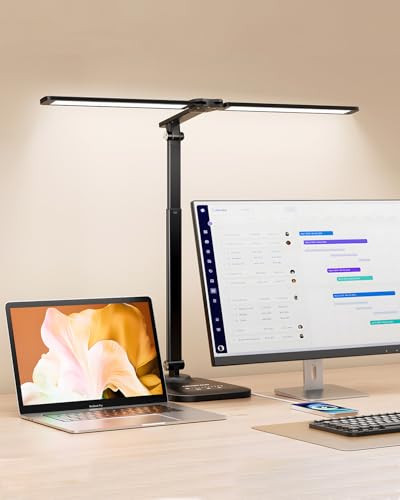


At a glance
| Product | Light output, and what it publishes | Price tier | Link |
|---|---|---|---|
| Voncerus | No lumens. Claims 50,000 hours | Budget | |
| 15W USB Lamp | Its first bullet says the USB ports cannot power it | Budget | |
| Airlonv | Genuinely stepless: 2700-6500K and 1-100% | Budget | |
| LEPOWER | 800 lumens, 1400 lux, and it names the safety standard | Budget | |
| Lepro | 800 lumens from 9.5W. The most efficient here | Budget | |
| CHARYJOD | The only CRI number here. Warns it flickers if overloaded | Mid-range | |
| Pzloz | 24W, no lumens, and the narrowest color range here | Mid-range | |
| ONEMIX 42in | 1800 lumens. The brightest, and it says so in lumens | Premium | |
How to choose
Watts is your electricity bill; lumens is your light
Six of these lamps advertise a wattage and no lumen figure, and a watt is a measure of what the lamp eats, not what it gives. LED efficiency varies enormously, so a 10W lamp might produce 500 lumens or 1500 and nothing on the box tells you which. Four lamps here do publish lumens, and the effect is immediate: two of them make 800 lumens, one from 9.5 watts and one from 12, so one is genuinely more efficient and you can see it. Meanwhile the 24 watt lamp on this page publishes no lumens at all, and it costs more than double the ones that do.
Lux is the number that describes your page
Lumens describe light leaving the lamp in every direction. Lux describes light arriving on the thing you are reading, and it is the figure that decides whether the page is bright enough. One lamp here publishes both, quoting 800 lumens and 1400 lux across a stated lighting area. That combination is the only place on this page where the three things you care about, output, spread and delivered brightness, are all present at once. Everywhere else you get one of the three, or none.
Blue light hazard is a rating, not an adjective
The phrase appears everywhere here and it comes from a genuine photobiological classification with defined risk groups, tested against a published standard. Exactly one lamp on this page names the standard and states its result: risk group zero, the exempt category. Every other listing borrows the vocabulary and reports nothing. That is the difference between a claim someone tested and a claim someone typed, and it costs the same money either way.
Ask for the CRI number
Color rendering index is the spec that matters most for reading and looking at anything in color, and it is a number out of a hundred. One listing here says high CRI without a figure. One publishes an actual value, above 80, which is decent. The other eight never mention it. If you are choosing a lamp to read under, a real CRI figure tells you more than any of the eye-caring language on this page.
Stepless and ten levels are opposites
Stepless means a continuous slide from dim to bright with no jumps. Ten levels means ten fixed steps. One lamp here promises stepless dimming in its title and ten brightness levels in its bullet, and those cannot both be true. Another genuinely is stepless on both axes, sliding from 1 to 100 per cent of brightness and continuously between warm and cool, which is the finest control on this page and it is at the cheap end. Read the bullet, not the title.
Watch how the color range narrows as the price climbs
The widest color temperature range here runs from a warm 2700K to a cool 6500K, continuously, on a lamp costing about twenty dollars. The most expensive lamp on this page but one runs 3000K to 5500K in five fixed steps, which is the narrowest range in the whole set. Warm end matters for reading at night and cool end matters for working in daylight, and paying more has bought less of both.
The USB port is not a power inlet
Several of these have USB sockets, and they are outputs for charging your phone, not inputs for running the lamp. One listing leads its entire bullet list with exactly that, saying plainly to use the included adapter, that the ports are output-only, and that they cannot power the lamp. It is the first thing you read. Another warns that if you charge and light at the same time from a weak adapter, the light will flicker, which is a specific and useful admission from a lamp whose selling point is flicker-free light.
Clamp lamps live or die on two measurements
How thick a desk the clamp will take, and how high the arm reaches. Two lamps here publish both, at 2.36 and 2.75 inches of desk thickness, and one of them also tells you the monitor size it clears. That is the difference between checking with a ruler and finding out on your kitchen table. Everyone else shows you a photo of a clamp.
Voncerus
The cheapest lamp here, with a memory function that brings back your last setting rather than starting from scratch every evening, which is a small thing you appreciate daily. Three named color temperatures, ten brightness levels, an aluminum light board for heat, a 360-degree gooseneck and a 5V 2A adapter in the box. It publishes no lumens, no lux, no CRI and no clamp capacity, and its claimed 50,000 hour life is a number nobody will ever be in a position to check.
Pros:
- The lowest price here; adapter included
- Memory function restores your last setting
- Three named color temperatures and ten brightness levels
- Aluminum light board; 360-degree gooseneck
Cons:
- No lumens, lux, CRI or wattage published
- No clamp capacity given
- A 50,000 hour claim with nothing behind it
Best for: the cheapest clamp lamp that remembers you.
15W USB Lamp
Its first bullet is a limitation, and that is why it is here. It tells you to use the included adapter, that the USB ports are output-only and cannot power the lamp, and that they will not fast charge. Those are the three things people get wrong with a USB desk lamp, answered before you buy rather than in a support email. Around that clarity: four auto-off timers from 30 to 120 minutes, a one-tap night light, three named color temperatures, five brightness levels, 60 beads in a 3.5 inch head, and a weighted anti-slip base.
Pros:
- Leads with the truth: the USB ports cannot power the lamp
- Four timers, 30 to 120 minutes, plus a one-tap night light
- Three named color temperatures; 60 beads; touch panel
- USB-A and USB-C outputs; weighted anti-slip base
Cons:
- No lumens, lux or CRI published
- The USB ports will not fast charge anything
- A base lamp, not a clamp; it takes desk space
Best for: a listing that answers the support questions first.
Airlonv
Genuinely stepless on both axes: 2700K to 6500K with nothing in between missing, and 1 to 100 per cent brightness with no fixed steps. That is the widest color range and the finest control on this page, from a lamp at the cheap end, and it is the difference between finding the light you want and picking the nearest preset. It is also the only budget lamp publishing the two numbers a clamp lamp needs: it grips desks up to 2.36 inches and reaches a working height of about 31 inches, clearing a 30 inch monitor. A 17 inch bar with 100 beads.
Pros:
- Stepless color from 2700K to 6500K and brightness from 1 to 100%
- Publishes clamp capacity at 2.36 inches and the monitor size it clears
- 17 inch bar with 100 beads; the widest spread at this price
- Built-in cable management; 5V 3A adapter included
Cons:
- No lumens, lux or CRI published
- A 60,000 hour claim; the highest and least checkable here
- No timer, no memory function
Best for: the finest control and the widest color range, cheaply.
LEPOWER
The only lamp here that names the standard behind the claim everyone else makes: risk group zero, tested against a published international specification, which is what “no blue light hazard” is supposed to mean and almost never does. It is also the only lamp publishing lux alongside lumens, at 1400 lux from 800 lumens across a 50 inch lighting area, so you know what reaches the page and not just what leaves the lamp. Fifty combinations from five color temperatures and ten levels, a stepless slide bar as well as buttons, memory, and a metal gooseneck.
Pros:
- Names its blue light risk group and the standard it was tested to
- Publishes lumens, lux and lighting area together; the only one here
- Stepless slide control as well as buttons; smart memory
- Fifty combinations; metal gooseneck; 12W for 800 lumens
Cons:
- Its 200% wider and 100% brighter claims name no baseline
- Less efficient than a rival making the same 800 lumens from 9.5W
- No CRI figure; no clamp
Best for: the only lamp that names a test rather than a feeling.
Lepro
Eight hundred lumens from 9.5 watts, which is the best efficiency on this page and only visible because it published both numbers. A penny separates it from another 800 lumen lamp here that needs 12 watts to do the same job. It also gives you the things nobody else bothers with: 72 LEDs, a 12V supply rather than 5V USB, an input range covering the whole world, and a 4.9 foot cord measured in both units. A frosted shade and a long head spread the light to cut the contrast against your monitor.
Pros:
- 800 lumens from 9.5W; the most efficient here
- Publishes LED count, supply voltage, input range and cord length
- Frosted shade and long head reduce monitor contrast
- Folds flat; five modes at five brightness levels
Cons:
- Its five color modes have no Kelvin values attached
- No lux, no CRI, no blue light rating
- No clamp; no timer; no USB port
Best for: the most light per watt, published.
CHARYJOD
The only lamp on this page with a CRI number, at above 80, which is the single most relevant figure for reading and the one every rival omits. It also does the real thing twice: it warns that running the light and the USB charger together on a weak adapter will make the light flicker, and it tells you to use a 5V 3A supply to avoid it. That is a company describing a real failure mode in a category that sells flicker-free as a slogan. Height adjusts from 15.55 to 22.83 inches on dual swing arms, 76 beads, 24 months of warranty. Its title says stepless and its bullet says ten levels.
Pros:
- Publishes a CRI figure; the only real one here
- Warns that charging plus lighting on a weak adapter causes flicker
- Height adjusts 15.55 to 22.83 inches; dual swing arms
- 45-minute timer; folds away; 24-month warranty
Cons:
- Title says stepless dimming; the bullet says ten levels
- No lumens, lux or wattage published
- Needs a better adapter than it ships with, on its own advice
Best for: the only CRI number, and a real flicker warning.
Pzloz
Twenty-four watts, no lumens, and the narrowest color range on this page at 3000K to 5500K, in five steps, for more than twice the price of a lamp that slides continuously from 2700K to 6500K. Its 25 modes are five temperatures multiplied by five brightness levels, which is arithmetic rather than a feature. What is genuinely here is articulation: 360 degrees of standing rotation, 180 degrees of foldable swing arm and a 270 degree head, plus a wireless remote. Its last bullet offers a free remote replacement with no return needed, which tells you something about the remote.
Pros:
- The most articulation here: 360, 180 and 270 degrees
- Wireless remote; night light and reading modes
- Free remote replacement with no return needed
- Clamps to a desk; suits dual monitors
Cons:
- 24 watts and no lumen figure at all
- 3000K to 5500K; the narrowest color range here
- Its 25 modes are five temperatures times five levels
- A remark about remote failure in its own final bullet
Best for: articulation, if you never wanted a warm evening light.
ONEMIX 42in
Eighteen hundred lumens, published, which is more than twice any other figure on this page, spread across a 42 inch bar in four segments you rotate independently. Fold them in for one bright pool or fan them out across 80 inches of desk. It publishes what clamp lamps need and rarely give: 2.75 inches of desk thickness and a 27.7 inch arm bending to 180 degrees. Five temperatures from 3200K to 6500K, a remote with timers, six presets, a full box list including a screwdriver, individual testing before shipping, 90 days to refund and a year of warranty.
Pros:
- 1800 lumens, published; more than twice anything else here
- A 42 inch four-segment bar covering up to 80 inches
- Publishes clamp capacity at 2.75 inches and arm length at 27.7
- Remote, timers, six presets; screwdriver and screws included
- 90-day refund and a one-year warranty
Cons:
- The highest price here
- No lux, no CRI, no blue light rating
- Warm end stops at 3200K; less cozy than cheaper rivals
- 42 inches needs a desk that can take it
Best for: the most light on this page, stated in the right unit.
The verdict
Six lamps sell you watts, which is what they consume. Four sell you lumens, which is what you get. One sells you lux, which is what reaches the page, and one gives you a CRI number, which is what decides whether the page looks right. Those are four different questions and almost nobody answers more than one.
Best overall: LEPOWER. It is the only lamp here that names the standard behind the blue light claim every rival makes, and reports its result as the exempt risk group. It is also the only one publishing lux next to lumens next to lighting area, so you know 800 lumens is arriving as 1400 lux across 50 inches rather than leaving you to imagine it. A stepless slide bar, fifty combinations and a memory function that keeps your setting. On a page of adjectives, it brought numbers and a test name.
Best value: Airlonv. Truly stepless on both color and brightness, running continuously from 2700K to 6500K and from 1 to 100 per cent, which is the widest range and the finest control on this page and it costs about twenty dollars. It also publishes the two things a clamp lamp must have and almost never states: it grips a desk up to 2.36 inches thick and clears a 30 inch monitor. A 17 inch bar with 100 beads spreads that light properly. Ignore the 60,000 hour claim.
Best premium: ONEMIX 42in. Eighteen hundred lumens is more than double anything else here and it is quoted in the unit that means something. The 42 inch bar splits into four segments you aim independently, folding into a task pool or fanning across 80 inches, and it tells you the clamp takes 2.75 inches and the arm runs 27.7. Ninety days to change your mind and a year of warranty. Its warm end stops at 3200K, so it is a working lamp more than a bedtime one.
FAQ
Is a higher wattage lamp brighter?
Not reliably. Watts measure consumption, lumens measure light, and LED efficiency varies a lot. Two lamps here make 800 lumens, one from 9.5 watts and one from 12. The 24 watt lamp on this page publishes no lumens at all.
What is lux and why does it matter more?
Lumens leave the lamp; lux arrives on your page. One lamp here publishes both, at 800 lumens and 1400 lux over a stated area, which is the only complete answer on this page.
Does eye-caring mean anything?
Only when a rating follows it. Blue light hazard is a real classification with risk groups and a published test standard. One lamp here names both. The rest use the phrase and report nothing.
What CRI should I look for?
A number, first of all. Above 80 is decent and above 90 is good. One lamp here gives a figure, one says high CRI with no figure, and eight never mention it, on products sold for reading.
Can I run the lamp from my laptop’s USB port?
Usually not. The USB sockets on these are outputs for charging your phone. One listing says so in its very first bullet. Another warns that charging and lighting together on a weak adapter makes the light flicker.
This article may contain affiliate links; see our Affiliate Disclosure.