One brand sells the same 135 amp welder twice on this page. Same weight, same wire speeds, same bullets. One listing says it welds mild steel up to 3/32 of an inch. The other says 2/5 of an inch, which is more than four times thicker and impossible for the machine. The first listing gives the answer away in brackets: 3/32 inch is 2.5mm, and somebody turned 2.5mm into 2/5 of an inch. It is still there, on the dearer of the two.





At a glance
| Product | The number that matters | Price tier | Link |
|---|---|---|---|
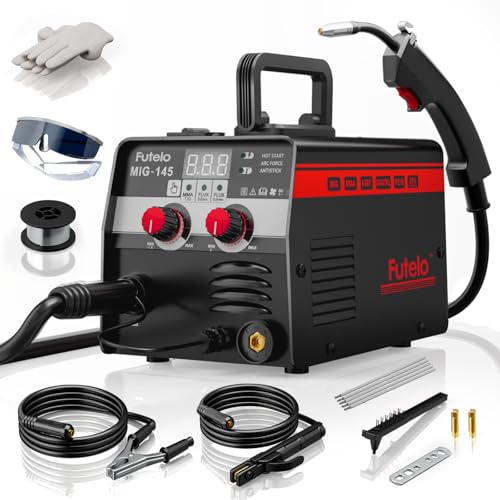
| Futelo 145A | The fullest box here. It contains goggles, not a helmet | Budget | |
| BILT HARD 135A | Publishes its error codes. Nobody else does | Budget | |
| BESTMIG 135A | 1/8 inch, an auto-darkening helmet and leather gloves | Budget | |
| YESWELDER 135A | 3/32 inch, stated correctly, with the millimeters | Budget | |
| YESWELDER FLUX-135PRO | The same machine, claiming 2/5 inch. Plus a real helmet | Budget | |
| ARCCAPTAIN 165A | 60% duty cycle. The only duty cycle on this page | Mid-range | |
| YESWELDER 165A | Takes 10lb spools. Its same-price rival takes 2lb only | Mid-range | |
| ARCCAPTAIN 200A | Six processes, four of which are in the box | Premium | |
How to choose
Amps without a duty cycle is half a specification
Duty cycle is the share of any ten minutes you can actually weld before the machine stops to cool itself. At 60% you weld six minutes and wait four. At 20% you weld two and wait eight. It is the difference between finishing a seam and standing in your garage watching a fan, and on a long job it matters more than the amperage does. Every machine here shouts its amps. Exactly one publishes a duty cycle. That means nine of these ten are asking you to compare the top of the range without telling you how long you get to stay there.
Count the processes that came in the box
Three-in-one, four-in-one, five-in-one, six-in-one. Now read the brackets, because every single one of them is there. The TIG torch is not included. On the bigger machines the spool gun is not included either. So the five-in-one arrives as a three-in-one and the six-in-one arrives as a four, and the difference is a purchase you make later at a price nobody mentions. One brand does something better: it names the exact torch model you would need to go and buy. That single part number is worth more than the extra digit in the headline.
The thickness figure is the one beginners need
You are not buying amps, you are buying the ability to weld the thing in front of you. Five of these ten publish a maximum steel thickness and five do not, and the five that do not include both of the most expensive machines here. One of them offers “thin and thick materials” instead, at more than three times the price of a machine that gives you a fraction. Among the ones that do answer, the numbers are sensible and close: 3/32 of an inch at 135 amps, 1/8 at 135, 3/16 at 165. Roughly, thirty more amps buys you another sixteenth.
Goggles are not a helmet
One machine here advertises that everything is in the box and no extra purchases are required, and then lists safety goggles. Goggles cover your eyes. Arc welding throws ultraviolet light and hot spatter at your whole face, which is why the standard protection is a helmet, and why every rival at this price puts one in. It is the one place on this page where a listing’s confidence and its contents genuinely part company, and a beginner is exactly the person least likely to notice.
Only one helmet here has any specifications
Four machines include eye protection and three of them describe it in two words: auto-darkening helmet, solar helmet. One publishes the numbers that decide whether a helmet is any good: a shade range of 9 to 13 with a 3.5 light state, an optical clarity rating of 1/1/1/1, and a viewing area measured in inches. Those are the specs that separate a helmet you can see through from one that gives you a headache. If the helmet is a big part of why you are buying a bundle, only one bundle tells you what the helmet is.
Spool size is a running cost
Two machines here cost exactly the same and put out the same 165 amps. One takes both 2lb and 10lb wire spools. The other adds a note at the end of its listing saying it holds 2lb spools only. Wire is cheaper per pound in the big spool and a 2lb reel disappears faster than beginners expect, so this is a difference you pay for repeatedly rather than once. Note also who told you: the machine with the limitation is the one that printed it.
Dual voltage splits this page in half
Everything under about a hundred and eighty dollars here runs on 110 volts only. Everything above it runs on 110 or 220. That is not a coincidence; a domestic 110V circuit caps what a welder can draw, and 220 is how you get to the higher currents on thicker steel. If you have a 220V outlet in the garage, or could have, the dual machines are the ones with somewhere to grow. One brand also warns, on both its machines, never to flip the voltage switch until the screen is off and the fan has stopped. Nobody else mentions it.
Futelo 145A
The cheapest machine here and the most thorough packing list: torch, ground clamp, electrode holder, five rods, wire, two contact tips, a wrench, gloves, a hammer and a manual. At 7.5 lbs it is the lightest thing on this page by a wide margin, it publishes a 30 to 145 amp range and 1 to 5mm of steel, and its synergic control even suggests a metal thickness for your settings, which is a genuinely thoughtful touch for a first-timer. Then read the eye protection: safety goggles, in a box whose bullet says no extra purchases are required.
Pros:
- The lowest price and the lightest machine here, at 7.5 lbs
- Publishes its amp range and steel thickness
- Synergic control suggests a metal thickness for you
- Gloves, rods, tips, wrench and hammer all included
- 30-day money-back promise
Cons:
- Ships goggles, not a helmet, while claiming nothing else is needed
- 110V only; no room to grow
- No duty cycle published
- TIG torch sold separately, as with everything here
Best for: the fullest box, once you buy a helmet.
BILT HARD 135A
It publishes its error codes, and for a beginner that is worth more than an extra thirty amps. When the machine stops mid-weld and shows E2, you know it overheated rather than broke, and the listing also tells you the fan will run for a minute or two before it is safe to restart. Nobody else on this page explains what their machine does when it stops. Around that: a solar helmet in the box, 2T, 4T and spot modes that nothing else this cheap offers, burn-back and inductance control on MIG, and hot start, arc force and VRD on stick.
Pros:
- Publishes its error codes and what they mean
- Tells you the fan cools for a minute or two before restart
- 2T, 4T and spot modes at the lowest price here
- Solar helmet, torch, clamp, wire, spare tip, brush and hammer included
- Burn-back and inductance on MIG; hot start, arc force and VRD on stick
Cons:
- No steel thickness published
- No duty cycle published
- The helmet has no shade range or optical rating given
- 110V only
Best for: knowing why it stopped.
BESTMIG 135A
An auto-darkening helmet that converts to goggles, plus leather gloves, plus the gun, clamp and holder, and a stated 1/8 inch of mild steel, which is the most generous real thickness among the 135 amp machines here. It calls its output a true current of 135A, which is a pointed phrase in a category where headline amps are often the theoretical peak. It handles wire from 0.030 to 0.040 inches, wider than most, and its digital control matches voltage and feed to what you dial in.
Pros:
- Auto-darkening helmet, convertible to goggles, plus leather gloves
- Publishes 1/8 inch; the best real figure among the 135A machines
- Calls it a true current of 135A
- Takes wire from 0.030 to 0.040 inches
Cons:
- No duty cycle published
- The helmet has no shade range, optical rating or viewing area given
- 110V only; no wire feed speed range published
Best for: a helmet and gloves without buying a bundle.
YESWELDER 135A
The most precisely specified machine at the budget end, and the listing that quietly proves its own sibling’s typo. It gives 3/32 inch with 2.5mm in brackets, so nothing is ambiguous. It publishes wire feed speed separately for each wire diameter, 120 to 420 inches a minute on 0.030 and 120 to 308 on 0.035, which is more feed detail than machines three times the price offer. Hot start and arc force are adjustable on stick, it weighs 11.4 lbs, and it comes with a spool of flux wire. No helmet.
Pros:
- 3/32 inch, with the millimeters in brackets; unambiguous
- Wire feed speed published per wire diameter
- Hot start and arc force adjustable on stick
- 11.4 lbs; flux wire included in the box
Cons:
- No helmet or gloves included
- 110V only; 2lb spools only
- No duty cycle published
- 3/32 inch is the thinnest capability here
Best for: the clearest numbers under a hundred and ten dollars.
YESWELDER FLUX-135PRO
The same 135 amp machine as above, with a helmet, and one bullet gone wrong. Its capacity line says 2/5 of an inch where its twin says 3/32, and the twin’s bracketed 2.5mm shows you exactly how the error happened. Ignore that line and this is the better bundle, because the helmet is the only one on this page with real specifications: shades 9 to 13 with a 3.5 light state, 1/1/1/1 optical clarity, a viewing area given in inches, and blue light filtering. Everything else matches its cheaper twin exactly.
Pros:
- The only helmet here with a shade range and optical rating
- Viewing area published; takes magnifying lenses
- Wire feed speed published per wire diameter
- Hot start and arc force on stick; 11.4 lbs
Cons:
- Claims 2/5 inch of steel; its own twin says 3/32
- 110V only; 2lb spools only
- No duty cycle published
- Thirty dollars more than the identical machine without a helmet
Best for: the only helmet on this page with numbers.
ARCCAPTAIN 165A
The only machine on this page that publishes a duty cycle, at 60%, which means six minutes of welding in every ten rather than a number nobody will tell you. It also names the exact TIG torch you would need to buy, gives 3/16 inch of mild steel, weighs 12.8 lbs, lists every item in the box, and warns you never to change the voltage switch until the screen is off and the fan has stopped. Then, at the very end, it notes it holds 2lb spools only, which its same-priced rival does not suffer from and which it did not have to admit.
Pros:
- 60% duty cycle; the only one on this page
- Names the exact TIG torch you need to buy separately
- 3/16 inch of mild steel published; 12.8 lbs
- Full box list; 2T and 4T; dual voltage
- Warns you how to switch voltage safely
Cons:
- 2lb spools only; its same-price rival takes 10lb
- No helmet or gloves included
- Its 4-in-1 count includes a TIG torch you buy separately
Best for: the only machine that says how long it can weld.
YESWELDER 165A
Same price and same amps as the ARCCAPTAIN above, and it takes 10lb spools, which is the difference between buying wire cheaply and buying it often. It adds a detachable torch, so the part that wears out and gets caught on things comes off for replacement rather than being wired in. On stick it offers hot start, arc force, VRD and anti-stick, the fullest stick feature set here, and it takes 0.023 through 0.035 wire. It weighs 18 lbs, publishes no thickness and no duty cycle.
Pros:
- Takes 2lb and 10lb spools; cheaper wire per pound
- Detachable torch; the wear part comes off
- Hot start, arc force, VRD and anti-stick on stick
- Takes 0.023, 0.030 and 0.035 wire; dual voltage
Cons:
- No duty cycle and no steel thickness published
- 18 lbs; heavier than its 165A rival
- No helmet or gloves included
Best for: big spools and a torch you can replace.
ARCCAPTAIN 200A
The most machine here, and the one whose headline needs the most reading. Six processes, of which the TIG gun and the spool gun are yours to buy, so four arrive. What genuinely arrives is good: ten stored presets per welding mode so your settings survive being changed, adaptive crater and burn-back adjustment, pre-flow and post-flow gas control, and a cooling fan that runs only when needed rather than droning all day. It handles solid, flux and aluminum wire, and it names which rollers you must buy for the outer sizes.
Pros:
- Ten stored presets per mode; your settings survive
- Adaptive crater, burn-back adjustment, pre and post gas flow
- Fan runs only when needed; no constant noise
- Takes solid, flux and aluminum wire; names the extra rollers
- Shoulder strap included; dual voltage
Cons:
- The 6-in-1 count includes two guns you do not get
- No duty cycle and no steel thickness published
- The highest price here, for the least documented capability
Best for: presets and fine control, if you already know what you want.
The verdict
Amps are the headline and duty cycle is the answer, and one machine on this whole page will give you one. Under that, the beginner questions are what steel it welds, what is in the box, and whether the eye protection is real. Half the page declines to answer the first, and the answers to the other two are not where the price would suggest.
Best overall: ARCCAPTAIN 165A. It publishes a 60% duty cycle, which no other machine here will do, and that number tells you more about your Saturday than any amp figure. It gives you 3/16 inch of steel in writing, names the exact TIG torch you would have to buy rather than leaving you to guess, lists every item in the box, and warns you how to switch voltage without destroying it. It also volunteers that it takes 2lb spools only, which it could easily have left out, and which its same-priced rival does better.
Best value: BILT HARD 135A. The cheapest machine here comes with a helmet, spot welding, 2T and 4T, and burn-back, inductance, hot start, arc force and VRD, which is a feature list from a machine costing twice as much. Its real distinction is smaller and better: it prints its error codes and tells you the fan will cool for a minute or two before restart. When your first welder shuts down mid-bead, being told E2 means overheat is the difference between waiting and panicking.
Best premium: ARCCAPTAIN 200A. Ten stored presets per mode, adaptive crater, burn-back, pre and post gas flow, and a fan that only runs when it needs to. This is a machine for someone who has learned what settings they like and wants them back tomorrow. Buy it knowing the six-in-one is a four-in-one until you buy two more guns, and that it will not tell you its duty cycle or what thickness it welds.
FAQ
What is a duty cycle and why does it matter?
It is the share of any ten minutes you can weld before the machine stops to cool. Sixty per cent means six minutes on and four off. Only one welder here publishes one, which makes the rest of the amp figures on this page half a specification.
Is a 6-in-1 better than a 3-in-1?
Read the brackets. Every multi-process count here includes a TIG torch you buy separately, and the bigger machines also count a spool gun you buy separately. The six-in-one arrives as a four. One brand names the exact torch, which is the only useful version of that sentence.
How thick can a 135 amp welder go?
About 3/32 to 1/8 of an inch of mild steel, which two listings here state plainly. A third claims 2/5 of an inch for the same machine, which is a mangled conversion of 2.5mm and is not possible.
Do I need a helmet or will goggles do?
A helmet. Goggles protect your eyes; welding throws ultraviolet light and hot spatter at your whole face. One machine here says no extra purchases are required and includes goggles.
Do I need dual voltage?
Only if you can reach a 220V outlet. Everything under about a hundred and eighty dollars here is 110V only, which caps the current available and therefore the steel you can weld. Dual voltage is the room to grow.
This article may contain affiliate links; see our Affiliate Disclosure.