Eyeballing a cut works until the day it doesn’t — a drawer front a hair too wide, a 3D-printed part that will not seat, a bolt you bought twice because “about 8mm” wasn’t. A twenty-dollar digital caliper or smart tape ends that guesswork with numbers you can trust to a hundredth of a millimeter.





Digital measuring tools split into two families: calipers, which grip a part between jaws and read to a hundredth of a millimeter, and smart tapes, which stretch across a room and log the result so you stop scribbling on offcuts. The best pick depends on whether your work lives on a bench or across a floor plan — and this group covers both, led by the tools that sell in the largest numbers.
| Tool | Standout features | Price | Link |
|---|---|---|---|
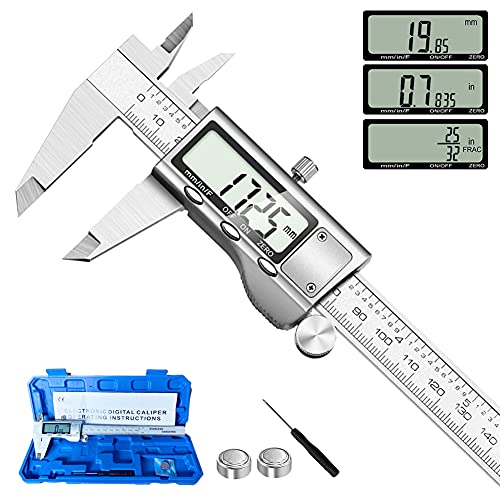
| HARDELL 6" Caliper | Stainless body, ±0.02mm accuracy, spare battery and ruler included | Budget | |
| 6" Steel Caliper (inch/F/mm) | Fraction mode, zero-set anywhere, ±0.02mm accuracy | Budget | |
| Steel Micrometer Caliper | Oil-proof stainless, 4-minute auto-off, locking screw | Budget | |
| Esydon 6" Plastic | 8-month battery life, wake-on-slide, three batteries included | Budget | |
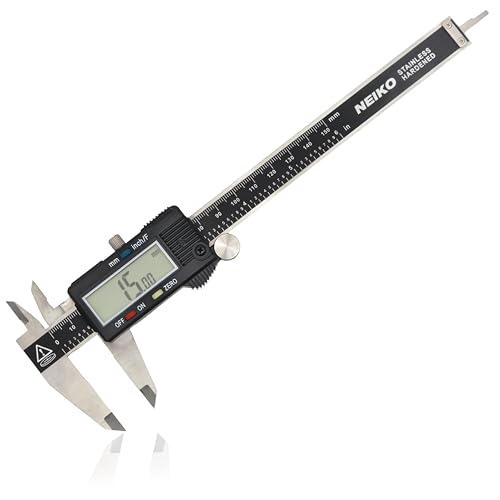
| NEIKO 01407A | Polished stainless, inch/fraction/mm, knurled roller, long track record | Budget | |
| Simhevn Plastic | Insulated jaws safe on live parts, zero-reset, auto shutdown | Budget | |
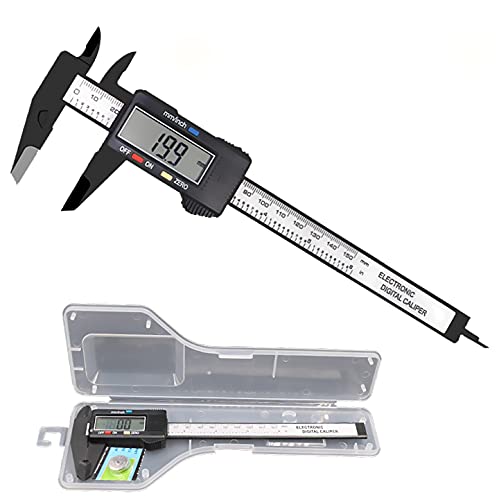
| SCITOOLS Carbon Fiber | Insulating plastic jaws, 3D-printing friendly, auto on/off | Budget | |
| PREXISO 2-in-1 Tape | 16ft digital tape, 50-record memory, USB-C rechargeable, magnetic hook | Mid-range | |
| Muylux 3-in-1 Laser Tape | 197ft laser + 16.4ft digital tape, TFT display, 30-slot memory | Mid-range | |
How to choose a digital measuring tool
The spec sheets here look interchangeable until you know which three numbers matter and which body material suits your bench. Here is the short course.
Accuracy versus resolution — read the second number
Every caliper advertises a resolution of 0.01mm, but resolution is only how fine the display counts. Accuracy is how close that count is to the truth. The steel calipers in this group are rated ±0.02mm, tight enough for machine work and bearing fits. The plastic ones are rated around ±0.2mm — ten times looser, though still far beyond a ruler. Match the tool to the tolerance: engine and lathe work wants steel; sizing a 3D-printer nozzle gap or a jewelry finding does fine with plastic.
Steel or plastic body
Stainless steel wins on rigidity, wear, and indifference to workshop oil and coolant — jaws stay parallel after years of pocket abuse. Plastic and carbon-fiber-composite bodies weigh less, cost a third as much, and have one genuine advantage: the jaws do not conduct, so measuring near battery terminals or live electronics is safer. They flex more under a heavy hand, which is where that looser accuracy rating comes from.
The four measurements every caliper makes
All these calipers measure four ways: outside jaws for diameters and thickness, inside jaws for holes and slots, a depth rod off the tail for blind holes, and the step face for shoulders. The habit worth building is zeroing before each session — close the jaws, press zero, measure. The zero button also does differential work: zero on a reference part, then read the next part as a plus-or-minus deviation directly.
Fractions, inches, and millimeters
One-button unit switching is universal here, but woodworkers should look for a dedicated fraction mode — a reading of 1-27/64" maps straight onto imperial drill and router bits, no decimal conversion at the bench. The NEIKO and the fraction-mode steel caliper both display it natively.
When a tape beats jaws
A caliper stops at six inches. For rooms, decks, and stud runs, the digital tapes take over: PREXISO’s 16-foot tape shows a live reading on an LCD and stores fifty measurements, and the Muylux adds a 197-foot laser for across-the-warehouse distances. If your measuring is mostly furniture-scale and smaller, buy a caliper first; if it is mostly rooms, start with the tape and add a caliper when precision work appears.
HARDELL 6-Inch Stainless Caliper
The best-selling tool in this comparison nails the fundamentals: a polished stainless body rated to ±0.02mm, a thumb roller that glides without slop, and a large LCD readable in direct sunlight. HARDELL rounds out the case with a small ruler, a screwdriver, and a spare battery — the accessory that matters, because a dead cell is how most calipers end up in a drawer.
Pros:
- Machine-work accuracy at a budget price
- Waterproof, abrasion-resistant stainless construction
- Spare battery and screwdriver included
- Bright LCD stays legible outdoors
Cons:
- No fraction display for imperial woodwork
- Heavier in the pocket than plastic rivals
Best for: the default choice — a proven, accurate steel caliper for mechanics, woodworkers, and makers.
6-Inch Steel Caliper with Fraction Mode
Functionally a twin of the HARDELL — same ±0.02mm rating, same stainless build — with one addition that changes daily use for imperial workshops: a fraction mode that reads in 64ths alongside inches and millimeters. Zero-set works at any jaw position, so comparative measurements against a reference part take one button press.
Pros:
- Fraction display maps directly to imperial bits and stock
- Full steel accuracy at the same budget price point
- Zero-set anywhere enables quick deviation checks
- Smooth glide with positive locking
Cons:
- Brand is less established than NEIKO or HARDELL
- Case is functional rather than rugged
Best for: woodworkers and imperial-first shops that think in 64ths.
Stainless Micrometer Caliper with Auto-Off
Another ±0.02mm stainless entry, this one leaning on fit and finish: an ergonomic frame, a locking screw for carrying a reading across the shop, and a four-minute auto-off that stretches battery life without shutting down mid-measurement. The body shrugs off water, stains, and oil — relevant anywhere cutting fluid flies.
Pros:
- Oil- and stain-proof stainless frame
- Locking screw holds a dimension for transfer work
- Sensible 4-minute auto-off timing
- Large, high-contrast display
Cons:
- Slightly pricier than the near-identical HARDELL
- Two display modes only — no fractions
Best for: garage and machine-shop use where oil and coolant are part of the job.
Esydon 6-Inch Plastic Caliper
Esydon’s pitch is fair: household accuracy at the lowest possible price. The ±0.2mm rating will not set bearing preloads, but it comfortably sizes screws, dowels, filament, and drill bits. The battery story is the surprise — wake-on-slide plus aggressive auto-off yields eight-plus months per cell, and three batteries ship in the box along with a hard case.
Pros:
- Costs less than a decent tape measure
- Wake-on-slide means it is always ready
- Three batteries and a protective case included
- Lifetime warranty backs it up
Cons:
- ±0.2mm rating rules out precision machine work
- Plastic jaws wear faster against metal parts
Best for: household fixes, DIY, and anyone measuring occasionally rather than daily.
NEIKO 01407A Digital Caliper
The NEIKO 01407A has been the workshop staple in this category for years, and the formula holds: finely polished stainless, a knurled thumb roller, an extra-large LCD, and three display modes including true fractions to 1/128". Accuracy matches the group’s steel standard at ±0.02mm. It is the pick when you want the tool with the longest public track record.
Pros:
- Years of proven service in home and pro shops
- Inch, fraction, and millimeter modes on one button
- Extra-large LCD is the easiest to read here
- Polished action with locking screw
Cons:
- Costs a few dollars more than newer equivalents
- Auto-off is less aggressive than some, so carry a spare cell
Best for: buyers who weight reputation and longevity over the last dollar saved.
Simhevn Plastic Caliper
The Simhevn’s plastic jaws are a feature, not just a cost cut: they do not conduct, so probing around battery packs, terminals, and live boards cannot short anything. Zero-reset at any position, inch/mm switching, and auto on/off cover the basics for jewelry, DIY, and electronics benches at a near-throwaway price.
Pros:
- Insulated jaws are safe around electronics
- Feather-light and pocketable
- Zero-reset anywhere for comparative checks
- Opens awake, shuts itself off
Cons:
- ±0.2mm accuracy is hobby-grade
- Display is smaller than the steel models’
Best for: electronics and jewelry work where non-conductive jaws matter more than the last decimal.
SCITOOLS Carbon-Fiber Caliper
Aimed squarely at the 3D-printing crowd, the SCITOOLS uses a carbon-fiber-composite body that is kind to printed parts — its lower hardness will not gouge a fresh PLA surface the way steel jaws can. The usual four measuring modes, unit switching, and five-minute auto-off are all present, and the maker is upfront that industrial tolerances belong to a different tool.
Pros:
- Gentle on printed and soft-material parts
- Insulating jaws add electrical safety
- Fair, clearly stated accuracy expectations
- Auto on/off preserves the battery
Cons:
- ±0.2mm rating, like all plastic models here
- Flexes if you squeeze hard — light touch required
Best for: 3D-printer owners checking dimensions on printed parts and filament.
PREXISO 2-in-1 Digital Tape Measure
PREXISO puts a live digital readout on a 16-foot tape: pull to the mark and the backlit LCD shows the distance in any of six unit formats, including feet-plus-inches with fractional or decimal inches. Fifty measurements store on board, the hook is magnetic, auto-lock stops recoil snap-back, and the battery recharges over USB-C instead of eating coin cells.
Pros:
- Live LCD reading eliminates squint-and-count errors
- Fifty-slot memory replaces the pencil-on-wrist habit
- USB-C rechargeable with auto-locking tape
- Six unit formats cover every trade convention
Cons:
- 16-foot reach is short for large rooms
- No laser — measuring is contact-only
Best for: furniture building, room layouts, and anyone tired of re-measuring what they forgot.
Muylux 3-in-1 Laser Tape Measure
The Muylux stacks three tools in one shell: a 16.4-foot digital tape with live tracking, a manual retractable tape, and a Class II laser that reads distances to 197 feet at ±2mm — point, click, done, even in sunlight. A color TFT screen shows tape and laser readings together, and thirty measurements store on board. For estimating jobs across big spaces, it replaces a pocketful of tools.
Pros:
- 197-foot laser range covers whole buildings
- Tape and laser readings share one color display
- Self-locking tape allows one-person measurements
- Thirty-slot memory with one-button recording
Cons:
- More to learn than a plain digital tape
- Laser accuracy of ±2mm is coarser than caliper work
Best for: construction, renovation, and estimating across rooms and lots.
Verdict
Best Overall: HARDELL 6-Inch Stainless Caliper. The category’s best seller pairs machine-grade ±0.02mm accuracy with a spare battery in the box, and it costs no more than the plastic tools cost a few years ago. For a single do-everything precision tool, this is it.
Best Value: Esydon 6-Inch Plastic Caliper. For a fraction of an already-small price you get months of battery life per cell, a hard case, and accuracy that covers every household and hobby task short of machining.
Best Premium: Muylux 3-in-1 Laser Tape. The most capable single instrument here — contact tape for the close work, laser for everything up to 197 feet, and memory so the numbers survive the walk back to the bench.
FAQ
Is a digital caliper more accurate than a dial caliper?
At this price range they rate similarly; the digital advantage is readability and instant unit conversion. Digital models eliminate dial-reading mistakes and add zero-anywhere differential measuring, which dial calipers cannot do.
What does the ±0.02mm rating actually mean?
Any single reading can be up to two hundredths of a millimeter off in either direction — about a quarter the thickness of a human hair. For steel calipers here that is the rating across the full six-inch range; plastic models rate around ten times looser.
Why does my caliper read a few hundredths with the jaws closed?
Debris or normal drift. Wipe the jaw faces, close them fully, and press the zero button — that resets the reference. Zeroing before each session is the single habit that keeps digital calipers trustworthy.
Can these calipers measure things bigger than six inches?
No — six inches (150mm) is the jaw travel. For longer work, use the digital tapes in this guide, or step up to an eight- or twelve-inch caliper, which costs considerably more.
Do digital tape measures replace a normal tape?
The two here include a conventional tape inside — the digital layer adds a live readout and stored measurements on top. You give up nothing except a little battery charging.
This article may contain affiliate links; see our Affiliate Disclosure.