One listing here advertises 4K dual channel recording and then, four lines down, states its front camera as 2560 by 1440. Those cannot both be true: 4K is 3840 by 2160, and 2560 by 1440 is a quarter fewer pixels than that in each direction. The same brand’s dearer model gets it right and prints 3840 by 2160. Once you notice that, the word 4K stops sorting this page and the sensor name starts.


Worth being clear about what these are. Almost everything here is a dash cam shaped like a mirror: it records, and it also shows you the rear feed. One product is the other way round, a genuine mirror that happens to record. That difference decides how it behaves the day the memory card fails.
At a glance
| Mirror | Standout feature | Price tier | Link |
|---|---|---|---|
| Hufdic 10-Inch | Cheapest here; 32GB card in the box | Budget | |
| Veement VT10 | Claims 4K for a fraction of the rest | Budget | |
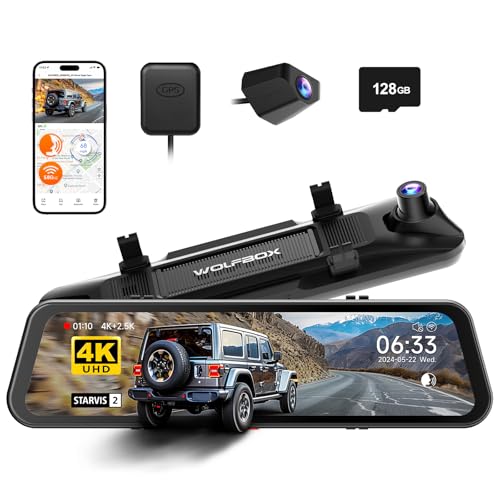
| WOLFBOX G930 | The best seller here; GPS speed and direction | Mid-range | |
| Pelsee S12 Pro | A named Sony sensor at half the usual price | Mid-range | |
| WOLFBOX G850 PRO | Blind spot detection and driver alerts | Mid-range | |
| Master Tailgaters | A real mirror, 4mm glass, that also records | Premium | |
| WOLFBOX G900 PRO | States real 4K at 30fps; 12 inch screen | Premium | |
How to choose a mirror dash cam
Check what the brand means by 4K
The G900 PRO states its front camera as 4K, 3840 by 2160, at 30fps, which is what 4K means. The G850 PRO, from the same brand, headlines 4K dual channel recording and then gives its front camera as 2160P in brackets 2560 by 1440. Those are two different resolutions and the second one is not 4K. The Veement claims 4K at well under half the price of anything else here and names no sensor at all. None of that means these are bad cameras. It means the word 4K is doing very different work in different listings.
The sensor name is the specification that survives
Three products here name the actual part: STARVIS 2 IMX678, which is a Sony sensor built for low light, and the G900 PRO and the Pelsee both quote 8MP alongside it. A named sensor is a claim you can look up. Resolution without a sensor is a file size, because a cheap sensor upscaled to 4K produces a large, blurry file rather than a detailed one. Given that the thing you actually need from a dash cam is a readable number plate at night, the sensor is the specification that matters and the resolution is the one being marketed.
Frame rate decides whether you can read a plate
This gets almost no attention and it should. The G900 PRO records front at 30fps. The Pelsee records 4K at 25fps and its rear at 25fps too. The G850 PRO’s rear runs at 25fps. Five frames per second sounds trivial until you consider that a car passing at speed crosses your frame in a fraction of a second, and the difference between 25 and 30 is the difference between a legible plate and a smear. Where a listing gives resolution and no frame rate, that is a gap.
A screen is not a mirror when it stops working
This is the difference between the two kinds of product here. Master Tailgaters replaces your original mirror with real glass, 4mm thick, clear and distortion free, and the LCD sits behind it and turns on to show the rear view. If the electronics die you still have a mirror. Everything else on this page straps over your existing mirror, which usually means the display is the mirror. Both work. Only one of them still works when the memory card corrupts on a wet Tuesday.
ADAS and blind spot detection are the real upgrade
The G850 PRO is the only unit here doing both: driver assistance alerts and blind spot detection, warning you during lane changes. That is a genuinely different thing from recording, because recording only helps after something has happened and an alert helps before. Pelsee includes ADAS alerts too. Everything else here is a witness rather than an assistant. If the reason you are shopping is safety rather than insurance evidence, that is the feature line to look along.
Check the cable and the card
The unglamorous details decide the install. Cable length matters because the rear camera lives at the back of the car and the mirror is at the front, so a long run covers a large vehicle and a short one leaves you stuck halfway down the roof lining. Card capacity matters because 4K fills a card fast. Hufdic includes a 32GB card, which gets you driving on day one and is small for 1080P, let alone anything higher, so budget for a bigger one on any of these.
Hufdic 10-Inch
The cheapest mirror here and clear about what it is: 1080P front and rear across a 10-inch full touch screen, with a 170 degree wide angle and night vision. No 4K claim, no sensor name, no confusion. A 32GB card comes in the box, so it works the day it arrives, and there is a 24-hour parking monitor with a G-sensor and parking assistance. Loop recording keeps it running once the card fills. That is enough to see what happened; it is not enough to read a plate two cars back at night.
Pros:
- Cheapest mirror on this page
- 32GB card included; working from day one
- 170 degree wide angle across a 10-inch touch screen
- 24-hour parking monitor with G-sensor
Cons:
- 1080P front and rear; the lowest resolution here
- No sensor named and no frame rate published
- 32GB is small; it will loop over itself quickly
Best for: a first mirror cam, working out of the box, for very little.
Veement VT10
The most 4K per pound on this page by a very long way, which is the reason to look and the reason to look carefully. It claims a 4K front camera and a 1080P backup camera on a 10-inch HD IPS display, with voice commands for locking footage hands-free and a 170 degree front angle for reverse assist and blind spots. The features are real and the price is a fraction of everything else claiming the same resolution. What it does not name is the sensor, and on a page where the premium units name a Sony part, that silence is the thing to weigh.
Pros:
- Claims 4K front and 1080P rear, far below the going rate
- 10-inch HD IPS display with full touch control
- Voice commands; lock footage without touching it
- 170 degree front angle with reverse assist
Cons:
- No sensor named, where the premium units name a Sony part
- No frame rate published
- Resolution without a sensor is file size, not detail
Best for: a big screen and a big resolution number for very little money.
WOLFBOX G930
The best-selling mirror here, and it is the sensible middle of WOLFBOX’s range. Front 4K and rear 1080P across a 10-inch touch screen you can slide up and down to reframe the view, which is a genuinely useful thing on a mirror that is showing you a camera. The screen itself is low-reflectivity LCD to cut daytime glare, which is the problem every mirror screen has and few address. GPS puts real-time speed and direction on the display once the receiver is plugged in, and that data lands in the footage, which is what makes it useful to an insurer. WDR handles the contrast.
Pros:
- The best-selling mirror on this page
- GPS speed and direction recorded with the footage
- Low-reflectivity LCD to cut daytime glare
- Slide the screen to reframe the view; 5.8GHz WiFi
Cons:
- No sensor named; no frame rate published
- 10 inches, where WOLFBOX’s dearer models give 12
- GPS receiver is a separate part to plug in
Best for: most people, with GPS data in the file for the insurer.
Pelsee S12 Pro
The specification bargain on this page. It carries the STARVIS 2 sensor, the same Sony low-light part that WOLFBOX puts in mirrors costing roughly twice as much, and that sensor is what decides whether a night-time plate is legible or a gray rectangle. Around it, 4K at 25fps front with 1080P at 25fps rear, both frame rates stated rather than left out, ADAS driver assistance alerts, and 5.8GHz Wi-Fi 6 moving footage to your phone at up to 20MB/s so pulling a clip is a minute rather than an evening. Named part, stated numbers, mid-range price.
Pros:
- STARVIS 2 sensor at roughly half what WOLFBOX charges for one
- Publishes both resolutions and both frame rates
- ADAS driver assistance alerts included
- Wi-Fi 6 at up to 20MB/s; clips off the camera fast
Cons:
- 25fps, where the G900 PRO records front at 30
- Sells poorly against WOLFBOX
- No blind spot detection
Best for: the sensor that matters, without the flagship price.
WOLFBOX G850 PRO
The only mirror here that warns you before something happens rather than recording it afterwards. ADAS gives driver assistance alerts and the enhanced blind spot detection watches for danger during lane changes, which on a mirror you are already looking at is the right place to put a warning. That combination is unique on this page. The awkward part is the resolution: the listing headlines 4K dual channel recording and then states the front camera as 2160P in brackets 2560 by 1440, which is not 4K. Read that as a capable 1440p camera with genuinely useful alerts.
Pros:
- The only unit here with both ADAS and blind spot detection
- Alerts you during lane changes, on the mirror you are watching
- Publishes its frame rates; 5.8GHz WiFi and voice control
- Warns before, rather than only recording after
Cons:
- Headlines 4K and then states 2560 by 1440, which is not 4K
- Rear camera runs at 25fps
- No sensor named, unlike WOLFBOX’s dearer models
Best for: blind spot warnings, if you read the resolution properly first.
Master Tailgaters
The only product here that is a mirror first. It completely replaces your original rear view mirror with real glass 4mm thick, clear and distortion free, and the 10-inch ultra-bright IPS screen sits behind that and turns on automatically to show the rear camera. The consequence matters: when the electronics are off, or the card fails, or the camera is unplugged, you still have a mirror in your car. A 140 degree CMOS camera records, with a superior night mode and automatic recording from ignition. Universal fit, and by some way the most expensive 1080p on this page.
Pros:
- A genuine mirror: 4mm glass, clear and distortion free
- Still a mirror when the electronics are off or fail
- Screen turns on automatically for the rear view
- Replaces the original mirror rather than clamping over it
Cons:
- 1080p at a price where others claim 4K
- 140 degrees; the narrowest angle here
- No WiFi, GPS, ADAS or voice control
Best for: a mirror that records, rather than a recorder shaped like a mirror.
WOLFBOX G900 PRO
The flagship, and the one that states its numbers properly. Front 4K, printed as 3840 by 2160 at 30fps, which is what 4K actually means and the highest frame rate on this page, with a 2.5K rear rather than the 1080P everything else settles for. Behind it sits the 8MP STARVIS 2 IMX678, a named Sony low-light sensor, which is what turns those pixels into a readable plate after dark rather than a large file of noise. Twelve inches of screen, 5.8GHz WiFi and voice control. It is the most expensive mirror here and the most precisely described.
Pros:
- States 4K correctly as 3840 by 2160 at 30fps
- 8MP STARVIS 2 IMX678; a named Sony low-light sensor
- 2.5K rear camera, where rivals give 1080P
- 12-inch screen; 30fps is the highest frame rate here
Cons:
- The most expensive mirror on this page
- Pelsee offers the same sensor family for roughly half
- No blind spot detection, unlike the cheaper G850 PRO
Best for: night-time plates, from the listing that does the arithmetic right.
The verdict
Two things to carry in. The word 4K is not consistent on this page, so check whether a listing prints 3840 by 2160 or something smaller. And the sensor name matters more than the resolution, because a plate you cannot read at night is the only failure that counts.
Best overall: Pelsee S12 Pro. It carries the STARVIS 2 sensor, the same Sony low-light part WOLFBOX puts in mirrors costing about twice as much, and that is the component that decides whether a night-time number plate is legible. It publishes both resolutions and both frame rates rather than leaving half the sentence out, adds ADAS alerts, and moves footage over Wi-Fi 6 at up to 20MB/s. It records at 25fps, not 30, which is the real trade.
Best value: Hufdic 10-Inch. The cheapest thing here and the least confused: 1080P front and rear, a 170 degree angle, a 10-inch touch screen, and a 32GB card in the box so it works the day it turns up. No 4K claim, no sensor name, nothing to unpick. It will show you what happened; it will not read a plate two cars back at night, and it never said it would.
Best premium: WOLFBOX G900 PRO. The only listing here that prints 4K as 3840 by 2160 and pairs it with 30fps, the highest frame rate on this page, behind an 8MP STARVIS 2 IMX678. The rear is 2.5K where everything else stops at 1080P, and the screen is 12 inches. It costs the most, and Pelsee gives you the same sensor family for roughly half, which is worth knowing before you order.
FAQ
Why do two mirrors from the same brand describe 4K differently?
Because one of them is not 4K. The G900 PRO prints 3840 by 2160, which is correct. The G850 PRO headlines 4K dual channel and then states 2560 by 1440, which is a quarter fewer pixels in each direction. Read the numbers in brackets, not the ones in the title.
Does the sensor matter more than the resolution?
Yes, for the only job that counts. A cheap sensor upscaled to 4K gives you a large blurry file; a good one gives a readable plate at night. Three products here name STARVIS 2 IMX678, a Sony low-light part you can look up. The rest name nothing.
What frame rate should I want?
30fps if you can get it, and only the G900 PRO publishes it here. Pelsee records at 25. A car passing at speed crosses your frame in a fraction of a second, and those five frames are the difference between a legible plate and a smear. Many listings skip the figure entirely.
Is a mirror cam still a mirror if it breaks?
Only the Master Tailgaters, which replaces your original mirror with 4mm glass and puts the screen behind it. Everything else clamps over your existing mirror and the display is the mirror. If the card corrupts or the unit dies, that difference is the whole point.
Are ADAS and blind spot detection worth it?
They are the only features here that help before a crash rather than after. The G850 PRO is the only unit with both, warning you during lane changes on the mirror you are already looking at. Pelsee includes ADAS. Everything else is a witness.
This article may contain affiliate links; see our Affiliate Disclosure.