Six portions of stir-fry in a 10-inch pan means cooking it in three batches, and by the time the third one is done the first has gone cold and rubbery. An electric skillet is the unglamorous fix: one flat surface big enough to cook the whole thing at once, holding a steady temperature the hob never quite manages.


What separates a good one is even heat with no scorching ring in the middle, a probe that holds the temperature you asked for, and a body that survives being washed properly rather than wiped and hoped over. The five below serve a full table, a couple batch-cooking for the freezer, a meal-prepper filling containers on a Sunday, or anyone who needs a second cooking surface at Christmas.
| Product | Standout feature | Price tier | Link |
|---|---|---|---|
| Elite Gourmet Ceramic Electric Skillet, 12″ | PFAS-free ceramic; fully immersible and dishwasher safe | Budget | |
| Elite Gourmet Extra Deep Skillet, 16″x13″ | 10.5 quarts, 3.15″ sidewalls, pour spout | Mid-range | |
| Dash Family Size Skillet | 6-quart pan with cool-touch handles and non-slip base | Mid-range | |
| Nuwave Medley XL Digital Skillet | Digital control in 5-degree steps, 100 degrees F to 425 degrees F | Premium | |
| Presto 16-inch Electric Foldaway Skillet | Handles fold and the base nests inside the pan | Premium | |
How to choose a large electric skillet
Measure capacity two ways
Listings quote both surface dimensions and quarts, and they answer different questions. Surface area is what matters for anything cooked in a single layer: pancakes, chops, grilled sandwiches, a fry-up. Quarts matter for anything with depth: chilli, curry, casseroles, a pan of stew. A 12-inch square pan and a 10.5-quart deep pan are both large, in different directions. Think about what you cook most before you buy the biggest number you can find.
Sidewall height decides what it can do
This is the specification people skip and later regret. Two inches of sidewall makes a skillet: fry, sear, pancakes, done. Three or four inches makes something closer to a braiser that can hold a full casserole without slopping over the edge when you stir it. High sides also cut spatter, which matters when the thing is sitting on a worktop rather than under an extractor. Deep pans do everything shallow ones do; the only cost is that they are bulkier to store and slightly more awkward for flipping.
The probe is the appliance
The removable temperature control probe is what makes an electric skillet worth owning over a pan on the hob. It reads the pan and holds a set temperature, so a low simmer stays a low simmer for an hour without being nursed. Two things to check. First, the range: something starting around 200 degrees F is fine for cooking, while a unit going down near 100 degrees F can also hold food warm for a buffet. Second, whether control is a dial or digital; dials are simple and approximate, digital gives you precise steps and a readout, which is worth real money for anything temperature-fussy like eggs or chocolate.
Immersible or not, and why it matters
Here is the practical difference between a skillet you use weekly and one that annoys you. If the probe comes out and the pan is fully immersible, you can drop it in the sink or the dishwasher like an ordinary pan. If not, you are wiping a plugged-in appliance with a cloth forever. Every skillet here removes its probe, but check the wording: some are dishwasher safe top rack only, some are fully immersible, and a few limit which parts can go in.
Coatings: ceramic, non-stick and PFAS
PFAS are a family of long-lasting synthetic chemicals used in many traditional non-stick coatings, and several makers now advertise PFAS-free ceramic instead. Ceramic tends to heat fast and release food well, and it is harder than it used to be, though its non-stick life is generally shorter than classic coatings and it dislikes high heat and metal tools. Traditional non-stick lasts well and is more forgiving. Either way, use wood or silicone rather than metal, and expect any coating to be a consumable measured in years.
Heating element and hot spots
An element that is fully embedded in the pan base and shaped to cover the whole floor, often described as M-shaped, is what stops the scorched ring in the middle that makes cheap electric skillets miserable. Cast aluminum bodies are thick enough to spread heat and resist warping, which is what keeps the base flat over years. Wattage tells you how fast it recovers when cold food hits it; 1200 to 1500W is normal, and higher recovers faster.
Where it lives when the meal is over
A 16-inch skillet is a large object with a permanently attached lid and cord. Worth a moment’s thought before buying, because a skillet that will not fit a cupboard tends to live on the worktop or in the garage, and the garage ones stop getting used. Folding handles and nesting bases exist for exactly this reason.
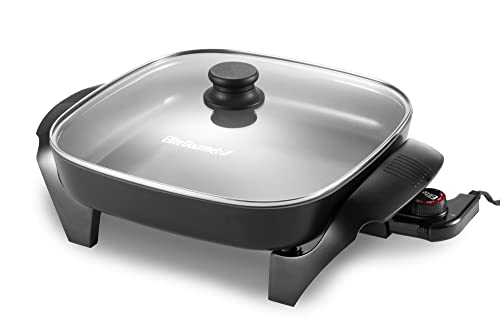
Elite Gourmet Ceramic Electric Skillet, 12″
The best seller here by a wide margin, and the cheapest thing in the guide, which is not a coincidence. The pan is 12 inches square with 2.15-inch sides and a thick cast aluminum body that resists warping and rust, running 1200W through a fully embedded element that heats rapidly and evenly. The Ceralast ceramic coating is PFAS-free, scratch-resistant and faster-heating than older ceramics, and food comes off it without a slick of oil. The part that earns daily use is the cleanup: pull the probe out and the whole thing goes in the sink or the dishwasher, no wiping around live electrics. The probe holds 250 degrees F to 450 degrees F, a tempered glass lid keeps moisture in, and it serves up to six. The square shape suits pancakes and sandwiches particularly well.
- Pros: Budget tier and the strongest seller here; fully immersible and dishwasher safe once the probe is out; PFAS-free Ceralast ceramic, scratch-resistant and fast-heating; thick cast aluminum resists warping; embedded element avoids hot spots; 250 degrees F to 450 degrees F control; square 12″ surface serves up to six.
- Cons: 2.15″ sides limit it for deep casseroles; the smallest capacity here; ceramic coatings generally have a shorter non-stick life; will not hold food at buffet temperature.
Best for: everyday meals for up to six, especially anything cooked flat.
Elite Gourmet Extra Deep Skillet, 16″x13″
Ten and a half quarts, which is a genuinely serious amount of food, and the pan that turns this category from a frying appliance into a one-pot cooker. The 16 by 13 inch floor gives you the surface for a full fry-up, and 3.15-inch sidewalls give the depth for gumbo, chilli or a casserole for eight without it climbing out when you stir. The integrated pour spout is the detail worth noticing: draining fat or juices from a full deep pan is a genuine hazard without one. An M-shaped element covers the entire floor for even heat, the honeycomb marbleized non-stick surface is scratch-resistant, and the probe runs 200 degrees F to 400 degrees F. Pull the probe and it is fully immersible, with the pan and lid dishwasher safe on the top rack. It is ETL certified with a one-year warranty behind it.
- Pros: 10.5 quarts, the largest capacity here; deep 3.15″ sidewalls handle stews and casseroles; big 16″x13″ floor for flat cooking; integrated pour spout for draining safely; M-shaped element across the whole base; fully immersible with dishwasher-safe pan and lid; vented tempered glass lid; ETL certified with a one-year warranty.
- Cons: A big object to store; tops out at 400 degrees F, lower than some; standard non-stick rather than PFAS-free ceramic.
Best for: one-pot meals for six to eight, batch cooking and freezer filling.
Dash Family Size Skillet
The unfussy one, and the one that looks least like an appliance. Six quarts, or 24 cups, is enough for a crowd without the bulk of the 10-quart pans, and the design is deliberately plain: a tempered glass lid, cool-touch handles, a non-slip base that stays put on a worktop when you are stirring hard. The removable heating probe gives the usual precise control, and the non-stick surface wipes down without ceremony. Dash sell on simplicity rather than specification, and the listing is correspondingly light on detail about elements and coatings, so judge it on what it plainly offers: a straightforward, good-looking family skillet that will not embarrass a worktop it lives on permanently.
- Pros: 6-quart capacity, ample for most meals; cool-touch handles and a non-slip base; removable heating probe with precise control; tempered glass lid; easy-clean non-stick; understated design for a worktop.
- Cons: Listing is vague on element design, coating type and temperature range; no pour spout; no stated PFAS-free claim; middling capacity for the price.
Best for: a simple, presentable skillet that lives out on the counter.
Nuwave Medley XL Digital Skillet
The only digital skillet here, and the range is what sets it apart: 100 degrees F to 425 degrees F in 5-degree steps, with a clear display and an easy-turn knob. That low end is the interesting bit, because 100 degrees F is not a cooking temperature, it is a holding temperature, which turns the pan into a buffet server that keeps food safe and edible for hours. Five-degree precision matters for eggs, delicate sauces and anything that turns on a small margin. The engineering underneath is thoughtful too: heat shields reflect heat from the embedded M-shaped element back into the unit, so the pan heats and the table does not. Seven quarts with high sidewalls covers family-size cooking, the G11 Duralon ceramic surface is PFAS-free and scratch-resistant, and the vented tempered glass lid is built to take real heat. It comes in four colors.
- Pros: Digital control in 5-degree steps from 100 degrees F to 425 degrees F; the low end holds food at buffet temperature; heat shields plus embedded M-shaped element for even heat; 7-quart capacity with high sides; PFAS-free G11 Duralon ceramic; vented tempered glass lid; lightweight with cool-touch handles; four colors.
- Cons: The most expensive here; digital controls are more to go wrong than a dial; ceramic coating wants gentle product.
Best for: precise temperature work, and keeping food warm through a long gathering.
Presto 16-inch Electric Foldaway Skillet
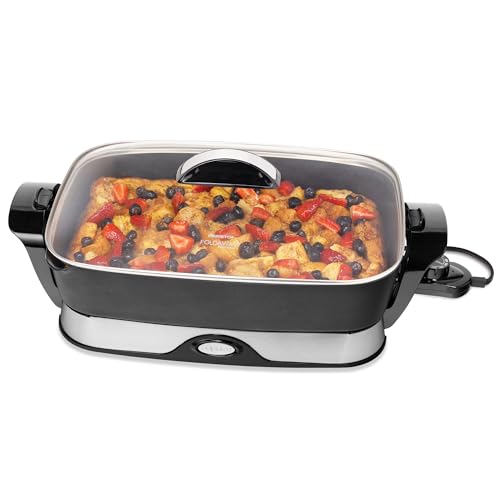
Presto solved the problem nobody else here even acknowledges: where the thing goes afterwards. The handles fold down, which detaches the pan from the base, and then the base nests inside the pan, so a 16-inch skillet collapses into something a cupboard will actually take. That removable base also means cleaning the pan without negotiating around electrics. The pan itself is big with high sidewalls, roasting, frying, grilling, stewing, baking and casseroles all within reach, and the PFAS-free non-stick runs inside and out, which matters more than it sounds since the outside is what gets splattered. A tempered glass cover with a stay-cool handle finishes it, and Presto point out it doubles as a buffet server, which a 16-inch pan holding a steady temperature does very naturally.
- Pros: Folding handles and a nesting base make a 16″ skillet genuinely storable; removable base simplifies cleaning; big pan with high sidewalls for real capacity; PFAS-free non-stick inside and out; tempered glass cover with stay-cool handle; doubles as a buffet server; long-standing brand.
- Cons: Premium tier; listing gives no temperature range or wattage; folding mechanism is another thing that can wear; plain looks.
Best for: big cooking in a kitchen with no spare cupboard, and serving straight from the pan.
Verdict
Best Overall – Elite Gourmet Ceramic Electric Skillet, 12″. It outsells everything else here comfortably and it is also the cheapest, which is a rare combination. The reason is that it gets the fundamentals right: an embedded element with no hot spots, a thick cast aluminum body, a PFAS-free ceramic surface, and full immersibility so cleaning it is no harder than cleaning a frying pan. If your cooking is mostly flat, for up to six, nothing here gives you less to complain about.
Best Value – Elite Gourmet Extra Deep Skillet, 16″x13″. Mid-range money for 10.5 quarts, the biggest pan here, with deep sides, a pour spout and full immersibility. For anyone cooking one-pot meals for six to eight or filling the freezer on a Sunday, this is the most food per pound in the guide by a distance.
Best Premium – Presto 16-inch Electric Foldaway Skillet. A 16-inch cooking surface that folds down and nests into itself for storage, which is the difference between a skillet you use and one that lives in the garage. PFAS-free coating inside and out, a removable base for easy washing, and it works as a buffet server when the meal is ready. If you want maximum surface and minimum regret about where to keep it, this is the one.
FAQ
How big a skillet do I need?
Work from what you cook. For food in a single layer, chops, pancakes, a fry-up, surface area is the number that counts, and a 12-inch pan handles about six portions. For food with depth, chilli or casseroles, quarts matter and sidewall height decides whether you can stir without spilling. Six to seven quarts suits most households; 10 quarts is for regular batch cooking or a full table.
Can I put an electric skillet in the dishwasher?
Usually, once the temperature probe is removed, but read the wording. Some are fully immersible and dishwasher safe throughout; others specify the top rack only for the pan and lid. The probe itself never goes in water. This is worth checking before you buy, because a skillet that cannot be washed properly is one you will stop reaching for.
What does PFAS-free actually mean?
PFAS are a family of durable synthetic chemicals long used in non-stick coatings. A PFAS-free skillet uses an alternative surface, usually ceramic, to avoid them. Ceramic heats quickly and releases food well; the trade-off is that its non-stick performance typically fades sooner than traditional coatings, and it prefers moderate heat and soft utensils.
Is an electric skillet better than a big frying pan?
For some jobs, clearly. It holds a set temperature steadily where a hob drifts, it frees a burner, it gives a bigger flat surface than most pans, and it can serve at the table. It will not give the fierce heat of a hob burner for searing, and it is another large object to store. Think of it as a second cooking surface with better temperature control, not a replacement for your pans.
Can I use metal utensils in one?
Better not to. Every coating here, ceramic or traditional non-stick, is described as scratch-resistant rather than scratch-proof, and metal edges are exactly what wears them out. Wood, silicone or nylon will add years to the surface. That is the single biggest thing you control in how long the pan lasts.
This article may contain affiliate links; see our Affiliate Disclosure.