One brand in this search sells the same travel toothbrush twice, a dollar apart. The cheaper one runs on a AAA battery for about three months. The dearer one charges over USB-C and runs for ninety days. Those are the same length of time. The dollar is not buying you more brushing. It is buying you a cable to remember, and on a travel toothbrush that is the wrong direction.




At a glance
| Product | Power and runtime | Price tier | Link |
|---|---|---|---|
| 7AM2M Battery | One AAA, about 3 months. Nothing to pack | Budget | |
| 7AM2M Type-C | 90 days a charge. Same brush, one dollar more | Budget | |
| PURSONIC Portable | Battery. 22,000 strokes, and no timer | Budget | |
| Oral-B 3D White | AA battery. The only rotating brush here | Budget | |
| Bitvae D2 | 60 days a charge. Eight heads in the box | Budget | |
| Aquasonic Icon | 30+ days a charge. Names the wrong dental body | Premium | |
| Voom Sonic Go 1 | AAA battery. Publishes its size and weight | Premium | |
How to choose
On a travel brush, the charger is the product
Everything else here is roughly equivalent. What actually changes your trip is whether you have to pack a cable. A AAA brush needs nothing: drop it in the bag, and when it fades in three months you buy a battery anywhere on earth. A rechargeable needs the cable, and one listing here notes in its contents that the plug adapter is not included and you should supply your own. Runtime is not the question. Runtime is fine on all of them. Cable is the question.
And the runtimes are the same anyway
One brand sells both versions of itself and the numbers give the game away: three months on a AAA, ninety days on a charge. Those are the same duration written two ways, for the same brush, with the same case, the same two heads, the same timer and the same waterproofing, one dollar apart. Nothing on this page charges once and runs longer than a battery lasts. The rechargeables are not winning on endurance; they are winning on not buying AAAs.
22,000 strokes is not a brand feature
Four products here from three different brands all quote exactly 22,000 strokes per minute, and all four are battery brushes. That is not four companies independently arriving at the same figure. It is the same class of motor wearing different badges, which is worth knowing because the price across those four varies by double. If you are paying more, you are paying for the case, the timer, the published dimensions or the heads. You are not paying for strokes.
Do not compare strokes across two different mechanisms
One brush here is a rotating brush, with a cup-shaped head that spins around each tooth, and it quotes 14,000 strokes per minute against everybody else’s 22,000. Those numbers describe completely different motions and cannot be ranked against each other. A rotating head and a vibrating head clean in different ways and both work. The 14,000 is not a worse version of the 22,000. It is a different unit that happens to look like the same one.
The timer is the feature, and two brushes here skip it
Take away the buzzing and the one thing an electric brush genuinely does for your habits is make you brush for two minutes and nudge you between quadrants every thirty seconds. Five products here have that. Two do not mention a timer at all, and one of those is a well-known name. If you are buying an electric brush to brush better rather than to brush faster, the timer is the reason, and it is the specification to check first.
One listing admits it is a manual brush that buzzes
Read the second bullet of one of the pricier brushes here: use the same brushing technique as a manual toothbrush, while the brush produces micro-vibrations to enhance the cleaning effect. That is unusually straight. A proper sonic brush is supposed to do the scrubbing while you guide it. This one is telling you it assists your technique rather than replacing it, which is a smaller claim than its rivals make and probably a truer one.
Check who is doing the accepting
Two brushes here claim the dental seal, and one of them cannot name the body correctly, calling it the American Dental Academy where the other correctly says the American Dental Association and even names the council that issues it. Both listings also drift between the words accepted and approved within their own text. It is one seal, from one organization, and a listing that gets the name wrong is a listing to read slowly.
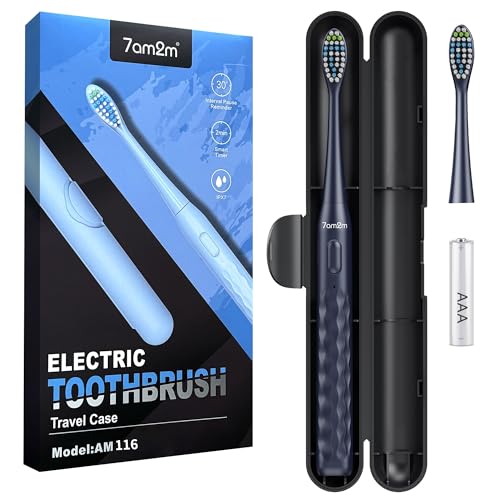
7AM2M Battery
The cheapest brush here and the one that best answers the actual search. One AAA battery runs it about three months and there is nothing to charge, which on a trip means no cable, no adapter and no hunting for a socket in a hotel bathroom. It has the full two-minute timer with a thirty-second pulse to move you between quadrants, IPX7 waterproofing, a travel case and two soft heads. Its listing includes an oddly specific warning that the battery goes in positive pole outward, which reads like a company answering the same email repeatedly.
Pros:
- The lowest price in this search
- One AAA, about three months, and no cable to pack
- Full two-minute timer with 30-second quadrant pulses
- IPX7, travel case and two heads included
Cons:
- You will be buying AAA batteries forever
- No brushing modes to choose from
- Publishes no size, weight or stroke rate
Best for: traveling without a charger, at the lowest price here.
7AM2M Type-C
The same brush as above with a USB-C socket instead of a battery compartment, one dollar dearer, and it is the clearest comparison on this page. Ninety days a charge against three months a battery, which is the same stretch of time. Same travel case, same two soft heads, same two-minute timer pulsing every thirty seconds, same IPX7. If you would rather charge a thing than feed it batteries, this is the version, and the reasoning is entirely about which small chore you prefer.
Pros:
- 90 days a charge; no batteries to buy, ever
- Charges over Type-C, so most cables you own will do
- Same timer, case, heads and IPX7 as the battery version
- One dollar more than its battery twin
Cons:
- Ninety days is the same as three months on a AAA
- A cable to pack on a travel toothbrush
- No modes; no size or stroke rate published
Best for: never buying a AAA again, for a dollar.
PURSONIC Portable
Three brush heads in the box, which the listing calls a three month supply, plus the battery and a travel cap, at a genuinely low price. It runs at the same 22,000 strokes as three other products here, and it uses Dupont bristles, which is at least a named supplier rather than an adjective. What it does not have, anywhere in its bullets, is a timer, and that is the feature most worth having. Its first bullet is also printed twice, word for word, which is the standard of attention on display.
Pros:
- Three heads included; a full quarter’s supply
- Battery included; travel cap in the box
- Names Dupont bristles rather than saying premium
- Pocket sized and cheap
Cons:
- No timer mentioned anywhere
- Its opening bullet appears twice, identically
- 22,000 strokes, same as brushes costing less
Best for: spare heads and a low price, if you time yourself.
Oral-B 3D White
The only rotating brush on this page, and that makes it the only genuinely different product here. Its cup-shaped head spins around each tooth and holds toothpaste against the surface, which is a different idea to vibrating, and its 14,000 strokes cannot be compared to anyone else’s 22,000 because they are not measuring the same motion. Heads are replaceable and cross-compatible with the brand’s other lines, which nothing else here offers. It takes an AA rather than a AAA, has no timer, and no travel case despite the search.
Pros:
- Rotating cup head; a genuinely different mechanism
- Heads swap with the brand’s other ranges
- Battery included; widely stocked heads
- The best-known name on this page
Cons:
- No timer at all
- No travel case, in a travel search
- AA battery makes it fatter than the AAA brushes
Best for: a rotating head, if that is what you are used to.
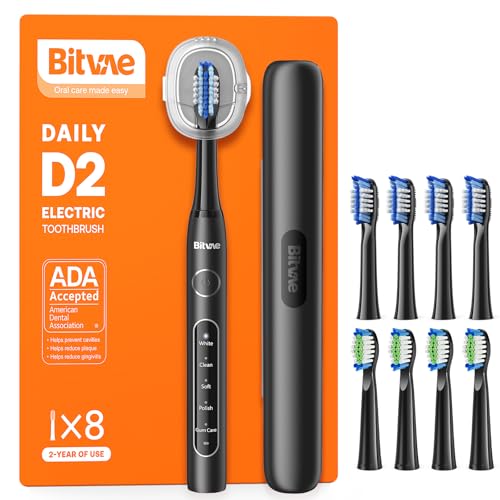
Bitvae D2
Eight brush heads in the box, which the listing reckons is two years of use, and heads are what these things actually cost you over time. Add five modes, a sixty day battery, IPX7, a two-minute timer pulsing every thirty seconds, and a holder that doubles as a protective cover so the bristles are not sitting in the open. The heads pair firm bristles in the middle with soft ones at the edges. It names the American Dental Association and the council that issues the seal, correctly, which one rival does not. The plug adapter is not included.
Pros:
- Eight heads; roughly two years of replacements
- Five modes and a full 30-second quadrant timer
- Holder doubles as a cover against dust and water
- Names the dental body and its council correctly
Cons:
- Adapter not included; supply your own plug
- Drifts between “accepted” and “approved” in its own text
- A cable to pack, on a travel brush
Best for: two years of heads for the price of a brush.
Aquasonic Icon
The best-finished object here, with a magnetic holder that sticks it to a mirror or tile and an ultra-slim case that is genuinely slim rather than a plastic coffin. Thirty-plus days a charge, two modes, and a timer that signals every thirty seconds then shuts the brush off at two minutes, which is the only automatic stop on this page. Its real bullet is the interesting one: it asks you to brush exactly as you would manually while it adds micro-vibrations. Its dental seal bullet names the American Dental Academy.
Pros:
- Shuts itself off at two minutes; nothing else does
- Magnetic holder sticks to mirror or tile
- Genuinely slim travel case, not a plastic box
- Real that it assists your technique, not replaces it
Cons:
- Names the dental body as an Academy, not an Association
- Two modes against five elsewhere; one head in the box
- 30+ days; the shortest runtime here
Best for: a brush that stops you at two minutes.
Voom Sonic Go 1
The only listing in a travel search that publishes how big it is: 6.5 inches, 2.5 ounces. That is the number the whole category should lead with and only this one does. Its vented cap is the other good idea, protecting the bristles like a case while letting them dry, because a sealed cap on a wet brush is how you grow things. AAA powered, so nothing to charge, two speeds, and a two-minute timer with thirty-second quadrant pacing. It runs at the same 22,000 strokes as brushes here costing half as much.
Pros:
- Publishes 6.5 inches and 2.5 ounces; nothing else does
- Vented cap protects the bristles and lets them dry
- AAA powered; no cable to pack
- Two speeds and a full quadrant-pacing timer
Cons:
- 22,000 strokes, same as brushes at half the price
- Only one spare head included
- The joint highest price here
Best for: knowing exactly what fits in your wash bag.
The verdict
Four brushes here quote the identical 22,000 strokes from three brands, so the motor is not the decision. The decisions are whether you pack a cable, whether there is a timer, and what the heads cost you over two years. And the one brand selling both a battery and a rechargeable version of the same brush shows the runtimes are identical.
Best overall: Bitvae D2. Eight heads in the box, which the listing calls two years of use, and heads are the real running cost of owning one of these. Around them: five modes, a sixty day battery, IPX7, a proper two-minute timer that pulses every thirty seconds, and a holder that doubles as a cover so the bristles are not left in the open. It also names the American Dental Association and its council correctly, which a rival here does not manage.
Best value: 7AM2M Battery. The cheapest brush in this search and the one that actually answers the word travel, because a AAA means no cable, no adapter and no socket. Three months per battery is the same stretch its own rechargeable sibling gets from a charge, for a dollar less. You still get the full timer with thirty-second quadrant pulses, IPX7, a case and two heads, which is everything that matters.
Best premium: Voom Sonic Go 1. The only listing in a travel-size search that tells you the size: 6.5 inches and 2.5 ounces. Its vented cap is the smartest small idea on this page, protecting the bristles while letting a wet brush dry rather than sealing it damp. Two speeds, a proper quadrant-pacing timer, and a AAA so there is nothing to charge. You are paying for the cap, the numbers and the finish, not the strokes.
FAQ
Battery or rechargeable for travel?
Battery, usually. One brand here sells both versions of the same brush a dollar apart: three months on a AAA, ninety days on a charge. Same duration. The battery version needs no cable, no adapter and no socket, which is the entire point of a travel brush.
Does 22,000 strokes mean it is better?
Not on this page. Four products from three brands quote exactly 22,000, and they range across double in price. The figure is the class of motor, not the brand. Compare the timer, the case and the heads instead.
Why does one brush say 14,000?
Because it is a rotating brush, not a vibrating one, and the two numbers describe different motions. A spinning cup head and a buzzing head clean differently and both work. The lower figure is not a worse version of the higher one.
Do I need the timer?
It is the best reason to buy an electric brush. Five here run two minutes and pulse every thirty seconds to move you between quadrants, and one shuts off automatically at the end. Two do not mention a timer at all.
What do the dental seal claims mean?
Two brushes claim it. One names the American Dental Association and the council that issues the seal. The other calls it the American Dental Academy, which is a different name entirely, and both drift between “accepted” and “approved” in their own text.
This article may contain affiliate links; see our Affiliate Disclosure.