A wall-mounted charger means an electrician, a permit, a hole in your drywall, and a box that stays behind when you move. A 32-amp portable EVSE means plugging into the same style of outlet a caravan uses, coiling the cable into a bag when you are done, and taking it with you. Same charging speed, none of the commitment.



All five units here do the same core job: pull 240 volts from a NEMA 14-50 outlet, deliver up to 32 amps through a J1772 connector, and add roughly 7.68 kilowatts to your battery. The differences are in the trim, and they matter more than the spec sheet suggests. Certification bodies, app support, how far the amperage dials down, and whether a 120-volt adapter is in the box all shape which one fits your driveway.
At a glance
| Product | Standout feature | Price tier | Link |
|---|---|---|---|
| AIMILER Level 2 EV Charger | Wi-Fi app scheduling plus built-in CCID-20 leakage protection | Premium | |
| VEVOR Level 2 EV Charger | Full 32A and a 25 ft cable at the lowest outlay here | Budget | |
| EVDANCE Portable 32A EV Charger | Five current steps down to 10A; case and wall bracket included | Mid-range | |
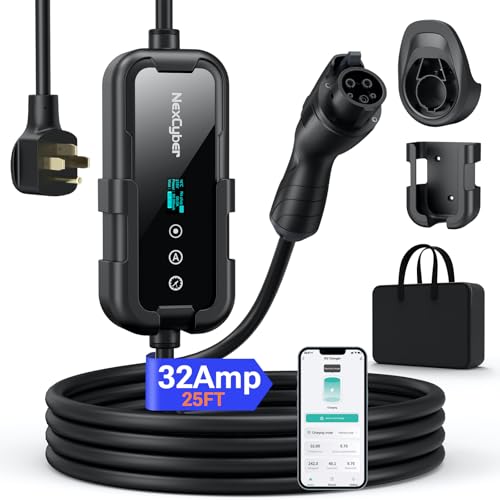
| NexCyber Level 2 EV Charger | Works with or without the app; 3-year warranty | Mid-range | |
| ChargeHere Level 1 & 2 EV Charger | UL Listed, with a 120V adapter in the box and no app required | Premium | |
How to choose a portable Level 2 charger
The outlet is the real purchase
Every charger here terminates in a NEMA 14-50 plug, the four-prong 240-volt outlet found in caravan parks and behind electric ranges. If you already have one in the garage, you are most of the way there. If you do not, adding one means an electrician and a 40-amp circuit, and that cost dwarfs the charger itself. The saving over a hardwired unit is real but smaller than the sticker suggests, and the payoff is different: the charger stays yours, unplugs in seconds, and moves house with you. Confirm the outlet is on a dedicated circuit, and note that many older 14-50 receptacles were installed for ranges drawing current in bursts, not for an EV pulling steadily for six hours.
Amperage steps and matching your breaker
Thirty-two amps is the headline, but the adjustable range is the feature that keeps the charger safe on your particular circuit. The rule these units follow is the standard continuous-load one: draw no more than 80 percent of the breaker rating. That gives 32A on a 40A breaker, 24A on a 30A breaker, and 16A on a 20A breaker. Every model here steps down through at least that range. The EVDANCE goes furthest, offering 10A, 16A, 20A, 24A and 32A, and the ChargeHere dials from 6A up. Lower settings are not only for weaker circuits: charging slower generates less heat, which is gentle on both the outlet and the battery when you have all night anyway.
UL Listed, ETL Listed, and what CCID means
This is where the group genuinely separates. The ChargeHere is UL Listed. The AIMILER and NexCyber are ETL Listed and state conformance with the relevant UL standards, including UL 2231 and SAE J1772. Both marks come from accredited labs and both are recognized by electrical inspectors, but a listing on the finished product is meaningful in a way that “meets the criteria of” language alone is not. Separately, look for built-in ground-fault protection: the AIMILER includes CCID-20 leakage detection, which is why it does not need a GFCI breaker upstream of a 14-50 receptacle. That can save a breaker swap and nuisance tripping, since two ground-fault devices in series often fight each other.
Cable length, weight, and the coiling tax
All five ship with 25 feet of cable, which is enough to reach around most cars and across most driveways without repositioning. It is also heavy. A 32-amp cable is thick, stiff in the cold, and takes real effort to coil every night, which is the practical difference between portable and wall-mounted charging that spec sheets never mention. If the charger will live plugged in at home and only travel occasionally, look for the wall bracket: the EVDANCE includes one, which turns a portable unit into a semi-permanent station without wiring anything. Carrying cases come with the VEVOR and EVDANCE.
J1772, Tesla, and the adapter question
Every charger here uses the SAE J1772 connector, which covers most non-Tesla electric and plug-in hybrid vehicles in North America: Ford, Chevrolet, Nissan, Hyundai, Kia, BMW, Volkswagen, Audi, Honda and more. Vehicles with a NACS port, which includes Teslas and a growing number of models from other brands, need a J1772-to-NACS adapter, and none of these include one. That is a small extra purchase, not a dealbreaker, but check your car’s port before ordering rather than after.
AIMILER Level 2 EV Charger
The AIMILER is the strongest seller of this group, and it earns that with the most complete feature set rather than the lowest outlay. It delivers up to 7.68 kW, adjusts from 16A to 32A either by long-pressing the on-unit button or through the app, and shows amperage, charging speed, input voltage and delay time on an LED screen. The Wi-Fi app tracks charging cost, session history, and completion, and schedules sessions into off-peak hours. It is ETL and FCC listed against the SAE J1772 and UL 2231 family of standards. The detail that stands out is the built-in CCID-20 anti-leakage protection, which removes the need for an additional GFCI breaker on a 14-50 receptacle. The cable is 25 feet of military-grade construction with a plug AIMILER rates for over 10,000 insertions, and the housing carries a NEMA Type 4 rating.
- Pros: Wi-Fi app with cost tracking, history and off-peak scheduling; works in plug-and-charge mode with no app at all; built-in CCID-20 leakage protection means no extra GFCI breaker; ETL and FCC listed; NEMA Type 4 housing; 25 ft cable; clear LED readout.
- Cons: Highest outlay of the five; app setup requires a 2.4 GHz network and can need a factory reset to re-pair; minimum current is 16A, less flexible than rivals; not for direct sun or driving rain.
Best for: Drivers on time-of-use electricity rates who want scheduling, monitoring, and one less breaker to worry about.
VEVOR Level 2 EV Charger
The VEVOR strips out the app and keeps everything that actually moves electrons. You get the full 32 amps, the same 25-foot cable, a NEMA 14-50 plug, and a bright LCD showing voltage, current, power and elapsed time in real time. Scheduling is handled on the unit itself, with a delay timer from 1 to 12 hours, which covers overnight and off-peak charging without a phone, an account, or a network. An intelligent chip guards against surge, leakage, grounding faults, overvoltage, undervoltage, overcurrent, overheating and overcharging. The control box is IP66 rated for outdoor conditions, and a carrying bag is included. It is the least expensive way into genuine Level 2 charging here, and the compromise is app connectivity rather than charging capability.
- Pros: Lowest outlay for full 32A charging; 25 ft cable; on-unit 1-12 hour delay timer needs no app or network; broad electrical protections; IP66 control box; carrying bag included; universal J1772 fit.
- Cons: No app, so no remote monitoring or cost tracking; listing marks are not stated as clearly as on the ETL and UL units; no wall bracket.
Best for: Anyone who wants Level 2 speed at the lowest cost and considers a phone app an unnecessary layer.
EVDANCE Portable 32A EV Charger
The EVDANCE’s advantage is granularity. Where most units offer three current steps, it gives five: 10A, 16A, 20A, 24A and 32A, selected by pressing the “A” button. That bottom 10A setting is genuinely useful, letting you trickle overnight on a circuit you are not confident about, or reduce heat when the car will sit until morning regardless. The LED screen reports amperage, voltage, speed and delay settings, and the delay timer shifts sessions into cheaper hours. Protection is NEMA Type 4 and IP66, and the 25-foot military-grade cable uses the same drop-resistant plug rated beyond 10,000 insertions. It is the best-equipped box of the group: a carrying case for the road and a wall-mounting bracket for home, which means it can serve as a tidy fixed station on weekdays and a travel charger at the weekend.
- Pros: Five current steps from 10A to 32A, the widest range here; carrying case and wall bracket both included; NEMA Type 4 and IP66; LED readout with delay scheduling; heavy-duty 25 ft cable; no electrician needed to change amperage.
- Cons: No Wi-Fi or app; certification is described rather than stated as a listing mark; not intended for direct sun or heavy rain.
Best for: Households wanting one charger that wall-mounts at home and still packs for trips, with fine control over charging current.
NexCyber Level 2 EV Charger
The NexCyber sits close to the AIMILER in capability and undercuts it, with a longer warranty as the sweetener. It offers Wi-Fi app control for cost tracking, session history, charge-complete alerts and off-peak scheduling, but ships in plug-and-charge mode by default, so it works fully as a dumb charger for anyone who never opens the app. The touch screen handles amperage between 16A and 32A and start-time scheduling directly. NexCyber rates it at up to 24 miles of range per hour at 32 amps, a manufacturer figure that will vary with your car’s efficiency. It is ETL and FCC certified against the SAE J1772 and UL 2231 standards family, carries a NEMA Type 4 housing, and comes with a 3-year warranty, the longest stated here.
- Pros: App control that is entirely optional; 3-year warranty, the longest in this group; ETL and FCC certified; touch screen for amperage and scheduling; NEMA Type 4 and IP66; 25 ft cable with 10,000-insertion plug; costs less than the AIMILER.
- Cons: No CCID note, so a GFCI breaker may still be in play depending on your install; 16A minimum current; app pairing needs 2.4 GHz Wi-Fi; not for exposed outdoor mounting.
Best for: Buyers who want app scheduling and a long warranty without paying the top tier for it.
ChargeHere Level 1 & 2 EV Charger
Two things set the ChargeHere apart, and both matter. It is UL Listed as a finished EVSE, the strongest certification statement in this comparison, which is worth knowing if an inspector, an insurer, or a landlord ever asks. And it includes the 5-15 adapter in the box, so the same unit plugs into an ordinary 120-volt household socket when a 240-volt outlet is not available. That turns it into a genuine travel charger: 32 amps at home, a slow top-up at a hotel or a relative’s house. Current adjusts from 6A to 32A, the widest span here, and a 1 to 12 hour delay timer schedules overnight charging with physical buttons rather than an app or a network. The LCD reports current, voltage, time and energy delivered. Protection covers leakage, over-voltage, over-current and over-temperature, with an IP66 rating.
- Pros: UL Listed as a complete unit; 120V adapter included for true Level 1 and 2 flexibility; 6A to 32A range, the widest here; delay start with no app or Wi-Fi dependency; detailed LCD including energy delivered; IP66; 25 ft cable.
- Cons: No app or remote monitoring; near the top of the range on cost; no wall bracket mentioned; 120V charging is slow, as it is with any Level 1 connection.
Best for: Drivers who travel with the charger, or anyone who wants the strongest certification and no reliance on an app.
The verdict
Best Overall: AIMILER Level 2 EV Charger. It leads this group in sales and in features. App scheduling with cost tracking, an on-unit mode for when you cannot be bothered with the phone, ETL and FCC listing, a NEMA Type 4 housing, and built-in CCID-20 leakage protection that spares you a GFCI breaker. It costs the most, and the feature list explains where that goes.
Best Value: VEVOR Level 2 EV Charger. Full 32 amps, the same 25-foot cable as everything else, an LCD, a 12-hour delay timer, a full suite of electrical protections, and a bag to carry it in, at the lowest outlay here. Dropping the app costs you monitoring, not charging speed. For most driveways, that is the trade to make.
Best Premium: ChargeHere Level 1 & 2 EV Charger. UL Listing on the finished product and an included 120V adapter make it the most flexible and the most conservatively certified of the five. The 6A to 32A range covers everything from a doubtful socket to a proper 40-amp circuit. Best for fine control is the EVDANCE, which pairs five current steps with both a carry case and a wall bracket.
FAQ
How much faster is 32A than charging from a normal socket?
Roughly six times, which is why every listing here shouts about it. A standard 120-volt household socket delivers around 1.3 to 1.8 kW, and many cars throttle to 12 amps on that connection. A 32-amp Level 2 connection at 240 volts delivers up to 7.68 kW. In practice that is the difference between recovering a few miles of range an hour and recovering something in the region of 20 to 25, depending on how efficient your car is.
Do I need an electrician?
Only for the outlet. The chargers themselves plug in, which is the point of the category. But a NEMA 14-50 receptacle on a dedicated 40-amp circuit is not a job to attempt casually, and an EV pulling 32 amps continuously for hours is a much harder duty than the range the outlet was probably installed for. If you already have a 14-50 in the garage, have someone confirm the wiring and the breaker are rated for continuous load before running a charger on it nightly.
Will these charge a Tesla?
Yes, with an adapter. All five use the SAE J1772 connector, and NACS-port vehicles need a J1772-to-NACS adapter, not included with any of them. The connector is the only obstacle: charging works normally once adapted.
Should I run 32A all the time?
Not necessarily. If the car sits overnight and needs only a partial top-up, a lower setting still finishes in time while producing less heat in the plug, outlet and cable. Heat is the enemy of connectors, and a warm 14-50 receptacle is a warning worth heeding. The EVDANCE’s 10A step and the ChargeHere’s 6A floor exist for this.
Can I leave a portable charger outside?
Under cover, yes. These units carry IP66 or NEMA Type 4 ratings, which handle dust and driving water. Several manufacturers state plainly that they do not recommend installing in direct sunlight or leaving the unit exposed to rain. A carport, a garage, or a sheltered wall is fine; an unprotected fence in full sun is asking for a shortened life.
This article may contain affiliate links; see our Affiliate Disclosure.