You are two seconds from a clean shot when someone upstairs starts a 4K stream, and your ping spikes from 30 to 300. Nothing is broken. Your router simply had no instruction to work on a game packet differently from a buffered video that could have waited half a second. That single decision, made thousands of times a minute, is what a gaming router is actually for.


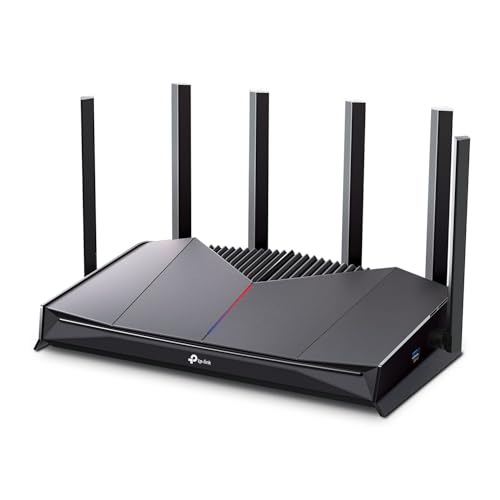

A gaming router will not shorten the distance to the game server, and any product promising lower ping on a congested line is selling you something. What it can do is stop your own household from being the problem: prioritize game traffic, give a wired machine an uncontested port, and move everything else onto spectrum your game is not using. That serves a competitive player on a busy home line, a household where several people stream at once, and anyone whose evening lag has a suspiciously domestic schedule.
At a glance
| Product | Standout features | Price tier | Link |
|---|---|---|---|
| GL.iNet Flint 2 (GL-MT6000) | 8-stream WiFi 6, dual 2.5G ports, fast VPN, AdGuard Home | Mid-range | |
| ASUS ROG Rapture GT-BE98 PRO | Quad-band WiFi 7, dual 10G ports, triple-level game acceleration | Premium | |
| TP-Link Archer GE650 | Tri-band WiFi 7, dedicated 5G gaming port, game panel, RGB | Premium | |
| TP-Link Archer GE400 | Dual-band WiFi 7, multi-gig gaming port, WTFast, game panel | Mid-range | |
| MSI Radix AXE6600 | Tri-band WiFi 6E, AI QoS, 8-stream, quad-core CPU, RGB | Budget | |
How to choose a gaming router
What a router can and cannot do to your ping
Be clear about the physics. Your base latency is set by the distance to the server and the quality of your internet line, and no router touches either. What a router controls is the queue at your own front door. When an upload saturates that queue, every packet behind it waits, and that wait is the lag spike you feel. Good QoS keeps the queue short and lets game packets jump it. On an empty line a gaming router changes almost nothing; on a busy household line it can be the difference between 30 and 300.
QoS is the feature that earns its keep
Quality of Service decides which traffic goes first. Every router here has some form: MSI’s is AI QoS, which sorts packets automatically rather than making you build rules, and TP-Link bundles QoS into HomeShield’s free tier. The best QoS is the kind you configure once and forget. Look for the ability to prioritize a specific device, since your console or PC is the thing that needs to win, not a category of traffic the router has to guess at.
Dedicated gaming ports and game acceleration
A dedicated gaming port is a physical LAN socket the router snacks as top priority by default: plug in, and your machine is first in the queue without touching a setting. Both TP-Link Archers have one, and the GE650’s is a 5 Gbps port. Game acceleration is a different claim. TP-Link uses WTFast to route game traffic over an optimized path to the server, and ASUS calls its version triple-level acceleration, covering the port, the router, and the route to the server. Routing services can genuinely help on a bad path to a distant server, and they do nothing when your route is already direct.
Wired still wins
The cheapest latency upgrade in this guide costs the price of an Ethernet cable. Wireless adds variable delay no QoS removes entirely. Multi-gig ports matter if your internet plan exceeds a gigabit or you move large files locally: the ROG offers dual 10G ports and quad 2.5G, the GE650 has 5G WAN and LAN plus three 2.5G, the GE400 has two 2.5G and three 1G, and the Flint 2 gives two 2.5G. Count the ports against the machines you intend to plug in.
Bands, 6 GHz, and MLO
The 6 GHz band, on WiFi 6E and WiFi 7, is the quiet one: no neighbors, no old devices, short range. It is excellent for a console in the same room and useless through two brick walls. Multi-Link Operation, a WiFi 7 feature, lets a device use several bands at once, which improves stability rather than raw speed. Read the band count carefully, because the GE400 is dual-band and has no 6 GHz at all despite being a WiFi 7 gaming router, and the ROG is quad-band.
CPU, RAM, and the things that fail quietly
QoS, VPN, and traffic inspection all cost processing. A weak CPU is why a cheap router slows down exactly when the network is busiest. Everything here runs a quad-core: the ROG Strix line and Flint 2 pair theirs with a gigabyte or more of memory, and MSI runs 1.8 GHz. If you plan to run a VPN for all traffic, this is the spec that decides whether you keep your speed, because encryption is the heaviest job a home router does.
GL.iNet Flint 2 (GL-MT6000)
The best-selling gaming router of this group, and the one that wins by refusing to play the marketing game. No RGB, no volcano styling, no game panel. Instead: 8-stream WiFi 6 rated up to 6 Gbps, two 2.5G Ethernet ports, a gigabyte of DDR4 and 8GB of eMMC storage, and the specification that actually separates it, VPN throughput of up to 900 Mbps on WireGuard and 880 Mbps on OpenVPN. Most routers collapse to double digits with a VPN running. It supports AdGuard Home for network-wide ad and tracker blocking, handles over a hundred devices, and its openness invites plugins rather than fighting them. GL.iNet ask you to update the firmware at setup, which is worth doing first rather than later.
Pros
- The clear best seller among the gaming routers here
- VPN speeds up to 900 Mbps on WireGuard, far beyond typical routers
- 8-stream WiFi 6 up to 6 Gbps, with two 2.5G ports
- AdGuard Home blocks ads and trackers for every device
- 1GB DDR4 and 8GB storage; comfortable past a hundred devices
Cons
- WiFi 6 rather than 6E or 7, so no 6 GHz band and no MLO
- No dedicated gaming port, game panel, or acceleration service
- Rewards tinkering; the plugin depth is wasted on a plug-and-play buyer
Best for: the player who wants throughput, a real VPN, and control, and who considers RGB a cost rather than a feature.
ASUS ROG Rapture GT-BE98 PRO
The flagship, and priced like one. It is a quad-band WiFi 7 router using 320MHz channels in the 6 GHz band and 4096-QAM for a rated ceiling up to 30 Gbps across all bands, which is a number no single device will ever see and which exists to describe total capacity. The parts that matter day to day are the wired ones: dual 10G ports and quad 2.5G ports, enough to feed a gaming PC, a NAS, and a multi-gig line at once. Triple-level game acceleration covers the gaming port, the router’s own prioritization, and the route to the server. Multi-link operation keeps devices on several bands simultaneously, AiMesh lets it anchor a whole-home mesh later, and security is subscription-free rather than a trial.
Pros
- Quad-band WiFi 7 with 320MHz channels and MLO
- Dual 10G ports plus quad 2.5G, the best wired setup here
- Triple-level game acceleration from port to server
- Subscription-free security, no ongoing fee
- AiMesh compatible, so it can anchor a mesh network later
Cons
- By far the most expensive router in this comparison
- Physically large, with external antennas that demand shelf space
- Quad-band and 10G ports are wasted on a sub-gigabit line
Best for: a multi-gig line, a wired NAS, and a household where the router is expected to outlast two consoles.
TP-Link Archer GE650
This is the one built for the fantasy properly: tri-band WiFi 7 at up to 5764 Mbps on 6 GHz, 4320 on 5 GHz, and 574 on 2.4 GHz, with a dedicated 5 GHz gaming band whose entire job is to stay clear of the household’s streaming. Ports are the strong suit, with 5 Gbps WAN, 5 Gbps LAN, and three 2.5 Gbps LAN. The dedicated gaming port needs no configuration. The game panel is a genuine convenience rather than decoration: one dashboard showing your network, which devices are being accelerated, traffic priority, and the RGB settings for the volcano-inspired shell. WTFast handles game acceleration to the server, and HomeShield covers antivirus and QoS.
Pros
- Tri-band WiFi 7 with a dedicated 5 GHz gaming band
- Dedicated gaming port, prioritized with no setup
- 5G WAN, 5G LAN, and three 2.5G LAN ports
- Game panel shows priority and accelerated devices at a glance
- WTFast acceleration and HomeShield security included
Cons
- Premium tier; a large step up from the GE400 below
- The RGB and styling are not to every taste, and cannot be hidden
- Game acceleration only helps on poor routes to distant servers
Best for: a gamer sharing a busy household line who wants a band reserved for play and a port that just works.
TP-Link Archer GE400
The GE650’s sensible sibling, and a genuinely interesting trade. You keep the three things that define the range, a dedicated multi-gig gaming port, prioritized game traffic, and WTFast acceleration, plus the same game panel and RGB. You give up the 6 GHz band entirely, which TP-Link states plainly in the listing rather than burying. It is 6-stream dual-band WiFi 7 at up to 5765 Mbps on 5 GHz and 688 on 2.4 GHz, covering up to 2,600 square feet and 90 devices with six antennas. Ports drop to two 2.5 Gbps and three 1 Gbps. For anyone on a sub-gigabit line whose devices are not WiFi 7, that missing 6 GHz band costs less in practice than the price gap suggests.
Pros
- Dedicated multi-gig gaming port and QoS at a mid-range price
- WTFast acceleration and the same game panel as the GE650
- Up to 5765 Mbps on 5 GHz, with 6 antennas and beamforming
- Covers up to 2,600 sq. ft. and 90 devices
- EasyMesh support for extending coverage later
Cons
- Dual-band only; no 6 GHz band despite being WiFi 7
- Three of its LAN ports are 1 Gbps rather than multi-gig
- Not compatible with Deco-style mesh systems
Best for: the gaming-router features that matter on a normal line, without paying for spectrum your devices cannot use.
MSI Radix AXE6600
The budget entry, and the only router here that gets you a 6 GHz band without reaching the premium tier. It is tri-band WiFi 6E running 8 streams across 2.4, 5, and 6 GHz for a combined 6.6 Gbps, driven by a 1.8 GHz quad-core processor. The feature that suits its price is AI QoS, which prioritizes packets automatically instead of asking you to build rules, which is the right call for a router someone sets up once. It has a game accelerator for steady connections, MU-MIMO for multiple devices at once, and Mystic Light RGB that syncs with the rest of an MSI build. The listing is quiet about port speeds, and gigabit wired is the reasonable assumption.
Pros
- Tri-band WiFi 6E with a 6 GHz band at a budget price
- 8 streams and up to 6.6 Gbps combined
- AI QoS prioritizes traffic without manual rules
- 1.8 GHz quad-core processor
- Mystic Light RGB syncs with other MSI components
Cons
- WiFi 6E rather than 7, so no MLO
- No multi-gig ports stated; wired tops out at gigabit
- No dedicated gaming port or route acceleration service
Best for: a first gaming router, or a console in the same room that can use a clean 6 GHz band.
The verdict
Best overall: GL.iNet Flint 2. The best seller here, and it earns it on substance rather than styling. Eight streams, dual 2.5G ports, a gigabyte of RAM, and VPN throughput that stays near line speed instead of collapsing. It skips the game panel and the 6 GHz band, and what remains is the part that keeps a network fast when it is busy.
Best value: MSI Radix AXE6600. A 6 GHz band, 8 streams, and automatic QoS at the budget end. Gigabit wired ports are its ceiling, and if your line is under a gigabit that ceiling is not one you will hit.
Best premium: ASUS ROG Rapture GT-BE98 PRO. Quad-band WiFi 7, dual 10G ports, and acceleration from the port to the server. Only worth it on a multi-gig line with hardware to match, and on that line nothing else here keeps up.
Between the two Archers, the GE400 is the smarter buy for most people, and the GE650 is worth the jump only if you will genuinely use the 6 GHz band and the 5G ports.
Frequently asked questions
Will a gaming router actually lower my ping?
It lowers the part of your ping your own home creates, which on a busy line is most of the variable part. It cannot shorten the distance to the server or improve your internet plan’s base latency. If you game alone on an idle fiber line, expect very little. If your lag arrives when someone streams or uploads, QoS and a prioritized port can remove those spikes almost entirely.
Is WiFi 7 worth it over WiFi 6E?
Only if your devices support it. WiFi 7’s real gains are Multi-Link Operation, which uses several bands at once for stability, and 320MHz channels for throughput. Both need a WiFi 7 client at the other end, and a phone or console on WiFi 6 sees none of it. Buying WiFi 7 for future devices is reasonable; expecting it to speed up current ones is not.
Should I use Ethernet or WiFi for gaming?
Ethernet, whenever you can reach it. A cable gives consistent latency with no interference, no contention with neighbors, and no band steering. That is why these routers put effort into a dedicated gaming port. If a cable is impossible, get the game device onto 6 GHz in the same room, or onto the reserved gaming band if your router has one.
What does a dedicated gaming port do?
It is a LAN port the router prioritizes above all other traffic by default. Plug your PC or console into it and its packets go to the front of the queue with no rules to configure. It solves the same problem as QoS, without the setup step people skip. Both TP-Link Archers here have one, and the ASUS builds the same idea into its acceleration chain.
Do I still need a modem?
For most internet services, yes. Every router here needs a separate modem or an ONT supplied by your provider, and TP-Link states this in each listing. Some providers give you a combined modem and router, in which case you put theirs into bridge or modem mode and let the gaming router handle routing. Running both in router mode causes double NAT, which is a genuine source of connection problems in games.
This article may contain affiliate links; see our Affiliate Disclosure.