One spigot, and four things that want it: the sprinkler, the drip line running to the tomatoes, the hose you wash the car with, and the timer you would rather not unscrew every single time. A splitter ends that rotation for less than the price of a decent nozzle. The catch is that most of them are the same casting with a different name stamped on it, and the differences that matter are not the ones the listings shout about.

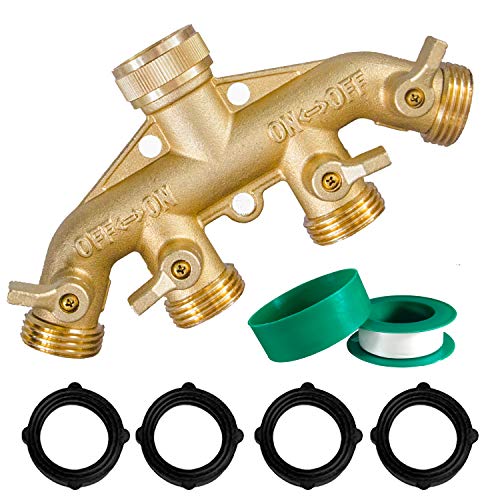


What separates a good splitter from one you replace next season is narrow: valve type, wall thickness, how the outlets are spaced, and whether it survives a freeze. Brass dominates this category for good reason, though it is not the only answer. The five below cover a shared spigot in a small garden, an irrigation setup running timers, and anyone tired of cross-threading fittings with wet hands.
At a glance
| Product | Standout features | Price tier | Link |
|---|---|---|---|
| Biswing 4 Way Brass Splitter | Solid brass, 4 ball valves, O-rings and seal tape included | Mid-range | |
| Hourleey Brass Splitter (4 Way) | Solid brass valves, rated to 0.8 MPa, 4 spare washers | Mid-range | |
| Cheerwater Brass 4 Way Splitter | Easy-grip levers, GHT fit, PTFE tape, 12-month warranty | Budget | |
| LNEZCDB 3 Way Heavy Duty Splitter | Large-bore valves, long handles, freeze resistant, timer spacing | Premium | |
| Melnor 4 Way Lever Valve Connector | High-volume flow-through valves, metal threads, lifetime warranty | Budget | |
How to choose a hose splitter or manifold
How many outlets you actually need
Four is the common answer and often one more than necessary. Every outlet is another joint that can weep, and an unused port is a washer slowly aging in the sun. Count what stays connected: a sprinkler and a hose is two, add a timed drip line and you are at three. Buy four if you expect to grow into it. A three-way with bigger internals, like the LNEZCDB here, will out-flow a four-way with narrow ports every time, so more outlets is not automatically more capable.
Brass, stainless, or molded body
Brass is the default because it resists corrosion, tolerates being over-tightened by hand, and does not go brittle in UV. All the brass units here are solid brass rather than plated zinc, which matters, since plated zinc looks identical for one season and then splits at the threads. The Melnor takes a different route with a molded body and metal hose threads, putting the metal where the stress is. Threads are where splitters fail, not the body.
Flow is decided by the bore, not the badge
This is the detail listings hide. A splitter whose valves neck down to a narrow passage will drop your pressure noticeably with two lines open, which is why sprinklers that ran fine on the tap suddenly barely turn. The LNEZCDB publishes real numbers, a 0.6-inch inner diameter and a 0.59-inch ball valve, because full-bore is its whole pitch. Melnor’s answer is high-volume valves. If you run two sprinklers at once, bore is the spec that decides whether that works.
Valve type and using it with cold hands
Ball valves with a quarter-turn lever are the sensible choice: they seal hard, they tell you their state at a glance, and there is no rubber washer being screwed into compression each time. What varies is the handle. Short stubby levers are miserable with wet hands or gloves, which is why the LNEZCDB fits a 2.1-inch handle and Melnor uses a longer, vertically oriented lever. If arthritis or gloves are part of your gardening, this beats every other spec here.
Outlet spacing, timers, and gravity
Hang a hose timer off a splitter and you learn about leverage quickly: the weight hangs on the fitting all season and slowly works the seal loose. Two design answers appear here. The LNEZCDB spaces its outlets 1.6 inches apart so bulky timers fit side by side, and orients the male threads vertically so gravity pulls straight down the thread rather than levering across it. If you use timers, measure their width before buying, because the standard splitter puts outlets too close for two of them.
Freezing, drinking water, and other fine print
Water expands when it freezes and will split a brass body without much ceremony. The LNEZCDB is tested from about minus 40 to 176 degrees Fahrenheit and still tells you to shut off and drain below minus 4, which is the real instruction for any splitter. The other piece of fine print worth reading: Biswing and several others state plainly that these are not for drinking water systems. For a garden that is irrelevant; for an RV or a caravan tap, it is the whole question.
Biswing 4 Way Brass Hose Splitter
The best seller of this group by a wide margin, and it is the archetype the others are measured against. Heavy-duty solid brass, four individually controlled ball valves, a 3/4-inch intake and 3/4-inch outlets, and a box containing four O-rings and a roll of thread seal tape so you are not driving to a hardware shop mid-job. Nothing about it is clever. It turns one tap into four, each line shuts independently, and the ball valves close tight enough that the unused ports do not drip. Biswing note it is not suitable for drinking water systems, which is standard for the category and worth respecting.
Pros
- The clear best seller here, by a wide margin
- Heavy-duty solid brass, corrosion proof
- Four ball valves, each shutting independently and tightly
- Four spare O-rings and thread seal tape in the box
- Standard 3/4-inch in and out, fitting ordinary spigots and hoses
Cons
- No published bore or pressure rating
- Short levers are awkward with gloves or wet hands
- Outlets sit close together, so two bulky timers will not fit
Best for: the straightforward job of turning one spigot into four independent lines, with no surprises.
Hourleey Brass Garden Hose Splitter (4 Way)
Nearly the same object as the Biswing, with two differences worth the swap. It publishes a pressure rating, 0.8 MPa, which is roughly 116 psi and comfortably above what a domestic supply delivers; almost nothing else in this category commits to a number. And it ships with four washers installed plus four spares, which sounds trivial until a washer perishes in August and the alternative is a trip out for a part worth pennies. Hourleey make the point that solid brass valves outlast plastic ones, and in a fitting left in sunlight all summer that is the failure everyone eventually meets.
Pros
- Publishes a real pressure rating of 0.8 MPa
- 100% solid brass body and valves, not plated zinc
- Four washers fitted plus four spares, and PTFE tape included
- Standard 3/4-inch connection fitting most hoses
- Each outlet shuts independently
Cons
- No bore diameter published, so flow with several lines open is unknown
- Same close outlet spacing as the other four-ways
- Short levers, no better for gloved hands than its rivals
Best for: the same job as the Biswing, for anyone who prefers a maker that publishes a number and packs spares.
Cheerwater Brass 4 Way Faucet Splitter
The cheapest way into an all-brass manifold here, and it gives up less than the price suggests. All-brass body and valves, universal 3/4-inch GHT threads that go on tool-free, pre-installed rubber washers with four spares, and PTFE tape included. Two things lift it above a pure price play. The shutoff levers are described as large and easy-grip, which is the exact complaint people have about this style of splitter. And Cheerwater back it with a twelve-month warranty against material and workmanship defects, which is unusual at this end and tells you something about their expected return rate.
Pros
- Budget tier while still all-brass in body and valves
- Large easy-grip levers, better than the usual stubby handles
- Pre-installed washers, four spares, and PTFE tape
- Twelve-month warranty against defects
- Tool-free install on standard GHT outdoor taps
Cons
- No pressure rating or bore figures published
- A much lower seller than the Biswing or Hourleey
- Precision-cut threads still need the supplied tape to seal reliably
Best for: a first splitter, a second spigot, or replacing one that finally cracked, without spending much.
LNEZCDB 3 Way Heavy Duty Hose Bib Splitter
Three outlets instead of four, and it will out-flow every four-way here. That is the trade, and the listing is unusually willing to show its working. The body is cast from C38500 brass with a 0.1-inch wall, a 0.6-inch inner diameter, and a 0.59-inch ball valve, so the water path never necks down; it weighs 1.52 pounds, which you feel in the hand. LNEZCDB describe destructive testing at high torque, bending, and tensile loads, plus temperature testing from about minus 40 to 176 degrees Fahrenheit with no cracking, and still advise draining below minus 4. The practical touches are as good as the numbers: 1.6-inch outlet spacing to clear large timers, vertical male threads that stop hanging weight levering the joint, and a 2.1-inch handle you can turn with gloves on.
Pros
- Full-bore 0.6-inch path; the best flow in this group
- Published pressure, torque, bending, and freeze test figures
- Outlets spaced 1.6 inches apart to fit large timers side by side
- Vertical male threads reduce strain from hanging equipment
- 2.1-inch handles are genuinely usable with gloves or stiff hands
Cons
- The most expensive here, and it gives you one fewer outlet
- At 1.52 pounds it hangs heavy on an older or loose spigot
- Still needs draining before a hard freeze, like anything else
Best for: irrigation timers, two sprinklers at once, and cold winters where a cracked splitter is a spring ritual.
Melnor 4 Way Lever Flow Through Valve Connector
The one that is not a brass block, and the only one here with a lifetime warranty behind it. Melnor builds it around high-volume flow-through valves designed to keep the water path open rather than turning it through a restricted brass port, with metal hose threads where the connection takes the load. The lever design is the standout: longer than the brass units’ stubby handles and vertically oriented, so you push rather than pinch. That sounds like a small thing until you are turning valves in February with cold hands. It is lighter than the brass manifolds, which means less strain hanging off an old spigot.
Pros
- Melnor limited lifetime warranty
- High-volume flow-through valves designed for maximum flow
- Longer vertical levers are easy with gloves or wet hands
- Metal hose threads at the connection points
- Lighter than brass, so less load on the spigot
Cons
- Not the all-brass body some buyers specifically want
- No pressure rating or bore figures published
- Sells in far lower volume than the brass leaders here
Best for: easy operation and a warranty that outlasts the argument, especially on a spigot you would rather not load with brass.
The verdict
Best overall: Biswing 4 Way Brass Hose Splitter. It outsells everything else here by a distance, and for the ordinary job of running four lines off one tap it does nothing wrong. Solid brass, four tight ball valves, spare O-rings and tape in the box. The limits are the category’s, not its own.
Best value: Cheerwater Brass 4 Way Splitter. The same all-brass construction at the budget end, with better levers than most and a twelve-month warranty. It sells in smaller numbers, and on specification there is very little between it and the leaders.
Best premium: LNEZCDB 3 Way Heavy Duty Splitter. Fewer outlets, more of everything else: a full-bore water path, published test figures, timer-friendly spacing, and handles built for gloves. If your splitter feeds irrigation rather than a hose you drag around, this is the one worth the money.
The Melnor is the pick if you want a lifetime warranty and levers that work in gloves, and the Hourleey if you want a published pressure rating and spare washers.
Frequently asked questions
Will a splitter reduce my water pressure?
Static pressure stays the same; flow is what changes. With one line open you will barely notice. Open two or three and a splitter with narrow internal ports becomes the restriction, and sprinklers that ran happily start throwing short. That is why bore diameter matters more than the number of outlets, and why a well-made three-way can serve two sprinklers better than a cheap four-way.
Do I need thread seal tape?
The hose-thread connections seal on a rubber washer, so no tape is needed there; just make sure the washer is present and not perished. The tape is for the pipe-thread joint at the spigot, where metal seals against metal. Most of these ship with a roll for exactly that reason. Two or three wraps in the direction of tightening is plenty, and hand-tight plus a light nip with a wrench is enough.
Can I leave a splitter on over winter?
Only if it cannot hold water. Trapped water freezes, expands, and splits brass without any warning. Shut off the supply, open every valve to drain the body, and ideally bring it inside. Even the heavily tested LNEZCDB, rated well below freezing, still tells you to drain it below minus 4 Fahrenheit. A splitter left full is the most common way these die.
Are these safe for drinking water?
Generally no, and several listings say so outright. Biswing states it is not suitable for drinking water systems, and others limit themselves to outdoor cold water. If you need a potable connection, for an RV or a caravan, look specifically for a lead-free rated fitting and do not assume brass qualifies. For watering a garden or washing a car, none of this matters.
Why do splitters drip at the valve?
Nearly always the washer, not the valve. Hose-thread joints seal on a rubber washer that flattens and hardens with age and sunlight; when it stops recovering, it weeps. That is why several of these ship spares. Replace it before assuming the splitter has failed. If a ball valve itself leaks when closed, grit in the seat is the usual culprit, and flushing the line often clears it.
This article may contain affiliate links; see our Affiliate Disclosure.