Eggs, bacon, pancakes, and hash browns all going at once, edges crisping, nothing falling through the grates into the fire. That is the case for a flat top griddle in about five seconds. Swap the bars for a solid steel plate and the backyard stops being a burgers-and-hot-dogs machine and starts turning out smash burgers with lacy edges, fried rice, quesadillas, teppanyaki, and a full breakfast for the whole street.


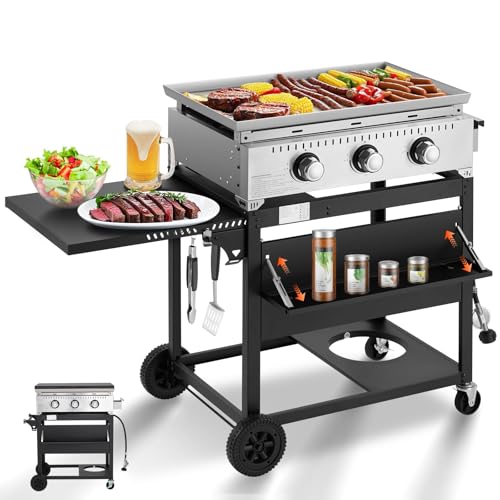

What makes a griddle worth owning is cooking area you actually use, burners you can control independently so one zone sears while another keeps warm, a surface that holds heat evenly, and grease management that does not turn cleanup into a chore. The five below run from a fold-up 23-inch portable to a 44-inch six-burner monster, so a couple on a small patio and a crowd at a tailgate are both covered.
At a glance
| Product | Standout feature | Price tier | Link |
|---|---|---|---|
| Blackstone 28-Inch 2-Burner Griddle | Best seller, 470 sq in, removable top, caster wheels | Mid-range | |
| Blackstone Original 28-Inch with Hood | 524 sq in, integrated hood, counter-height shelves, 34,000 BTU | Premium | |
| Royal Gourmet 3-Burner Portable Griddle | Collapsible stand, 314 sq in, ceramic-coated top | Mid-range | |
| MELLCOM 3-Burner Cast Iron Griddle | 450 sq in cast iron, lid and side table, lowest cost | Budget | |
| Royal Gourmet 6-Burner 44-Inch Griddle | 994 sq in, up to 50 burgers, six independent burners | Premium | |
How to choose an outdoor flat top griddle
What a griddle does that a grill cannot
A solid plate changes the menu. Small, delicate, and loose foods, eggs, chopped vegetables, rice, shrimp, sliced onions, stay where you put them instead of dropping into the flames. Full contact with hot steel is also what gives a smash burger its crust and hash browns their crunch, something bars simply cannot do. Grease runs to a channel rather than dripping onto burners, so flare-ups mostly disappear. What you give up is the char-striped, smoky character of a grate, which is why plenty of backyards end up with both.
Cooking area and burners
Match the surface to the crowd. Roughly 300 square inches feeds a couple or a small family and suits a compact patio or a campsite. Around 450 to 525 square inches is the popular middle, enough for a family breakfast or a table of guests, often quoted as about 20 burgers at once. Beyond that, 900-plus square inches serves nine or ten people and turns out around 50 burgers, which is party or tailgate territory. Independent burner control matters as much as size: separate zones let you sear on one side and hold food warm on the other, which is the whole trick to serving a hot meal all at once.
Surface material
Three approaches, three personalities. Rolled or carbon steel is the classic, and it wants seasoning, a baked-on oil layer you build over time, and it rewards you with excellent heat and a natural non-stick that improves with age. It will rust if you neglect it. Ceramic-coated tops resist corrosion, scratches, and high heat with less fuss, and clean up easily, though most still ask for seasoning before first use. Cast iron holds heat like nothing else, which is superb for searing and steady cooking, at the cost of weight and slower warm-up. Stainless with no coating avoids peeling worries entirely.
Grease management and cleanup
This is the difference between a griddle you use weekly and one that gathers dust. A rear grease system lets you push debris straight back off the plate into a cup, which is fast and keeps the working surface clear. Front-draining designs pull grease toward you into a slide-out tray, which some cooks prefer for reach. Either way, look for a removable, decent-sized cup you can empty without dismantling anything, and drainage holes positioned to keep grease away from high heat and the smoke it causes.
Portability and storage
Be honest about where this thing lives. A full cart with caster wheels rolls around the yard and gives you shelves and a tank holder, but it needs a permanent parking spot. Collapsible stands and removable legs fold into a trunk for camping and tailgating, and some griddles lift off their cart to become a tabletop unit, which is the best of both. Foldable side tables keep the footprint small in storage while still giving you prep room when open.
Hoods, covers, and the weather
An integrated hood protects the plate from rain, leaves, and curious animals between cooks, and doubles as a wind shield when open. It also lets you trap a little heat to melt cheese. What a hood is not is a substitute for a cover if the griddle lives outdoors year round, since a steel plate plus weather equals rust. Some models use their side table as a lid, a neat trick that saves space. Either way, plan to protect the surface and give it a light oil after cleaning.
Blackstone 28-Inch 2-Burner Griddle
This is the griddle that made backyard flat-top cooking mainstream, and it remains the best seller here. You get 470 square inches of restaurant-style cooking surface, enough for breakfast, lunch, and dinner duties from eggs and pancakes to steak, potatoes, and teppanyaki-style meals, plus a bottom shelf and two side shelves for storage and prep. Battery-powered push-button ignition means no matches or charcoal fuss, and the rear grease management system keeps cleanup quick. The clever part is mobility: the griddle top lifts off, the legs fold up, and four industrial caster wheels roll it around the yard or into the car for a campsite. Simple to assemble and simple to live with.
Pros
- Proven best seller with 470 sq in of cooking space
- Removable top and folding legs for transport
- Push-button ignition, no matches or charcoal
- Rear grease management and three shelves
Cons
- No hood, so the plate needs a cover outdoors
- Two burners give fewer heat zones than bigger units
Best for: most backyards. A do-everything griddle that also travels to the campsite.
Blackstone Original 28-Inch with Hood
The same 28-inch footprint, but better equipped for a griddle that lives on the patio. It offers 524 square inches, holding up to 21 burgers or 15 pancakes, and two independently controlled H-style burners producing a combined 34,000 BTUs, so you can run one side low while the other side sears. The integrated hood is the headline, shielding the cooking surface between sessions and cutting wind while you cook. Counter-height side shelves make prep and serving genuinely comfortable rather than a stoop, the patented rear grease system sends debris to a cup at the back, and electric ignition plus two wheels round it out. It is the upgrade pick for a permanent outdoor kitchen spot.
Pros
- 524 sq in and 34,000 BTU across two independent burners
- Integrated hood protects the top and blocks wind
- Comfortable counter-height side shelves
- Rear grease management and electric ignition
Cons
- Priciest 28-inch option here
- Heavier and less packable than the base model
Best for: a patio griddle that stays put, where a hood and counter-height prep space earn their keep.
Royal Gourmet 3-Burner Portable Griddle
Built for people who cook where they are, not just where they live. The collapsible stand folds down in seconds, which makes it a camping, tailgating, and small-patio favorite and solves the storage problem that keeps many people from buying a griddle at all. Despite the size, three burners heat 314 square inches, enough for about eight burgers at once, and the ceramic-coated top resists high heat, corrosion, and scratches while spreading heat evenly. It passes PFAS testing, and two lid latch buckles clamp it shut so nothing pops open in the trunk. A right-side shelf and two built-in hooks keep plates and rags in reach. Season the top before first use.
Pros
- Collapsible stand folds fast for storage and transport
- Three burners across 314 sq in for real heat zones
- Ceramic-coated top resists corrosion and scratches
- Lid latches for secure travel, side shelf and hooks
Cons
- Smallest cooking area here, so not for big crowds
- Griddle top needs seasoning before use
Best for: camping, tailgating, and compact patios where the griddle has to fold away.
MELLCOM 3-Burner Cast Iron Griddle
The most griddle for the least money, and the only cast iron plate in the group. That thick cast iron layer, pre-treated with a high-temperature oil film for a natural non-stick surface, holds heat beautifully for searing, and 450 square inches gives you room for a family meal. Three stainless burners put out 30,000 BTUs across independently adjustable zones, from a slow roast to a hard sear, with wind-resistant vent slots and a preheat under five minutes. The modular design is genuinely useful: the cart splits, the seasoning board becomes a grill table, and the griddle works standalone on a countertop or dropped into an outdoor kitchen. Piezoelectric ignition starts it instantly, and locking casters make it easy to move.
Pros
- Thick cast iron plate holds heat for excellent searing
- 450 sq in and 30,000 BTU at a budget price
- Modular: use on the cart, a counter, or an outdoor kitchen
- Doubles as a lid via the dual-purpose side table
Cons
- Cast iron is heavy and slower to warm up
- Assembly takes about half an hour
Best for: value seekers who want cast iron heat retention and a flexible, modular setup.
Royal Gourmet 6-Burner 44-Inch Griddle
When the guest list gets serious, this is the answer. A 994-square-inch surface holds up to 50 burgers and serves nine or ten people, and six independently controlled burners mean you can genuinely run six different things at six different temperatures, which is how you get a big meal on the table hot. The ceramic-coated top resists rust, scratches, acid, and corrosion while spreading heat evenly and wiping clean. Storage is thought through: two folding side tables with a towel rack, knife holder, and tool hooks, double-layer bottom shelves for utensils and boxes, a front spice rack, and a cylinder base for the tank. It is big and it is priced accordingly, but nothing else here feeds a crowd like it.
Pros
- Huge 994 sq in surface, up to 50 burgers
- Six independent burners for true multi-zone cooking
- Ceramic-coated top, easy to clean and rust-resistant
- Extensive storage, racks, hooks, and folding tables
Cons
- Large footprint needs dedicated space
- Highest price and overkill for small households
Best for: parties, big families, and backyard cooks who regularly feed nine or ten people.
The verdict
Best overall: the Blackstone 28-inch 2-burner is the category best seller and the right call for most backyards, with 470 square inches, easy ignition, rear grease management, and a removable top that lets it come camping.
Best value: the MELLCOM 3-burner delivers 450 square inches of cast iron and 30,000 BTUs across three zones for the lowest price here, plus a modular cart and a side table that doubles as a lid.
Best premium: the Royal Gourmet 6-burner is the crowd-feeder, with 994 square inches, six independent burners, and storage everywhere. For a smaller patio, the hooded Blackstone Original is the more refined 28-inch upgrade.
FAQ
Should I buy a griddle or a grill?
A griddle handles eggs, pancakes, rice, shrimp, and smash burgers that would fall through grates, with fewer flare-ups. A grill gives char marks and smoky flavor. If you mostly cook breakfasts, burgers, and mixed dishes, the griddle wins; many people keep both.
Do I have to season the surface?
Usually yes. Steel and cast iron tops need a baked-on oil layer that builds a natural non-stick finish and keeps rust away, and most ceramic-coated tops also ask for seasoning before first use. It takes one session and then a light oil after each clean.
How much cooking area do I need?
Around 300 square inches suits a couple or a campsite, 450 to 525 covers a family or a table of guests, and 900-plus is party territory serving nine or ten. Buy for your usual crowd, not your biggest ever cookout.
Ceramic-coated, steel, or cast iron?
Ceramic-coated is the easiest to maintain and resists rust and scratches. Cast iron holds heat best for searing but is heavy and slow to warm. Rolled steel is the classic that seasons beautifully but needs care to avoid rust.
Can I leave a griddle outside?
Only with protection. A hood helps between cooks, but a proper cover and a light coat of oil on the plate are what actually prevent rust if it lives outdoors. Store the tank safely and keep the grease cup emptied.
What propane tank do these use?
Full-size cart griddles are built around a standard refillable propane tank, usually held in a base or holder on the cart, and ship with a regulator and hose. Check whether the tank is included, since it often is not.
This article may contain affiliate links; see our Affiliate Disclosure.