The search says back support. Four chairs here answer it with a cushion on a strap, which sits wherever the strap holds it rather than where your spine curves. Four others answer it with a mechanism that moves, and three of those publish how far it travels in inches. The first four are the ones called gaming chairs.


At a glance
| Product | What the back support actually is | Price tier | Link |
|---|---|---|---|
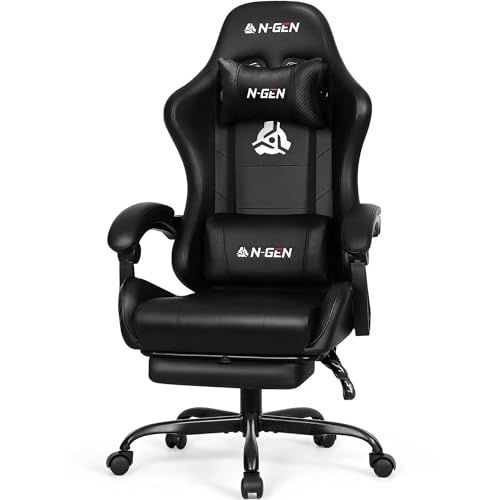
| N-GEN Gaming | A pillow. Cheapest here. FSC-certified wood inside | Budget | |
| Homall Gaming | A massage pillow. BIFMA base, Class 3 lift | Budget | |
| Dowinx Gaming | A massage pillow, plus armrests that track your recline | Budget | |
| Marsail Mesh | A mechanism: 1.18″ fore and aft, 2.16″ up and down | Mid-range | |
| TRALT Mesh | A mechanism, and it explains what it left out to afford it | Mid-range | |
| CAPOT Mesh | Eight levels across 2 inches, mapped to L1-L5 | Premium | |
| ELABEST X100 | A real mechanism, buried in unreal percentages | Premium | |
How to choose
A pillow is not lumbar support
Your lower back curves inward, and the support has to meet that curve at the height where your spine actually bends, which is different on a person of five foot four and a person of six foot two. A cushion held on with an elastic strap sits wherever the strap ends up and slides down through the evening. A mechanism moves to your spine and stays. One listing here puts it bluntly, calling its adjustable lumbar not a fixed afterthought, and contrasting it with supports that crack or lose tension.
Three chairs publish how far theirs moves
This is the specification to shop on and it exists on exactly three products here. One moves 1.18 inches forward and back and 2.16 inches up and down. One gives 2 inches over eight levels and says it maps to the L1 to L5 vertebrae. One gives roughly an inch and a half of depth and two inches of height plus a bit of rotation. Every chair in this search that describes its lumbar as a pillow publishes no measurement at all, because there is nothing to measure.
The chair sinks, and four listings say why
The failure everyone eventually meets is the seat drifting downward while you work. One listing explains the mechanism plainly: the pneumatic cylinder loses pressure and slowly sinks during use. Four chairs here name a certification against it and they do not agree on the scale, offering Class 3, Grade-4, a three-level lift, and simply a certified lift with no class given. Class 3 is the one that appears twice from different brands, which makes it the closest thing to a common language here.
Certified sustainable wood is not back support
Three gaming chairs here advertise FSC-certified wood, which certifies that a forest was managed responsibly. It is a fine thing and it tells you nothing about your spine. What it does quietly confirm is that there is a plywood board inside your seat, which is normal and which nobody would otherwise mention. Read it as a sustainability note that wandered into the ergonomics section.
Ask who is doing the certifying
Four chairs here cite BIFMA, which is the recognized furniture standards body, and one goes further and names the specific standard by number rather than just the initials. One chair also cites certification from a body it has to define for you in its own footnote, for a claim about fatigue reduction over twelve hours. When a listing has to explain who its certifier is, the certification is doing less work than the sentence it sits in.
Percentages need something to be a percentage of
One chair here reduces neck strain by 31 percent, improves airflow by 38 percent, raises elasticity by 25 percent, and uses foam 27 percent denser. Another lessens back pressure by 50 percent, enhances support by 30 percent and reduces pelvic pressure by 20 percent. Not one of those figures says compared to what. The same two listings also publish real geometry in inches, which is the odd part: the checkable numbers and the decorative ones sit side by side.
Watch the units, because one of them slipped
The most expensive chair in this search describes an extra-wide headrest and then gives its size as 28 cubic centimeters. Twenty-eight cubic centimeters is about two tablespoons. That is not a headrest, it is a typo wearing a specification’s clothes, and it sits in the same bullet as a claim to reduce neck strain by a precise 31 percent. Precision and accuracy are different things, and this page has a lot of the first.
N-GEN Gaming
The cheapest chair here and a well-equipped one for the money: removable headrest, lower back pillow, pull-out footrest, linkage armrests, a certified gas lift rated to 300 pounds and a heavy-duty steel base. The racing shape and breathable PU leather are what the category is built on. The back support is a pillow rather than a mechanism, so it will sit where the strap puts it, and the notable certification in its bullets is for the sustainably sourced wood inside the seat cushion.
Pros:
- The lowest price on this page
- Removable headrest, back pillow and pull-out footrest
- Certified gas lift rated to 300 lbs; steel base
- Linkage armrests move with the recline
Cons:
- Lumbar is a pillow; nothing adjusts to your spine
- Its named certification is for the wood, not the chair
- 300 lbs; the joint lowest capacity here
Best for: a lot of chair, cheaply, if the pillow suits you.
Homall Gaming
A massage lumbar pillow is the pitch, and a vibrating cushion is a genuinely nice thing at the end of a long session even if it is not support. Around it: high-density foam under soft PU on the cushions, backrest and armrests, a reclining mechanism to 135 degrees, a pull-out footrest and a 360 degree swivel. Its base is BIFMA-certified metal and its gas lift is a Class 3, which is the specific class that turns up twice on this page from different brands, and it is worth having.
Pros:
- Massage lumbar pillow; pleasant after long sessions
- BIFMA-certified metal base and Class 3 gas lift
- Reclines to 135 degrees; footrest pulls out
- Padded armrests as well as seat and back
Cons:
- Massage is not adjustment; the pillow still slides
- No lumbar measurement of any kind
- Publishes no seat dimensions or user height range
Best for: the massage, with a certified base under it.
Dowinx Gaming
The one genuinely new idea among the gaming chairs here: armrests that adjust for height and then move with you as you recline, so your elbows stay supported at any angle instead of being left behind when the back goes down. That is a real problem solved. It also uses a spring cushion under the foam rather than foam alone, which is the plain answer to seats going flat, and it publishes an aluminum five-star base, a certified gas lift and a 330 pound rating. The lumbar is a massage pillow.
Pros:
- Armrests adjust for height and track your recline
- Spring cushion under the foam; resists going flat
- Aluminum five-star base; certified gas lift; 330 lbs
- Reclines to 150 degrees; adjustable headrest
Cons:
- Lumbar is a massage pillow, not a mechanism
- Gas lift certified but no class given
- Its named wood certification is a forestry one
Best for: elbows that stay supported when you lean back.
Marsail Mesh
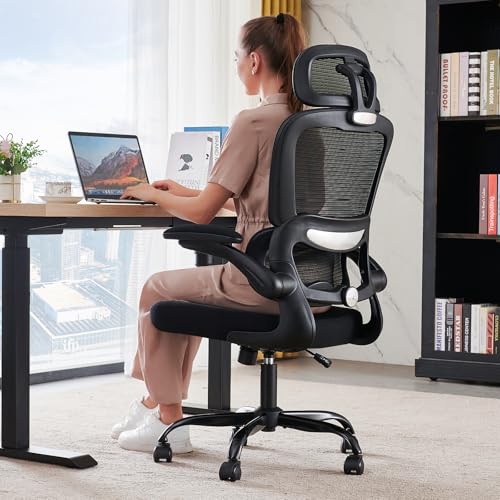
The cheapest chair here whose back support is a mechanism rather than a cushion, and it tells you exactly how far it moves: 1.18 inches forward and back, 2.16 inches up and down, which is what lets it meet your particular spine rather than a generic one. Add a mesh back that breathes instead of peeling, 3D armrests that flip up so the chair tucks under a desk, a 2D headrest, 90 to 120 degrees of recline, and 3.14 inches of high-density foam in a 330 pound seat.
Pros:
- Publishes its lumbar travel: 1.18″ and 2.16″
- The cheapest real lumbar mechanism here
- 3D armrests flip up; chair tucks under the desk
- Mesh back; 3.14 inches of seat foam; 330 lbs
Cons:
- 120 degrees of recline; less than the gaming chairs
- No footrest
- Publishes no seat width or user height range
Best for: an adjustable lumbar with the numbers on it, cheaply.
TRALT Mesh
The only listing in this search that talks like someone who has sat in a bad chair. It names the failures rather than the features: cylinders that lose pressure and sink, foam that hardens and sags within months, faux leather that flakes, plastic bases that crack near the hub. Then it publishes the geometry, at 19.7 inches of seat width and 17.3 of depth, calibrated for the recommended two to four finger gap behind your knees, with a height range that fits five foot four to six foot two. And it explains what it deliberately left out: a cheap headrest, so the money went to the lumbar, the base, the cylinder and the seat.
Pros:
- Names the actual failure modes, not just features
- Publishes seat width, depth, height range and user height
- Cites the two-to-four finger rule behind the knees
- Explains what it left out and why; 2-year warranty
Cons:
- No headrest at all, by design
- Its lumbar travel is described but not measured
- No footrest and no recline beyond a desk chair’s
Best for: the money going where it matters.
CAPOT Mesh
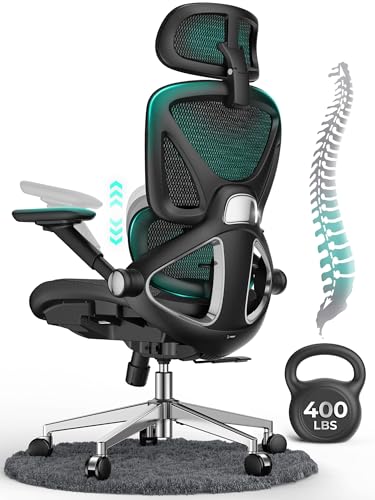
The most precisely specified chair here: a lumbar giving 2 inches of travel over eight discrete levels, described as aligning with the L1 to L5 vertebrae, which is the only anatomical reference on this page. It cites BIFMA by standard number rather than by initials, publishes its seat at 19.3 by 20 inches with a height range for people from five foot five to six foot two, locks the backrest at 90, 110 or 125 degrees, holds 400 pounds on a stainless base, and carries a five-year warranty with free parts. Its percentages have no baselines.
Pros:
- Lumbar in 8 levels across 2 inches, mapped to L1-L5
- Cites the BIFMA standard by number
- 400 lbs on a stainless base; leak-proof certified lift
- Five-year warranty with free replacement parts
Cons:
- Its 50, 30 and 20 percent claims name no baseline
- No footrest
- Fits 5’5″ to 6’2″; shorter users are outside it
Best for: eight levels of lumbar and five years of parts.
ELABEST X100
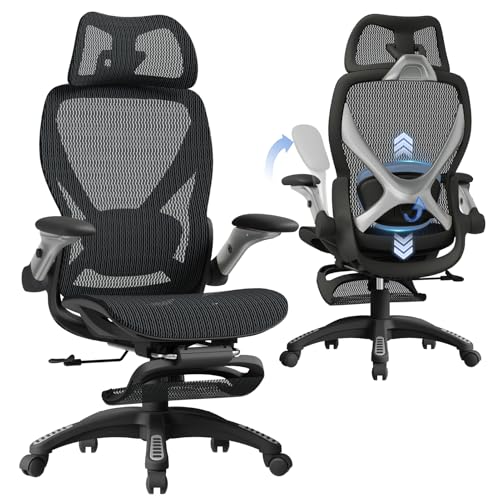
Underneath the language there is a serious chair: a spring-loaded lumbar that tracks you automatically, locks, and travels roughly an inch and a half in depth and two in height with some rotation, plus 5D flip-up armrests, an 18 inch extendable footrest, BIFMA-certified construction and a Grade-4 lift. It is the only mesh chair here with a footrest. Then the listing: neck strain down a precise 31 percent, airflow up 38, foam 27 percent denser, a certifying body it defines in its own footnote, and a headrest measured at 28 cubic centimeters.
Pros:
- Spring-loaded lumbar that tracks and locks
- The only mesh chair here with an 18 inch footrest
- 5D flip-up armrests; BIFMA-certified construction
- Publishes its lumbar travel in inches
Cons:
- Gives its headrest size as 28 cubic centimeters
- Cites a certifier it has to define in a footnote
- Four percentage claims with no baseline; highest price here
Best for: a mesh chair with a footrest, reading past the copy.
The verdict
Back support splits this page in two. The chairs called gaming chairs hand you a cushion on a strap and publish no measurement, because a pillow has nothing to measure. The chairs called office chairs give you a mechanism, and three of them tell you how many inches it travels. Then check who is certifying what, because sustainable forestry and a chair that holds your spine are different achievements.
Best overall: TRALT Mesh. It is the only listing here written by someone who knows how chairs fail, and it names them: the cylinder losing pressure and sinking, the foam hardening within months, the faux leather flaking, the plastic base cracking at the hub. It publishes the seat geometry properly and cites the two-to-four finger gap behind your knees. Best of all it explains what it left out, skipping a cheap headrest so the budget went to the lumbar, the base and the certified cylinder.
Best value: Marsail Mesh. The cheapest chair on this page whose back support actually moves, and it tells you how far: 1.18 inches forward and back, 2.16 inches up and down. That is the difference between support meeting your spine and a cushion meeting your strap. Around it you get a mesh back that will not peel, 3D armrests that flip up so the chair goes under the desk, and over three inches of foam in a seat rated to 330 pounds.
Best premium: CAPOT Mesh. Eight discrete lumbar positions across two inches, described against the L1 to L5 vertebrae, which is the only time anything on this page refers to an actual spine. It cites its BIFMA standard by number rather than waving at the initials, holds 400 pounds on a stainless base, and backs it with five years and free parts. Ignore its percentages, which have no baselines, and buy the geometry and the warranty.
FAQ
Is a lumbar pillow the same as lumbar support?
No. Your spine curves at a height particular to you, and a strapped cushion sits where the strap holds it and slides. A mechanism moves to meet you and stays. Four chairs here have pillows and publish no measurement; three publish their travel in inches.
What number should I look for?
How far the lumbar moves. One chair gives 1.18 inches fore and aft and 2.16 up and down. One gives 2 inches over eight levels against the L1 to L5 vertebrae. If a listing cannot give you that, it has a cushion.
Why do chairs sink?
The gas cylinder loses pressure, which one listing here explains outright. Four cite a certification against it and none agree on the scale, offering Class 3, Grade-4, a three-level lift, and a certified lift with no class named.
What does FSC-certified wood mean on a chair?
That the forest was managed responsibly, which is a good thing and not an ergonomic one. Three gaming chairs here advertise it. It also quietly tells you there is a plywood board inside your seat.
Can I trust the percentage claims?
Not without a baseline. One chair reduces neck strain by 31 percent and improves airflow by 38, against nothing stated, and gives its headrest size as 28 cubic centimeters, which is about two tablespoons. The inches on the same page are the numbers worth reading.
This article may contain affiliate links; see our Affiliate Disclosure.