Six of the seven heaters on this page are 1500 watts. Not roughly. Exactly. That is not a coincidence and it is not a coordinated pricing scheme, it is the most a standard wall socket will give you before the circuit says no. One listing does the conversion and lands on 5,120 BTU, which is precisely what 1500 watts produces. So six of these heaters make identical heat, and the only one that escapes it is hardwired into your electrical panel.




At a glance
| Heater | Power, and what it actually is | Price tier | Link |
|---|---|---|---|
| DREO Space Heater | 1500W. A bedroom heater. The best seller | Budget | |
| Dura Heat EUH1465 | 1500W, steel body. Publishes 5,120 BTU plainly | Budget | |
| Wall-Mounted ECO | Publishes no wattage at all, on a heater | Budget | |
| Dreo Oscillating | 1500W, 270 sq ft. Warns off extension cords | Budget | |
| Dr. Infrared | 1500W infrared. Heats you, not the air. IP55 | Mid-range | |
| VEVOR 5000W | 5000W, hardwired. The only real garage heater | Mid-range | |
| Dreo Smart Wall | 1500W. 200 sq ft primary, 750 supplementary | Premium | |
How to choose
Everything you can plug in is 1500 watts
A standard socket on a 15 amp circuit gives you about 1500 watts of continuous load and no more. That is why six heaters here land on exactly that figure and why the brands compete on fans, apps and oscillation instead of on heat, because heat is the one thing none of them can add. Dura Heat does the conversion and prints 5,120 BTU, which is precisely what 1500 watts produces. Every 1500 watt heater on this page makes that same 5,120 BTU. The differences are all downstream.
Getting past 1500 watts means hardwiring
One heater here is 5000 watts and the word that makes it possible is in its own title: hardwired. It is wired into your consumer unit rather than plugged into a wall, which is why it can draw more than a socket allows, and why it is a job rather than a purchase. That is the plain answer to the search. A garage is a big cold uninsulated box, and 5,120 BTU of plug-in heat will not warm it. If you want the room warm, this is the category.
A garage is uninsulated, and one listing says the quiet part
Dreo’s wall heater publishes the most accurate coverage figure in this search: 200 square feet as a primary heat source, or up to 750 as a supplementary one, and then adds that you should check whether your room is properly insulated. A garage is the least insulated space in the building. So the 200 is optimistic and the 750 was never about a garage at all. The other 1500 watt heaters here quote a single number, from 270 square feet upward, without saying which kind it is.
Infrared heats you; convection heats the air and loses it
This is the physics that decides a garage. A fan heater warms the air, and in a drafty uninsulated space that air leaks out through every gap, so you are paying to heat the street. Infrared skips the air entirely and warms whatever it lands on, which is you, your bench and your car. One heater here is infrared, with a mirror reflector at 90 percent reflectivity to aim it. For a garage that difference matters more than every watt on this page.
Never run one on an extension cord
Dreo prints this and nobody else does: do not use with an extension cord, plug directly into the wall outlet. It matters because 1500 watts is 12.5 amps, and a garage is exactly where the socket is never near where you want the heater, so an extension lead is the obvious move and the wrong one. That single sentence is the most useful safety line in this search, and it applies to every plug-in heater here, not only the one that bothered to write it.
Get it off the floor
A garage floor holds cars, tools, sawdust and feet, and a heater on it collects all four. Two heaters here mount overhead: one comes with wall and ceiling brackets in the box, the other offers wall-mounted or hanging installation with adjustable louvres so you can aim the heat where you work. One of those two is also rated IP55, which is weatherproofing, and a garage in winter is a damp place. The rest are floor-standing or wall-only.
DREO Space Heater
The best-selling heater in this search by a wide margin and the cheapest, and for what it is it is very good: 1500 watts of PTC ceramic, ETL certified with a tilt sensor and flame-retardant materials, a thermostat you set anywhere from 41 to 95 degrees in single-degree steps, a brushless motor at 34 decibels, a remote, a timer and a child lock. What it is, by its own title, is a heater for an office or a bedroom. It is not a garage heater and it never says it is.
Pros:
- The best seller here by a distance, and the cheapest
- Thermostat from 41 to 95 degrees in single-degree steps
- Tilt sensor, overheat protection, ETL certified
- 34 decibels; remote, timer, child lock and memory
Cons:
- An office and bedroom heater, by its own title
- 1500 watts; the plug ceiling, like almost everything here
- No coverage figure published
Best for: a desk or a bedroom, which is what it says.
Dura Heat EUH1465
The only listing here that converts its watts into BTU, and the conversion is exact: 1500 watts is 5,120 BTU, and that is what it prints. Do that sum on every other 1500 watt heater on this page and you get the same answer, which is the most useful thing this listing gives you. The body is rugged steel rather than plastic and it is aimed at garages, workshops and commercial spaces, with an adjustable thermostat, a pivoting base and a fan-only setting for summer.
Pros:
- The only real watts-to-BTU conversion here, and it is exact
- Steel body, built for a workshop rather than a desk
- Pivoting base to aim the heat
- Adjustable thermostat and a fan-only mode
Cons:
- 1500 watts; the same 5,120 BTU as everything plug-in
- No coverage figure published
- No remote, timer or oscillation
Best for: a workshop, from the listing that shows its arithmetic.
Wall-Mounted ECO
Three oscillation angles rather than one, at 60, 90 and 120 degrees, which is more choice than anything else here offers and genuinely useful if you want to sweep a bench rather than a room. There is an ECO mode that trims the power to the ambient temperature, a thermostat from 41 to 95 degrees, a 24-hour timer, an LED display, a remote and a child lock. What there is not, anywhere across five bullets on a heater, is a wattage figure.
Pros:
- Three oscillation angles; the most choice here
- ECO mode trims power to the room temperature
- 24-hour timer, remote, LED display and child lock
- 12-month replacement policy stated
Cons:
- Publishes no wattage at all, on a heater
- No coverage figure either
- Remote batteries not included
Best for: sweeping a specific area, if the wattage does not worry you.
Dreo Oscillating
The listing that prints the safety line the rest of this page needs and does not carry: do not use with an extension cord, plug directly into the wall outlet. In a garage, where the socket is never near the bench, that is the sentence that matters. Beyond it: 1500 watts of PTC across a stated 270 square feet, 70 degrees of oscillation on a trackball rated past 750,000 cycles, ECO mode dropping to 1000 watts, ETL certification, a 6 foot flat cord and a 24-hour auto-off.
Pros:
- The only listing warning against extension cords
- Publishes a coverage figure at 270 square feet
- 70 degree oscillation, rated past 750,000 cycles
- ECO mode between 1000 and 1500 watts; ETL certified
Cons:
- 1500 watts; the same heat as everything plug-in here
- Its 270 sq ft does not say primary or supplementary
- Floor-standing; a garage floor is a busy place
Best for: a room, safely, from the listing that says how.
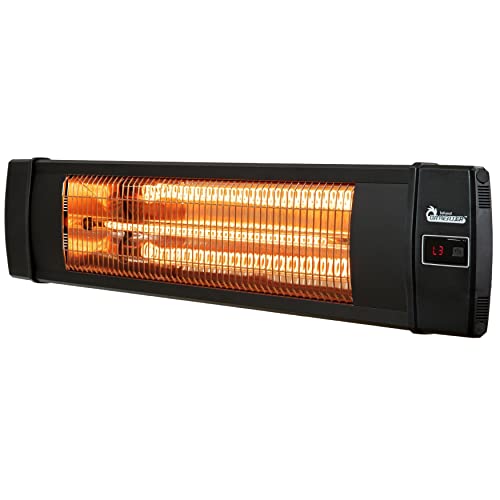
Dr. Infrared
The only heater here that does not try to warm the air, and in a garage that is the whole argument. Infrared lands on you, your bench and your car and warms those directly, so the draft through the door stops mattering. A mirror aluminum reflector at 90 percent reflectivity aims it. It is IP55 rated for indoors and out, which is real weatherproofing for a damp winter garage, it comes with wall and ceiling brackets to get it off the floor, and it runs at 900, 1200 or 1500 watts.
Pros:
- Infrared; heats you rather than air that leaks away
- IP55 rated; genuinely built for a damp garage
- Wall and ceiling brackets included
- Three power levels; weatherproof aluminum body
Cons:
- No thermostat, as its own title says
- Still 1500 watts at the top; the plug ceiling applies
- Infrared warms what it points at, and nothing else
Best for: a drafty garage, where heating the air is hopeless.
VEVOR 5000W
The only heater in this search that answers it. Five thousand watts, which is more than three times what any plug on this page can deliver, and it manages that because it is hardwired into your electrical panel rather than plugged in. It covers a stated 50 square meters, holds temperature to within 2 degrees, and is built from cold-rolled steel with overheat cutoff and ETL certification. It mounts on a wall or hangs from the ceiling, with adjustable louvres to aim the heat and a fan delay to scavenge the last of it.
Pros:
- 5000 watts; the only heater here past the plug ceiling
- Wall-mounted or hanging, with adjustable louvres
- Holds temperature to within 2 degrees; ETL certified
- Cold-rolled steel body; fan delay for leftover heat
Cons:
- Hardwired; this is an electrician, not an unboxing
- Quotes coverage in square meters where everyone else uses feet
- The worst-selling heater on this page
Best for: actually heating a garage, if you will wire it in.
Dreo Smart Wall
The most accurate coverage bullet in this search: 200 square feet as a primary heat source, up to 750 as a supplementary one, and check your insulation. Two numbers for one heater, correctly labeled, which is how coverage should always be quoted. It oscillates 120 degrees vertically rather than side to side, so it pushes warmth from floor to ceiling, mounts on a wall with a drilling guide in the box, dims its panel at night, and takes app and voice control.
Pros:
- Publishes primary and supplementary coverage separately
- Tells you to check your insulation; nobody else does
- 120 degree vertical oscillation, floor to ceiling
- Wall-mounted with a drilling guide; app and voice control
Cons:
- 1500 watts; 200 sq ft as a primary source is a small garage
- The most expensive plug-in heater here
- Wall only; no ceiling option
Best for: a small insulated space, with the numbers stated properly.
The verdict
A plug gives you 1500 watts and that is 5,120 BTU, whichever brand is printed on it. Six heaters here make exactly that. A garage is a large uninsulated box, so the real options are to heat yourself with infrared rather than heating air that escapes, or to hardwire something bigger. And never run any of them on an extension lead.
Best overall: VEVOR 5000W. The only heater in this search that gets past the socket, at more than three times the power of anything you can plug in, because it is wired into your panel instead. It covers 50 square meters, holds to within 2 degrees, mounts on a wall or hangs from the ceiling with louvres you aim, and it is built from cold-rolled steel. It needs an electrician, which is the real price of actually heating a garage.
Best value: Dura Heat EUH1465. A steel-bodied 1500 watt heater built for workshops rather than desks, with a thermostat and a pivoting base, and it is the only listing on this page that converts its watts into BTU. That figure, 5,120, is exact, and it is the number that tells you every other plug-in heater here produces precisely the same heat no matter what else it claims.
Best premium: Dr. Infrared. The only heater here that stops trying to warm the air, which in a drafty uninsulated garage is a losing game, and instead lands its heat on you and your bench directly. It is IP55 rated for a damp winter garage, comes with wall and ceiling brackets so it leaves your floor alone, and aims itself with a 90 percent reflector. There is no thermostat, and its own title says so.
FAQ
Why is everything 1500 watts?
Because that is what a standard socket allows before the circuit objects. Six heaters here land on exactly 1500, which converts to 5,120 BTU, as one listing correctly prints. They all make the same heat; only the fans and features differ.
How do I get more heat than that?
Hardwire it. The 5000 watt heater here is wired into the panel rather than plugged in, which is why it can draw more than three times what a socket gives. That is an electrician’s job, and it is the plain answer for a garage.
Should I use infrared or a fan heater?
Infrared, in a garage. A fan heater warms air, and uninsulated air leaks out through every gap. Infrared warms you, your bench and your car directly, so the draft stops mattering. One heater here is infrared and it is also the only IP55 one.
How big a space will 1500 watts heat?
Smaller than you hope. The only listing that splits it plainly says 200 square feet as a primary heat source, or 750 as supplementary, and adds that insulation matters. A garage is the least insulated room you own, so take the 200 as optimistic.
Can I run it on an extension cord?
No, and only one listing here says so: plug directly into the wall. At 1500 watts a heater pulls about 12.5 amps, and a garage is exactly where the socket is never near the bench. The advice applies to every plug-in heater on this page.
This article may contain affiliate links; see our Affiliate Disclosure.