One of DEWALT’s four tools is a torch. Not a work light with a stand and a swivel head, a torch, and the listing publishes its output: 11 lumens. Your phone does five times that. So a four-tool kit arrives as three tools and a keyring light, and it is not alone, because a six-tool kit on this page is five tools and a light too. Count what is actually in the box before you count what is in the title.




At a glance
| Kit | Tools, voltage and what is published | Price tier | Link |
|---|---|---|---|
| BLACK+DECKER | 4-tool, 20V. Its bullets account for three | Budget | |
| PORTER-CABLE | 4-tool, 20V. Publishes the drill’s weight | Budget | |
| RYOBI P1819 | 6-tool, 18V. Five tools and a light. No specs | Budget | |
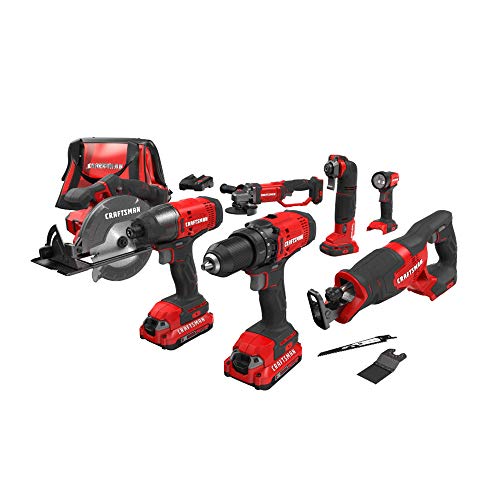
| CRAFTSMAN V20 | 7-tool, 20V. A number for every tool. Best seller | Budget | |
| DEWALT 4-Tool | 4-tool, 20V. One of them is an 11-lumen torch | Mid-range | |
| FLEX 24V | 4-tool, 24V, all brushless. Every tool spec’d | Mid-range | |
| DEWALT 5-Tool | 5-tool, 20V. Twice the price for two fewer tools | Premium | |
How to choose
The tool count includes the torch
Read the itemized list, not the number on the box. DEWALT’s four-tool kit is a drill, an impact driver, an oscillating tool and an LED light rated at 11 lumens, which the listing publishes and which is dimmer than the phone in your pocket. RYOBI’s six-tool kit is five tools and a work light. BLACK+DECKER’s four-tool kit names a drill, a circular saw and a work light across its bullets, leaving one tool unaccounted for entirely. The light is padding, and it is padding you are paying for.
20V MAX and 18V are the same battery
Every kit here except two says 20V MAX, and one says 18V, and they are describing the same thing from different ends. Twenty volts is what a fresh pack reads with nothing attached; eighteen is what it actually delivers under load. RYOBI quotes the working number and everyone else quotes the peak. Do not read that as a weaker battery, because it is not one. The genuine outlier is the 24V kit, and that one really is a different pack.
Blade size is what decides your cuts
The circular saws here run from 5.5 inches to 7.25, and that gap is the difference between a saw for plywood and a saw for framing. Only one kit here carries a full-size 7-1/4 inch blade, and only that one publishes a depth of cut, at 2-9/16 inches, which is what lets you get through a 2×4 on the bevel. The rest give you 6-1/2 or 5-1/2 inches and describe cutting 2x material without ever saying how deep they reach. Blade speed follows the same order.
Brushless is the specification nobody else claims
One kit here says every one of its motors is brushless, and nobody else on this page uses the word at all. Brushless motors have no carbon brushes to wear out and waste less energy as friction and heat, which shows up as longer runtime from the same battery and a longer life from the tool. It is the single biggest difference between a cheap combo kit and a good one, and its absence from six listings is the most eloquent thing about them.
Watts out is a house measurement
Two kits here rate their drills in UWO, or unit watts out, at 280 and 300, and you can compare those two because they come from the same corporate family. A third rates its drill at 750 inch-pounds of torque, which does not convert to UWO in any published way. So you can rank two drills on this page against each other and neither against the third, and two more publish nothing but a speed. Compare within a unit or do not compare.
The battery decides the next ten years
RYOBI’s listing is three bullets long and names no specification whatsoever, and then makes the best argument in this search: over 125 tools all run on the same battery. That is the thing you are really choosing. A combo kit is an entry fee into a battery system, and every tool you add for the next decade has to fit it. Count the tools available on the platform before you count the tools in the box.
BLACK+DECKER
The cheapest kit here by a clear margin and clear about who it is for, describing its drill and its saw as ideal for consumer DIY projects rather than pretending otherwise. The drill has a 3/8 inch chuck at 0 to 650 rpm with an 11-position clutch, which is the feature that stops you stripping screws, and the 5.5 inch saw has tool-free depth and bevel adjustment. Two batteries are included. Its four bullets describe a drill, a saw and a work light, which is three things.
Pros:
- Cheapest kit in this search, with two batteries
- 11-position clutch; the drill will not strip screws
- Tool-free depth and bevel on the saw
- Real that it is aimed at consumer DIY
Cons:
- Four-tool kit whose bullets account for three
- 5.5 inch blade; the smallest saw here
- 650 rpm drill; no torque figure published
Best for: occasional jobs around a house, cheaply.
PORTER-CABLE
A genuine four-tool kit with two batteries, and the only listing here that publishes what its drill weighs, at 3.5 pounds, which after an afternoon overhead is a number you feel. The drill is a two-speed with a half-inch chuck, an LED and bit storage in the base. The 5-1/2 inch saw runs 3,700 rpm with a carbide blade included and bevels at 45 and 90 with tool-free depth. The reciprocating saw does 0 to 3,000 strokes a minute with a 7/8 inch stroke and a pivoting shoe.
Pros:
- The only kit publishing its drill’s weight, at 3.5 pounds
- A real four-tool kit with two batteries
- Carbide blade included; tool-free depth and bevel
- Publishes stroke length and speed on the recip saw
Cons:
- 5-1/2 inch blade at 3,700 rpm; the slowest saw here
- No torque or UWO figure for the drill
- The worst-selling kit on this page
Best for: four real tools and two batteries, without the padding.
RYOBI P1819
Three bullets, no specifications, and the strongest argument in this search: over 125 tools run on this one battery. That is what you are actually buying, because a combo kit is a decision about the next decade of purchases rather than the next weekend. In the box are five real tools and a work light, called six, plus two batteries at 4.0 and 1.5 amp-hours and a bag. It quotes 18 volts where everyone else quotes 20, which is the same pack described plainly.
Pros:
- Over 125 tools on the same battery; the best ecosystem here
- Two batteries of different sizes, plus a bag
- Five genuine tools including a circular and recip saw
- Quotes the working voltage rather than the peak
Cons:
- Three bullets; not one specification anywhere
- The sixth tool is a work light
- No brushless claim; no blade size, torque or speed
Best for: buying into the system rather than the box.
CRAFTSMAN V20
The best-selling kit here and the arithmetic is startling: seven tools and two batteries for half what a five-tool kit on this page costs. Better, every one of the seven gets a number. The drill is 280 UWO across two gears. The impact driver is 1,460 inch-pounds at 2,800 rpm and 3,100 blows a minute. The recip saw has a 1 inch stroke at 3,000 strokes a minute. The circular saw is 6-1/2 inches at 4,200 rpm. The oscillating tool runs 8,000 to 18,000. The grinder does 8,500.
Pros:
- The best seller here; seven real tools, no torch padding
- Publishes a figure for every single tool
- Includes a grinder, which nothing else here does
- Half the price of a five-tool kit on this page
Cons:
- No brushless claim on any of the seven
- 280 UWO is below the DEWALT drills it shares a unit with
- 6-1/2 inch saw; no depth of cut published
Best for: the most tools with the most numbers attached.
DEWALT 4-Tool
A four-tool kit whose fourth tool is a light producing 11 lumens, and credit where it is due, DEWALT publishes that figure rather than leaving you to find out. So this is a drill, an impact driver and an oscillating tool, with a torch, and two batteries. What you get is a genuinely well-regarded trio: a compact drill at 300 UWO, an impact driver with one-handed bit loading that takes 1 inch tips, and an oscillating tool whose accessories change without a wrench.
Pros:
- Publishes the light’s output rather than hiding it
- 300 UWO drill; the highest published here in that unit
- One-handed bit loading on the impact driver
- Tool-free accessory changes on the oscillating tool
Cons:
- The fourth tool is an 11-lumen torch
- No saw of any kind in the box
- Costs more than a seven-tool kit here
Best for: three good tools, if you know what the fourth is.
FLEX 24V
Four tools, four model numbers, four specification lines, and no torch. The circular saw is a full-size 7-1/4 inch at 5,800 rpm with a published 2-9/16 inch depth of cut, which is the only saw here you could frame with. The recip saw offers orbital and linear modes at 4,000 rpm. The grinder is 5 inches at 10,000 rpm. The drill is a two-speed half-inch at 750 inch-pounds. Every motor is brushless, the pack is genuinely 24 volts, and the two batteries are different sizes.
Pros:
- Every motor brushless; the only kit here to claim it
- Full-size 7-1/4 inch saw with a published depth of cut
- A model number and a specification for all four tools
- Genuinely 24V; two battery sizes and a 160W fast charger
Cons:
- Its drill’s torque unit does not compare to anyone else’s
- A smaller platform than the established brands
- Among the most expensive kits here
Best for: four real tools, brushless, with every number printed.
DEWALT 5-Tool
The most expensive kit here, at roughly double what a seven-tool kit on this page costs, for two fewer tools. What the money buys is the DEWALT name and five genuine tools with no torch among them: a 300 UWO drill, a compact impact driver at 5.55 inches front to back, a reciprocating saw with a keyless clamp so you change blades without touching a hot one, an oscillating tool, and a 6-1/2 inch circular saw that will cut a 2×4 at 45 degrees in one pass.
Pros:
- Five real tools; no torch counted among them
- Keyless blade clamp; no touching a hot blade
- Cuts a 2×4 at 45 degrees in a single pass
- Compact drill and impact driver for tight spaces
Cons:
- Roughly double the price of a seven-tool kit here
- Its title says battery, singular, where the cheaper kit says two
- 300 UWO is the only number in the whole listing
Best for: the badge, and five tools with no padding.
The verdict
Count the tools in the bullets rather than the title, because on this page a four-tool kit can mean three tools and an 11-lumen torch. Then look for brushless, which only one kit claims, and for a blade big enough to reach through what you cut. And remember the battery is the real purchase; the box is just the entry fee.
Best overall: FLEX 24V. Four tools and four of them are tools: a model number, a specification and a brushless motor each, which no other kit here manages even once. Its 7-1/4 inch saw is the only full-size blade on the page and the only one with a published depth of cut, at 2-9/16 inches, which is what gets you through a 2×4 on the bevel. The 24 volts is genuine rather than a marketing figure.
Best value: CRAFTSMAN V20. The best-selling kit in this search, and seven tools with two batteries for half what a five-tool kit on this page costs. Every one of the seven gets a number: 280 UWO on the drill, 1,460 inch-pounds on the impact driver, 3,000 strokes a minute on the recip saw, 4,200 rpm on the circular saw, and a grinder nothing else here includes. No torch among them.
Best premium: DEWALT 5-Tool. It costs roughly double the seven-tool kit above it and gives you two fewer tools, so the case rests on the badge and on five genuine tools with no light padding the count. The keyless blade clamp means you change a recip blade without touching a hot one, and the circular saw takes a 2×4 at 45 degrees in a single pass. Check the battery count before you order.
FAQ
Is a four-tool kit really four tools?
Sometimes. DEWALT’s four-tool kit includes an LED light rated at 11 lumens, which it publishes. RYOBI’s six-tool kit is five tools and a work light. Read the itemized list in the bullets, because that is where the count is fair.
Is 20V MAX better than 18V?
No, they are the same battery. Twenty volts is the peak reading with nothing attached; eighteen is what it delivers under load. One brand here quotes the working figure and the rest quote the peak. The genuine outlier is the 24V kit.
What does brushless actually get me?
Longer runtime from the same battery and a longer life from the tool, because there are no carbon brushes wearing out and wasting energy as heat. One kit here says every motor is brushless. Nobody else uses the word at all.
What size circular saw do I need?
7-1/4 inches if you want to frame; 6-1/2 for sheet goods and general work; 5-1/2 is small. Only one kit here has the full-size blade, and only that one publishes a depth of cut, which is the number that says what it can actually get through.
Can I compare the drill power figures?
Only some of them. Two kits rate their drills at 280 and 300 UWO, and those two are comparable. A third quotes 750 inch-pounds, which does not convert. Two more publish only a speed. Compare within a unit or not at all.
This article may contain affiliate links; see our Affiliate Disclosure.