A garlic press is a lever. That is the whole machine: a long handle multiplying your grip until it beats a clove through a grid of holes. Handle length decides how hard you have to squeeze, and how hard you squeeze is the only thing anyone ever complains about. So how long are these? One listing out of ten will tell you. The rest describe their ergonomic handles at length and never once say how much handle there is.




At a glance
| Press | Material and the one useful number | Price tier | Link |
|---|---|---|---|
| Rocker Set | 304 steel. A rocker, not a press. Cheapest here | Budget | |
| HiramWare | Zinc alloy. Dozens of holes, no count | Budget | |
| Kitessensu | Zinc. 37 studs published. Explains why zinc | Budget | |
| Zulay Kitchen | Material unnamed. The best seller, by a mile | Budget | |
| Gorilla Grip | Zinc alloy. The only one publishing its length | Mid-range | |
| OXO Good Grips | Die-cast zinc. The only built-in cleaner | Mid-range | |
| Detachable Handle | 304 steel. No hinges to trap anything | Premium | |
How to choose
Handle length is the specification
Everything else on this page is decoration. The press is a lever, your hand is the effort, the clove is the load, and a longer handle means less force from you for the same result. Gorilla Grip is the only listing here that publishes a length, at 6.8 inches. Everybody else writes paragraphs about ergonomic contours and soft grips and finger notches without ever stating the dimension that decides how hard the thing is to squeeze. If your hands are the reason you are shopping, that number is the only evidence on offer.
Zinc is not the cheap option, it is the right one
Stainless steel sounds superior and here it mostly is not. The best-regarded press on this page is die-cast zinc, and Kitessensu explains the reasoning nobody else bothers with: zinc is non-reactive, so garlic’s natural acids do not leave a lingering smell in it, and it is stiff enough to press a clove without flexing. That stiffness is the point of a lever. Read stainless steel on a garlic press as a material choice to check rather than a promise, and read zinc as the category standard it is.
No need to peel means the peel is now inside your tool
Four listings here promise you can press an unpeeled clove, and all four quietly explain what happens next: the peel stays in the chamber. That is true and it is not the same as not dealing with a peel. You are moving the peel from your fingers into a perforated basket, where you then dig it out. The tell is in the boxes: several of the presses making this promise also include a silicone peeler, which is a manufacturer conceding that you will want to peel the garlic anyway.
Cleaning it is the reason it lives in a drawer
Everyone here says dishwasher safe and everyone here includes a brush, which together tell you the truth: garlic pulp dries into the holes and it is a nuisance. Two designs actually attack this. OXO builds a cleaner into the press that pushes the peels and pulp back out through the holes, which is why it has stayed the recommendation for years. The dearest press here takes the handle apart instead, and points out it has no hinges or hooks for food to hide in. Everything else hands you a brush.
Count the studs, if you can find a count
The studs are the pegs that push the garlic through the holes, and matching them properly to the grid is the difference between paste and a clove sitting there defeating you. Kitessensu is alone in publishing a number, 37, and in saying the spikes are matched to the holes. Zulay says built-in studs. HiramWare says dozens of small holes. Everybody else says fine holes. One number, ten listings, and it is on the cheapest press with a real specification.
A rocker is a different tool
One product here is not a press at all. A rocker is a curved blade you push down and roll across a clove on a board, with no chamber, no lever and no basket to clean. It costs a fraction of everything else, it produces evenly minced garlic rather than paste, and it needs a board and a wiped surface afterwards. It is a perfectly good tool and it answers a different question. If you wanted the thing that turns a clove to paste in one squeeze, it is not that.
Rocker Set
The cheapest thing in this search by a wide margin and the only one that is not a press. It is 304 stainless steel with a silicone arc-shaped handle, and you rock it back and forth over a clove on a board to produce evenly minced garlic in a few seconds. The listing makes the useful claim plainly: it is easy to master even with weak grip strength or smaller hands, because rocking uses your body weight rather than your fingers. There is no chamber, so there is nothing to unclog.
Pros:
- A fraction of the price of every press here
- Uses body weight, not grip strength
- No chamber and no holes to clean out
- 304 stainless steel; peeler and brush included
Cons:
- Not a press; it needs a chopping board
- Minces rather than producing paste
- The worst-selling product in this search
Best for: weak hands, or anyone who hates cleaning a basket.
HiramWare
One of the cheapest actual presses here and it commits to the material, saying solid high quality zinc alloy rather than hiding behind food-grade. That is the right stuff for the job. The chamber is large with dozens of small holes, it handles peeled or unpeeled cloves, and it works for ginger, onion, soft nuts and small seeds as well. It rinses under a tap or goes in the dishwasher, and there is a hassle-free replacement or refund if it disappoints. No brush, no peeler, no frills.
Pros:
- Among the cheapest real presses here
- Names its material plainly as zinc alloy
- Large chamber; handles ginger, onion, nuts and seeds
- Replacement or refund offered
Cons:
- No hole or stud count published
- No dimensions published
- No peeler or brush in the box
Best for: a plain zinc press and nothing else.
Kitessensu
The most informative listing in this search and one of the cheapest products in it. It is the only press that counts its studs, at 37, and the only one to point out that they are matched to the holes in the chamber, which is what turns a clove into paste rather than mush. It is also the only listing that explains why the category uses zinc: it is stiff enough to press through garlic and non-reactive, so it does not pick up a smell from garlic’s acids. It even promises not to feel like a grip strengthener.
Pros:
- The only press publishing its stud count, at 37
- Explains why zinc, rather than just naming it
- Studs matched to the holes, and it says so
- Among the cheapest presses here
Cons:
- No dimensions published
- No peeler or brush included
- Recommends hand rinsing rather than the dishwasher
Best for: the most information for the least money.
Zulay Kitchen
The best-selling garlic press in this search by an enormous margin, ranked in the mid three hundreds where the next product sits near a thousand, and it costs very little. It comes as a set with a silicone peeler and a brush, has built-in studs to extract more paste, handles unpeeled cloves with the peel staying behind in the chamber, and carries a lifetime warranty, which on a metal lever is a confident thing to offer. Zulay usefully advises rinsing straight after use before the pulp hardens.
Pros:
- The runaway best seller in this category
- Lifetime warranty at a very low price
- Silicone peeler and brush included
- Plain advice to rinse before the pulp sets
Cons:
- Never names its material; only food-grade
- No stud count or dimensions published
- Ships a peeler while promising you need not peel
Best for: what most people buy, backed for life.
Gorilla Grip
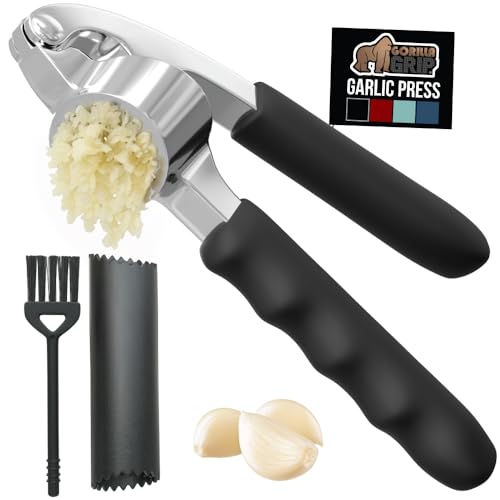
The only listing in this search that publishes a dimension, and on a lever that makes it the only one telling you anything real about effort: the press is 6.8 inches long, the roller 5.1 and the brush 4.3. The handle is oversized with finger notches, the chamber is heavy-duty zinc alloy, and it is sized for many small cloves or one elephant garlic clove, which is a specific and testable claim. It is third-party tested to comply with US regulations, which nobody else here mentions.
Pros:
- The only press publishing its length, at 6.8 inches
- Oversized handle with finger notches; real leverage
- Takes an elephant garlic clove; a specific claim
- Third-party tested; peeler and brush included
Cons:
- No stud or hole count published
- Costs several times the cheap zinc presses
- No built-in cleaner, at this price
Best for: big cloves, and hands that need the leverage.
OXO Good Grips
Five plain lines and one of them is the reason this press has been the answer for years: a built-in cleaner that pushes the peels and pulp back out through the holes. That is the job everyone else hands you a brush for, solved inside the tool. The body is die-cast zinc, which is stiff and heavy where it needs to be, the chamber takes multiple cloves, and the handles are soft and non-slip so they absorb the pressure rather than printing it into your palm. Dishwasher safe.
Pros:
- The only press with a built-in cleaner; no brush needed
- Die-cast zinc; stiff where a lever must be
- Soft non-slip handles that absorb the squeeze
- The second best seller here; large chamber
Cons:
- Costs double or triple the cheap zinc presses
- No dimensions or hole count published
- No peeler in the box
Best for: never fighting a brush again.
Detachable Handle
The most expensive press here and it solves the cleaning problem from the other direction: the handle comes apart, and the listing makes the point that matters, that there are no hinges or hooks to trap food. Anyone who has picked dried garlic out of a hinge will understand the appeal. It is 304 stainless throughout with round grill holes aimed at fine mincing, it presses unpeeled cloves with the skin staying behind, and it carries a lifetime warranty from a brand that named itself after one.
Pros:
- Handle detaches; no hinges or hooks to trap food
- 304 stainless steel throughout
- Round grill holes aimed at fine mincing
- Lifetime warranty
Cons:
- By far the most expensive press here
- Steel, where the category standard is zinc
- No dimensions or hole count published
Best for: cleaning it properly, forever.
The verdict
It is a lever, and one listing in ten publishes its length. Zinc is the category standard for good reasons that one brand bothers to explain. Everything promising you need not peel is telling you the peel ends up in the basket instead, and half of them ship a peeler anyway.
Best overall: OXO Good Grips. The second best seller here and the only press that builds the cleaner into the tool, pushing peels and pulp back out through the holes instead of handing you a brush and wishing you luck. Die-cast zinc gives a lever the stiffness it needs, the chamber takes several cloves, and the soft handles absorb the squeeze rather than transmitting it into your palm.
Best value: Zulay Kitchen. The runaway best seller in this search, ranked far ahead of anything else, for the price of a sandwich, with a silicone peeler and a brush in the box and a lifetime warranty behind it. It never says what it is made of, which is a fair criticism, and its advice to rinse before the pulp hardens is the most practical sentence on this page.
Best premium: Detachable Handle. It costs the most and it earns it on the one thing that sends garlic presses to the back of a drawer: cleaning. The handle comes apart and there are no hinges or hooks for pulp to hide in, which is a design answer rather than a brush. 304 stainless throughout, round holes for fine mincing, backed for life.
FAQ
Zinc or stainless steel?
Zinc, usually, and it is not the cheap option. Kitessensu explains why: it is stiff enough to press a clove without flexing, and non-reactive, so garlic’s acids do not leave a smell behind. The best-regarded press here is die-cast zinc. Stainless is a choice to check, not a promise.
Can I really press an unpeeled clove?
Yes, and then the peel is inside the chamber. Four listings promise this and all four say where the skin ends up. Several also include a silicone peeler, which rather gives the game away.
Why is my garlic press so hard to squeeze?
Short handle. It is a lever, so length is leverage, and only Gorilla Grip publishes one, at 6.8 inches. Everything else describes its ergonomics without giving you the number that decides the effort.
What is the easiest one to clean?
OXO builds a cleaner into the press that pushes pulp back out through the holes. The dearest press here takes its handle apart and has no hinges for food to hide in. Everything else gives you a brush and tells you to rinse it before the pulp dries.
Is a rocker better than a press?
It is different. A rocker uses your body weight instead of your grip and has nothing to unclog, which suits weak hands. It minces on a board rather than making paste in one squeeze, and you need the board.
This article may contain affiliate links; see our Affiliate Disclosure.