The best-selling product in this search is not a pot. It is a wire basket, it costs a fraction of everything else here, and it outsells the nearest complete pot by more than three to one. That is people working out something the rest of the category would rather they did not: you probably already own the pot. What you are missing is the thing that lifts the pasta out of the water, so you never carry a gallon of boiling water across a kitchen again.




At a glance
| Product | Capacity, oven limit and the catch | Price tier | Link |
|---|---|---|---|
| Gotham Steel | 5qt. Strainer lid, not an insert. 300F oven | Budget | |
| Tramontina Insert | Basket only. The best seller, by a distance | Budget | |
| CLMSTE Multipot | 8qt, but two steamer inserts and no pasta one | Budget | |
| Oster Sangerfield | 5qt. Not induction, and it says so last | Mid-range | |
| EXCELSTEEL | 12qt. Title and bullets disagree on height | Mid-range | |
| OXO | 8.4qt. The only interior volume markings | Mid-range | |
| All-Clad | 8qt. 600F oven, lifetime warranty, 90% recycled | Premium | |
How to choose
An insert and a strainer lid are opposite ideas
This is the fork in the search and the listings blur it. An insert is a basket that sits in the water: you lift the pasta out and the water stays on the hob, cooling down safely where you left it. A strainer lid has holes in it, which means you pick up a full pot of boiling water and carry it to the sink. Both drain pasta. Only one of them means never moving a gallon of boiling water again, and that is the reason inserts exist. Work out which you are buying.
Five quarts is not much once the basket is in it
A pound of pasta wants a lot of water, and the capacities here run from 5 quarts to 12. Now put a basket inside the 5-quart pot, fill it enough to cover the pasta, and remember that boiling water climbs. There is not a lot of headroom left. The 8-quart pots are the sensible middle, the 12-quart ones are for a crowd or a crab boil, and the 5-quart ones are a tight fit for a family portion. Capacity is the first number, before any of the clever features.
Check the oven limit, because one of them contradicts itself
The oven ratings here run from 300 degrees to 600, which is a factor of two on the same shelf of products. All-Clad states 600, and plain stainless steel is generally happy there. The 300-degree pot is the one to look at twice, because its own listing recommends one-pot meals that go from burner to broiler. A broiler runs far hotter than 300. You cannot do both, and the listing offers no way to reconcile them, so take the number and ignore the sentence.
One pot cannot do induction, and it mentions it last
Induction has become the default assumption, and most of these are compatible and say so early. One is not. Its bullet opens with the words versatile compatibility, lists gas, electric and ceramic, promises reliable performance and even heat distribution, and then closes the same sentence with a parenthetical saying it will not work on induction. If your hob is induction, that bracket is the whole review. Read to the end of every compatibility bullet, because that is where this information goes.
The insert only works if it fits, and nobody gives you the number
The best seller here is a basket sold to drop into a pot you already own, and it is clear about the risk: it is engineered for one specific 8-quart stock pot, fits many standard 8-quart pots, and it asks you to verify your pot’s interior dimensions first. That is the right advice. It is also slightly maddening, because the listing never publishes the basket’s own dimensions, so you are asked to check a measurement against a number that is not there. Measure your pot, then ask before ordering.
What you can actually compare
Almost every pot here says 18/10 stainless steel with an encapsulated aluminum base, which is the same construction described in the same words, so it is not a differentiator. What varies and matters: the oven limit, whether it takes induction, the capacity, and whether the insert lifts pasta out or the lid makes you carry water. After that come the small mercies, like the one pot with volume markings inside so you can measure water without a jug, and the one with a warranty behind it.
Gotham Steel
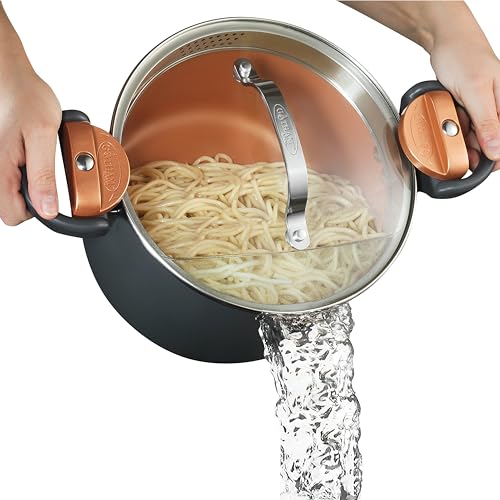
The cheapest complete pot here and the cleverest lid: twist the handles and the strainer lid locks down, so you can tip without it sliding, and there are two hole sizes on it, coarse on one side for ravioli and potatoes and fine on the other for spaghetti. That is a genuinely good idea nobody else attempts. It is a ceramic nonstick, triple-coated, free of PFOA and PFOS, and metal-utensil safe. It is also a strainer lid rather than an insert, so you carry the water, and it is oven safe only to 300 degrees.
Pros:
- Two hole sizes in one lid; nobody else does this
- Twist-and-lock handles clamp the lid down for pouring
- Ceramic nonstick, free of PFOA, PFOS, lead and cadmium
- The cheapest complete pot in this search
Cons:
- A strainer lid, not an insert; you carry the boiling water
- 300 degrees in the oven, half of what the best here manages
- Its broiler suggestion contradicts its own 300 degree limit
Best for: draining without a colander, if you never use the oven.
Tramontina Insert
The best seller in this search by a wide margin, and it is a basket. That is the point: if you own an 8-quart stock pot, this is the only part you are missing, at a fraction of what a whole new pot costs. It is 18/10 stainless, precision-perforated for fast drainage and heat circulation, with ergonomic handles for lifting a heavy load out of boiling water. It also doubles as a large steamer basket. Tramontina is upfront that it is built for its own pot and asks you to verify your interior dimensions.
Pros:
- The best-selling product in this search, by a distance
- A fraction of the price of any complete pot here
- 18/10 stainless; doubles as a large steamer basket
- Tells you to measure your pot first; nobody else does
Cons:
- Never publishes its own dimensions to measure against
- Built for one specific pot; fit elsewhere is a gamble
- A basket; you need the pot already
Best for: the pot in your cupboard, for very little money.
CLMSTE Multipot
An 8-quart four-piece set at a price that undercuts every other complete pot here, and it publishes its dimensions, at 9.66 inches square and 12.5 tall, which most of this page will not. The lid is heat and shatter resistant glass so you can watch without lifting. The catch is what is in the box: a main pot, two steaming inserts and a lid. Two steamers, and no pasta insert, in a search for a pasta pot with a strainer insert. It is a good steamer set that has wandered into the wrong aisle.
Pros:
- Cheapest complete 8-quart set here
- Publishes its exact dimensions
- Two steaming inserts for stacked steaming
- Shatter-resistant glass lid
Cons:
- No pasta insert; two steamers instead
- No oven limit or induction compatibility stated
- The worst-selling product on this page
Best for: steaming, which is not what this search asked for.
Oster Sangerfield
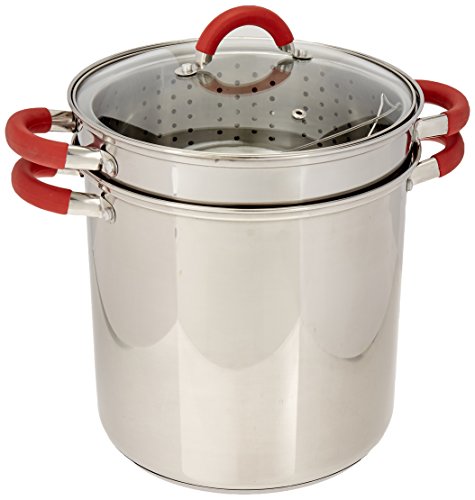
A proper four-piece set: a 5-quart pot, a lid, a steamer insert and a strainer insert, so unlike much of this page you get both baskets. It is the only listing here that publishes a weight, at 3.6 pounds, alongside its assembled dimensions, which is more courtesy than anyone else manages. Polished stainless with an encapsulated aluminum base, stay-cool riveted handles and a tempered glass lid. Then the last bullet, after the words versatile compatibility, quietly says it will not work on induction.
Pros:
- Both a steamer insert and a strainer insert included
- The only listing publishing a weight
- Stay-cool riveted handles; tempered glass lid
- Encapsulated aluminum base for even heat
Cons:
- Not compatible with induction, stated last and in brackets
- 5 quarts is tight once the basket is in
- No oven limit published
Best for: a full set on a gas or electric hob, never induction.
EXCELSTEEL
Twelve quarts, which is a serious pot: enough for a crowd, a seafood boil or several pounds of pasta at once, in 18/10 stainless with an encapsulated base and induction ready. The silicone-covered handles and knob are a real improvement when you are moving a full 12-quart pot, which is heavy and hot in equal measure. The listing is short and it disagrees with itself on height: the title says 14 inches, the bullet says 9.5. One of those is the pot and one is something else, and it never says which.
Pros:
- 12 quarts; among the largest here
- Silicone-covered handles and knob for a hot, heavy pot
- 18/10 stainless, induction ready
- Encapsulated base for even heat
Cons:
- Title says 14 inches tall; the bullet says 9.5
- No oven limit published
- A very sparse listing for the money
Best for: cooking for a crowd, if you can spare the cupboard.
OXO
Eight and a half quarts in a four-piece set with both a pasta insert and a steamer insert, induction ready, on an encapsulated base. Two details set it apart and both are small mercies you notice weekly. There are volume markings inside the pot, so you measure water without a jug, which nothing else here offers and which matters if you salt your pasta water by ratio. And the edges are angled into pouring rims, so tipping it does not run down the outside of the pot and onto the hob.
Pros:
- The only pot here with interior volume markings
- Both pasta and steamer inserts included
- Angled pouring rims; genuinely drip-free
- Induction ready; encapsulated base
Cons:
- No oven limit published
- Sells poorly against cheaper sets
- No warranty mentioned
Best for: measuring the water without hunting for a jug.
All-Clad
Several times the price of anything else here and it earns it on numbers rather than adjectives: oven safe to 600 degrees, double the lowest on this page, any stovetop including induction, and a limited lifetime warranty, which is the only warranty in this search. The body is 90 percent recycled stainless steel. The insert is wide and deep with straining holes in the base and extra-wide handles you can grip in oven mitts. And it tells you plainly what most premium brands bury: designed in Pennsylvania, made in China.
Pros:
- 600 degree oven limit; the highest here by far
- The only limited lifetime warranty in this search
- 90 percent recycled stainless steel body
- States where it is made, plainly
Cons:
- Several times the price of every rival here
- No steamer insert; the pasta insert only
- Handwashing recommended despite being dishwasher safe
Best for: buying once, with a warranty and real numbers.
The verdict
An insert lifts the pasta out and leaves the water on the hob. A strainer lid makes you carry a gallon of boiling water to the sink. That is the real fork here, and the best seller in the search is people realizing they only need the basket. After that, check the oven limit, which ranges over a factor of two, and read the compatibility bullet to the end.
Best overall: Tramontina Insert. The best seller in this entire search and the cheapest answer by a mile, because most kitchens already contain an 8-quart stock pot and this is the part that turns it into a pasta pot. 18/10 stainless, fast-draining, doubles as a big steamer, and it is the only listing here that tells you to measure your pot before ordering. Measure it, then ask the seller for the basket’s dimensions, because those it does not print.
Best value: Gotham Steel. The cheapest complete pot here, with the only genuinely novel idea in the search: a strainer lid that twist-locks onto the pot and carries two hole sizes, coarse for ravioli and fine for spaghetti. Take it for what it is, which is a pot you carry to the sink rather than a basket you lift out, and note the 300 degree oven limit and the broiler suggestion that cannot coexist with it.
Best premium: All-Clad. It costs several times its rivals and it is the only pot here with a lifetime warranty, a 600 degree oven rating, induction compatibility and a 90 percent recycled body. The insert is wide and deep with handles sized for oven mitts. And the listing says designed in Pennsylvania, made in China, which is the kind of sentence most brands at this price leave out entirely.
FAQ
Insert or strainer lid?
Insert, if you can. A basket lets you lift the pasta out and leave the water sitting safely on the hob. A strainer lid means picking up a pot full of boiling water and walking it to the sink, which is the thing the insert was invented to avoid.
Do I need a whole new pot?
Probably not, and the market agrees: the best seller in this search is a basket, not a pot. If you own an 8-quart stock pot, the basket is the only missing part, at a fraction of the price. Measure the inside of your pot first.
What capacity should I get?
Eight quarts is the sensible middle. Five is tight once the basket is in and the water needs room to boil without climbing out. Twelve is for a crowd or a seafood boil, and it is a large thing to store.
Why does the oven rating matter?
Because it ranges from 300 degrees to 600 across this page, and 300 is barely an oven. One pot rated to 300 also suggests going from burner to broiler, which a broiler’s temperature makes impossible. Take the number over the sentence.
Will these work on induction?
Most, but read to the end of the compatibility bullet. One pot here opens that bullet with the word versatile, lists three hob types, and then closes with a bracket saying it will not do induction. That bracket is the whole story if induction is what you have.
This article may contain affiliate links; see our Affiliate Disclosure.