A pull-through sharpener works by scraping metal off your knife. That is not a criticism, it is the mechanism, and it is why one of the pricier tools here sells against them by name, promising to restore sharpness while helping preserve blade life. Both are telling you the truth. You just need to know which trade you are making.




Four approaches sit on this page. A pull-through drags the blade past fixed abrasives and sets whatever angle the slot was cut at. A roller holds the knife at a magnet-set angle while you roll an abrasive disc along it. A guided system clamps the blade and lets you dial the angle yourself. An electric one spins the abrasive and does the work. They differ in speed, in control, and in how much of your knife they consume.
At a glance
| Sharpener | Standout feature | Price tier | Link |
|---|---|---|---|
| AccuSharp | Cheapest here; blades last 5 to 10 years | Budget | |
| SHARPAL 191H | Suction base holds it down so both hands are free | Budget | |
| KITCHELLENCE | Best seller here; three stages and a glove | Budget | |
| Narcissus | Cheapest electric; collects the metal dust | Budget | |
| AIERLIAN | Publishes its grits; includes a leather strop | Mid-range | |
| Tumbler | The rolling design, with a honing helix disc | Premium | |
| Work Sharp Precision Adjust Elite | Any angle from 15 to 30 degrees, explained | Premium | |
| Chef’s Choice 15XV | Regrinds a 20 degree edge to 15, on purpose | Premium | |
How to choose a sharpener
The angle is the specification, and most tools choose it for you
Work Sharp prints the clearest explanation in this whole category: 15 degrees for Japanese-style knives, 20 for Western kitchen knives, 25 for hunting blades, 30 for cleavers. That is the map. A pull-through has its slots cut at one fixed angle and applies it to whatever you feed in, so a Japanese knife ground at 15 comes out reground toward the slot’s angle, losing steel and its character in the process. The rollers here at least let you pick 15 or 20 with a magnet. Only the guided system lets you set the number.
Pull-throughs are fast, effective and hungry
Carbide slots take a lot of metal, quickly, which is exactly what you want on a tired supermarket knife and exactly what you do not want on something expensive. Tumbler makes the point in its own listing, positioning against basic pull-throughs specifically on blade life. Both are being straight with you. If your knives cost less than the sharpener, use the fast thing and enjoy it. If any knife in the block was a present you would be sad to lose, do not put it through a slot.
Grit numbers are the plain way to describe an abrasive
Two brands here publish them. AIERLIAN uses a 400 diamond disc to cut and a 3000 ceramic to refine. Work Sharp gives you a 320 coarse diamond plate and a 600 fine one, plus a ceramic finishing rod. Everyone else says diamond, tungsten carbide or ceramic and leaves it there, which tells you the material but not how aggressive it is. Coarse repairs damage, fine sets the edge, and something very fine polishes it. A tool that names its grits is a tool that has thought about the sequence.
Serrated blades need a rod, not a slot
Several sharpeners here claim to handle serrated knives and most of them do it by dragging the scallops past an abrasive, which touches the tips and misses the valleys. Work Sharp is the one that solves it properly, with a dedicated conical ceramic rod sized to sit inside a serration. Chef’s Choice also sharpens serrated edges through its diamond stages. If your bread knife matters, that conical rod is the feature to look for.
Read what an electric sharpener will do to your bevel
Chef’s Choice is admirably upfront: the 15XV is designed for converting traditional 20 degree factory edges into 15 degree edges. That is not a touch-up, it is regrinding the entire bevel, permanently, and it is a genuine upgrade if a sharper, more acute edge is what you want. It is also a surprise if you assumed a sharpener maintains what you already have. Know which one you are buying before you switch it on.
Safety is a real feature, not padding
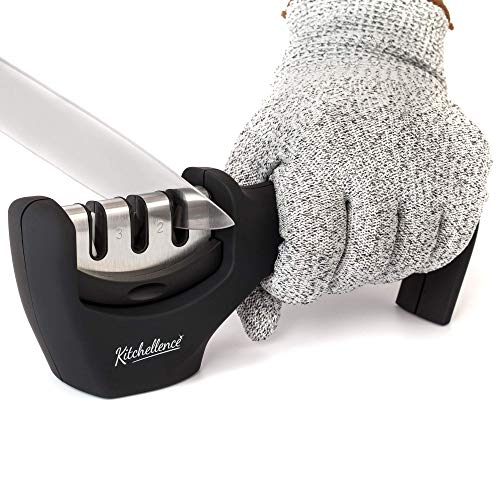
You are dragging a blade toward yourself. KITCHELLENCE and the other pull-throughs include a cut-resistant glove, and non-slip bases are standard. SHARPAL goes furthest with a suction base it says is twice as strong as rivals, activated by a switch, so the sharpener stays put and you are not holding it steady with your spare hand while pulling steel past it. That is a small engineering decision with an obvious payoff.
AccuSharp
The cheapest sharpener here and one of the longest-lived designs in any kitchen drawer. Diamond-honed tungsten carbide blades, double-bevelled so you can flip them when one side wears, and AccuSharp reports most people go five to ten years before replacing them. It sharpens most blades in about ten seconds, straight or serrated, from paring knives to cleavers, and the ergonomic handle works in either hand. This is the fast, blunt, effective end of the category and it does not pretend otherwise.
Pros:
- Cheapest sharpener here
- Diamond-honed tungsten carbide; blades last 5 to 10 years
- About ten seconds per knife
- Reversible blades; works either handed
Cons:
- Fixed angle, whatever your knife was ground at
- Carbide removes a lot of steel
- No polishing or honing stage
Best for: everyday knives you use hard and do not baby.
SHARPAL 191H
The one that fixes the awkward part. Press a switch and the suction base clamps to the counter with what SHARPAL says is twice the force of comparable products, so the sharpener stays put and both your hands are free for the knife. Three stages cover the sequence properly: tungsten carbide to set an edge quickly, ceramic to hone it, and a dedicated slot for serrated blades. It is small enough to disappear in a drawer, and SHARPAL is a real company with offices on three continents and a three-year commitment behind it.
Pros:
- Suction base holds it down; no hand needed to steady it
- Carbide to cut, ceramic to hone, plus a serrated slot
- Compact enough to store anywhere
- Three-year support from an established company
Cons:
- Fixed angles; no adjustment
- Needs a smooth flat surface for the suction to work
- No grit figures published
Best for: a safer, steadier pull-through, for the same money.
KITCHELLENCE
The best-selling sharpener on this page, and it earns that by doing the whole sequence in one cheap tool. The first slot is a diamond rod that repairs and straightens genuinely damaged edges, then the later stages set and polish, so a knife with a chip goes in and a working knife comes out. The handle suits either hand, the base is non-slip, and a cut-resistant glove is in the box, which matters given what you are about to do. Solid ABS, and it takes seconds.
Pros:
- The best-selling sharpener here
- Diamond rod repairs damaged edges, not just dull ones
- Three stages from repair to polish in one tool
- Cut-resistant glove included; non-slip base
Cons:
- Fixed angle; wrong for Japanese knives
- No grits or angles published anywhere
- Aggressive on good steel
Best for: a block of ordinary knives, one of which has a chip in it.
Narcissus
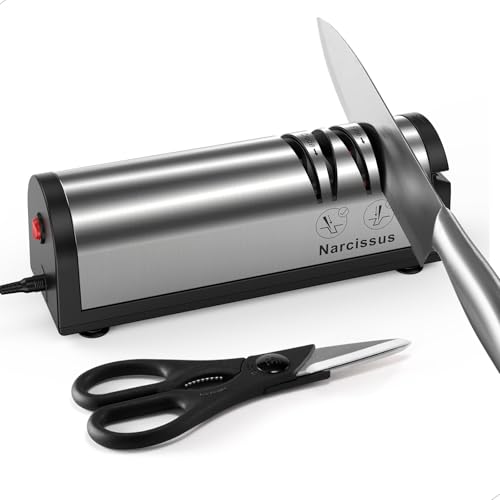
The cheapest way to let a motor do it. A 30 watt DC motor runs continuously for over an hour, so you can do the whole block in one sitting rather than one knife at a time, across two stages: coarse to cut and fine to polish. There is a scissors slot on the side, and the detail worth noticing is the metal dust collection box, because an electric sharpener produces a surprising amount of swarf and it has to go somewhere. Narcissus backs it with twelve months of free replacement or refund.
Pros:
- Cheapest electric sharpener here
- Runs over an hour continuously; do the whole block at once
- Metal dust collection box, which most electrics skip
- Scissors slot; twelve-month replacement policy
Cons:
- Two stages only; no stropping
- No angle published, and no way to change it
- A powered abrasive is the fastest way to remove too much
Best for: a drawer full of dull knives and no patience.
AIERLIAN
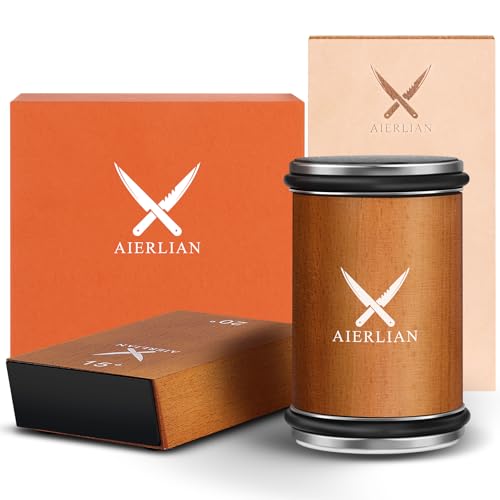
The rolling design at a sensible price, and it publishes the numbers the cheap tools hide: a 400 grit diamond disc to cut and a 3000 grit ceramic disc to refine. Four N42 magnets in a natural wood block hold the knife at either 15 or 20 degrees, so the angle stays constant while you roll, which is the variable that ruins freehand sharpening. A leather strop is included for the final polish, which is the step that turns sharp into genuinely sharp. It comes in a gift box, which tells you who it is aimed at.
Pros:
- Publishes both grits: 400 diamond and 3000 ceramic
- Magnetic support at 15 or 20 degrees; constant angle
- Leather strop included for a polished finish
- Far cheaper than the other rolling option
Cons:
- Only two angles, so no cleavers or hunting bevels
- More steps than a pull-through; slower
- Wood and magnets need somewhere dry to live
Best for: good kitchen knives, a constant angle, and a strop at the end.
Tumbler
The original rolling sharpener, and the brand that names the problem it exists to solve: unlike basic pull-throughs, it uses a diamond-plated disc to restore sharpness while preserving blade life. That is the real pitch for this whole design. Secure the blade against the magnetic angle support at 15 or 20 degrees, roll the diamond disc to sharpen, then swap to a proprietary stainless helix disc that hones and refines the edge. No stones, no water, no mess, and fixed magnets doing the thinking. It costs a lot for something with no motor.
Pros:
- Diamond disc removes far less steel than a carbide slot
- Magnetic support locks 15 or 20 degrees
- Stainless helix disc hones after sharpening
- No mess, no water, no technique to learn
Cons:
- Costs three times the AIERLIAN doing the same thing
- Publishes no grit figures
- Two fixed angles only
Best for: knives you want kept sharp rather than kept being reground.
Work Sharp Precision Adjust Elite
The only tool here that lets you set the number, anywhere from 15 to 30 degrees, and the only listing that explains what those numbers are for: 15 for Japanese knives, 20 for Western kitchen knives, 25 for hunting blades, 30 for cleavers. Clamp the blade, set the angle, sharpen. The kit is complete: a 320 grit coarse diamond plate, a 600 grit fine one, a ceramic finishing rod, a conical ceramic rod that genuinely fits inside a serration, and a tri-brasive attachment for curved blades. Everything about it is guided, so it is hard to do badly.
Pros:
- Adjustable 15 to 30 degrees, and explains which is which
- Publishes its grits: 320 coarse and 600 fine diamond
- A real conical rod for serrated blades, not a slot
- Guided clamp makes it difficult to get wrong
Cons:
- Among the most expensive here
- Clamping and setting up takes real minutes per knife
- More parts than anything else on this page
Best for: a mixed collection where every knife wants a different angle.
Chef’s Choice 15XV
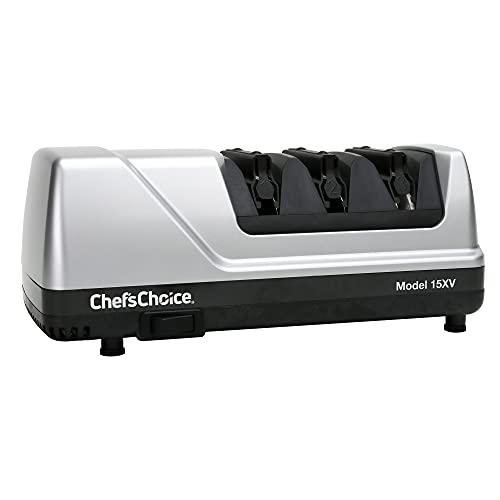
The serious electric, and it is doing something more ambitious than sharpening: it converts a traditional 20 degree factory edge into a 15 degree one, permanently regrinding the bevel to something more acute. Three stages of 100 percent diamond abrasives, with a stropping stage at the end, and patented flexible spring guides that hold the angle for you rather than trusting your hand. It handles straight and serrated blades, carries a three-year warranty, and it is the most expensive thing here. Understand the conversion before you use it, because it is not reversible.
Pros:
- Three stages of 100 percent diamond, including a stropping stage
- Spring guides hold the angle automatically
- Sharpens serrated as well as straight edges
- Three-year warranty; publishes its dimensions
Cons:
- Most expensive sharpener here
- Regrinds your 20 degree edges to 15, permanently
- A powered diamond abrasive is unforgiving of mistakes
Best for: deliberately converting Western knives to a finer edge.
The verdict
Best overall: KITCHELLENCE. The best-selling sharpener here, and for the knives most people actually own it is the right tool: a diamond rod that repairs a chipped edge, then stages that set and polish it, in about the time it takes to fill a kettle. It comes with a glove, which you will want. It is a fixed angle and it is hungry on steel, so keep it away from anything Japanese, and for the block by the hob it is hard to beat at this price.
Best value: AccuSharp. The cheapest thing here, with diamond-honed tungsten carbide blades that flip when one side wears and, by AccuSharp’s own reckoning, last five to ten years before replacement. Ten seconds a knife, straight or serrated, either hand. It has one angle and no finesse whatsoever. For a working kitchen where knives are tools rather than heirlooms, that is the entire point.
Best premium: Work Sharp Precision Adjust Elite. The only sharpener here that lets you choose the angle, from 15 to 30 degrees, and the only listing that teaches you which number belongs on which knife. Add published grits, a clamp that removes your hand from the equation, and a conical rod that actually fits inside a serration. It is slow, it has the most parts, and it will sharpen anything you own correctly.
FAQ
Will a pull-through ruin my knives?
It depends what they are. Carbide slots remove a lot of steel quickly at whatever fixed angle they were cut, which is perfect for a tired supermarket knife and wrong for a Japanese blade ground at 15 degrees. Tumbler sells against pull-throughs on exactly this point, and it has a case. Cheap knives, use the fast thing. Good knives, do not.
What angle does my knife need?
Work Sharp’s listing is the best answer in the category: about 15 degrees for Japanese-style knives, 20 for Western kitchen knives, 25 for hunting blades and 30 for cleavers. Most pull-throughs pick one for you and apply it regardless. The rollers offer 15 or 20; only the guided system lets you set it.
Do any of these really sharpen serrated knives?
Properly, only the ones with a rod. A slot drags the scallop tips past an abrasive and misses the valleys. Work Sharp includes a conical ceramic rod sized to sit inside a serration, and Chef’s Choice sharpens serrated edges through its diamond stages. Most other serrated claims here are optimistic.
What do the grit numbers mean?
How aggressive the abrasive is. AIERLIAN uses 400 diamond to cut and 3000 ceramic to refine; Work Sharp uses 320 coarse and 600 fine. Low numbers repair damage and remove metal, high numbers polish. Brands that publish grits have thought about the sequence; brands that just say diamond have told you the material and nothing else.
Is an electric sharpener a shortcut?
It is faster and less forgiving. A motor removes steel quickly and does not notice when it has taken enough. The Chef’s Choice goes further and deliberately regrinds a 20 degree edge to 15, which is a real upgrade if you want it and a permanent surprise if you did not read the box.
This article may contain affiliate links; see our Affiliate Disclosure.