You are not buying five reflectors. You are buying one translucent disc and a reversible zip-on sleeve with four surfaces, which together give five effects. Three brands here say that outright in a note at the bottom of the listing. The others let you find out when the box arrives.




Once you know that, the decision gets simple, because these discs are all made of the same few things. What actually differs is how big the disc is, which decides how soft the light is, and whether the kit includes anything to hold it, which decides whether you can use it without a friend standing in the cold.
At a glance
| Reflector | Standout feature | Price tier | Link |
|---|---|---|---|
| HerFarCai 12 inch | Cheapest here; pocket-sized for product work | Budget | |
| NEEWER 22 inch | Folds to about a third of its size | Budget | |
| K&F Concept 24 x 36 oval | Oval shape suits a standing person | Budget | |
| K&F Concept 32 inch | Real about what 5-in-1 means; right size for a face | Budget | |
| UTEBIT 43 inch | Stand and clip in the box; 90 percent reflectivity | Mid-range | |
| NEEWER 43 inch | Biggest here, with grips and a clamp | Mid-range | |
| WELLMAKING 32 inch | Dual grips, tilt adapter, stand and threads | Premium | |
How to choose a reflector
Five effects, one disc
K&F Concept prints it in a note on every listing, and HerFarCai does the same: this is a translucent panel with four coatings on a reversible sleeve, giving five photographic effects rather than five separate reflectors. That is not a criticism, it is how every 5-in-1 has always worked, and the clarity is worth rewarding. The practical consequence is that changing surface means unzipping and reversing a sleeve, so you cannot go from silver to gold in a hurry with a subject waiting.
What each surface actually does
The listings explain this better than most people expect. Translucent goes between the sun and your subject to soften it, which is the one you will use most and the only one that is not a reflector at all. White bounces a soft, neutral fill. Silver bounces harder and brighter, which is contrasty and can be unkind to skin up close. Gold warms the light, useful at the ends of the day and easy to overdo. Black reflects nothing and that is the point: it subtracts light, deepening a shadow you want kept dark, which is the surface nobody buys a reflector for and professionals reach for constantly.
Size is the only spec that changes the picture
Bigger discs make softer light, because a larger source relative to your subject wraps around it. The range here runs from 12 inches up to 43. A 12 inch disc is for a plate of food or a watch; a 22 is for a head and shoulders in tight; a 32 is the sensible portrait size; a 43 is the one that lights a whole standing person and, on a breezy day, tries to take off. Match the disc to the subject, not to the budget.
Round or oval
Almost every reflector is round because it folds neatly, and people are not round. K&F’s oval, at 24 by 36 inches, is the same idea in a shape that matches a standing figure: tall where you need coverage, narrow where you do not, so you carry less disc for the same result. If you shoot people rather than objects, that geometry earns its place.
Somebody has to hold it, and that is the real decision
A reflector on the floor does nothing. The cheap discs here come with no handle and no mount, which means an assistant or a lot of improvising. WELLMAKING and NEEWER both fit dual grips, so you can aim it one-handed. NEEWER’s 43 inch adds a heavy-duty metal clamp for any standard light stand, and UTEBIT and WELLMAKING both include a stand in the box. If you work alone, that is the feature to buy, and it is the only real difference between a cheap disc and an expensive one.
Threads and adapters, if you already own stands
Check the fitting before you assume it works with your kit. NEEWER’s grips carry a 3/8 inch thread. WELLMAKING’s dual handle model has both 1/4 inch-20 and 3/8 inch-16 threads plus a tilt adapter, which is what lets you set an angle and walk away. NEEWER’s clamp fits standard 5/8 inch light stands. Those numbers are the difference between a reflector that joins your setup and one that sits in a bag.
HerFarCai 12 inch
Tiny, cheap, and fair. HerFarCai prints the note plainly: five effects, not five reflectors, from one collapsible disc. At 12 inches this is a product and macro tool, the thing you tuck behind a bottle or beside a plate to lift a shadow, and it will do nothing useful for a portrait. Gold, silver, white, black and translucent are all there, the fabric resists fading, and it zips into a pouch that goes in a camera bag pocket rather than needing its own space.
Pros:
- Cheapest reflector here by a wide margin
- States plainly that it is five effects, not five reflectors
- Small enough to live in a camera bag pocket
- Genuinely useful for product, macro and food work
Cons:
- 12 inches is far too small for a person
- No handle, grip or mount of any kind
- Small discs make hard light, not soft
Best for: lifting shadows on small subjects, on a tabletop.
NEEWER 22 inch
The long-standing budget disc, and its virtue is portability: a twist folds it to roughly a third of its size and it comes with a case, so it goes everywhere and costs almost nothing. Zip on whichever surface you want, use it in a studio or outdoors, and there is a built-in accessory loop so you can hold, hang or mount it rather than only clutch it. At 22 inches it suits a head and shoulders at close range. It has no grips, so expect to hold it by the rim.
Pros:
- Folds to about a third of its size; case included
- Built-in accessory loop for holding, hanging or mounting
- All five surfaces zip on and off
- Very cheap
Cons:
- No grips, tilt adapter or stand
- 22 inches is small for a full portrait
- Does not print the five-effects note the real brands do
Best for: throwing in a bag and having something rather than nothing.
K&F Concept 24 x 36 oval
The shape argument. People are tall and narrow, and a 24 by 36 inch oval matches that better than a circle of the same area, so you get the coverage where a standing subject needs it without carrying a disc that is mostly wasted. The five surfaces are the usual gold, silver, white, black and translucent, and K&F explains what each one does rather than listing colors. The fabric resists fading, the zip is decent, and it folds into a handheld bag. K&F also prints the plain note about what 5-in-1 means.
Pros:
- Oval shape matches a standing person
- Prints the real five-effects note
- Explains what each surface does, not just its color
- Fade-resistant fabric; folds into a carry bag
Cons:
- No handle, grips or mount
- Oval discs are more awkward to fold than round ones
- Narrow, so it is less useful for wide subjects
Best for: portraits of standing people, cheaply.
K&F Concept 32 inch
The sensible middle, and the size most people should own: 32 inches is big enough to make genuinely soft light on a face and small enough to hold steady on a windy afternoon. K&F walks through the surfaces properly, explaining that translucent goes above the subject to soften sunlight and white bounces a neutral fill, which is more useful than another paragraph about premium quality. Fade-resistant gold and silver fabric, a good zip, quick folding and a handheld bag. And the plain note again about five effects rather than five reflectors.
Pros:
- 32 inches is the right size for portrait work
- Prints the real five-effects note
- Explains the purpose of each surface
- Fade-resistant fabric; folds small with a bag
Cons:
- No grips, clamp or stand included
- Round, so less efficient than an oval on a standing figure
- Nothing to mount it to without buying more
Best for: the right size disc at the right price, if you have a helper.
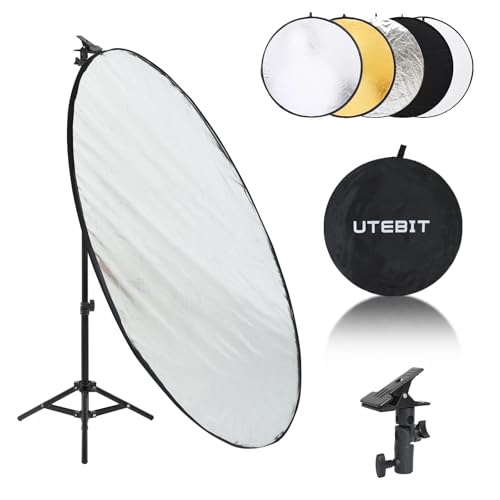
UTEBIT 43 inch
The kit that solves the actual problem: a 43 inch disc, an adjustable metal clip mount and a light stand, all in the box, so you can position it and let go. That is the whole difference between owning a reflector and using one when you work alone. It is the biggest disc here, which means the softest light and a full standing figure covered, and UTEBIT is the only brand quoting a number for the coating, claiming up to 90 percent reflectivity. It collapses to 17 inches and comes with a case.
Pros:
- Stand and clip mount included; no assistant needed
- 43 inches covers a standing person with soft light
- The only brand here quoting a reflectivity figure
- Folds to 17 inches with a carry case
Cons:
- A 43 inch disc on a light stand catches wind like a sail
- The bundled stand is a bundled stand
- Does not print the real five-effects note
Best for: working alone, indoors, with a full-length subject.
NEEWER 43 inch
The big one done properly. Two hand grips let you aim and hold it without pinching the fabric, one carrying a 3/8 inch thread, and a heavy-duty metal clamp holder fits any standard 5/8 inch light stand, so it works handheld or mounted with kit you probably own. The panel is flexible alloy steel under quality polyester, built to be twisted flat repeatedly without taking a set, and it folds into the bag supplied. At 43 inches it is the softest light on this page.
Pros:
- Dual grips plus a heavy-duty clamp for standard light stands
- 3/8 inch thread on a grip for accessories
- Alloy steel frame that survives repeated folding
- 43 inches; the softest light here
Cons:
- No stand included, only the clamp
- A large disc is genuinely hard to hold in wind
- Does not print the five-effects note
Best for: big soft light, if you already own a light stand.
WELLMAKING 32 inch
The most complete kit here, and it is built around the manageable 32 inch size rather than the unwieldy 43. Dual comfort grips for one-handed use, a tilt adapter so you can set an angle and leave it, both 1/4 inch-20 and 3/8 inch-16 threads so it fits essentially any stand or arm you own, and a portable white light stand in the box. The coating is a multi-layer reflective finish with a raised grain, and it folds to 12 inches with a case. It costs the most here, and it is the only one where nothing is missing.
Pros:
- Dual grips, tilt adapter, threads and a stand all included
- Both 1/4 inch-20 and 3/8 inch-16 fittings
- 32 inches: soft enough for a face, small enough to control
- Folds to 12 inches with a carry case
Cons:
- Most expensive reflector here by a distance
- Does not print the real five-effects note
- Smaller than the 43 inch discs, so slightly harder light
Best for: one purchase that leaves nothing else to buy.
The verdict
Best overall: UTEBIT 43 inch. It ships the two things that turn a reflector from an object into a tool: a clip mount and a light stand, so you can set it, aim it and walk back to the camera. It is also the biggest disc here, which means the softest light and a whole standing person covered, and the only one willing to quote a reflectivity figure. Outdoors in a breeze, a 43 inch disc on a stand is a sail, so keep that in mind.
Best value: K&F Concept 32 inch. The right size for photographing people, at a price that barely registers, from the brand plain enough to print a note explaining that 5-in-1 means five effects from one disc rather than five reflectors. It explains what each surface is for, too. There is nothing to hold it with, so this is the pick if you have a friend or a wall.
Best premium: WELLMAKING 32 inch. Everything else here is missing a piece. This one has dual grips, a tilt adapter, both common thread sizes and a stand, on a manageable 32 inch disc that stays controllable when the wind gets up. It costs several times the cheap discs and it is the only kit where the reflector, the way you hold it and the way you mount it all arrive together.
FAQ
Is a 5-in-1 really five reflectors?
No, and the better brands say so. It is one translucent disc inside a reversible sleeve carrying four surfaces, giving five effects. K&F Concept and HerFarCai both print that as a note; others leave it implied. It also means switching surfaces involves unzipping and reversing a sleeve, not a quick flip.
What is the black side for?
Taking light away. It reflects nothing, so you use it to deepen a shadow that ambient light is filling in when you want contrast. It is the surface nobody buys the kit for and the one professionals use constantly. Everything else here adds light; black is the only one that subtracts it.
What size should I buy?
Match it to the subject, because bigger discs make softer light. Twelve inches is for a plate or a product. Twenty-two suits a tight head and shoulders. Thirty-two is the sensible portrait size. Forty-three covers a standing figure and becomes a sail the moment there is any wind.
Can I use one on my own?
Only if it comes with something to hold it. The cheap discs have no grips and no mount, which means an assistant or propping it against furniture. UTEBIT and WELLMAKING both include stands; NEEWER’s 43 inch includes a clamp that fits standard 5/8 inch stands. That is the single most useful thing to pay for.
Which surface should I use outdoors?
Usually the translucent one, held between the sun and your subject to soften hard light, which is the most common problem outdoors and the one a bounce cannot fix. White for a gentle fill into shadow, silver when you need real punch, and gold only when you want the warmth and mean it.
This article may contain affiliate links; see our Affiliate Disclosure.