A gratin works because every potato slice is the same thickness; a knife cannot promise that, and neither can patience at 6 p.m. A mandoline turns a pile of vegetables into identical slices in seconds — the entire trick is choosing one designed so your fingertips never audition for the blade.




Mandolines come in three shapes: handheld boards you sweep food across, adjustable-dial platforms with interchangeable cuts, and enclosed “safe slice” designs where fingers physically cannot reach steel. Blade quality, thickness control, and the safety system are the whole purchase — and the ten below start with the best-selling classic of the category.
| Slicer | Standout features | Price | Link |
|---|---|---|---|
| OXO Good Grips Handheld | 1 / 2.5 / 4mm settings, bowl-hook foot, the category classic | Budget | |
| Gramercy Adjustable | Rotating blade dial, non-slip base, cut-resistant gloves included | Mid-range | |
| Ourokhome 6-Blade | Six swap-in blades, waffle cut, 2L catch tray | Budget | |
| Stainless Adjustable | All-stainless deck, dial thickness, no blade handling | Budget | |
| PrepSolutions | Thickness dial, hand guard, compact footprint | Budget | |
| SupMaKin Safe | Enclosed blades, push-handle feed, 0.1–8mm range | Mid-range | |
| Compact 3-Setting | 1 / 2.5 / 4mm, comfort grip, cheapest entry | Budget | |
| ZKIRON Handheld | 1 / 2 / 3mm thumb slide, full-cover food holder, bowl hooks | Budget | |
| DASH Safe Slice | 30+ presets 1–8mm, julienne + dice, hands never near blades | Mid-range | |
| OXO Precision Handheld | Five cuts, auto-pressure food holder, clear runway | Mid-range | |
How to choose a mandoline
Speed is guaranteed with any of these. Safety architecture, thickness control, and cleanup are where the designs genuinely differ.
The safety system is the purchase
Mandoline injuries happen at the end of the stroke, when the food gets short. Three defenses exist: hand guards that grip the food (OXO, ZKIRON, PrepSolutions — use them every time, not just when convenient), cut-resistant gloves (bundled with the Gramercy), and enclosed designs (DASH, SupMaKin) where the blade sits inside a chamber and a handle or plunger feeds the food. The enclosed style is the only one that makes contact physically impossible — the right call for households with kids helping, or anyone whose attention wanders while prepping.
Thickness adjustment: steps or dial
Fixed steps (1, 2.5, 4mm on the OXO handheld) cover chips, salads, and gratins with zero ambiguity. Dial systems (Gramercy, PrepSolutions, SupMaKin’s 0.1–8mm, DASH’s thirty-plus presets) slice anywhere in the range — the difference between “thin” and exactly-what-the-recipe-said. Dials matter most for paper-thin work: potato chips and radish garnishes live below 2mm, where a step system may not have the setting you want.
One blade or a blade wardrobe
Straight slicing covers most cooking, but julienne turns the same tool into a slaw and stir-fry machine. The Ourokhome’s six swap-in blades add waffle cuts and shredding; the DASH does julienne and even dicing inside its enclosure; the OXO Precision packs five cuts into a handheld. More blades mean more capability and more small sharp parts to store and wash — be honest about which cuts you will actually use.
Where the slices land
Handheld boards want a bowl or board below — the OXO and ZKIRON hook over bowl rims, which keeps slices contained and the work height comfortable. Platform models with catch trays (Ourokhome’s 2-liter tray) contain the mess entirely and measure your progress. Enclosed models feed into their own chambers. If counter space is tight, handhelds store flat in a drawer; platforms claim cabinet space.
Cleanup and the dishwasher question
Starch dries like glue: rinse any mandoline immediately after use and even the fiddly ones stay easy. Most models here tolerate the dishwasher — the Gramercy advertises it outright — but hand-washing preserves edge sharpness longest, exactly as with knives. Brush along the blade, never across your palm.
OXO Good Grips Handheld Mandoline
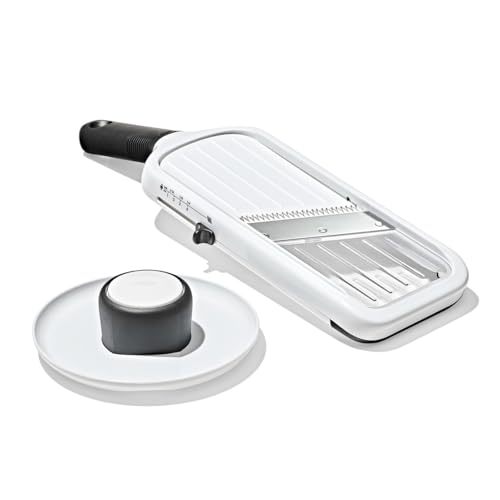
The best-selling mandoline in this comparison is the one to beat: three snap-in settings at 1, 2.5, and 4mm; a large non-slip handle; a stable foot that also hooks over bowls; and a window in the runway that shows how much you have sliced. It stores flat, sets up in two seconds, and does the potato-cucumber-onion routine of an ordinary week with zero drama.
Pros:
- Dead-simple three-setting adjustment
- Hooks over bowls or works flat on a board
- Comfortable, secure grip and included hand guard
- Drawer-flat storage
Cons:
- Straight slices only — no julienne
- Three fixed thicknesses, no in-between
Best for: the everyday default — fast, safe slicing with nothing to learn.
Gramercy Adjustable Mandoline
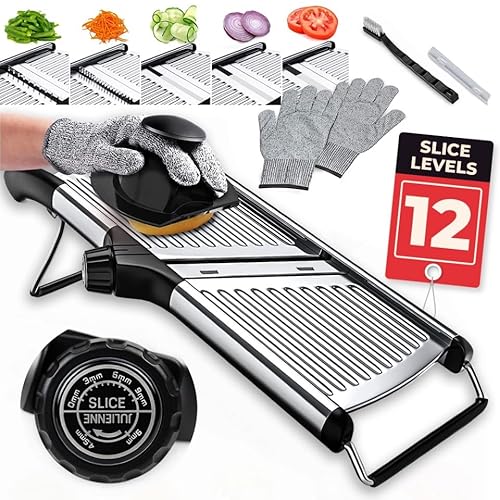
The Gramercy’s rotating blade cylinder switches thickness settings with a dial twist — no blade handling, no parts to swap — and its anti-slip feet plant the platform for two-handed strokes. Cut-resistant gloves ship in the box, an inclusion that says the maker understands what actually sends mandoline users to urgent care, and the whole unit is dishwasher safe.
Pros:
- Dial adjustment never touches a blade
- Cut-resistant gloves included
- Stable non-slip platform for confident strokes
- Dishwasher-safe cleanup
Cons:
- Bulkier storage than flat handhelds
- Costs more than the simple boards
Best for: dial-in thickness control with the safest budget-tier accessory kit.
Ourokhome 6-Blade Slicer
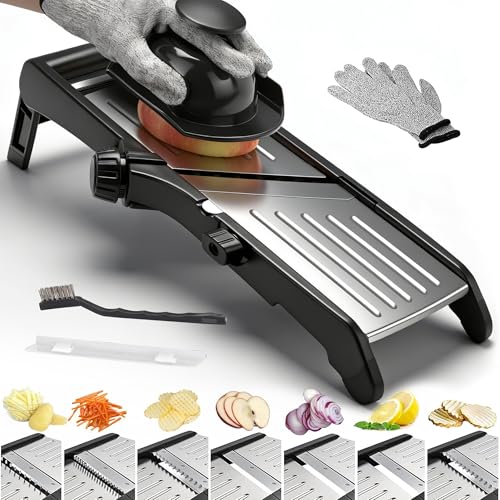
The Ourokhome is the multi-cutter of the group: six razor-sharp interchangeable blades covering 2mm and 4mm slices, shredding, and a waffle cut most mandolines skip, all feeding into a 2-liter catch tray that keeps the counter clean and the output measured. For slaws, gratins, hash browns, and party trays from one tool, this is the feature-per-dollar leader.
Pros:
- Six cuts including waffle and shred
- 2L tray catches and measures everything
- Blades store with the unit
- Bargain price for the versatility
Cons:
- More parts to wash and track
- Blade swaps mean handling sharp steel — carefully
Best for: cooks who want one gadget to replace three single-cut tools.
Stainless Adjustable Mandoline
This slicer’s pitch is the deck: full stainless steel where budget rivals use plastic, so the platform stays rigid and unstained years into service. Thickness settings change without touching the blade, the cutting edge is wide enough for large potatoes and onions, and gloves are included as a handling aid. It is the durability pick of the budget platforms.
Pros:
- Corrosion-resistant stainless deck outlasts plastic
- No-touch thickness switching
- Wide blade takes large produce
- Gloves in the box
Cons:
- Steel deck adds weight
- Included gloves are an aid, not full protection — use the guard
Best for: buyers who have cracked a plastic mandoline and want metal this time.
PrepSolutions Adjust-A-Slice
The Adjust-A-Slice keeps things cheerful and compact: a thickness dial running paper-thin to hearty, stainless blades, a hand guard, and a non-slip base in a bright green shell that stores in almost no space. It is a proven design from a prep-tools specialist at an impulse price — the mandoline for kitchens that use one monthly, not daily.
Pros:
- True dial adjustment at a bottom-tier price
- Compact, light, and easy to stash
- Hand guard and non-slip base included
- Simple enough for first-time users
Cons:
- Smaller runway suits medium produce best
- Plastic body flexes under heavy pressure
Best for: occasional slicing on the smallest budget and shelf.
SupMaKin Safe Mandoline
The SupMaKin encloses its blades completely: food loads into a chamber, a push handle drives it through, and your fingers never share a plane with the steel. Thickness adjusts continuously from a translucent 0.1mm up to 8mm slabs — the widest range here — and the unit folds flat for cabinet storage and rinses clean under the tap.
Pros:
- Fingers physically cannot reach the blade
- 0.1–8mm continuous thickness range
- Folds flat for storage
- Push-handle feed is fast once loaded
Cons:
- Chamber limits maximum produce size
- More mechanism than a simple board
Best for: maximum thickness range inside a fully enclosed design.
Compact 3-Setting Mandoline
The cheapest tool on the list keeps the OXO formula at half the price: 1, 2.5, and 4mm settings, stainless blades, comfort grip, non-slip base, and a hand guard. It is sized for produce under three inches wide — cucumbers, carrots, radishes, small onions — which covers a surprising share of real slicing.
Pros:
- Lowest price here by a margin
- The three most-used thickness settings
- Light and drawer-friendly
- Guard and grippy base included
Cons:
- Three-inch produce ceiling rules out big potatoes
- Build matches the price
Best for: salads-and-garnish slicing at pocket-change cost.
ZKIRON Handheld Slicer
ZKIRON refines the handheld with a thumb-slide that clicks between 1, 2, and 3mm and a full-cover food holder that grips produce from above, keeping knuckles well back while adding control. Non-slip grooves at the tip hook standard mixing bowls, and the open frame rinses clean in seconds — starch never gets a chance to set.
Pros:
- Full-cover holder beats small pronged guards
- One-thumb thickness switching
- Secure bowl-rim hooks
- Fast-rinse open design
Cons:
- 3mm ceiling — no thick-cut setting
- Straight slices only
Best for: thin-slice work over bowls with the best budget hand protection.
DASH Safe Slice
The Safe Slice built its reputation on one promise: hands never go near the blades, period. Food drops into the hopper, the plunger feeds it, and more than thirty preset combinations deliver 1-to-8mm slices plus julienne and dice — cuts that normally require handling separate sharp attachments. It folds down for storage and includes a cleaning brush for the internals.
Pros:
- The safest architecture in the category
- 30+ cut combinations including julienne and dice
- Folds compact; brush included
- Kid-in-the-kitchen friendly
Cons:
- Hopper limits produce size
- Internal channels need the brush after starchy jobs
Best for: anyone whose mandoline anxiety has kept them slicing by knife.
OXO Good Grips Precision Handheld
OXO’s upgraded handheld adds what the classic lacks: five cutting options, a transparent runway that shows the slice happening, and an automatic food holder that maintains even downward pressure as the produce shortens — the exact moment ordinary guards get abandoned. It stores flat like its sibling and remains a genuine one-hand tool.
Pros:
- Auto-pressure holder protects through the whole stroke
- Five cuts in a flat handheld format
- Clear runway improves accuracy
- OXO build quality and grip
Cons:
- Twice the price of the classic OXO
- More mechanism to rinse around
Best for: handheld users upgrading for more cuts and end-of-stroke safety.
Verdict
Best Overall: OXO Good Grips Handheld. The category’s best seller for years running: three perfect settings, a bowl hook, a real guard, and flat storage. Most kitchens need exactly this much mandoline.
Best Value: Ourokhome 6-Blade. Six cuts and a catch tray for the price of one takeout order — the most capability per dollar in the group.
Best Premium: DASH Safe Slice. Thirty-plus cuts with blades your fingers cannot reach — the mandoline for households that prioritized safety enough to read this far.
FAQ
Are mandolines actually dangerous?
The blade is as sharp as any knife, and injuries cluster at the end of the stroke when food gets short. Used with the guard every single time — or with an enclosed design like the DASH or SupMaKin — the risk drops to ordinary kitchen levels. The rule: no guard, no stroke.
What thickness should I use for what?
Around 1mm for chips and translucent garnish, 2–3mm for salads, pickles, and quick-cooking stir-fry, 4mm and up for gratins, roasting, and casseroles that need slices holding their shape.
Do I still need a knife for onions and potatoes?
For slicing, no — the mandoline is faster and more even. You still knife the prep around it: halving large produce to fit the runway, trimming ends, and any dicing your model cannot do.
How do I keep the blade sharp?
Rinse immediately so starch never dries on the edge, hand-wash when you can, and store with the blade covered or the unit folded. Blades on most budget models are not replaceable — care is the lifespan.
Cut-resistant gloves or the hand guard?
Both have a place: the guard keeps fingers away from the blade, gloves protect during blade swaps and washing. Gloves resist cuts but do not make you invincible — keep using the guard even gloved.
This article may contain affiliate links; see our Affiliate Disclosure.