Cloud-dependent smart homes have a single point of failure: someone else’s server. Z-Wave took the other road — door locks, sensors, and switches talking on their own dedicated mesh, run by a hub in your house, working identically whether the internet is up or not. The hub you pick decides how much of that promise you collect.




A working Z-Wave setup is a hub plus the devices it orchestrates, and this lineup covers the whole stack: turnkey hubs (Aeotec/SmartThings, Homey Pro), USB controller sticks that turn a Raspberry Pi or PC into a hub (Z-Stick 10 Pro, Z-Stick 7), and the scene controllers and plugs that put the mesh to work. Best sellers lead; the exotic seven-protocol flagship closes.
| Device | Standout features | Price | Link |
|---|---|---|---|
| Aeotec Smart Home Hub | SmartThings platform: Z-Wave + Zigbee + Matter in one hub | Mid-range | |
| Aeotec Hub2 V4 | Newer SmartThings hub: Zigbee + Matter, local automations, no Z-Wave | Mid-range | |
| Z-Stick 10 Pro | Z-Wave 800 + Zigbee 3.0 USB stick, Long Range, Home Assistant | Mid-range | |
| Zooz ZEN32 Scene Controller | 5 buttons, controls a wired fixture, 800 series Long Range | Mid-range | |
| Minoston Scene Controller | 4 buttons / 16 scenes, magnetic mount, 800 series | Budget | |
| Aeotec Z-Stick 7 Plus | 700-series USB stick, SmartStart + S2, Pi/PC hubs | Budget | |
| Zooz ZEN37 Wall Remote | 4 buttons / 24 scenes, rechargeable, mounts anywhere | Budget | |
| Homey Pro | 7 protocols: Z-Wave, Zigbee, Matter, Thread, BLE, IR, WiFi; local-first | Premium | |
| GE Enbrighten Plug | Dual Z-Wave outlets, range extender, works with any hub | Budget | |
| SmartThings Hub v3 | The classic 3rd-gen hub: Zigbee + broad ecosystem | Premium | |
How to choose a Z-Wave hub
The hub decision comes down to three questions: turnkey or DIY, which protocols you need beside Z-Wave, and how much runs locally when the cloud blinks.
Turnkey hub or USB stick plus your own box
The Aeotec/SmartThings hubs are appliance-simple: plug in, open the app, add devices — the sane path for most households. The USB sticks serve the other temperament: plugged into a Raspberry Pi or mini-PC running Home Assistant, a Z-Stick becomes the radio of a fully local, endlessly customizable hub with no vendor cloud at all. The stick route costs less in hardware and more in evenings; be clear about which currency you prefer spending.
Check the Z-Wave chip generation
Z-Wave hardware generations matter: the 800-series silicon in the Z-Stick 10 Pro, ZEN32, and Minoston brings Long Range support — up to a mile line-of-sight, and more usefully, whole-property coverage without repeater chains — plus S2 authenticated security. The 700-series Z-Stick 7 remains excellent for normal-house scale. Anything older on the used market is worth skipping now.
Watch the V4 trap — and the multi-protocol question
Product lines evolve: Aeotec’s newer Hub2 V4 drops the Z-Wave radio entirely, keeping Zigbee and Matter. If Z-Wave devices are the point, the original Smart Home Hub (V3-based) is the one with the radio — read the listing carefully. For homes mixing ecosystems, the multi-protocol picture runs from the V3’s Z-Wave-plus-Zigbee-plus-Matter to Homey Pro’s seven radios, which can adopt nearly anything with an antenna, infrared remotes included.
Local execution is the resilience spec
The reason Z-Wave people are Z-Wave people: automations that run on the hub keep working through internet outages. SmartThings executes many automations locally on the Aeotec hubs; Home Assistant on a stick is local by construction; Homey Pro is explicitly local-first. If your automations include locks and security sensors, weight this spec heavily — the cloud always picks the worst night to fail.
Scene controllers make the mesh usable
A smart home nobody can operate without a phone fails the household test. Scene controllers — the Zooz ZEN32 in a switch box, its battery ZEN37 sibling anywhere, the magnetic Minoston — put whole-scene control on physical buttons: movie night, goodnight, all-off. Note the fine print both Zooz listings carry: scene programming needs a capable hub (SmartThings, Home Assistant, Homey, Z-Box); the most basic Z-Wave systems cannot map multi-tap scenes.
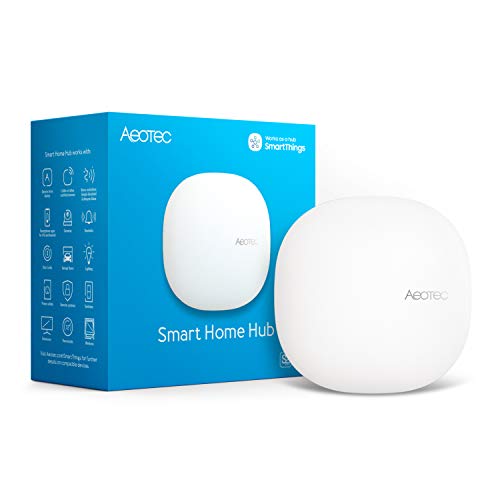
Aeotec Smart Home Hub
The best seller here is effectively the SmartThings hub in Aeotec hardware: Z-Wave Plus, Zigbee, and Matter radios under one roof, driven by the SmartThings app with its enormous device catalog and voice control through Alexa and Google. Setup over WiFi or Ethernet takes minutes, and thousands of certified devices — locks, sensors, switches from every major brand — join without drama. For most homes this is the whole answer.
Pros:
- Three protocols in one box, Matter included
- SmartThings ecosystem breadth and polish
- Ethernet or WiFi backhaul
- The proven default — huge installed base
Cons:
- Deeper automations lean on the Samsung cloud
- Z-Wave is on the V3 model only — verify the version
Best for: the standard choice — full-protocol smart home with app-store simplicity.
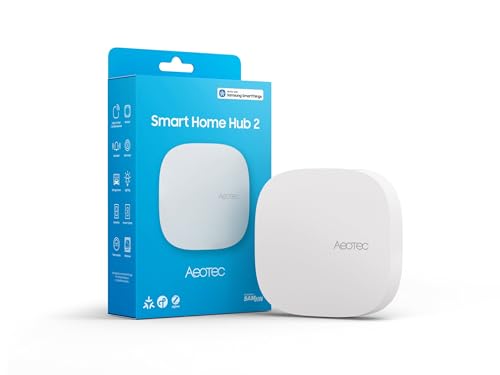
Aeotec Smart Home Hub2 (V4)
The newer Hub2 modernizes the platform — faster local automation execution that keeps routines running through cloud hiccups, current Matter certification, Zigbee support — and makes one big editorial decision: no Z-Wave radio. For a household starting fresh on Matter and Zigbee it is the cleaner, cheaper buy; for a Z-Wave estate it is explicitly not the upgrade path.
Pros:
- Enhanced local execution survives internet outages
- Current Matter + Zigbee certification
- Cheaper than the tri-protocol original
- Same SmartThings app and ecosystem
Cons:
- No Z-Wave — the headline caveat in this guide
- Existing Z-Wave gear would need replacing
Best for: new Matter/Zigbee-first builds with no Z-Wave legacy.
Z-Stick 10 Pro
The enthusiast’s radio: a single USB stick carrying both the latest Z-Wave 800 chip — Long Range capable, up to a mile of reach — and a Zigbee 3.0 radio, turning any Home Assistant, Zigbee2MQTT, or Z-Wave JS box into a dual-protocol hub with no cloud anywhere in the loop. The slim housing leaves neighboring USB ports free, and it speaks to more than eight thousand devices across both ecosystems.
Pros:
- Z-Wave 800 Long Range plus Zigbee 3.0 on one stick
- Fully local operation, no vendor cloud
- Works with Home Assistant and every major open platform
- Slim design spares adjacent ports
Cons:
- You supply the computer and the configuration hours
- No hand-holding app — community documentation instead
Best for: Home Assistant builders who want both meshes from one port.
Zooz ZEN32 Scene Controller
The ZEN32 replaces a light switch with a command center: the large main button drives a wired fixture (or pure wireless control), and four programmable buttons each trigger scenes across the network — up to multi-tap combinations per button on a capable hub. Built on 800-series silicon with Long Range and S2 security, it slots into standard boxes just 1.1 inches deep and wires like a normal three-way. Neutral wire required.
Pros:
- Five buttons of whole-home scene control in a switch slot
- Controls a real wired load, not just scenes
- 800-series chip: Long Range plus S2 security
- Shallow housing fits crowded boxes
Cons:
- Needs a neutral wire and a scene-capable hub
- Programming depth depends on your platform
Best for: the wall point where one switch should run the whole room.
Minoston Scene Controller
Minoston’s remote takes scene control off the wall: four buttons, four scenes each — sixteen triggers — in a battery-powered unit that drops into a standard switch box or sticks magnetically to any flat surface. The 800-series chip brings the same range and security generation as premium gear, and it pairs with SmartThings, HomeSeer, and Home Assistant.
Pros:
- Sixteen scene triggers at the lowest controller price here
- Magnetic mounting goes anywhere — fridge, bedside, garage
- No wiring at all
- Latest-generation 800 chip
Cons:
- Basic hubs may not support its scene programming
- Battery replacement eventually joins the chore list
Best for: adding scene buttons wherever wiring never reached.
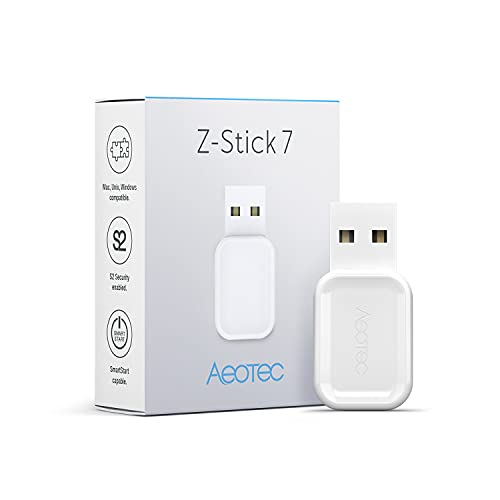
Aeotec Z-Stick 7 Plus
The Z-Stick 7 Plus is the budget door into DIY Z-Wave: a 700-series USB controller with SmartStart QR-code onboarding and S2 security, transmitting up to 250% further than older sticks. It turns a Raspberry Pi, Windows, Mac, or Linux box into a hub under Home Assistant and friends. No Zigbee radio and no Long Range — the 10 Pro’s upgrades — but for a normal house of Z-Wave gear it simply works.
Pros:
- Cheapest solid path to a local Z-Wave hub
- SmartStart makes device onboarding painless
- German-engineered Gen7 radio with S2
- Broad OS and platform support
Cons:
- No Zigbee, no Long Range
- Software setup is on you
Best for: Pi tinkerers starting a local Z-Wave mesh on a budget.
Zooz ZEN37 Wall Remote
The ZEN37 is the ZEN32’s cordless sibling: four buttons commanding up to twenty-four scenes, powered by a rechargeable battery, living in a decora box, stuck to a wall, or loose on the nightstand. The 800-series Long Range chip means it keeps working from the detached garage, and registering the purchase extends the warranty to five years.
Pros:
- Twenty-four scenes from four buttons
- Rechargeable — no battery purchases
- Mounts in a box, on a wall, or nowhere at all
- Long Range reach on the 800 chip
Cons:
- Same scene-capable-hub requirement as the ZEN32
- Controls scenes only — no wired load
Best for: bedside and sofa-side scene control without an electrician.
Homey Pro
Homey Pro is the maximalist answer: Z-Wave Plus, Zigbee, Matter, Thread, Bluetooth LE, infrared, and WiFi — seven radios in one local-first hub that claims compatibility with fifty thousand devices from a thousand brands, dusty IR-remote air conditioners included. The Flow automation builder is genuinely powerful, doubled RAM keeps big installs responsive, and energy dashboards track usage against solar production.
Pros:
- Seven protocols — nothing else here comes close
- Local-first execution with polished visual automations
- Infrared support adopts legacy AV and HVAC gear
- Strong energy monitoring and solar-aware scheduling
Cons:
- Costs as much as several ordinary hubs combined
- Overkill for a single-protocol home
Best for: mixed-protocol households consolidating everything onto one local brain.
GE Enbrighten Z-Wave Plug
Every mesh needs workhorses, and the Enbrighten plug is the classic: two independently controlled Z-Wave outlets in one compact unit that leaves the second wall socket usable, acting as a signal repeater that strengthens the whole network as a side effect. It pairs with every certified hub — SmartThings, Ring Alarm, Home Assistant via a stick — and brings lamps and appliances under voice and schedule control.
Pros:
- Two schedulable outlets per unit
- Extends mesh range as a repeater
- Works with every certified Z-Wave hub
- Space-saving design spares the other socket
Cons:
- Needs a hub — does nothing standalone
- Z-Wave Plus (700-era), not 800 silicon
Best for: the first device on a new mesh — and the third, and the fifth.
SmartThings Hub v3
Samsung’s third-generation hub is the platform that mainstreamed hub-based smart homes: one app monitoring and automating an enormous range of devices, with triggers on doors, presence, and time. It survives in the market as remaining stock at collector-grade prices, which makes the Aeotec version of the same platform the sensible buy — listed here because its ecosystem is the reference point everything above gets measured against.
Pros:
- The definitive SmartThings ecosystem experience
- Mature app with deep device support
- Automations across brands in one place
- Alexa and Google compatible
Cons:
- Legacy stock now priced far above its replacement
- The Aeotec hubs are the same platform, cheaper
Best for: completing an existing v3 installation — everyone else, buy the Aeotec.
Verdict
Best Overall: Aeotec Smart Home Hub. The best-selling path to a real Z-Wave home: three protocols, the SmartThings catalog, and minutes-long setup. The default for good reason.
Best Value: Aeotec Z-Stick 7 Plus. For the price of two smart plugs, it turns hardware you may already own into a fully local hub — the cheapest ticket to cloud-free automation.
Best Premium: Homey Pro. Seven protocols, local-first execution, and one app over all of it — the consolidation machine for homes that accumulated every ecosystem.
FAQ
Why choose Z-Wave over WiFi smart devices?
Z-Wave runs on its own low-power mesh away from WiFi congestion, every device is certified interoperable, battery sensors last years, and hub-local automations keep working when the internet fails. WiFi devices are cheaper individually; Z-Wave scales into a system.
What is Z-Wave Long Range?
An 800-series-era mode extending direct reach to roughly a mile line-of-sight — practically, whole-property coverage including detached garages and gates without repeater chains. Both hub and device must support it; the Z-Stick 10 Pro, ZEN32, ZEN37, and Minoston here all do.
Can I run Z-Wave without any cloud at all?
Yes — that is the stick-plus-Home-Assistant path (or Homey Pro’s local-first design). Pairing, automations, and control all execute on hardware you own; remote access is optional and self-hosted if you want it.
Do Z-Wave locks work with all these hubs?
Locks require S2 security support, which every current hub and stick here provides. Pair locks close to the hub first, then mount — and note that lock automations are exactly the ones you want executing locally.
How many devices can one Z-Wave network hold?
Classic meshes support 232 nodes; Long Range networks raise that ceiling dramatically. Real homes rarely approach either limit — plan instead around powered devices (which repeat signal) versus battery devices (which do not) so the mesh stays healthy.
This article may contain affiliate links; see our Affiliate Disclosure.