The first time on a paddle board usually ends one of two ways: a calm glide across flat water, or a cold, splashy lesson in balance. The board under your feet decides which one you get.



A forgiving first board is wide, thick, and stable, with enough volume to stay flat when your weight shifts. Inflatable models make that easier to live with, since they roll into a backpack and shrug off knocks against docks and rocks. The five boards below all suit first-timers, casual weekend paddlers, and anyone planning to share the deck with a child or a dog.
| Board | Standout feature | Price tier | Link |
|---|---|---|---|
| Niphean StabilTrac 10’6″ | 450 lb capacity, big accessory kit, 3-year warranty | Mid-range | |
| Roc 10’6″ | Extra-wide all-around shape, strong PVC | Premium | |
| FunWater Ultra-Light 10’6″ | Light to carry, tri-fin tracking | Mid-range | |
| EGGORY Extra-Wide Set | Complete kit at the lowest price | Budget | |
| SLOOSH Ripple 10’6″ | Beginner-tuned round nose, rigid feel | Mid-range | |
How to choose a beginner paddle board
Almost every wobble a new paddler feels traces back to a handful of numbers on the box. Learn to read them and the shopping gets simple.
Width and thickness decide your stability
Balance is mostly about width. A board 33 inches or wider gives your feet a broad, planted platform, which is exactly what you want while your core is still learning to make micro-corrections. Narrower race-style boards feel tippy until you have hours under you. Thickness matters too: a 6-inch deck holds its shape under load instead of sagging in the middle, so the board stays rigid and pushes back against your weight rather than folding. All five boards here run 6 inches thick and at least 33 inches wide, which is the sweet spot for learning.
Volume and weight capacity
Higher capacity is not just for heavier riders. A board rated to 450 pounds sits higher and flatter in the water for everyone, which translates directly into a steadier feel. It also leaves room to bring a small passenger, a cooler, or a dog without the nose plowing under. The Niphean and SLOOSH lead here at 450 pounds; the Roc and EGGORY sit closer to 350, which is plenty for a solo adult but leaves less margin for cargo.
Deck grip and the fall-off factor
You will fall early on, and a soft anti-slip EVA foam deck makes that far less punishing. A full-length pad, rather than a small patch, lets you move your feet, try a kneeling start, or stretch into a held stretch without hunting for traction. Textured foam also cushions knees during those first tentative stand-ups, so the practice sessions feel less like an ordeal.
What comes in the box
Inflatable boards almost always ship as a complete kit, and the quality of that kit shapes your first day. Look for an adjustable paddle, a coiled ankle leash for safety, a dual-action pump that fills the board faster, at least one fin, a repair patch, and a padded backpack. A waterproof phone pouch is a small touch that saves an expensive mistake. Every board below includes the essentials; the Niphean and SLOOSH kits are the most generous.
Packed weight and portability
An inflatable only earns its keep if you actually carry it to the water. Most beginner boards land near 19 to 21 pounds once deflated and rolled, which fits into a wheeled or shoulder backpack. Padded straps and a center carry handle make the walk from the car far more pleasant, especially if the launch is a long trail from the parking area.
Fins, tracking, and the paddle
Fins keep the board pointed where you aim it. A larger center fin, sometimes paired with two smaller side fins, resists the sideways slip that makes a first paddle feel like a slow zigzag. All of these boards use removable fins, so you can pull them for shallow water or packing and refit them without tools. The paddle counts just as much: set it about a hand’s height above your head so your stroke stays comfortable and your shoulders do not tire in the first half hour. Each board here ships with an adjustable paddle, so you can dial in the length as you find your rhythm.
Niphean StabilTrac Inflatable Paddle Board
This is the best-selling board in the group, and the reasons hold up on the water. At 10’6″ by 33″ by 6″ it hits the classic stable-beginner footprint, and the StabilTrac fin design adds tracking so you spend less energy correcting course and more time gliding straight. The 450-pound capacity gives real headroom for a passenger or gear, and eleven D-rings let you strap on a cooler, a kayak seat, or a second board. Niphean also backs it with a three-year warranty, which is triple the industry norm and a genuine confidence booster for a first purchase.
Pros:
- High 450-pound capacity for stability and shared rides
- Generous kit: paddle, three fins, leash, pump, backpack, phone bag, repair kit
- Eleven D-rings for seats, coolers, and accessories
- Three-year manufacturer promise
Cons:
- At around 19 pounds it is average weight, not the lightest to haul
- Popular enough that color choices can sell through
Best for: a first board you can grow into, especially if you plan to bring a child, pet, or cooler along.
Roc Inflatable Stand Up Paddle Board
Roc built its reputation on a wide, planted all-around shape that flatters nervous first-timers, and this 10’6″ model carries that forward. The maker points to reinforced material it rates well above typical budget boards, so the deck feels reassuringly firm once pumped up. A 350-pound weight limit covers most solo adults comfortably, and the board arrives with a complete accessory pack. Buyers also tend to praise the responsive, US-based customer service, which matters when a pump or fin needs a replacement part.
Pros:
- Extra-wide, forgiving all-around shape
- Durable reinforced construction for a rigid feel
- Complete accessory bundle included
- Strong, US-based customer support
Cons:
- 350-pound limit leaves less room for a passenger or heavy gear
- Sits at the top of this group on price
Best for: a solo paddler who wants a proven wide shape and dependable support behind it.
FunWater Ultra-Light Inflatable Paddle Board
FunWater aims squarely at paddlers who dread the carry, and the ultra-light build shows it. The same 10’6″ by 33″ by 6″ dimensions deliver beginner-friendly stability, while the reduced weight makes the walk to the water and the lift back onto a roof rack noticeably easier. A three-fin setup keeps the board tracking straight, and the upgraded non-slip EVA pad gives a secure footing for cruising, light Pilates, or a first attempt at casting a line. The kit covers the basics, and a three-year board warranty backs it up.
Pros:
- Lightweight and easy to carry and store
- Tri-fin layout for steadier tracking
- Cushioned non-slip deck for confident footing
- Three-year board warranty
Cons:
- Fewer mounting D-rings than the top picks
- Accessory list is functional rather than lavish
Best for: paddlers who value an easy carry and a simple, no-fuss setup.
EGGORY Extra-Wide Paddle Board Set
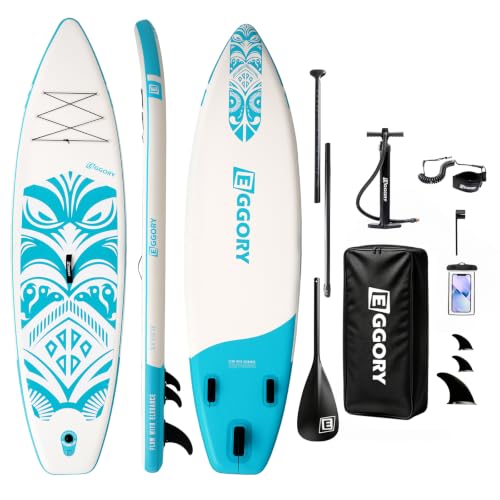
The EGGORY set is the value entry here, and it does not feel stripped down. The extra-wide deck aims for the same planted stability the others chase, and the reinforced material carries UV resistance so a summer of sun exposure does not fade or weaken it prematurely. Depending on the size chosen, capacity runs from 350 up to 450 pounds. The complete kit is the surprise: adjustable paddle, three fins, leash, a dual-action high-pressure pump, a waterproof phone pouch, a repair kit, and a roomy backpack. For a first board bought on a tight budget, that is a lot of gear in one box.
Pros:
- Lowest price in the group
- Complete kit including dual-action pump and phone pouch
- UV-resistant reinforced material
- Extra-wide deck for easy balance
Cons:
- Newer brand with a shorter track record
- Weight capacity varies by the size you choose
Best for: a budget-minded first-timer who still wants the full accessory kit.
SLOOSH Ripple Inflatable Paddle Board
The SLOOSH Ripple was clearly shaped with new paddlers in mind. Its round nose and wide tail add stability where beginners need it, and at 33 inches wide it splits the difference between twitchy narrow boards and sluggish extra-wide ones. A double-layer, mesh-reinforced construction lets it pump up to a rigid, hard-board-like feel that resists flexing under load. The dual-action pump cuts inflation time, three reinforced handles make carrying easier, and the padded backpack spreads the weight across your shoulders, waist, and back for the walk in.
Pros:
- Beginner-tuned round nose and wide tail
- Reinforced double-layer build for a rigid, stable ride
- 450-pound capacity for passengers or gear
- Faster dual-action pump and a well-padded backpack
Cons:
- One-year warranty is shorter than the three-year rivals
- Rigid feel needs a full pump to high pressure to appear
Best for: a learner who wants a board specifically balanced for the first few seasons on the water.
The verdict
Best overall: the Niphean StabilTrac 10’6″ earns the top spot. It pairs the group’s best-selling track record with the widest margins that matter for beginners: 450-pound capacity, a stable footprint, eleven D-rings, a full accessory kit, and a three-year warranty. It is the board most people can learn on and keep enjoying.
Best value: the EGGORY Extra-Wide Set delivers a complete, ready-to-paddle kit at the lowest price, so nothing extra is needed on day one.
Best premium feel: the Roc 10’6″ backs its wide, firm shape with well-regarded support, a reassuring combination for anyone buying their first board sight unseen.
Frequently asked questions
How wide should a beginner paddle board be?
Aim for 32 to 34 inches. That width gives your feet a stable base while your balance develops. Every board here is at least 33 inches wide, which is why they suit first-timers.
Is an inflatable board good enough for learning?
Yes, and in some ways better. A quality inflatable pumped to its rated pressure feels firm underfoot, cushions falls, shrugs off scrapes, and packs into a backpack for easy storage and transport. Those traits are ideal for someone still building confidence.
How long does it take to inflate one?
With the included dual-action pump, most beginners reach riding pressure in roughly five to ten minutes. Dual-action models move more air on the down and up stroke, so they fill faster than single-action pumps.
Can I bring a child or a dog on board?
On the higher-capacity boards, yes. The Niphean and SLOOSH are rated to 450 pounds, which leaves comfortable room for a small passenger or a dog alongside an adult. Keep the combined weight well under the limit for the steadiest ride.
What accessories do I actually need to start?
A paddle, a fin, a pump, and a leash cover the essentials, and every board here includes them. A repair kit and a waterproof phone pouch are worthwhile extras that most of these kits already provide.
How should I store an inflatable board?
Rinse off salt or grit, let it dry fully, then roll it loosely and keep it out of direct sun and hard freezes. A little care here avoids mildew and protects the seams, so the board stays airtight season after season. Storing it slightly under full pressure, or fully deflated in the backpack, both work.
This article may contain affiliate links; see our Affiliate Disclosure.