Four people, four microphones, one recording where nobody clips, nobody vanishes, and the loud laugher does not destroy the quiet guest. That is the whole job of a multi-host podcast mixer, and it is why a laptop and a shared mic stop working the moment your show grows.



The thing that separates a real multi-host board from a streaming gadget is simple: how many microphones it truly takes, and whether every host can hear themselves. This guide compares five mixers, from an affordable two-mic console to a full four-seat studio, so a co-hosted show, a roundtable, or a growing podcast network can find the right table.
| Mixer | Standout feature | Price tier | Link |
|---|---|---|---|
| Maono AME2 | Two XLR mics, 11 sound pads | Mid-range | |
| PUPGSIS T12 | Faders, phantom power, Bluetooth | Budget | |
| Tascam Mixcast 4 | Four mic inputs, four headphone outs | Premium | |
| Zoom LiveTrak L-8 | Battery power, four mics included | Premium | |
| Rode RODECaster Pro II | Per-host processing, complete studio | Premium | |
How to choose a multi-host mixer
Count mic inputs, not channels
This one trips up nearly every first-time buyer. A mixer advertised as four-channel or ten-channel is usually counting everything it can play or record: a USB feed from the computer, a Bluetooth phone, a music source, an instrument. The number that decides how many people can sit at your table is the count of actual microphone inputs, usually XLR sockets with phantom power. A ten-channel board with two XLR inputs seats two hosts, not ten. Before you buy, find the mic input count and match it to the largest show you plan to record.
Headphone outputs are the other half
Every host needs to hear the mix, or they will talk over each other and drift off mic. A dedicated headphone output per seat, ideally with its own volume, is what makes a four-person recording feel controlled instead of chaotic. Boards built for tables provide four separate outputs; smaller mixers offer one, which means splitters and compromise. If more than two people record together regularly, handle per-host headphone outs as a requirement rather than a luxury.
Multitrack recording and mix-minus
Recording every microphone to its own track, rather than one merged file, is what lets you fix a single host in editing without touching the others. Boards that write multitrack straight to an SD card can record with no computer at all, which removes a whole category of things that go wrong mid-session. If you bring in phone guests, look for mix-minus, a feature that sends the caller everything except their own voice so they do not hear themselves echoing back.
Preamps, phantom power, and mic type
Dynamic microphones, the broadcast standard for bare rooms, are quiet and need plenty of clean gain, so preamps matter more than the spec sheet suggests. Condenser mics are more sensitive and require 48V phantom power, which most boards here supply. Sound pads for music beds and stingers are the fun part, but preamp quality and enough gain are what make four voices sound like a produced show.
Budget for the whole table, not the board
The mixer is one line in a bigger sum, and forgetting that derails plenty of first setups. Four hosts need four microphones, four stands or arms, four XLR cables, and ideally four sets of headphones, and those extras can rival the console’s price. This is why bundles exist and why they often make sense: buying a board and discovering you need several hundred dollars of accessories before you can record is a familiar disappointment. Work out the full cost of a working table before comparing consoles, since a pricier bundle that includes mics, stands, and cables can be better value than a cheaper board plus a shopping list.
Room sound beats gear
Worth saying plainly, because it is where most shows lose quality: a modest mixer in a soft room beats an expensive one in an echoey box. Four open microphones in a bare room capture the same reflections four times over, and no processing fully removes that. Dynamic mics with tight pickup patterns help, and placing hosts close to them helps more. If you fix one thing, add rugs, curtains, and soft furnishings before upgrading the console.
Maono AME2 MaonoCaster
The AME2 is the most popular capable mixer here and the value sweet spot for a co-hosted show. It takes two XLR microphones on independently controlled inputs with quality preamps, three-level gain up to a generous ceiling, 48V phantom power for condensers, and a denoize function, so both a dynamic broadcast mic and a sensitive condenser are at home. Eleven customizable sound pads cover music beds and stingers, with three of them recording longer clips and looping. It adds a quarter-inch instrument input for guitar, Bluetooth, USB-C to a computer, outputs for a phone and monitors, plus reverb modes, auto-tune, tone controls, and pro touches like sidechain and loopback.
Two features here are the ones seasoned podcasters actually use. Loopback lets you record audio playing on your computer, a clip, a call, a video you are reacting to, straight into the mix without cabling anything, which is the tidy solution to a problem that otherwise involves splitters. Sidechain automatically ducks the music under a voice, so your bed drops when someone speaks and rises when they stop, without you riding a fader. The ten-channel label is counting sources rather than microphones, so read it as a two-mic board with plenty of inputs for music, phone, instrument, and computer. Note that USB microphones are not supported; this is an XLR and analog board.
- Two XLR mic inputs with strong preamps and phantom power
- Eleven customizable sound pads with looping
- Instrument input, Bluetooth, and computer connection
- Sidechain, loopback, and music-only switches included
- Two mic inputs cap it at two hosts at the table
- USB microphones are not supported
Best for: two-host shows that want serious features, sound pads, and room to grow without a big spend.
PUPGSIS T12 Audio Mixer
The PUPGSIS T12 is the budget entry to multi-mic recording. It offers a professional preamp with 48V phantom power for an XLR microphone, and supports up to three mic sources in total, so two people plus a headset can talk at once. Four smooth faders independently control mic one, mic two, aux or Bluetooth, and line out, with a display showing levels at a glance. Zero-latency monitoring and one-touch mute avoid the classic live mishaps, and you get voice-changing modes, four sound pads, and reverb presets for a bit of fun. Bluetooth 5.3 and broad phone, tablet, and computer compatibility make it flexible for a first setup.
The real limitation is the single headphone output, which means a second host either shares through a splitter, losing individual volume control, or goes without. For two people sitting close that is workable; for a real roundtable it is the reason to step up. Read the voice-changer features as evidence of where this board is aimed, at streamers as much as podcasters, and take the faders and phantom power as the real value.
- Lowest price for a genuine multi-mic board
- 48V phantom power and a capable preamp
- Four faders with a clear level display
- Zero-latency monitoring, mute, and Bluetooth
- One headphone output, so hosts must share or split
- Effects-heavy design aimed at streaming as much as podcasting
Best for: new podcasters recording two voices who want faders and phantom power for very little money.
Tascam Mixcast 4
The Mixcast 4 is the first board here built for a real four-person table, and it is the natural step up. Four combination mic inputs and four individual headphone outputs mean every host plugs in and hears themselves without splitters or compromise. It records fourteen tracks straight to its own SD card, so a session happens with no computer in the room, and a touch screen keeps the controls approachable rather than intimidating. Eight banks of illuminated pads fire music, jingles, and effects live, an aux input with mix-minus makes phone guests painless, and Bluetooth and USB cover the rest. The included editor handles post-production.
The fourteen-track recording deserves emphasis, since it is what buys you a calm edit. Every microphone lands on its own track alongside the pads and external inputs, so if one host coughs or sits too far back you fix that track alone rather than fighting a merged file. The touch screen is what makes it approachable: putting the routing behind a screen rather than a wall of identical knobs means a host can run the show alone. Microphones are not included, so budget for four.
- Four mic inputs and four headphone outputs
- Fourteen-track recording direct to SD, no computer needed
- Touch screen control and eight banks of sound pads
- Aux input with mix-minus for phone calls
- A significant jump in price from two-mic boards
- Microphones are not included
Best for: four-host shows that want a self-contained studio with per-seat monitoring.
Zoom LiveTrak L-8 Bundle
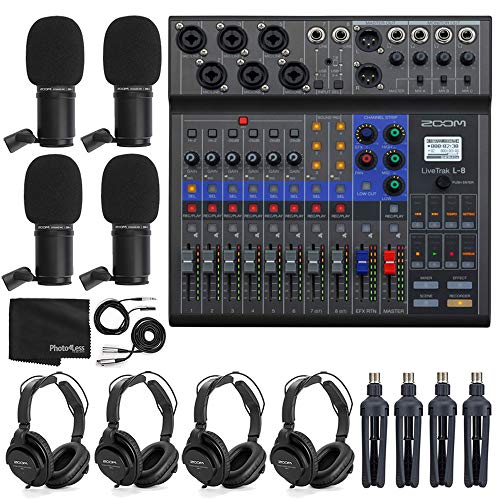
The LiveTrak L-8 bundle is the one to grab if your show travels. It is an eight-channel digital mixer and multitrack recorder with four headphone outputs, each with independent level and mix selection, so all four hosts hear exactly what they need. It records up to ten discrete tracks plus a stereo mix to an SD card at high resolution, and doubles as a computer audio interface. The clincher is power: it runs on AA batteries for hours, so you can record in a hotel room, a conference hall, or a car park. This bundle arrives complete with four microphones, headphones, windshields, cables, and tabletop stands, and the first two channels take instruments directly.
Independent headphone mixes are the underrated part. Each of the four outputs has its own level and mix selector, so a host who wants more of their own voice and less music can have exactly that. The battery option is not a gimmick either: a set of AA cells runs it for hours, which turns a hotel room or a conference floor into a viable studio. Because the bundle includes four mics with headphones, windshields, cables, and stands, it is a complete table rather than a console you then have to equip.
- Four headphone outputs with independent mixes
- Multitrack recording to SD plus interface duty
- Runs on batteries for genuinely portable sessions
- Bundle includes four mics, headphones, and stands
- Fader-and-button interface is less immediate than a touch screen
- Bundle price is a serious investment
Best for: shows recorded on location or at events that need four seats and battery power.
Rode RODECaster Pro II Studio Bundle
This is the complete four-person studio in one purchase, and the most polished setup here. The RODECaster Pro II console gives each of four microphones its own preamp, its own processing chain, and its own headphone output, so every host is dialed in and monitors independently while the board records the table as a clean multitrack. Its preamps deliver ample quiet gain, which is exactly what the included dynamic broadcast microphones want, with no inline booster and no hiss. Every channel gets exciter, bass enhancement, and leveling processing plus compressor, gate, de-esser, and EQ, and eight smart pads across eight banks fire dozens of actions from the touch screen. The bundle adds four mics, four weighted desk stands, balanced cables, and a storage card, and it records to microSD with each host on a separate stem.
The pairing of these preamps with these microphones is the point. Dynamic broadcast mics are quiet by design, and plugged into ordinary preamps they force you to crank the gain until hiss arrives with the voice, which is why so many people buy an inline booster. This console delivers abundant quiet gain on all four channels at once, so every mic runs loud and clean with nothing extra in the chain. The included mics have internal pop filters and shockmounts that reject keyboard knocks and room reflections. It is more capability than a young show needs, and it will not be outgrown.
- Four mics with per-host processing and headphone outs
- Very quiet, high-gain preamps suited to dynamic mics
- Deep per-channel processing and 8 banks of smart pads
- Complete bundle with mics, stands, cables, and card
- By far the highest price here
- More capability than a small show will use
Best for: established multi-host shows and networks that want broadcast polish out of the box.
Verdict
Best Overall: the Maono AME2 is the most popular capable board here and the smart starting point for most multi-host podcasts. Two XLR inputs with good preamps, phantom power, sound pads, and loopback cover a co-hosted show properly, and it costs a fraction of a four-seat console.
Best for a full four-mic table: the Tascam Mixcast 4 is the value pick once your show seats four, with four mic inputs, four headphone outputs, and computer-free multitrack recording. The Zoom LiveTrak L-8 bundle is the answer when the show travels, thanks to battery power and four included mics.
Best Premium: the Rode RODECaster Pro II bundle delivers per-host processing, excellent preamps, and everything you need to record four voices from the moment the box opens.
Frequently asked questions
How many hosts can a “four-channel” mixer handle? Often just one or two. Channel counts usually include music, USB, and Bluetooth sources. Check the number of XLR microphone inputs instead, since that is what decides how many people can speak into their own mic at once.
Do all four hosts need their own headphone output? For a comfortable roundtable, yes. Separate outputs let everyone hear the mix at their own volume and stay on mic. Splitting one output across four sets of headphones works in a pinch but removes individual control.
Do I need a computer to record? Not with the boards designed for it. Several here record multitrack straight to an SD card, so a session runs with no laptop at all. Smaller mixers connect over USB and rely on software on a computer or phone.
Dynamic or condenser microphones for a multi-host show? Dynamic mics are the usual choice for bare rooms because they reject room noise and bleed from other hosts. They need clean preamp gain to sound full. Condensers capture more detail but need 48V phantom power and a quieter space.
What is mix-minus and do I need it? It sends a phone guest everything in the mix except their own voice, which stops them hearing themselves echo back a fraction of a second later. If you ever bring callers into the show, it turns an unusable mess into a normal conversation. If everyone is in the room, you can ignore it.
Should I record multitrack or a single mixed file? Multitrack, whenever the board allows. Recording each mic separately means one host’s cough, rustle, or level problem is fixed on its own track without touching anyone else. A single mixed file bakes every mistake in permanently.
This article may contain affiliate links; see our Affiliate Disclosure.