One of these warmers tops out at 167 degrees F. Another starts at 100 and stops at 122. Both say they protect the nutrition in breastmilk. Both cannot be right, and on a product whose entire job is a number, that gap is the first thing to look at.


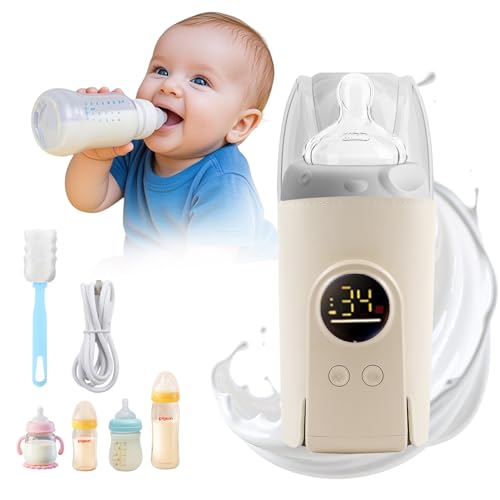

A bottle warmer for the car has a narrow job: bring milk to about body temperature, in a moving vehicle, without a mains socket, before the baby’s patience runs out. Four genuinely different approaches answer that below, and they differ far more than the photographs suggest: one carries a battery, one carries hot water, one wraps the bottle in a heated sleeve, and one heats without water at all.
At a glance
| Warmer | Standout feature | Price tier | Link |
|---|---|---|---|
| Papablic | Needs no power at all; fits a cup holder | Budget | |
| Vdhwter USB bag | A heated sleeve that fits bottles of any material | Budget | |
| Abnaok | Starts at body temperature; LCD and auto-stop | Mid-range | |
| JDZ | Biggest battery here, in 316 stainless steel | Premium | |
How to choose a travel bottle warmer
Read the temperature range, then read it again
Milk wants to arrive at roughly body temperature, and that is the whole specification. So the published ranges here are worth comparing carefully. Abnaok runs from 100 to 122 degrees F, which starts almost exactly where you want to end up. JDZ offers seven settings from 113 to 167 degrees F, which begins above body temperature and climbs a very long way past it. Both brands say they preserve nutrition and avoid overheating, and Abnaok backs that with an automatic cut-off once the milk reaches the temperature you set. Use the lowest setting that works, whichever you buy, and follow the guidance your own health visitor or paediatrician gives you over anything printed on a box.
Do not improvise with an adult food warmer
Search this category and you will be shown electric lunch boxes and portable ovens: 80 and 100 watt units that heat an adult meal in 25 to 40 minutes with no temperature control worth the name. They are good products for a driver’s lunch and they are the wrong tool for a bottle. Milk is not a casserole. It needs a modest target temperature, reached quickly and then stopped, and none of that describes a lunch box.
Battery, hot water, or a sleeve
Three genuinely different mechanisms, three different failure modes. A battery warmer works anywhere and stops working when it is flat, which is why capacity matters: JDZ carries 16,000 mAh, Abnaok 6,000. A vacuum flask like the Papablic has no battery to die and no electronics to fault, but you have to have filled it with hot water before you left the house. A USB sleeve like the Vdhwter needs a live USB port, which a car has, and warms gently rather than fast. Pick the one whose failure mode you can live with at two in the morning.
Waterless is faster and fussier
The traditional way to warm a bottle is to stand it in hot water, which is gentle and slow. Waterless designs, like the Abnaok, heat the bottle directly and surround it, which is faster and means nothing to pour or spill in a car. The trade is fit: without water filling the gaps, the warmer has to actually touch your bottle. Abnaok says it expands to 2.5 inches in diameter to suit most bottles, which is the number to check against the ones you own.
Check your bottles against the list
Papablic does something almost nobody does and names the incompatibilities outright: it fits Medela, Dr. Brown, Philips Avent and Evenflo, and it does not fit Comotomo or Tommee Tippee. That clarity is worth more than another paragraph of adjectives, because a warmer your bottle will not sit in is a paperweight. Measure the widest bottle you own before ordering anything here.
Leak-proofing matters more in a car than anywhere
This lives in a footwell, a door pocket or a changing bag, on its side, over speed bumps. JDZ and Papablic both call out leak-proof construction specifically for bags, cars and strollers, and it is the sort of claim you only appreciate once. If it holds water rather than heating dry, that seal is the difference between a warm bottle and a wet nappy bag.
Papablic
The cleverest thing here, and the cheapest by a distance: there is no battery, no cable and no electronics. It is a double-wall vacuum-insulated stainless flask that keeps water hot for hours, and a chamber you stand the bottle in. Fill it before you leave, and it will warm a feed whenever you need it with nothing to charge and nothing to fail. It weighs under a pound, fits most car cup holders and a changing bag, and Papablic names exactly which bottles fit and which do not, which almost no brand bothers to do.
Pros:
- Cheapest warmer here by a wide margin
- No battery or power needed; nothing to fail
- Vacuum insulation keeps water hot for hours
- Names its compatible and incompatible bottle brands outright
Cons:
- You must remember to fill it with hot water before leaving
- No temperature control at all; you judge it yourself
- Does not fit Comotomo or Tommee Tippee bottles
Best for: planned trips, where forgetting to charge things is the real risk.
Vdhwter USB bag
The simplest electric option: a five-layer insulated fabric sleeve that wraps the bottle and warms it from a USB cable, which every car already has. Three heat levels run at roughly 50 and 60 degrees Celsius on the middle and high settings. Because it is a sleeve rather than a chamber, it does not care what your bottle is made of or exactly how wide it is, which sidesteps the fit problem the rigid warmers have. It also holds temperature once warm, so it doubles as a way to keep a bottle ready rather than only heating one.
Pros:
- Runs from any USB port, including the car’s
- Fabric sleeve fits bottles of most materials and widths
- Five insulating layers hold the temperature once reached
- Light, soft and packs flat in a changing bag
Cons:
- Its stated levels are hotter than body temperature
- Needs a live USB port, so it will not work in a pram
- Warms gently rather than quickly
Best for: keeping a bottle ready on a long drive rather than heating one fast.
Abnaok
The one whose numbers make the most sense. Six settings from 100 to 122 degrees F, shown on an LCD so you are reading a temperature rather than guessing from a light, and it stops heating automatically once the milk reaches what you set. Abnaok’s own reasoning is the right one: stop at the target and the breastmilk is not cooked past it. It is waterless, warming the bottle from all sides on a 6,000 mAh battery, so nothing spills in a car, and it expands to 2.5 inches to take most bottles. A built-in nightlight is a small thing that turns out to matter at 3am.
Pros:
- Range starts at body temperature rather than above it
- LCD display and automatic cut-off at your set temperature
- Waterless and surround-heated; nothing to pour or spill
- Expands to 2.5 inches; nightlight built in
Cons:
- 6,000 mAh is well under half the JDZ’s battery
- Sells modestly against the leaders
- Needs two full charges before first use, per Abnaok
Best for: night feeds and anyone who wants to see the actual number.
JDZ
The best-selling proper bottle warmer here, and the most capable on paper: a 16,000 mAh battery, well over twice anything else, so road trips and flights do not end in a cold feed. The chamber is 316 stainless steel, a higher grade than the 304 in most kitchen gear, and it holds 17 oz, which suits most bottles and covers a full day’s feeds. It is leak-proof for bags, cars and strollers. The seven settings span 113 to 167 degrees F, which is a wide range that begins above body temperature, so use the bottom of it and take the top as a range for something other than milk.
Pros:
- 16,000 mAh battery, by far the largest here
- 316 stainless steel chamber; 17 oz capacity
- Best-selling dedicated bottle warmer on this page
- Leak-proof for bags, cars and strollers
Cons:
- Its range starts at 113 degrees F, above body temperature
- 167 degrees F is far hotter than a feed should ever be
- Most expensive warmer here
Best for: long trips away from any socket, used on its lowest settings.
The verdict
Best overall: Abnaok. It is the only warmer here whose temperature range starts where a feed should end, at 100 degrees F, with an LCD so you are reading a number instead of watching a light, and an automatic cut-off so it stops rather than keeps climbing. Waterless surround heating means nothing sloshes in a moving car, it expands to take most bottles, and the nightlight earns itself the first time you use it in the dark. The battery is the compromise.
Best value: Papablic. The cheapest thing here and arguably the most reliable, because it has nothing to go wrong: a vacuum flask of hot water and a chamber. No charging, no electronics, no flat battery. It asks one thing of you, which is remembering to fill it before you leave, and it repays that by naming exactly which bottles fit and which do not. It fits a cup holder.
Best premium: JDZ. The best-selling dedicated warmer here, with a 16,000 mAh battery that outlasts everything else on this page, a 316 stainless chamber and 17 oz of capacity. Buy it for the endurance, and use the bottom of its range: its seven settings reach 167 degrees F, which is a long way past anything a bottle needs.
FAQ
How warm should a bottle actually be?
Around body temperature is the usual target, which is why the ranges here are worth comparing. Abnaok starts at 100 degrees F, JDZ starts at 113 and climbs to 167. Use the lowest setting that gets there, and take your feeding guidance from your own health visitor or paediatrician rather than from packaging.
Can I use an electric lunch box for a bottle?
Don’t. The heated lunch boxes and portable ovens sold alongside these are 80 to 100 watt units that take 25 to 40 minutes and have no meaningful temperature control. They are made for a driver’s dinner. Milk needs a modest target reached quickly and then stopped.
Battery or hot water?
Depends which failure you would rather have. A battery warmer works anywhere until it is flat, so capacity matters: 16,000 mAh on the JDZ against 6,000 on the Abnaok. A flask like the Papablic never runs out of charge but is useless if you left the house without filling it.
Will it fit my bottles?
Check before you buy, because this is the common disappointment. Papablic names names: Medela, Dr. Brown, Philips Avent and Evenflo fit; Comotomo and Tommee Tippee do not. Abnaok expands to 2.5 inches. The fabric sleeve is the most forgiving, since it wraps whatever you put in it.
What does waterless actually change?
It heats the bottle directly rather than standing it in hot water, so it is faster and there is nothing to pour, carry or spill in a moving car. The catch is fit: with no water filling the gaps, the warmer has to physically contact your bottle, so the diameter it accepts becomes a real specification.
This article may contain affiliate links; see our Affiliate Disclosure.