Take a stirrup hoe to a dandelion and you will remove the dandelion, briefly. It will be back in two weeks, because you cut the leaves off a root that goes down further than the blade ever went. That is not a bad hoe. It is the wrong hoe, and this category makes that mistake very easy to buy.





There are really three jobs here and they need three different edges. Slicing seedlings off at the surface across a bed. Digging a tap root out whole so it does not come back. And working close between plants you actually want to keep. Nothing on this page does all three well, whatever the packaging says, so the useful question is which weed is beating you.
At a glance
| Tool | Standout feature | Price tier | Link |
|---|---|---|---|
| Japanese Weeding Sickle | Cheapest here; hand-forged high carbon steel | Budget | |
| COCONUT 45 inch | Simple double-sided hoe and tiller | Budget | |
| CALCHELE | Hollow blade that will not clog in wet clay | Budget | |
| NICOFPHY 2-in-1 | Best seller here; six tines for tap roots | Mid-range | |
| DonSail | A true loop hoe that cuts both directions | Mid-range | |
| Oliynedy | Loop hoe on one side, four tines on the other | Mid-range | |
| CKLT 2-in-1 | Tempered spring steel and stainless poles | Premium | |
How to choose a hoe
Match the tool to the root, not to the weed
Annual weeds, the fine green things that appear in drifts across a bed, have shallow fibrous roots. Sever them just under the crown and they die. That is what a stirrup or a Dutch hoe does, standing up, at walking pace. Perennials with a tap root, dandelions and dock especially, regenerate from whatever you leave behind, so cutting the top off is gardening as a subscription service. Those need lifting out whole, which is what the tined pullers here are for. Work out which you have before you decide which tool you want.
Stirrup, oscillating, scuffle, loop: all the same tool
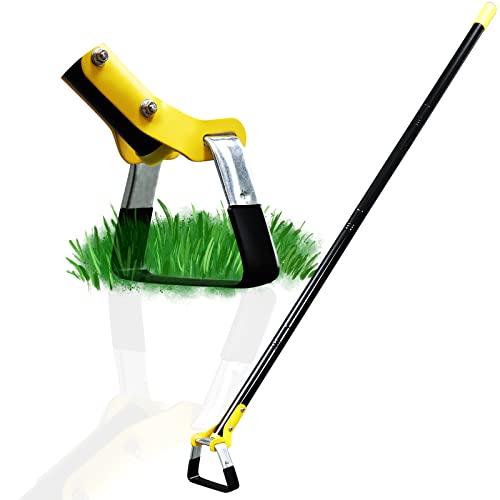
The naming in this category is chaos. A stirrup hoe, an oscillating hoe, a scuffle hoe and a loop hoe are one design: a closed loop of sharpened steel that pivots slightly so it cuts as you push and again as you pull. DonSail, Oliynedy and Lilyvane all sell it under different names. DonSail’s own listing goes further and calls its stirrup hoe a collinear hoe in the next breath, which it is not, since a collinear is a thin fixed blade for skimming. Ignore the word and look at the head.
The carbon steel argument is marketing on both sides
Three brands here sell against carbon steel explicitly. NICOFPHY says its heads are cast steel unlike most carbon steel heads. WELLOPLO and CKLT make the same move, offering cast and tempered spring steel as the upgrade. Then look at the two Japanese tools, which advertise high carbon steel as the premium feature and the reason the edge lasts. Both cannot be right. Carbon steel is a broad family, not a grade, and how a head is formed and tempered matters more than the word. Take unlike carbon steel as a slogan.
Hoe dry, hoe shallow, hoe small
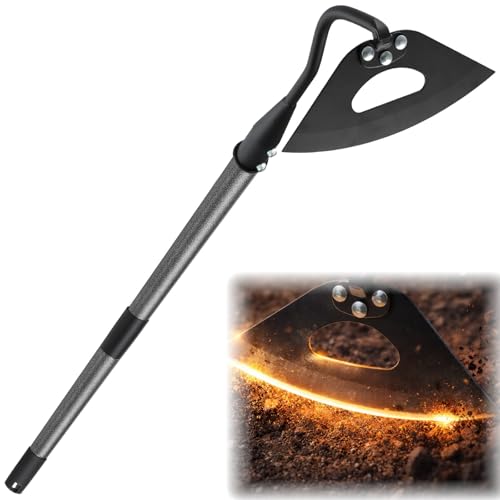
A surface hoe works because a severed seedling lying on dry soil dries out and dies. Do the same job after rain and half of them simply re-root and carry on. So the technique is to go early, when weeds are small, on a dry day, skimming barely under the surface rather than chopping. CALCHELE claims its hollow blade works well in wet soil and clay, which is a genuine design answer to clogging, though it does not change what happens to a cut weed lying on wet ground.
An adjustable handle is the difference between doing it and not
Almost everything here telescopes: 16 to 60 inches on the NICOFPHY and the CKLT, 30 to 61 on the DonSail, 32 to 62 on the Oliynedy, 23 to 58 on the CALCHELE. The point is standing upright with your arms relaxed rather than stooping, because a stoop is what ends the session after twenty minutes. Set it so the head reaches the soil with your back straight, and note the short end matters too: collapsed down, these become hand tools for close work.
Handle diameter is the quiet spec
Thin tube flexes, and a hoe you have to push hard through compacted soil is exactly where flex becomes a snapped handle. Two brands give you a number: DonSail at 1.3 inches of steel and Oliynedy at about 1 and 1/7 inches of stainless. Everyone else says heavy duty. On a tool that is essentially a lever, the diameter of the lever is not a detail.
Japanese Weeding Sickle
The cheapest tool here and the only one made by hand, one at a time, by a maker specializing in garden tools. There is nothing to adjust and nothing to assemble: a high carbon steel blade on a handle, ground properly, and it holds that edge because high carbon steel does. This is a kneeling tool for close work, slicing weeds out from between seedlings and along edges where a 60 inch pole is a liability. It is the opposite of everything else on this page, and if your weeding is precise rather than broad, it is the right opposite.
Pros:
- Cheapest tool here
- Hand-forged high carbon steel that holds an edge
- Nothing to assemble, adjust or break
- Precise enough to work between plants you want to keep
Cons:
- You will be kneeling; there is no long handle
- Slow across an open bed
- High carbon steel needs drying and oiling or it will rust
Best for: close work between seedlings, where accuracy beats reach.
COCONUT 45 inch
The plain one, and there is something to be said for that. A traditional draw hoe blade on one side for chopping weeds and digging planting holes, a tined tiller on the other, and you flip the handle rather than swap tools. The steel handle is 1 inch across with a non-slip grip, and it assembles from three poles so you can run it at full 45 inches or shorten it for tight corners. No loop, no telescoping mechanism, no marketing about steel grades. It digs, it chops, it breaks up soil.
Pros:
- Double-sided: draw hoe one side, tiller tines the other
- Build it at one, two or three poles for the length you want
- Non-slip grip on a 1 inch steel handle
- Genuinely useful for digging planting holes, not just weeding
Cons:
- A chopping draw hoe is more work than a loop hoe for surface weeds
- 45 inches is short if you are tall
- Sells modestly against the leaders
Best for: general bed work where weeding is one job among several.
CALCHELE
A Dutch scraper, which is the other way to cut weeds at the surface: a fixed blade pushed just under the soil rather than a pivoting loop. The blade is hollow, and that is the interesting part, because an open head lets soil pass through instead of building up in front of it, which is exactly what ruins a solid hoe in wet clay. CALCHELE claims the beveled edge is self-sharpening in use, which is a fair description of how a single-bevel blade wears. It adjusts from 23 to 58 inches, so it collapses to a hand tool.
Pros:
- Hollow blade lets soil through instead of clogging
- Specifically designed for wet soil and clay
- Beveled edge that wears rather than blunts
- Adjusts from 23 to 58 inches, hand tool to full length
Cons:
- By far the lowest seller here
- A fixed blade cuts on the push only, unlike a loop
- Reinforced carbon steel, which the brand does not elaborate on
Best for: heavy or damp soil that clogs an ordinary hoe.
NICOFPHY 2-in-1
The best-selling tool in this group, and it is the one that answers the dandelion problem. Six sharp tines drive deep and lever the whole root out rather than trimming the top off, and the other face is a sharpened edge for slicing. That combination is why it sells: most gardens have both kinds of weed. The head is cast steel, welded rather than stamped, and the handle takes four stainless poles to run anywhere from 16 to 60 inches, assembled in about half a minute. Standing up, not kneeling.
Pros:
- The best-selling weeding tool here
- Six tines that lift tap roots out whole
- Sharpened hoe edge on the reverse for surface weeds
- Four stainless poles, 16 to 60 inches, 30 second assembly
Cons:
- A tined rake disturbs the soil far more than a loop hoe
- Cast steel is sold against carbon steel, which is a slogan
- Not the tool for fast work across an open bed
Best for: dandelions, dock and anything with a root that comes back.
DonSail
A proper loop hoe, and the push-pull action is the point: the blade cuts on the way out and again on the way back, so you are working continuously in a shuffle rather than swinging and chopping. That is faster and far less tiring across a bed of seedlings, and it disturbs almost nothing. DonSail publishes what few here do, a 1.3 inch diameter steel handle, thick enough not to flex when you lean on it, and it adjusts to 30, 43 or 60 inches. It is all-steel and hollow, so it stays light. Ignore the line calling it a collinear hoe; it is a stirrup.
Pros:
- True push-pull loop; cuts in both directions
- Publishes a 1.3 inch handle diameter, thicker than most
- Three set lengths from 30 to 60 inches
- Hollow steel keeps it light through a long session
Cons:
- Its own listing calls it both a stirrup and a collinear hoe
- Will not remove a tap root, whatever you do with it
- One tool, one job
Best for: clearing annual weeds across a bed, fast, standing up.
Oliynedy
The best compromise on this page: a loop hoe on one side for slicing, four cultivator tines on the other for digging a root out whole, so one handle covers both weeding jobs. The blade has a sharpened end so you can either scrape the surface or get under it and rip roots up. The handle is thickened stainless at roughly 1 and 1/7 inches, adjustable between 32 and 62 inches, and it takes about five minutes to bolt together. If you do not want to own two tools, this is the plain way to own one.
Pros:
- Loop hoe and four-tine cultivator on the same handle
- Publishes its handle diameter; thickened stainless
- Adjusts 32 to 62 inches for standing or seated work
- Sharpened blade end works above or below the surface
Cons:
- Five minutes and a bolt to assemble, longer than rivals
- Carbon steel blade, where pricier heads claim spring steel
- Four tines lift less than the six-tine pullers
Best for: a mixed garden with both kinds of weed and one tool budget.
CKLT 2-in-1
The most specified tool here. The heads are tempered spring steel, which is a real answer to the thing that kills a cheap tined weeder: tines that bend and stay bent when you lever against a stubborn root. Spring steel returns. The hoe side is a trapezoid blade for slicing compacted soil and weeds, the poles are 304 stainless in four screw-locking sections up to 60 inches, and the heads carry a sand-textured finish for grip and corrosion resistance. It costs the most here, which in this category is a couple of pounds.
Pros:
- Tempered spring steel heads that return rather than stay bent
- 304 stainless poles in four screw-locking sections
- Sand texture finish for grip and corrosion resistance
- Trapezoid hoe blade for compacted soil
Cons:
- Most expensive tool here
- Sells behind the near-identical NICOFPHY
- Sells against carbon steel, which is a slogan not a grade
Best for: hard ground that has already bent a cheaper weeder.
The verdict
Best overall: NICOFPHY 2-in-1. The best seller here and the most useful compromise for a real garden, because most gardens have both problems. Six tines lift a dandelion out root and all, the sharpened reverse face slices the fine stuff at the surface, and a four-pole stainless handle runs from a hand tool at 16 inches to a stand-up 60. Ignore the marketing about cast steel beating carbon steel; buy it for the two heads.
Best value: Japanese Weeding Sickle. The cheapest thing on this page, made by hand, in high carbon steel that takes and holds a genuinely sharp edge. It has no handle, no adjustment and no versatility, and it will out-cut everything here between seedlings where a pole tool cannot go. Dry it and oil it. It is a different way of gardening rather than a smaller version of the same one.
Best premium: CKLT 2-in-1. Nearly the same tool as the best seller, for a little more, with the one upgrade that matters on a tined weeder: tempered spring steel that springs back instead of taking a set the first time you lever hard on a root in dry ground. Add 304 stainless poles and a textured finish against rust. If your soil fights back, this is the one to buy.
FAQ
Which hoe kills dandelions?
None of the slicing hoes. A dandelion regrows from its tap root, so cutting the top off just prunes it. You need a tined puller that levers the whole root out: the NICOFPHY has six tines for exactly that, the Oliynedy four. A stirrup hoe is the wrong tool for the job no matter how sharp it is.
What is the difference between a stirrup and an oscillating hoe?
Nothing. Stirrup, oscillating, scuffle and loop all describe the same closed loop of steel that pivots and cuts on both the push and the pull. The names are interchangeable and the listings use them at random. One brand here even calls its stirrup a collinear hoe, which is a different tool entirely.
Is cast steel better than carbon steel?
Not automatically, and the category is arguing with itself. Three brands here sell cast or spring steel as an upgrade over carbon steel, while the two Japanese tools sell high carbon steel as their premium feature. Carbon steel is a family, not a grade. How the head is formed and tempered matters more than the phrase.
Why isn’t my hoeing working?
Probably timing rather than tooling. A surface hoe kills by severing the weed and leaving it to dry, so it works best on small weeds on a dry day, skimmed shallow. Do it after rain and a good proportion simply re-root. Go early, go often, and go barely under the surface.
How long should the handle be?
Long enough that the head reaches the soil while your back is straight. Most tools here adjust: 16 to 60 inches on the NICOFPHY and CKLT, 23 to 58 on the CALCHELE. The short setting is worth having too, since collapsing one down turns it into a hand tool for a raised bed or a container.
This article may contain affiliate links; see our Affiliate Disclosure.