Read any of these listings and you will notice most of it is a list of camera models. That is not padding. It is the product. A shutter release that fits a Canon will not fit a Nikon, and the one that fits your Nikon may not fit the Nikon next to it, so the compatibility list is the specification and everything else is detail.




The job is simple: fire the shutter without touching the camera, because touching a camera on a tripod during a long exposure puts a shake into the picture that no amount of stacking will remove. Beyond that, three things separate these. Whether they plug in or transmit, whether they can hold the shutter open for you, and whether they can do it repeatedly while you sit in the car.
At a glance
| Remote | Standout feature | Price tier | Link |
|---|---|---|---|
| SHOOT wired | Cheapest here; needs no battery at all | Budget | |
| AFUNTA wired | An 11.4 ft extension cable in the box | Budget | |
| Kiwifotos MC-DC2 | The Nikon wired option | Budget | |
| Kiwifotos Sony | The Sony multi-terminal option | Budget | |
| AODELAN BR-E1A | No receiver box; talks straight to the camera | Budget | |
| Hanpusen | Rechargeable with an OLED screen; Nikon | Mid-range | |
| AODELAN wireless | Works wireless or wired, out to 80 meters | Mid-range | |
| AODELAN intervalometer | Built-in interval timer and an LCD | Premium | |
How to choose a shutter release
Find your camera in the list first
Nothing else matters until this is settled. Canon bodies mostly take an E3 socket, which is what the RS-60E3 style cables fit. Nikon uses a DC2 connector on many bodies. Sony uses a multi-terminal port. They look similar and they are not interchangeable, and within a brand the socket changed between generations. Every listing here spends most of its space on model numbers for exactly this reason. Read yours in the list, not the brand on the box.
For long exposures you need a lock, not a button
This is the actual job. Beyond about 30 seconds your camera needs Bulb mode, where the shutter stays open as long as the release is held, and holding a button for four minutes by hand is both tiring and pointless. SHOOT describes the mechanism properly: half press to focus, full press to shoot, and lock the button for long exposures or continuous shooting. That lock is the feature you are buying. Without it, a release is just a button on a string.
Wired needs no battery, and that matters at 3am
SHOOT states it plainly: no battery required, powered by the camera. On a cold night shooting star trails, that is not a small thing. Cold flattens batteries, and the remote is the one component you cannot check without ruining your dark adaptation. The wireless units here run on two AAAs or a rechargeable cell, which is fine and is one more thing to have failed while you were not looking.
Wireless comes in two shapes
Most wireless releases are three parts: a transmitter in your hand, a receiver on the camera, and a cable between the receiver and the camera’s socket. AODELAN’s 80 meter unit works that way and its receiver doubles as a wired remote, which is a neat piece of thinking. The BR-E1A is different: it talks straight to the camera with no receiver at all, so there is nothing to mount and nothing to plug in. The trade is compatibility, and AODELAN is blunt that it works with a specific list and nothing else.
An intervalometer is a different tool
If you want a time-lapse, or twenty long exposures in a row while you sit somewhere warm, a plain release will not do it. You need an interval timer that fires the shutter on a schedule and counts the frames for you. Only the AODELAN intervalometer here has one built in, with an LCD to set intervals and counts. Its cheaper wireless sibling lists time-lapse among its modes. Everything else fires when you press it and stops when you let go.
Check for the caveats the brands print themselves
Two real warnings worth heeding. AODELAN’s BR-E1A tells you to set the camera’s drive mode to remote before pairing, and says outright that it will not work with unlisted models. Hanpusen notes that at least one Nikon body needs a particular firmware version. These are the kind of details that turn into a return, and both brands deserve credit for putting them in the listing instead of the manual.
SHOOT wired
The cheapest thing here and, for its one job, close to perfect. It replicates every function of the shutter button: half press to focus, full press to fire, and a lock for long exposures or continuous shooting, which is the whole point of owning one. It draws its power from the camera, so there is no battery to die on a cold night and nothing to check before you leave the house. It fits Canon bodies with the E3 socket, and the model list is long. There is nothing clever about it and nothing to go wrong.
Pros:
- Cheapest release here
- No battery; powered by the camera
- Locks for Bulb exposures and continuous shooting
- Replicates every shutter button function including half-press focus
Cons:
- Canon E3 socket only
- You are tethered to the camera by the cable
- No extension cable included
Best for: long exposures on a Canon, for the price of a coffee.
AFUNTA wired
The same idea with the one genuinely useful addition: an 11.4 ft extension cable on a 2.5 mm plug, on top of the 3.3 ft lead. That gets you a proper distance from the camera without going wireless, which matters for wildlife, for a camera set up somewhere awkward, or simply for not standing next to a tripod on a windy clifftop. Half press to focus, full press to shoot, and Bulb operation for long exposures. It fits Canon E3 socket cameras and some Samsung bodies. Plug in and it works, with no batteries and no pairing.
Pros:
- An 11.4 ft extension cable included
- Nearly 15 ft of total reach without going wireless
- No battery, no pairing, plug and play
- Half press focus and Bulb mode supported
Cons:
- Canon E3 socket and selected Samsung only
- Fifteen feet of cable to coil and tangle
- No lock explicitly mentioned
Best for: standing well back from the tripod without buying batteries.
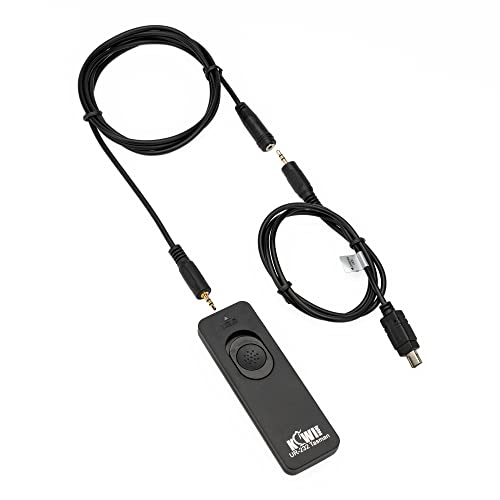
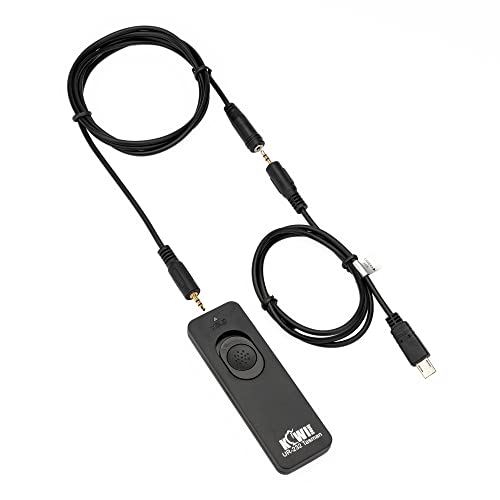
Kiwifotos MC-DC2
The Nikon answer, and the reason it is on this page is that nothing else here fits your camera if your camera is a Nikon with a DC2 socket. It controls autofocus and shutter triggering without shaking anything, and Kiwifotos names its use cases plainly: Bulb exposures, super telephoto, and macro, which are precisely the three situations where touching the camera ruins the frame. The cabling is generous, 70 cm to the camera plus a 130 cm extension, so you get real distance in the box.
Pros:
- Fits Nikon bodies with the DC2 connector
- 70 cm cable plus a 130 cm extension included
- Controls autofocus and shutter separately
- Aimed squarely at Bulb, telephoto and macro work
Cons:
- Nikon DC2 only; check your body is on the list
- Wired, so you stay near the camera
- No battery-free claim stated, though wired releases rarely need one
Best for: Nikon owners who want the cheap, reliable answer.
Kiwifotos Sony
The same cable for Sony’s multi-terminal port, which is a different socket again and the reason you cannot simply buy the Canon one and hope. It covers a long list of Sony mirrorless bodies across the compact and full-frame ranges. Same virtues: autofocus and shutter control without touching the camera, 70 cm to the body plus a 130 cm extension, and it is aimed at Bulb exposures, long telephoto work and macro, where the tiniest nudge is visible at full size.
Pros:
- Fits Sony’s multi-terminal port; a long compatible list
- 70 cm cable plus a 130 cm extension
- Separate autofocus and shutter control
- Cheap enough to keep permanently in the bag
Cons:
- Sony multi-terminal only
- Wired only; no wireless option in this design
- Slightly dearer than the Canon and Nikon versions
Best for: Sony owners, for exactly the same reasons.
AODELAN BR-E1A
Wireless with nothing on the camera. There is no receiver box and no cable, because it pairs directly with Canon bodies that already have the radio built in, which means nothing to mount, nothing to plug in and nothing to leave behind. It handles stills with immediate or two-second delayed release, and video too, plus autofocus. AODELAN is admirably direct about the limits: it works with a specific list of bodies and nothing else, and you must set the camera to remote drive mode before pairing. Read both sentences before ordering.
Pros:
- No receiver, no cable, nothing mounted on the camera
- Stills and video, with immediate or delayed release
- Autofocus supported; genuinely pocketable
- Real about compatibility and the drive mode setting
Cons:
- Works only with a specific list of Canon bodies
- Needs the camera set to remote drive mode first
- Zoom control only works with a separate Canon adapter
Best for: a recent Canon with the radio already inside it.
Hanpusen
The Nikon wireless option, and the best-equipped small remote here. It charges over USB-C rather than eating AAAs, running up to ten hours, and an OLED screen shows status and settings rather than making you count LED blinks in the dark. It supports autofocus, instant shooting, short video recording and zoom control on compatible lenses, with quick pairing and omni-directional operation. Hanpusen is plain enough to note that at least one body needs a specific firmware version, which is the sort of thing you want to read before you buy.
Pros:
- Rechargeable over USB-C; up to ten hours
- OLED screen shows status and settings
- Autofocus, stills, video and zoom control
- States the firmware requirement up front
Cons:
- Nikon only, and a specific list at that
- One body needs a firmware update first
- A rechargeable cell is one more thing to charge
Best for: a recent Nikon, and reading the screen instead of guessing.
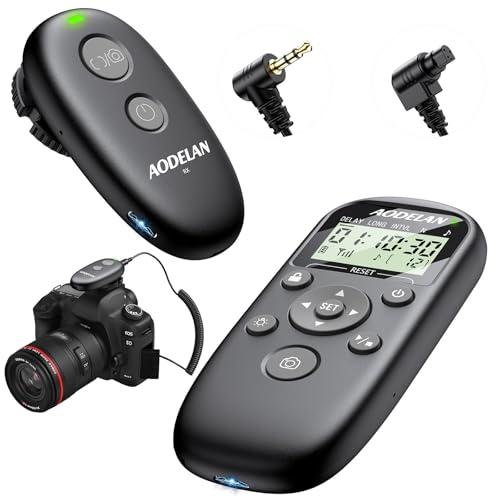
AODELAN wireless
The most versatile remote here, and the reason is a small design decision: the receiver also works as a wired shutter remote on its own. So it is a wireless release when you want to be 80 meters away, and a plain cable release when the batteries are flat or you are standing at the tripod anyway. It uses 2.4 GHz radio with strong interference rejection, supports autofocus, single shot, time-lapse, continuous shooting and Bulb, and it replaces two different Canon originals, so one box covers bodies with either socket.
Pros:
- The receiver doubles as a wired remote; two tools in one
- 2.4 GHz radio out to a stated 80 meters
- Autofocus, single, time-lapse, continuous and Bulb
- Covers Canon bodies with either of two socket types
Cons:
- Needs two AAA batteries in the receiver
- Canon only
- Three pieces to keep track of
Best for: one remote that covers both ways of working.
AODELAN intervalometer
The one that does the job you cannot do yourself: an interval timer that fires the shutter on a schedule and counts the frames, so a time-lapse or a night of repeated long exposures happens without you standing over it. A clear LCD sets the intervals and counts, the battery is built in and rechargeable rather than a pair of AAAs, and it works either wirelessly through the included receiver or as a direct cable release. The compatibility list is the broadest here, reaching across Canon, Fujifilm and Contax bodies.
Pros:
- Built-in intervalometer with a clear LCD; the only one here
- Rechargeable rather than AAA powered
- Works wirelessly or as a direct cable release
- The broadest compatibility list on this page
Cons:
- Most expensive remote here by a wide margin
- Overkill if you never shoot time-lapse
- Another device to keep charged
Best for: time-lapse, star trails, and anything that runs for hours.
The verdict
Best overall: AODELAN wireless. It covers both ways of working from one box, because the receiver is also a wired remote in its own right. So you get 80 meters of 2.4 GHz range when you want it and a plain cable release when the batteries are dead or you are standing at the camera anyway. It handles autofocus, single, continuous, time-lapse and Bulb, and it replaces two different Canon originals, which widens the list of bodies it fits.
Best value: SHOOT wired. The cheapest thing here does the actual job perfectly: half press to focus, full press to fire, and a lock to hold the shutter open through a Bulb exposure. It takes its power from the camera, so there is no battery to flatten on a freezing night, and there is nothing to pair, charge or lose. If your Canon has the E3 socket, this is all most people ever need.
Best premium: AODELAN intervalometer. A plain release fires when you press it. This one fires on a schedule, counts the frames and lets you go and sit down, which is the difference between wanting a time-lapse and having one. Add a rechargeable battery, an LCD you can read, wired or wireless operation and the widest compatibility here, across Canon, Fujifilm and Contax.
FAQ
Will any remote fit my camera?
No, and this is the whole thing. Canon bodies mostly use an E3 socket, Nikon uses DC2, Sony uses a multi-terminal port, and none of them interchange. Sockets have also changed between generations within a brand. Find your exact body in the compatibility list before you look at anything else on the box.
What do I need for exposures over 30 seconds?
Bulb mode on the camera, and a release with a lock. In Bulb the shutter stays open while the release is held, and a lock holds it for you so you are not standing there with your thumb down for four minutes. SHOOT’s listing describes it exactly: half press to focus, full press to shoot, lock for long exposures.
Wired or wireless?
Wired if reliability matters most: no battery, nothing to pair, powered by the camera. Wireless if distance does, and the ranges here are real, up to 80 meters on the AODELAN. The clever compromise is that same AODELAN, whose receiver also works as a wired remote, so you carry one thing and get both.
Do I need an intervalometer?
Only for sequences. If you want a time-lapse, or a long series of exposures fired automatically while you do something else, a plain release cannot do it. The AODELAN intervalometer is the only one here with a timer and frame counter built in.
What is the catch with the receiver-free wireless remotes?
Compatibility. The BR-E1A talks straight to Canon bodies that already contain the radio, so there is nothing to mount, and AODELAN says clearly that it will not work with anything off its list. You also have to set the camera’s drive mode to remote first, which is the step people miss and then blame the remote for.
This article may contain affiliate links; see our Affiliate Disclosure.