A cable machine gives you something a dumbbell never can: steady tension through the whole arc of a movement, from any angle you can bolt a pulley to. The awkward truth is that a stack of latex tubes, a door anchor, and a pair of handles reproduce most of that for the price of a takeaway dinner – and the parts fit in a drawer.


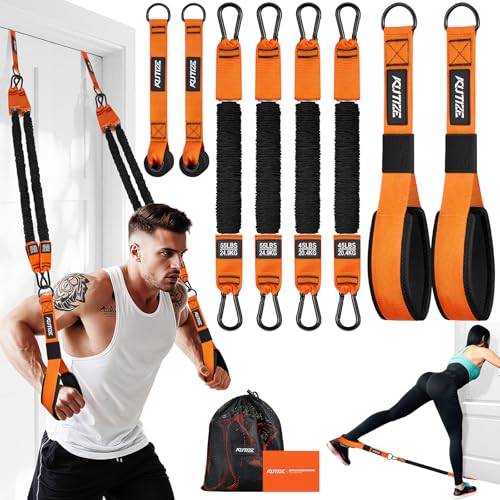

This is a comparison of two approaches, and a look at the band gear that stands in for a pulley stack. A cable machine wins on smooth, constant load and on heavy pulling. A band setup wins on cost, footprint, and the fact that it travels. What separates a good band kit from a frustrating one is rarely the bands themselves – it is the anchor, the handles, and whether the resistance stacks high enough to keep challenging you.
At a glance
| Product | Standout feature | Price tier | Link |
|---|---|---|---|
| Riawit Pedal Resistance Band with Handle | Six tension ropes with a padded foot pedal; self-anchoring | Budget | |
| Brebebe Door Anchor Strap | Five D-ring anchor points; rated to 500 lb | Budget | |
| HPYGN Ankle Resistance Bands with Cuffs | 10/20/30 lb tubes with neoprene ankle straps | Budget | |
| KUTIZE Resistance Bands with Handles and Door Anchor | 45 lb and 55 lb tubes, stackable to a claimed 200 lb | Premium | |
| Serious Steel Fitness Single D Handle (Pair) | Steel D-ring handles that fit bands and pulley machines alike | Mid-range | |
How to choose between bands and a cable stack
The physics gap, stated plainly
A cable machine holds load almost constant. Lift the pin to a plate and that is what you fight from the first inch to the last. A band does the opposite: tension climbs as it stretches, so the start of a rep is light and the end is heavy. For a chest fly or a lat pulldown that ascending curve is genuinely useful, because most people are strongest near the end of the range anyway. For a movement where you are weakest at the finish, it fights you. That is the real trade, and no amount of latex changes it.
Anchor points decide what you can train
The pulley is the real product on a cable machine, not the weight. Height is what lets you do a high fly, a mid row, and a low cable curl on the same frame. A band kit only matches that if you can anchor at several heights, which is why a multi-point door strap does more for your training range than a stronger band does. Anchor low and you have pull-aparts and curls. Anchor high and you have pushdowns and lat work. Anchor at chest height and you have rows and presses. One strap, three machines’ worth of angles.
Resistance that stacks, not resistance that maxes out
The most common band disappointment is outgrowing the kit in two months. A single fixed tube has one answer. A set with clipped, combinable tubes lets you add tension the way you add plates, and the ones that combine to triple digits will keep pace with a pulley stack for pressing and pulling for a long time. Take the printed pound ratings as a rough ladder rather than a calibrated figure – they describe tension at a particular stretch, not a weight hanging on a cable.
The failure points are the parts you don’t think about
Latex is rarely what disappoints. Handles crack, clips bend, and cheap foam turns slick once a workout gets sweaty. A band snapping loaded is unpleasant in a way a dropped plate is not, so sleeved tubes and steel hardware earn their keep. If a kit is a permanent fixture rather than a travel item, it is worth putting the money into the handles and the anchor and staying relaxed about the tubes, which are the cheap consumable part.
Where a cable machine still wins outright
Heavy, low-rep pulling. Anything where you want to know the number went up. A cable stack is also simply easier to use: no threading, no clipping, no wondering whether the door will hold. If you have the floor space, the budget, and a spot to bolt it down, the machine is a better machine. Bands are the answer when one of those three is missing, which for most homes is all three.
Riawit Pedal Resistance Band with Handle – the whole setup in one piece
This is the most popular pick in the group, and the reason is not subtle: it needs no door, no wall, and no hardware. Your feet are the anchor. You sit on the floor, plant both feet on the padded pedal, and row, curl, or press against six latex tubes. That solves the one problem that stops most band setups before they start – nowhere to attach anything. The pedal is fabric-padded rather than hard plastic, which matters more than it sounds when you are pulling against it barefoot.
Pros
- Six high-elasticity latex tubes for a meaningful pull
- Needs no door, wall, or anchor point at all
- Soft textured foot pedal works barefoot or in shoes
- Detaches flat and packs into a bag
- The lowest-cost way into seated rowing and pressing
Cons
- Seated floor position only; no high or mid anchor angles
- Tension is fixed by the tube count, so it eventually caps out
- Marketing leans hard on fat-loss claims worth ignoring
Best for: anyone who wants band training tonight, in a rental, without drilling or hanging anything.
Brebebe Door Anchor Strap – the part that turns a door into a pulley tower
Most door anchors give you one attachment point, which gives you one angle. This one runs a 17-foot strap down the door with five stainless D-rings along its length, so a single band clips in high for pushdowns, at chest height for rows and flies, or near the floor for curls and pull-throughs. That is the closest a band setup comes to the adjustable pulley that makes a cable machine worth owning. It hangs over the top of any door up to about 8.5 feet, needs no tools, and the strap is rated to 500 lb.
Pros
- Five anchor heights from one strap, so the angles come free
- Stainless D-rings take carabiners and band clips cleanly
- No drilling, no nails, no permanent fixture
- 500 lb strap rating leaves ample margin over any band
- Works with band sets you already own
Cons
- An accessory, not a workout; bands are sold separately
- Depends on a door that closes firmly and opens away from you
- Needs re-hanging each session if the door is in daily use
Best for: turning a band set you already have into something that trains high, middle, and low angles.
HPYGN Ankle Resistance Bands with Cuffs – the low-pulley job, minus the pulley
Kickbacks, hip abduction, and standing leg curls are the movements people queue for the low pulley to do. This set does them with a neoprene cuff, a double D-ring, and three tubes rated 10, 20, and 30 lb that clip on singly or together. The cuff is the part that decides whether the thing is usable: a thin strap digs in and slides, and a padded one stays put. This one uses a sponge-filled neoprene pad, which is the right approach for a strap that spends the whole set being pulled sideways across the ankle bone.
Pros
- Three tubes at 10, 20, and 30 lb, usable in combination
- Padded neoprene cuff with a double D-ring that holds position
- Covers the low-pulley leg work most band kits ignore
- Packs into the included mesh case; genuinely travel-sized
- Pairs with a door anchor to add standing angles
Cons
- Leg and glute work only; no upper-body use
- Needs an anchor for standing movements
- Listing copy is aimed squarely at an aesthetics pitch
Best for: hip and glute training at home when a low cable is what you actually miss.
KUTIZE Resistance Bands with Handles and Door Anchor – the closest thing to a stack
Where the cheaper sets top out, this one keeps going. Two heavy tubes rated 45 lb and 55 lb combine, and the maker puts the stacked figure at 200 lb – the only kit here aimed at someone who wants a band to feel heavy rather than merely present. It ships as a complete unit: tubes, foam grips, and a door anchor, so face pulls, rows, lat pulldowns, chest flies, and tricep pushdowns are all available out of the box. The thick foam grip is a real consideration on heavy tube work, where thin plastic handles cut into the palm.
Pros
- Heaviest resistance here; tubes stack well past a light kit’s ceiling
- Door anchor included, so the pulling angles come in the box
- Thick extended foam grips suit high-tension sets
- Covers pushdowns, rows, flies, and pulldowns with one set
- Packs into the supplied travel bag despite the tension
Cons
- Priciest option in this group
- Stacked pound ratings are indicative, not calibrated
- Heavy tubes make light warm-up work clumsy
Best for: replacing a cable stack for pressing and pulling, not just supplementing one.
Serious Steel Fitness Single D Handle – the handle that spans both worlds
Sold as a cable attachment, and that is exactly why it belongs in a band kit. A waffle-textured rubber grip on a nylon strap and a steel D-ring clips to a band at home and to a pulley at the gym, so the feel of your single-arm rows stays the same in both places. It is the upgrade you make when the handles that came with your band set start to flex, crack, or turn slippery. The 4.75-inch grip fits most hands, and the maker notes the sensible caution about loads above 150 lb.
Pros
- Works on bands and on most pulley cable machines
- Steel D-ring and webbed nylon rather than molded plastic
- Sweat-resistant rubber grip holds up mid-set
- Sold as a pair, so both sides match
- Consistent grip feel between home and gym sessions
Cons
- No bands included; strictly an attachment
- Maker advises caution above 150 lb
- Only worth it if your current handles are the weak link
Best for: training in both places and wanting one handle that behaves the same on either.
The verdict
Best Overall – Riawit Pedal Resistance Band with Handle. It is the most popular pick in this group by a wide margin, and popularity here reflects something real: it removes the anchor problem entirely. Six tubes, a padded pedal, your own feet as the mounting point, and you are training in ninety seconds. It will not train every angle, but it is the one that gets used.
Best Value – Brebebe Door Anchor Strap. The cheapest genuine capability upgrade on this page. Five anchor heights convert any band you own into high, mid, and low pulls, which is the actual thing a cable machine sells you. If you own bands and no anchor, start here.
Best Premium – KUTIZE Resistance Bands with Handles and Door Anchor. The only kit built for people who want heavy. Tubes that stack far beyond a starter set, a door anchor in the box, and grips that tolerate real tension. This is the setup that answers “when are bands enough” with “further than you’d think.”
FAQ
Can a band setup actually build muscle like a cable machine?
For most people training in a normal rep range, yes. Muscle responds to tension and effort near failure, and it does not audit where the tension came from. The gap opens up at heavy, low-rep work, where a cable stack is easier to load precisely and to progress in known increments.
How do band pound ratings compare to cable machine plates?
They do not map cleanly. A band’s rating describes its tension at some particular stretch, so the same tube is lighter at the start of a rep and heavier at the end, while a cable plate is the same throughout. Take band numbers as a ladder for comparing bands to each other, not as an equivalent to the pin position on a stack.
Is a door anchor safe on a normal interior door?
On a door that closes properly and latches, with the anchor on the hinge side so your pull holds the door shut rather than pulling it open, it is standard practice. Straps rated far above band tension leave sensible margin. Check the strap and stitching now and then, and skip hollow or sliding doors.
What wears out first on a band kit?
The hardware, usually – handles, clips, and foam grips fail before the latex does. Tubes do age: latex hardens with heat, sunlight, and time, so store them somewhere cool and dark, and retire a tube showing nicks or cloudy patches rather than finding out mid-rep.
Do I need every piece here, or will one do?
One will do to start. A self-anchoring set covers seated pulling with nothing else at all. The anchor, the ankle cuffs, and better handles are each a specific angle you cannot otherwise reach, so add them when you notice a movement missing rather than buying the set up front.
This article may contain affiliate links; see our Affiliate Disclosure.