Your webcam is probably fine. The ceiling bulb behind your head is the problem, and it has quietly turned you into a silhouette with a voice.



Good call lighting does one job: put a soft, even source in front of your face, slightly above eye level, brighter than whatever is behind you. Everything else is a question of how much desk you can spare, whether the light needs to travel, and how often the camera moves. The five picks below cover a clip-on panel that fits in a coat pocket, three ring lights on stands, and one studio-sized ring for a room you never rearrange.
At a glance
| Product | Standout features | Price tier | Link |
|---|---|---|---|
| ALTSON 60 LED Portable Selfie Light | Rechargeable 2200mAh battery; CRI 97+; clip and 1/4-inch mounts; 95g | Budget | |
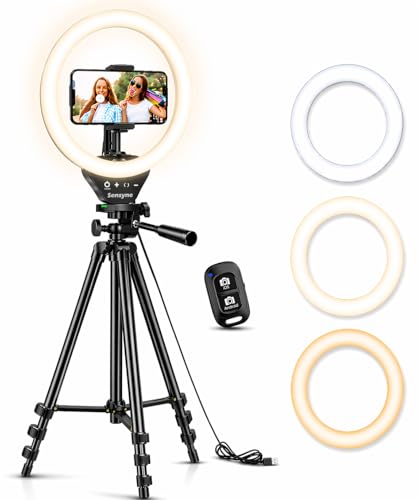
| Sensyne Ring Light with Stand | Stand from desk height to 50 inches; wireless remote; 3 color modes | Mid-range | |
| EMART 10" Ring Light | True 10-inch ring; two remotes; two phone holder styles; aluminum stand | Budget | |
| NEEWER 18" Ring Light Kit | 18-inch 55W ring; 1-100% dimming; color filters; DSLR and phone mounts | Premium | |
| Aureday 14" Selfie Ring Light | 14-inch ring, 288 beads; 5 color modes; touch control; 16-62 inch stand | Mid-range | |
How to choose a light for video calls
Ring or panel: what the shape does to a face
A ring puts light around the lens, so shadows fall directly behind you instead of across your cheek. It also leaves a circular catchlight in the eyes, which reads as polished on camera and slightly staged in a boardroom. A rectangular panel clipped to a monitor does the same softening job from one side of the frame, gives a normal rectangular catchlight, and disappears from view faster when a call ends. Neither is better in the abstract. Rings suit anyone whose face is the content; panels suit anyone whose spreadsheet is the content.
Size, and how close you sit
Softness comes from how large the light looks from where you sit, not from wattage. A 10-inch ring two feet from your face is a big, gentle source. The same ring across the room is a hard little dot. This is why an 18-inch ring earns its bulk only if you sit back from the camera or want room to move; at normal desk distance, 10 to 14 inches already wraps a face nicely.
Color temperature and color accuracy
Two numbers matter. Color temperature, quoted in Kelvin, sets warm to cool: roughly 2700-3200K matches household bulbs, 5600-6500K matches daylight. Match the room you sit in, or your skin drifts orange against a blue window. The second number is CRI, which describes how accurately a light reproduces color. High CRI keeps skin looking like skin instead of a waxwork. Fixed-temperature lights are not a flaw, but they do force the rest of the room to agree with them.
How it mounts
A clip grabs a laptop lid or monitor and costs no desk space. A weighted desk base is steadier but claims a footprint. A floor tripod frees the desk entirely and lets the light rise above eye level, which is where you want it, at the price of a stand you will eventually trip over. Check the tripod’s minimum height too, not just the maximum: a stand that only starts at chest height is awkward next to a seated desk.
Power
Battery lights go anywhere and need charging. USB lights run forever from a monitor port, but some draw more current than a laptop port likes and will look dim or flicker on an underpowered adapter. Mains-powered studio lights never dim unexpectedly and never move.
One light, or one light plus the room
A single source in front of you is a complete answer for most calls, but it is worth knowing what it cannot do. One light leaves the background as dark as it was, so a dim room still reads as a dim room with a well-lit head floating in it. It also lights both sides of a face equally, which is clean but flat. If either bothers you, the cheap fix is not a second light: it is turning on a lamp behind you, off to one side, to separate you from the wall. Buy the second light only once the first one is doing its job and you have decided what is still missing.
Brightness you will actually use
Dimming range matters more than peak output. Almost every light here is far brighter than a face needs at desk distance, so you will live somewhere in the bottom half of the scale. Ten fixed steps are usually enough. Stepless dimming is nicer, because the gap between “slightly dark” and “slightly hot” on a ten-step dial can be exactly one step wide, and you will spend calls wishing for the setting in between.
ALTSON 60 LED Portable Selfie Light
This is the best seller of the group, and the reason is not subtle: it weighs 95 grams, charges over USB-C, and clips to a laptop lid in about two seconds. It is a flat panel rather than a ring, with 60 LEDs behind a diffuser, and the listing claims CRI 97+ for color accuracy. Three modes cover white, natural and warm across a 2500K-6500K range, with ten brightness steps. The 2200mAh battery is quoted at roughly 15 hours at 10% brightness and about 4 hours at 50%, so a working day of calls is realistic if you are not running it flat out. The panel tilts through 160 degrees, and a 1/4-inch adapter with a 180-degree head and hot shoe mount means it also lives on a tripod or camera.
- Pros: runs on its own battery, so no cable to the desk; pocket-sized at roughly 3.9 x 2.8 x 0.78 inches; high stated CRI; clip plus tripod and hot shoe mounting; wide 2500K-6500K range; pouch, cable and adapters included.
- Cons: a small panel is a harder light source than a big ring, so shadow edges are more defined; 4 hours at half brightness means remembering to charge it; no remote; the rectangular catchlight will not give you the ring look if that is what you came for.
Best for: anyone who takes calls from more than one place, or whose desk has no spare outlet or space.
Sensyne Ring Light with Stand
The second-best seller here solves the height problem properly. Its tripod runs from 15.7 inches to 50 inches, which is the useful span: the low end sits on a desk beside a monitor, the high end stands on the floor and looks down at you slightly, which is the flattering angle. Three color modes and ten brightness levels handle the room-matching job, the head and phone holder rotate through 360 degrees for portrait or landscape, and a wireless remote works from up to 30 feet away. It arrives as a complete kit: light, stand, phone holder, remote.
- Pros: one stand covers desk-height and standing use; remote means no reaching past the camera; 360-degree head for any orientation; nothing else to buy.
- Cons: the listing does not state the ring’s diameter, so confirm it before buying if size matters to you; the phone holder is the design’s center of gravity, which is less relevant if you only ever use a webcam; a floor stand needs floor.
Best for: a desk that also has to serve as a filming spot now and then.
EMART 10" Ring Light
A genuine 10-inch ring at the budget tier, which is the sweet spot for someone sitting an arm’s length from a monitor. Three color temperatures (white, warm white, yellow white) and ten brightness levels give enough control to match a room without a menu system. The aluminum stand is adjustable and doubles as a selfie stick, and the kit ships with two remotes: an inline controller for the light itself and a Bluetooth shutter good to about 30 feet. Two phone holders are included as well, a pole mount that opens to 3.9 inches and a 360-degree ball head, so it adapts to whatever you point at it.
- Pros: real 10-inch ring for the price of a takeaway lunch; separate light controller and camera remote; two mounting styles in the box; aluminum rather than plastic; light enough to carry.
- Cons: the product name quotes a 55-inch stand while the specification says it adjusts from 20 to 51 inches, so check the height you actually need before ordering; a ring plus tripod still occupies floor space; no battery, so it needs a USB source.
Best for: a first proper ring light where the budget is the constraint.
NEEWER 18" Ring Light Kit
This is the one that stops being a webcam accessory and becomes lighting. The ring measures 18 inches across with 240 LEDs drawing 55W at a fixed 5600K daylight balance, and it dims smoothly from 1% to 100% rather than in ten fixed jumps, which matters when you are trying to sit half a stop below blown-out. At that diameter the light wraps a face almost shadowlessly. The kit includes a 61-inch aluminum stand, a soft tube for angling the head, white and orange filters, a ball head hot shoe adapter for a DSLR, a phone holder, a power adapter and a carrying bag. NEEWER notes the stand is most stable with the leg joint 4 to 8 inches off the ground, which is worth respecting given what sits on top.
- Pros: big source means genuinely soft light; 1-100% stepless dimming; filters to shift the color; mounts a camera or a phone; low heat and no UV or IR; comes with a bag.
- Cons: one fixed 5600K temperature, so warming it means fitting the orange filter; needs a wall outlet; by far the largest footprint and the heaviest to move; overkill for a laptop on a kitchen table.
Best for: a permanent home studio corner where the camera position rarely changes.
Aureday 14" Selfie Ring Light
Fourteen inches is the real middle ground between a desk ring and a studio ring, and Aureday packs 288 beads into it. Five color settings run from warm through sunlight to cold white, each with ten brightness steps from 10% to 100%, and the controls are a touchpad rather than clicky buttons. The four-section stand adjusts from 16 to 62 inches with three locks and folds backward for storage, and the head rotates so the ring can sit perpendicular or parallel to the pole. The phone clip opens from 2.3 to 5.3 inches and swivels 360 degrees, and the bundled remote reaches about 33 feet. One caveat is printed in the listing itself: the light wants a 10W or better supply, and Aureday recommends a 5V 2A adapter.
- Pros: 14-inch ring is noticeably softer than a 10-inch at desk range; five color settings; touch control; the widest height range here at 16-62 inches; remote included.
- Cons: underpower it and it flickers or looks dim, and the recommended adapter is not in the box; no battery option; a touchpad is harder to adjust by feel than a button.
Best for: anyone who shoots standing as well as seated, or wants more ring without going to 18 inches.
The verdict
Best Overall: ALTSON 60 LED Portable Selfie Light. It is the clear best seller of this group, and it wins on the thing most people actually need: a light that fixes a call in seconds, from any chair, without a cable or a stand. High stated CRI, a full Kelvin range and a battery that lasts a day of meetings cover the job. It is a panel, not a ring, so choose it for results rather than for the circular catchlight.
Best Value: EMART 10" Ring Light. A true 10-inch ring, an aluminum stand, two remotes and two phone mounts at the budget tier is a lot of hardware for the money. Confirm the stand height first, given the listing quotes two different figures.
Best Premium: NEEWER 18" Ring Light Kit. Stepless dimming, an 18-inch source and filters put it in a different class, if you have the corner to give it and do not mind working around a fixed daylight balance.
FAQ
Do I need a ring, or will a panel do?
For calls, a panel does the job. The ring’s advantage is the round catchlight in the eyes and perfectly even shadow fall, which matters for beauty and presenter work. For a status meeting, being lit from the front at all is 90% of the win.
Where should the light sit?
In front of you, slightly above eye level, angled down a little. Behind the monitor or just beside it works well. Never behind you: a window or lamp at your back forces the camera to expose for the bright area and your face goes dark.
Which color temperature should I use?
Match the room. Warm settings around 3000K blend with normal household bulbs. Daylight settings near 5600-6500K blend with a window. Mixing the two lights half your face one color and half another, which looks worse than no light at all.
Will a ring light reflect in my glasses?
It can. Raise the light higher and angle it down, or move it slightly off to one side, and the reflection drops below the lens. Larger rings at close range are more prone to it, which is one quiet argument for a panel placed off-axis.
Can I power one of these from my laptop?
Sometimes. A laptop USB port often supplies less current than these lights want, and the symptom is dimness or flicker rather than a clear failure. A 5V 2A wall adapter or a powered hub avoids the issue. A battery light sidesteps the question entirely.
This article may contain affiliate links; see our Affiliate Disclosure.