The search says wire-free. One mower here lists boundary wire among the accessories it includes, and detects obstacles by bumping into them. It is the newest-looking listing on the page. Meanwhile the cheapest mower in the search claims to cover an acre and a half, which is more ground than the one costing eleven times as much.




At a glance
| Product | How it knows where it is | Price tier | Link |
|---|---|---|---|
| BESTMOW | Title says RTK, bullet says GPS. 1.5 acres, cheapest here | Budget | |
| YARDCARE | A bumper. And it includes boundary wire | Budget | |
| ECOVACS O1000 RTK Care | RTK, with an extension cable to move the antenna | Budget | |
| ANTHBOT M9 | RTK plus dual cameras. Title says 1/4 acre, bullet says 0.3 | Budget | |
| Sunseeker S4 | LiDAR. Says RTK mowers fail completely under trees | Mid-range | |
| ECOVACS O1000 LiDAR PRO | LiDAR, no antenna. And it admits its edge trimmer misses bits | Mid-range | |
| Mammotion LUBA 3 AWD | All three at once. 80 percent slopes on four motors | Premium | |
How to choose
Wire-free does not mean nothing to install
Most of these mowers replace the buried perimeter wire with satellite positioning, and satellite positioning needs an antenna planted in your garden with a clear view of the sky. One RTK listing here ships an extension cable specifically so you can move that antenna somewhere with better reception, and describes it as allowing optimal placement for improved satellite signal. That cable is an admission. You have swapped a wire in the ground for a mast in the flowerbed.
Three rivals independently say RTK fails under trees
The LiDAR mowers here are not subtle about it. One says it needs no perimeter wire and no RTK antenna, and works under trees, near fences and in shaded areas where GPS mowers lose signal. Another says goodbye to GPS dead zones, and that it navigates under dense canopies and narrow passages where traditional RTK mowers fail completely. When three listings from two brands attack the same weakness in the same words, the weakness is real. If your lawn has trees over it, that is your answer.
A laser does not care about the sky
LiDAR spins a laser and measures what bounces back, so it builds a map from the ground rather than from orbit. That is why the LiDAR mowers claim two centimeter positioning under a canopy where a satellite mower is guessing. One brand here offers the identical mower in both flavors at different prices, which is the cleanest way to see the choice: same body, same app, and the difference is whether it looks up or looks around.
Read the acreage against the price, then read it twice
The cheapest mower in this search claims an acre and a half, which is more than the machine costing eleven times as much claims. The same listing describes its navigation as GPS mapping in the bullets while its title says RTK, and those are not the same thing: one is accurate to meters, the other to centimeters. It also handles the shallowest slopes here and needs an activation code emailed to you before it will run at all.
Slope is the spec that rules mowers out
Figures here run from 25 percent to 80, and that range is the difference between most gardens and some. One mower publishes both units, 80 percent and 38.6 degrees, because it has four independently driven wheels rather than two, plus suspension that steps over roots and thresholds up to 50 millimeters. Everything else here is two-wheel drive somewhere between 25 and 45 percent. Walk your worst slope before you shop; it is the one number that cannot be worked around.
Counting obstacle types is counting vocabulary
One mower recognizes over 300 obstacle types. Another recognizes over 1,000, and costs a quarter as much. That number is the size of a database, not a measure of whether the machine will stop for your cat. The genuinely useful figure appears once on this page: detection precision down to five centimeters, which describes how accurately the mower sees rather than how many nouns it knows. Elsewhere, one mower’s 10 trillion operations per second and another’s 10 TOPS are the same number in two units.
The edge trimmer is a string trimmer, so it eats string
Two mowers here carry an integrated trimmer for cutting right to the border, which genuinely saves you walking round afterwards, and the listing tells you what it costs: two rolls of line, each good for about three kilometers of edging. That is a consumable. The same brand is also refreshingly real in one of the two listings, adding that for complex corners, narrow gaps or raised edges, occasional manual trimming may still be needed. Its dearer sibling does not mention that.
BESTMOW
The cheapest mower in this search by a distance and the one making the biggest claim: an acre and a half, more ground than the machine here at eleven times the price. It runs four hours a charge in wet or dry, self-charges, cuts up to four inches, and has anti-theft protection. Read the bullets against the title, though. The title says RTK and the navigation bullet says GPS mapping, which are different orders of accuracy, its slope figure is the lowest here at 25 to 30 percent depending on conditions, and it needs an activation code sent to you before first use.
Pros:
- By far the lowest price on this page
- Four hour runtime; works wet or dry
- Cutting height up to four inches; anti-theft built in
- Self-charging with app scheduling
Cons:
- Title says RTK; the bullet says GPS mapping
- 25 to 30 percent slope; the shallowest here
- Will not run until an activation code arrives
Best for: a flat lawn and low expectations of the acreage claim.
YARDCARE
A perfectly decent mower of the previous generation, in a search that asked for the current one. Its final bullet lists boundary wire among the accessories included, which is the thing this whole page exists to avoid, and its obstacle detection is a sensitive bumper that feels the object and turns, rather than a camera that sees it coming. What it does well it does simply: a brushless motor, IPX5 weather resistance, a rain sensor that sends it home, and manual cutting height from 0.8 to 2.4 inches on a triple blade.
Pros:
- Brushless motor; quiet and low maintenance
- IPX5 rated with a rain sensor that returns it home
- Cutting height 0.8 to 2.4 inches on triple blades
- Everything needed for setup is in the box
Cons:
- Includes boundary wire, in a wire-free search
- Detects obstacles by bumping into them
- 1/8 acre; the smallest area here
Best for: a small lawn, if you do not mind laying wire.
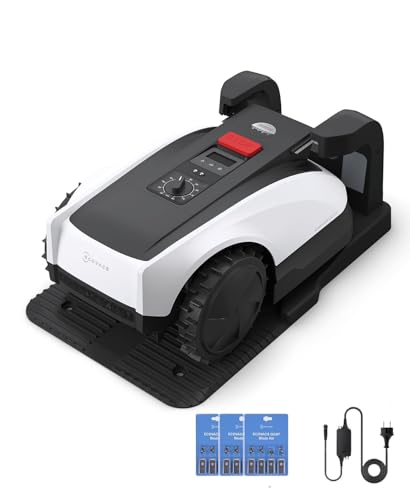
ECOVACS O1000 RTK Care
The satellite version of a mower this brand also sells with a laser, bundled with 36 spare blades, which is the cheapest way into proper centimeter-level RTK navigation and systematic path planning rather than random bouncing. It maps automatically and manages multiple zones from the app. The revealing inclusion is the RTK extension cable, supplied so you can put the antenna somewhere with better satellite reception, described in its own bullet as helping in complex yards with trees or obstacles. That cable tells you where RTK struggles.
Pros:
- Centimeter-level RTK with systematic paths, not random
- 36 spare blades bundled; long service interval
- Extension cable for better antenna placement
- Auto mapping and multi-zone management
Cons:
- Needs an antenna planted with a clear sky view
- The extension cable exists because trees are a problem
- Publishes no acreage figure at all
Best for: an open lawn with nothing overhead.
ANTHBOT M9
The setup story is what sells it: it builds its own map in the app in about ten minutes without you walking it round the garden like a dog, which is the tedious part of owning one of these. Dual 150-degree cameras give it a claimed thousand recognisable garden objects, it handles 45 percent slopes, manages up to 30 zones, cuts from 1.2 to 2.7 inches, runs under 58 decibels and takes over-the-air updates. Its title says quarter of an acre and its own bullet says a maximum of 0.3.
Pros:
- Maps itself in ten minutes; no walking it round
- 45 percent slope; steeper than most here
- Dual 150-degree HDR cameras; 30 zones
- Under 58 dB; emergency braking; OTA updates
Cons:
- Title says 1/4 acre; the bullet says 0.3
- Needs the RTK reference station planted outside
- Ships in multiple separate packages
Best for: an open slope, set up in ten minutes.
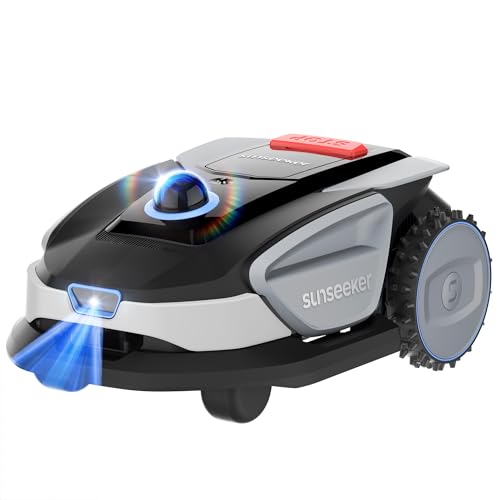
Sunseeker S4
The bluntest listing on this page: it says goodbye to GPS dead zones and states that traditional RTK mowers fail completely under dense canopies, tall eaves and narrow passages. Its 360-degree 3D LiDAR fused with vision on a 10 TOPS chip builds the map, and setup is genuinely charming: you drive it around with the app like a remote-control car and it draws the yard as it goes, no base station calibration. It runs at 60 decibels, handles 42 percent slopes and covers a quarter acre.
Pros:
- 3D LiDAR; works under canopies and in the dark
- Drive it round with the app to map instantly
- No base station and no calibration
- 60 dB published; 42 percent slope
Cons:
- Quarter acre; among the smallest areas here
- No edge trimmer
- Two typos in its own bullet headings
Best for: a shaded, awkward garden that defeats satellites.
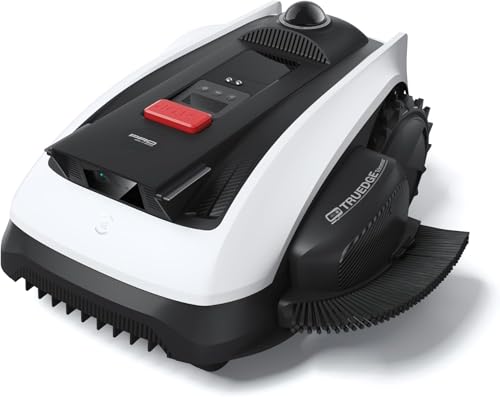
ECOVACS O1000 LiDAR PRO
No perimeter wire and no RTK antenna either, which is the version of wire-free that means what it says: dual LiDAR maps the yard and holds two centimeter positioning under trees and beside fences. It carries an integrated trimmer for true edge-to-edge cutting, publishes a detection precision of five centimeters across 200-plus obstacle types, and its narrow body slips through gaps as tight as 0.8 meters. Best of all, its own bullets admit that complex corners and raised edges may still need manual trimming, and that setup may take some fine-tuning.
Pros:
- No wire and no antenna; 2 cm positioning under trees
- Publishes 5 cm detection precision, not just a type count
- Integrated edge trimmer; 0.8 m gaps
- Admits its trimmer misses complex corners
Cons:
- Quarter acre only
- Trimming line is a consumable you will rebuy
- Its own listing says setup needs fine-tuning
Best for: a real garden, from a listing that describes one.
Mammotion LUBA 3 AWD
The only mower here that refuses to pick a navigation technology, running 360-degree LiDAR, network RTK and dual-camera vision together and switching between them as conditions change. That is the plain answer to a page where each camp says the other fails. It is also the only all-wheel-drive machine, with four independent motors climbing 80 percent slopes, which it helpfully converts to 38.6 degrees, and suspension that steps over roots and curbs up to 50 millimeters. Two 165 watt motors, 215 minutes a charge, 50 zones, 1.25 acres.
Pros:
- LiDAR, RTK and vision together, switching as needed
- 80 percent slopes on four independent motors
- Publishes degrees as well as percent; steps 50 mm obstacles
- 215 minutes a charge; 50 zones; 1.25 acres
Cons:
- Three times the price of anything else here
- Claims 300 obstacle types where a cheaper mower claims 1,000
- No edge trimmer despite the price
Best for: a big, steep, difficult garden that beats everything else.
The verdict
Wire-free splits into two answers. Satellite mowers swap the buried wire for an antenna in your garden, and one of them ships an extension cable so you can find it a better view. Laser mowers need neither, and three listings from two brands say plainly that satellites fail under trees. Everything else on this page, the obstacle counts especially, is vocabulary.
Best overall: ECOVACS O1000 LiDAR PRO. It is wire-free in the sense the phrase implies, needing no perimeter wire and no antenna either, and it holds two centimeter positioning under the trees where satellite mowers lose their signal. It publishes a detection precision of five centimeters, which is the only figure on this page describing how well a mower sees rather than how many things it can name. It has a real edge trimmer, and its own listing tells you where that trimmer will still leave grass.
Best value: ANTHBOT M9. It maps your garden by itself in about ten minutes, where most of these expect you to walk the machine around the boundary first, and that is the difference between owning one and dreading it. Dual cameras, 45 percent slopes, thirty zones, under 58 decibels and over-the-air updates, at a price nothing else with this specification approaches. Confirm the area with the seller, because its title says a quarter acre and its own bullet says 0.3.
Best premium: Mammotion LUBA 3 AWD. It is the only mower here that declines the argument the rest of the page is having, running LiDAR, network RTK and vision together and switching between them as the garden changes. It is also the only all-wheel-drive machine, and 80 percent slopes on four independent motors is not a number anything else here approaches. It publishes that figure in degrees as well as percent, which tells you who wrote the listing.
FAQ
Does wire-free mean nothing to install?
Not for satellite mowers. RTK needs an antenna in your garden with a clear sky view, and one listing here ships an extension cable so you can move it somewhere with better reception. Laser mowers need neither wire nor antenna.
RTK or LiDAR?
Depends on your trees. Three listings from two brands say directly that satellite mowers lose signal or fail completely under canopies, near fences and in shaded areas. A laser builds its map from the ground and does not care about the sky.
Can the cheapest mower really do 1.5 acres?
Read its bullets. Its title says RTK and its navigation bullet says GPS mapping, which is meters of accuracy rather than centimeters. It also has the shallowest slope rating here and needs an activation code emailed to you before it will start.
Does the obstacle count matter?
It is a database size. One mower knows 1,000 object types at a quarter the price of one that knows 300. The figure worth having appears once: a detection precision of five centimeters, which describes seeing rather than naming.
Do the edge trimmers work?
Mostly, and one brand tells you where they do not. Its listing adds that complex corners, narrow gaps and raised edges may still need manual trimming, and that the line is a consumable at about three kilometers a roll.
This article may contain affiliate links; see our Affiliate Disclosure.