Every fan here puts a decibel figure in its title and every one of those figures is the fan on its slowest setting, barely moving. One listing breaks ranks and publishes both ends: 20 to 43 decibels across all speeds. That second number is the fan you will actually run on a hot night, and it is more than twice the one on the box.


At a glance
| Product | Height, and what it publishes | Price tier | Link |
|---|---|---|---|
| Dr. Prepare 13″ | 13 inches. A desk fan, and fair: under 60dB | Budget | |
| DR.PREPARE 16″ | 16 inches. Publishes its outlet size, which gives it away | Budget | |
| PELONIS 30″ | 29.7 inches, 7.16 lbs. The only full dimensions here | Budget | |
| LEVOIT Mini | A mini. And the only full noise range: 20 to 43dB | Budget | |
| LEVOIT 36″ | 36 inches. The only CFM figure in this search | Mid-range | |
| Honeywell QuietSet | Called QuietSet. Publishes no noise figure at all | Mid-range | |
| Lasko Elevation | 42 to 54 inches. The only adjustable height here | Premium | |
How to choose
The decibel figure is the fan asleep
Six fans here quote a single noise number and put it in the title, and every one of those numbers is the lowest speed. One fan says 20 decibels on the box and, in a bullet, 20 to 43 across all speed levels. That is the plain version and it changes everything: the quietest setting is a whisper and the setting you need in July is twice as loud. The cheapest fan here quotes under 60 decibels and does not pretend, which is worth more than a flattering 20.
Feet per second is the jet; CFM is the room
Six listings quote an air speed in feet per second and exactly one quotes CFM, which is cubic feet per minute, the volume of air actually moved. Those measure different things. A narrow outlet can push air out very fast while shifting almost nothing, and a room cools when air is exchanged rather than when a jet is thrown across it. The one fan here publishing CFM gives 1044. Everyone else gives you a speed and lets you assume.
One fan hands you the arithmetic to prove it
A desk-sized fan here publishes both its air speed at 22 feet per second and, unusually, its outlet at 1.7 by 8.1 inches. Multiply the outlet area by the speed and you get roughly 126 cubic feet a minute. Compare that with the 1044 published by the 36 inch tower on this same page and the gap is about eightfold. Both listings are telling the truth. Only one of them is telling you the number that matters.
Three of these are desk fans
The search says tower fan, and one result is 13 inches, one is 16, and one describes itself as a mini. Those are desk fans wearing a tower’s name, and there is nothing wrong with them at a desk. On the floor they blow at your ankles. A tower fan’s whole idea is to move air across a room at the height of a person, and the ones here that do that stand between 30 and 54 inches.
Height is the only adjustment that changes where the air goes
One fan here extends from 42 to 54 inches, which is the only height adjustment in this search and a more useful feature than another speed setting. Sitting on a sofa, standing at a counter and lying in bed are three different heights, and a fixed 30 inch tower is aimed at one of them. Everything else on this page is whatever height it arrives at.
A fan named for quietness with no noise figure
One fan here carries quietness in its actual product name and publishes no decibel figure anywhere, along with no air speed, no CFM, no dimensions, no oscillation angle and no timer. What it publishes is eight speed settings and a fused safety plug. It is a well-known brand at a mid-range price and it is asking to be bought on the name, because it has given you nothing else to compare.
Wider angle is not an angle
Oscillation here runs from 80 degrees to 110, and the widest belongs to the smallest fan on the page. One listing offers a choice of 30, 60 or 90 degrees, which is genuinely useful when you want the air on you rather than on the room. And one describes its oscillation as a wider angle, twice, in two identical bullets, without ever saying wider than what or by how much.
Dr. Prepare 13″
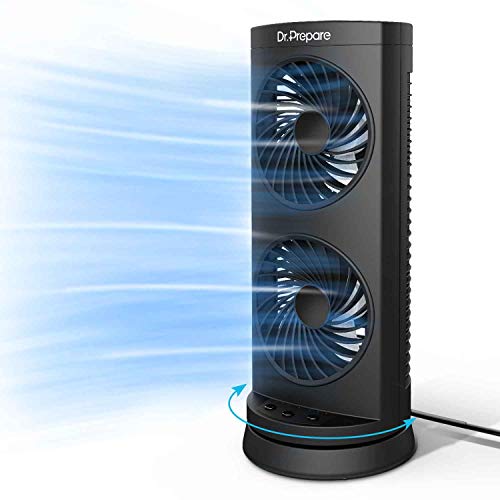
The cheapest fan here and the most accurate about its noise: less than 60 decibels, which it frames as a right amount of white noise rather than pretending to be silent. Every other fan on this page quotes its sleeping figure. It has dual fans stacked for airflow, 110 degrees of oscillation which is the widest sweep in this search, three timers at two, four and eight hours, and a 16 watt motor. It is 13 inches tall, which makes it a desk fan.
Pros:
- Real noise figure: under 60dB, not a sleeping number
- 110 degrees of oscillation; the widest here
- Three timers at 2, 4 and 8 hours
- Dual fans; 16W; the lowest price on this page
Cons:
- 13 inches; a desk fan, not a tower
- Three speeds only; no remote
- No air speed or CFM published
Best for: a desk, from a listing that does not flatter itself.
DR.PREPARE 16″
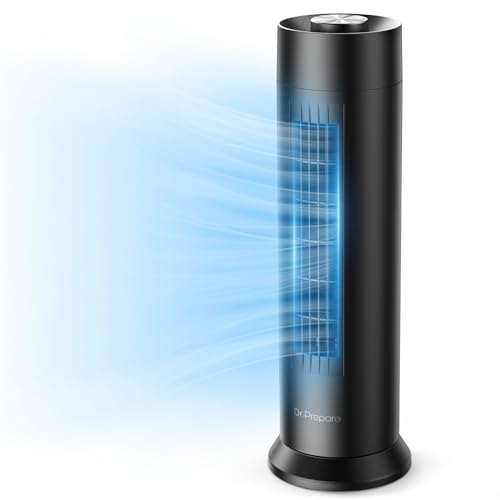
The only fan in this search that publishes its air outlet, at 1.7 by 8.1 inches, alongside its 22 feet per second, and those two numbers together let you work out what it actually moves, which is roughly 126 cubic feet a minute. That is clarity by accident and it is genuinely useful. The impeller and rear guard come out for rinsing under a tap, which nothing else here offers so plainly, and it runs at about 28 decibels on a rotary dial. Its own bullet says it has no timer.
Pros:
- Publishes its outlet size; you can compute its real airflow
- Impeller and rear guard detach and rinse under a tap
- Says outright that it has no timer
- 16 inches and 5.1 wide; fits a bedside table
Cons:
- Its computed airflow is a fraction of a real tower’s
- 16 inches; a desk fan in a tower search
- Three speeds on a dial; no remote, no timer
Best for: a bedside table, and a listing you can check.
PELONIS 30″
An actual tower at 29.7 inches, and the only listing here that publishes its full dimensions and its weight: 6.8 deep by 7 wide by 29.7 high, 7.16 pounds, with a built-in handle. Those numbers matter more than they sound, because a tower fan lives in a corner and gets carried between rooms, and nothing else on this page will tell you whether it fits or how heavy it is. Three speeds, 90 degrees of oscillation, a timer in 20 minute steps to two hours, and a one-year warranty.
Pros:
- Publishes full dimensions and weight; nothing else does
- A genuine 29.7 inch tower at a desk-fan price
- Built-in handle; 7.16 lbs; easy to move
- One-year warranty; timer in 20 minute steps
Cons:
- No decibel figure, air speed or CFM at all
- Three speeds; no remote and no modes
- Timer stops at two hours
Best for: a real tower, measured, at the smallest price.
LEVOIT Mini
The only listing on this page that tells you what the fan sounds like when it is working: 20 to 43 decibels across all speed levels. Every rival quotes the bottom of that range and stops. It also gives you three oscillation angles at 30, 60 and 90 degrees, so you can put the air on yourself rather than the room, runs on 7.5 watts at full tilt, has a soft carrying handle, five speeds plus turbo, a 12 hour timer and options to silence the beep and kill the display.
Pros:
- Publishes its full noise range: 20 to 43dB
- Three oscillation angles: 30, 60 or 90 degrees
- 7.5 watts at maximum; carrying handle; 12 hour timer
- Sound and display can both be turned off
Cons:
- A mini; not a room-height tower
- 23 ft/s and no CFM published
- Its own title quotes only the 20dB end
Best for: knowing what you are getting, on a desk.
LEVOIT 36″
The only fan in this search that publishes CFM, and 1044 is the number that tells you it will cool a room rather than throw a jet at one corner of it. Everything else quotes feet per second, which describes the air leaving the outlet and not the air being exchanged. It is a genuine 36 inch tower, 90 degrees of oscillation, 28 decibels, a 12 hour timer, five speeds and four modes, and a temperature sensor that trims the airflow as the room changes so you are not woken at 4am by a fan still on turbo.
Pros:
- 1044 CFM; the only volume figure in this search
- A real 36 inch tower with 90 degree oscillation
- Temperature sensor adjusts airflow as the room cools
- 12 hour timer; five speeds; four modes with a remote
Cons:
- Its 28dB figure is still the quiet end only
- No dimensions or weight published
- Costs more than the taller Pelonis tower
Best for: cooling a room, measured in air rather than speed.
Honeywell QuietSet
Eight speed settings is the most granular control on this page, and the remote nesting into the back of the housing is a genuinely thoughtful detail, because a fan remote is a thing you lose. It has a fused safety plug and a long-established name. What it does not have is a number: no decibels, no air speed, no CFM, no dimensions, no oscillation angle, no timer. That is a striking omission on a fan whose product name is built around being quiet.
Pros:
- Eight speeds; the finest control here
- Remote stores in the back of the fan
- Fused safety plug; long-established brand
- Slim enough for a medium to large room corner
Cons:
- Named for quietness and publishes no decibel figure
- No air speed, CFM, dimensions or oscillation angle
- No timer mentioned anywhere
Best for: eight speeds and trusting the badge.
Lasko Elevation
It goes up and down, from 42 to 54 inches, and that is the only adjustment on this page that changes where the air actually arrives. Sitting, standing and lying in bed are three heights, and every other fan here is aimed at whichever one it happens to be. It also has the highest air speed in the search at 31 feet per second, throwing to 40 feet, with 90 degree oscillation, 28 decibels, four speeds, four modes and a temperature sensor that adjusts as the room changes.
Pros:
- Adjusts from 42 to 54 inches; the only height adjustment
- 31 ft/s to 40 feet; the highest speed and reach here
- Temperature sensor adjusts the speed automatically
- Four speeds, four modes, auto and sleep, with a remote
Cons:
- Publishes ft/s but no CFM
- 28dB is the quiet end only
- The highest price on this page
Best for: putting the air where you actually are.
The verdict
Two numbers decide this page and both are usually missing. The decibel figure in every title is the fan on its slowest setting, and one listing admits the real range runs to 43. And feet per second describes the jet leaving the outlet, where CFM describes the air actually moved, which is what cools a room. Exactly one fan here publishes CFM.
Best overall: LEVOIT 36″. It is the only fan in this search that tells you how much air it moves, at 1044 cubic feet a minute, rather than how fast a jet leaves the grille. That is the difference between cooling a room and pointing at it. It is a genuine 36 inch tower with 90 degrees of oscillation, a 12 hour timer, and a temperature sensor that winds the speed back as the room cools so it is not still roaring at four in the morning.
Best value: LEVOIT Mini. The only listing on this page that publishes the noise you will actually hear: 20 to 43 decibels across all speeds, where every rival quotes the bottom number and stops. It backs that clarity with three oscillation angles at 30, 60 and 90 degrees, 7.5 watts flat out, a 12 hour timer, and switches to silence the beep and kill the display. It is a desk fan, and its listing is the straightest here.
Best premium: Lasko Elevation. It extends from 42 to 54 inches, and height is the only adjustment in this search that changes where the air ends up, which matters because sitting, standing and sleeping are three different altitudes. It also throws the hardest, at 31 feet per second out to 40 feet, and its sensor trims the speed as the room temperature drops. It gives you feet per second rather than CFM, like almost everything else here.
FAQ
Why does every fan claim 20 or 28 decibels?
Because that is the slowest setting. One listing publishes the full range, 20 to 43 decibels across all speeds, which is the only plain version on this page. The cheapest fan here quotes under 60 and does not pretend otherwise.
Is feet per second a useful number?
Not for cooling a room. It describes how fast air leaves the outlet, not how much moves. CFM is the volume figure and one fan here publishes it, at 1044. A narrow outlet can produce a fast jet while shifting very little air.
How can I compare fans that only give ft/s?
One listing here accidentally shows you how, publishing both its 22 feet per second and its 1.7 by 8.1 inch outlet. Multiply them out and you get about 126 cubic feet a minute, against 1044 from the tower that states it directly.
Are all of these tower fans?
No. One is 13 inches, one is 16, and one calls itself a mini. They are desk fans, and they are fine at a desk. A tower moves air across a room at body height, and the real ones here are 30 to 54 inches.
Does oscillation angle matter?
It decides whether the air lands on you or the room. Angles here run 80 to 110 degrees, and one fan lets you pick 30, 60 or 90. One describes its sweep only as a wider angle, twice, in two identical bullets.
This article may contain affiliate links; see our Affiliate Disclosure.