The appeal is simple enough to explain in one image: you pull off a forest road, pop a latch, and ninety seconds later you have a dry bed six feet above the mud, the ants and the tree roots that always find your spine. No hunting for flat ground, no groundsheet, no pegs bouncing off rock.



What separates a rooftop tent worth the money is rarely the fabric. It is the shell material, whether the thing actually sheds condensation, how fast it opens when you arrive after dark, and how tall it sits on the roof for the other fifty weeks of the year. The tents below suit weekend campers, road trippers and people building an overlanding rig, on anything from a hatchback with decent crossbars to a full-size truck.
At a glance
| Product | Standout feature | Price tier | Link |
|---|---|---|---|
| WildFinder Hard Shell Rooftop Tent | Aircraft-grade aluminum shell; marine and condensation pads; full kit | Mid-range | |
| Naturnest Sirius 1 Plus Hard Shell Tent | 30-second setup; honeycomb insulation; heater and cooler vent | Premium | |
| Joyinrute Aluminum Hard Shell Rooftop Tent | Removable winter liner; 4 hydraulic struts; flocked anti-condensation floor | Mid-range | |
| Nice C Inflatable Rooftop Tent | Inflatable frame, no struts; complete kit with pump and repair patches | Budget | |
| Arctwonder Hard Shell Tent with Solar Panel | Solar panel and 12V outlet; 7 in closed height; winter thermal layer | Premium | |
How to choose a rooftop tent
Start with your roof, not the tent
This is the step people skip and regret. Your vehicle has two load ratings, and they are wildly different numbers. Dynamic load is what the roof may carry while you are driving, and it is often around 150 to 165 pounds on a normal car. Static load is what it may carry parked, and it is several times higher, because a stationary roof is not fighting cornering forces and pothole shocks. A hard shell tent typically weighs well over 100 pounds bare, so the tent alone must fit under your dynamic rating, crossbars included. Your body weight only has to fit under the static rating, which is why sleeping up there is fine even though driving with the same load would not be.
Check the figure in your owner’s manual, not on a forum. Then check your crossbars separately, since they carry their own rating and their spacing has to match the tent’s mounting rails. Factory rails on a small crossover are frequently the limiting factor, and no tent is worth finding that out at speed.
Hard shell, soft shell or inflatable
Hard shell tents open with gas struts in seconds, sit lower and quieter when closed, and shrug off weather. They cost more and give you a footprint no bigger than the shell. Soft shell tents fold out over the side of the vehicle, which yields more floor for the money, but they take longer to set up and pack down damp. Inflatable tents are the newcomer: a pump replaces the frame, so the whole thing packs small and light, which is the pragmatic answer if your roof rating is tight or your budget is. The trade is that you carry a pump, you can puncture the frame, and setup is minutes rather than seconds.
Closed height matters more than you expect
You will spend one night in the tent for every hundred hours it sits on the roof. Closed height decides whether it fits in your garage, how much fuel it costs you, and how loudly it whistles at highway speed. Seven inches closed is a genuinely low profile; a taller shell is more noticeable on all three counts. Aerodynamic shaping helps, but nothing beats a shell that is simply thin.
Condensation is the real enemy
Two people breathing overnight put a surprising amount of water into a small sealed space, and it condenses on the coldest surface it can find, which is the underside of your mattress on a metal floor. Wake up, find the mattress damp, and blame the tent’s waterproofing. Anti-condensation matting is the fix: a mesh or flocked layer under the mattress that lets air circulate and moisture escape. A tent that ships with it has understood the problem. So has one with several mesh windows, because ventilation is the other half of the answer.
Read the weather ratings properly
A 5000mm waterproof rating describes how tall a column of water the fabric holds before it seeps; it is a good number for a rooftop tent and most quality tents here quote it. Seam sealing matters just as much, since water finds stitching first. Wind ratings quoted as grade 6 refer to the Beaufort scale, roughly a strong breeze, and are about the tent standing up rather than the vehicle being safe. If you camp in cold weather, look for a removable thermal liner rather than a permanently insulated tent, so you are not sweating through it in July.
Mattress and ladder
The mattress is your sleep, and rooftop tent mattresses run thin. Around two inches is common, and the difference between two and three is the difference between waking rested and waking sore. Many people add a topper. Ladders are usually telescoping aluminum around seven and a half feet; check that yours reaches comfortably given your vehicle’s height, because a ladder at a steep angle is unpleasant at 3am.
WildFinder Hard Shell Rooftop Tent
The best seller of this group, and it gets there by building the shell from aircraft-grade aluminum rather than plastic. That matters more than it sounds: plastic shells age through repeated summer and winter cycles and eventually let water in, whereas aluminum resists both the ageing and the expansion that opens those gaps. Stainless steel pressure rods lift it, so nothing rusts. Inside, three layers work on moisture: a recessed marine pad, a condensation pad, and a 5cm mattress that does not deform. It sleeps two or three, rates 5000mm rainproof, grade 6 windproof and level 4 for heavy snow, and arrives with a genuinely complete kit.
- Pros: Full aluminum alloy shell that resists ageing and thermal cycling; stainless steel gas struts that will not rust; three-layer moisture system including a recessed marine pad; 5000mm waterproof, grade 6 wind, level 4 snow ratings; 7.5 ft telescoping ladder, LED strip, ten organizer bags, two shoe organizers, three mesh windows; sleeps 2 to 3.
- Cons: Crossbars are not included, so budget for those separately; no thermal liner for genuine winter use; closed height is not published.
Best for: The default choice for weekend and road-trip camping on a Jeep, SUV, truck or van.
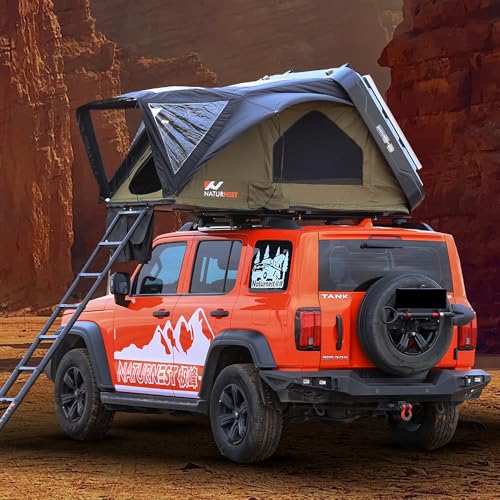
Naturnest Sirius 1 Plus Hard Shell Rooftop Tent
The most thoroughly engineered tent here, and the one with the trick worth paying for: a dedicated vent that accepts a heater or a cooler, turning the tent into a climate-controlled room rather than a box you endure. The shell is high-strength ABS over an aluminum frame with honeycomb panels that insulate against both temperature and noise, and the floor uses the same honeycomb aluminum. Setup is about thirty seconds: release the locks, pull the ladder. The interior measures 82.7 by 63 inches, enough for two adults and a child, with blackout fabric and a 1.97-inch mattress. Roof crossbars come with it for carrying skis, bikes or solar panels on top of the tent itself.
- Pros: Heater and cooler vent for real climate control; honeycomb panels insulate against heat, cold and noise; 30-second setup; roof crossbars included so you keep your load capacity; 316 stainless struts and YKK zips; replaceable tear-resistant fabric; spacious 82.7 x 63 in interior; genuine 4-season build.
- Cons: The most expensive here; ABS shell rather than the aluminum used by the WildFinder and Joyinrute; the 1.97 in mattress is the thinnest of the group.
Best for: Serious four-season campers, and anyone wanting two adults plus a child in one tent.
Joyinrute Aluminum Hard Shell Rooftop Tent
Take the aluminum-shell recipe and add the two things the WildFinder leaves out. First, a removable winter thermal liner, so the tent insulates in January and comes apart in July rather than cooking you. Second, four high-strength hydraulic struts instead of two, which makes opening and closing noticeably smoother and gives the lid more support in wind. The floor is flocked rather than bare, which is the anti-condensation answer done properly, and the 320g blackout polyester rates 5000mm waterproof, 99% sun protection and grade 6 wind. Four windows, each with both a mesh layer and a windproof layer, give you real control over airflow.
- Pros: Aircraft-grade aluminum shell; removable winter thermal liner for true all-season use; four hydraulic struts for smooth, well-supported operation; flocked floor lining fights condensation; four windows with separate mesh and windproof layers; 5000mm waterproof, grade 6 wind; 7.5 ft ladder, LED strip, condensation pad and storage bags included.
- Cons: Rated for 2 people rather than 2 to 3; mattress thickness is not clearly published; the extra liner is one more thing to store.
Best for: Campers who want one tent for winter and summer without buying two.
Nice C Inflatable Rooftop Tent
Roughly a third the price of the hard shells, because there is no shell. An inflatable frame does the structural work: connect the pump, wait a few minutes, and you have an 81.5 by 62.6 by 66.5 inch room with an air mattress in it. That approach solves the problem that stops most people buying a rooftop tent at all, which is a roof rack that cannot take 130 pounds of aluminum. Everything needed is in the box, including the pump, a repair kit, a folding ladder, tie-downs, support brackets, shoe bag and carry bag. Double-layer mesh doors, panoramic windows and awnings handle ventilation and weather.
- Pros: By far the lowest price; far lighter than a hard shell, so it suits modest roof ratings; packs into a carry bag rather than living on the roof year-round; complete kit including pump and repair patches; generous 81.5 x 62.6 in floor with 66.5 in of headroom; double-layer mesh doors and awnings.
- Cons: Setup is minutes with a pump rather than seconds with struts; an inflatable frame can be punctured, hence the repair kit; less rugged in sustained wind and snow than a hard shell; no thermal liner.
Best for: First-time rooftop campers, tight roof load ratings, and anyone who wants the tent off the car between trips.
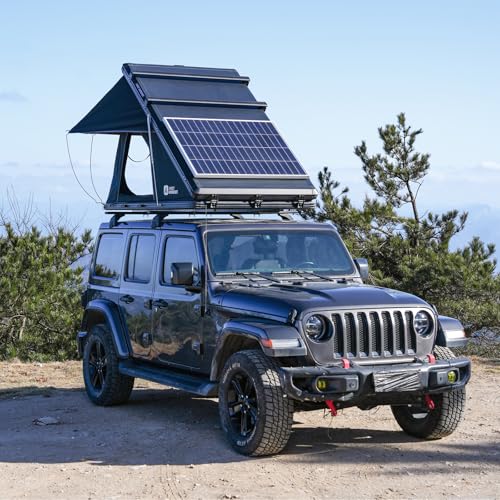
Arctwonder Hard Shell Rooftop Tent with Solar Panel
Two numbers define this one. Seven inches closed, which is about as low as a hard shell gets and means your garage and your fuel gauge barely notice it. And ten seconds to pop up on its pressure rods, with a two-step close that one person can do alone. On top sits a solar panel feeding a 12V multi-function outlet, so phones and power banks charge without running the vehicle. Aluminum forms the base plate, top cover and all four corners, the 320g polyester rates W/R 5000 with glued seams, and a removable winter thermal layer of canvas over thermal cotton makes it a true all-season tent. The mattress is the thickest here at 6cm, being 5cm of foam plus a 1cm condensation pad.
- Pros: Solar panel and 12V outlet for off-grid charging; lowest closed height at 7 in; pops up in about 10 seconds, closes in two steps solo; removable winter thermal layer; thickest mattress here at 6cm including condensation pad; aluminum base, cover and corners; two luggage poles, 7.5 ft ladder, LED strip, 10 storage bags and 2 shoe bags.
- Cons: Premium price; rated for 2 people only; a roof-mounted solar panel is modest, better for phones than for running a fridge.
Best for: Overlanding and off-grid trips, low garages, and anyone camping alone who must set up without help.
The verdict
Best overall: the WildFinder hard shell rooftop tent. It is the strongest seller of the group and it spends its money in the right places: an aluminum shell that will not age out like plastic, stainless struts, a three-layer defense against condensation, and weather ratings that cover heavy snow. It sleeps three and it arrives with everything except the crossbars.
Best value: the Nice C inflatable rooftop tent. It answers the two questions that stop most people, price and roof load, and still hands you a full-size sleeping room with a mattress, ladder and pump in the box. Accept a few minutes of pumping and a puncture repair kit in the boot.
Best premium: the Naturnest Sirius 1 Plus, for honeycomb insulation, a heater vent, included crossbars and a thirty-second setup. The Arctwonder takes it instead if you want solar power and the lowest profile, and the Joyinrute is the aluminum-shell middle ground with a winter liner.
Frequently asked questions
Will my car’s roof actually take one?
Check the dynamic load rating in your owner’s manual, and your crossbars’ own rating, then compare against the tent’s weight. Hard shell tents commonly exceed 100 pounds, which is close to the dynamic limit on many cars once bars are included. Your own weight counts against the static rating instead, which is much higher, so sleeping up there is not the issue. If the numbers are tight, an inflatable tent is the sensible route.
How much fuel does a rooftop tent cost me?
Enough to notice. A shell on the roof adds drag and weight, and the effect grows with speed. Lower profiles help, which is why a seven-inch closed height is worth seeking out. Many people take the tent off between trips for exactly this reason, which is easier with a lighter or inflatable design.
Do I need a special roof rack?
Not usually special, but suitable. Most of these tents mount to standard factory or aftermarket crossbars, provided the bars have the right spacing and enough capacity. Confirm both before ordering, and note that at least one tent here does not include crossbars in the box.
Why does my mattress get damp when it did not rain?
Condensation. Warm, humid breath meets a cold floor and turns to water underneath the mattress. Anti-condensation matting, a flocked or recessed floor layer, and cracking a mesh window for airflow all deal with it. It is normal physics, not a leak.
Can I leave bedding inside when it is closed?
With a hard shell, generally yes, and it is one of the best reasons to own one. Sleeping bags and pillows stay in place while the shell closes over them, so arriving at camp means opening a latch rather than making a bed. Check that the mattress plus bedding still lets the shell shut cleanly, and air it out at home rather than storing it damp.
This article may contain affiliate links; see our Affiliate Disclosure.