A scroll saw turns a flat board into lace: tight curves, sharp inside corners, and fretwork so fine it looks impossible. No other power tool cuts intricate patterns, puzzles, and delicate inlay with the same control. The saws below range from an affordable workhorse to a professional near-silent machine, and one is the best-selling scroll saw of the group.



A good scroll saw comes down to smooth, low-vibration cutting, quick blade changes for inside cuts, and enough throat depth for your projects. These picks suit a hobbyist cutting holiday ornaments and puzzles, a crafter shaping acrylic and inlay, or a serious woodworker doing fine fretwork. One note before the list: a coping saw is a hand tool for occasional trim and portable work, not a substitute for a powered scroll saw’s speed and precision, so every pick here is a proper bench scroll saw. Below is the quick comparison, then a guide to choosing.
| Scroll saw | Standout features | Price | Link |
|---|---|---|---|
| WEN 3922 16" | Variable 550–1600 SPM, flip-open blade access, cuts 2" thick, cast iron base | Budget | |
| SKIL SS9503 16" | LED work light, dust removal, electronic variable speed, keyless blade change | Mid-range | |
| DEWALT DW788 20" | Double parallel-link arm, very low vibration, tool-free blade clamps, 20" throat | Premium | |
| Dremel Moto-Saw | Compact, detachable handheld coping mode, auto tensioning, variable speed | Mid-range | |
| PeakPursuit 16" | Variable 500–1600 SPM, LED light, tilting table, dust port, lowest price | Budget | |
How to choose a scroll saw
The features that separate a joy to use from a frustrating one are vibration, blade handling, and visibility. Here is what to weigh.
Throat depth and cutting capacity
Throat depth is the distance from the blade to the rear arm, and it sets the widest board you can maneuver. A 16-inch throat handles most ornaments, puzzles, and craft patterns, while a 20-inch machine like the DEWALT gives room for larger fretwork and signs. Also check thickness capacity: most here cut up to about 2 inches of wood, which covers the vast majority of scroll projects. Match throat depth to the size of work you plan to do rather than buying more reach than you need.
Variable speed
Variable speed is essential, not optional. Slower strokes suit hardwoods, acrylic, and delicate detail where too much speed melts plastic or chips fine points, while faster strokes clear softwood quickly. A range like 500 to 1600 strokes per minute, common across these saws, lets you dial in the right pace for the material and the tightness of the curve. Electronic speed control that holds steady under load is better than a basic dial.
Blade changes and pinned versus pinless blades
You will change blades constantly, especially for interior cutouts where you thread the blade through a drilled hole. Tool-free or keyless blade changes, and easy-access panels like WEN’s flip-open side, save enormous time and frustration. Blades come in two styles: pinned blades are easy to install but too thick for the finest detail, while pinless (plain-end) blades are thinner for intricate work but need a clamp system to hold them. Saws that accept pinless blades open the door to true fretwork.
Vibration and cut quality
Vibration is the enemy of precision, since a shaking table makes it hard to follow a line and tires your hands. Heavier cast iron bases damp vibration, and premium arm designs go further: the DEWALT’s double parallel-link arm dramatically reduces vibration and noise for exceptionally accurate, quiet cuts. If you scroll for hours or chase very fine detail, low vibration is the single biggest quality-of-life upgrade.
Visibility, dust, and table tilt
Following a tight pattern demands a clear view of the blade. An integrated LED work light aimed at the cut line reduces eye strain, and a dust blower plus a port for a vacuum keeps sawdust off the line so you can see it. A table that tilts 0 to 45 degrees lets you cut bevels and angled edges for inlay and three-dimensional work. These conveniences do not change what the saw can cut, but they make accurate cutting far easier and more pleasant.
Blades, setup, and getting good results
The saw is only half the story; the blade you fit and how you set it up decide the finish. Blades are sold by tooth count and width, with finer, narrower blades for tight curves and detail and coarser ones for faster cuts in thicker stock, so stocking a small assortment lets you match the blade to the job. Tension matters just as much: a properly tensioned blade tracks straight and resists wandering, while a loose one bows and leaves a ragged edge, which is why quick, reliable tensioning is worth having. For interior cutouts, drill a small starter hole inside the waste area, thread the blade through, reattach it, and cut, which is the technique that makes fretwork possible. Start with simple patterns on thin softwood to learn how the saw feeds and how hard to push, then work up to hardwoods, acrylic, and fine fretwork as your control improves. Feed the wood slowly and let the blade do the cutting rather than forcing it, and keep the cut line clear with the dust blower. Good habits here matter more than the price of the saw, and they turn any of these machines into a source of clean, precise, satisfying work.
WEN 3922 16-Inch Variable Speed Scroll Saw
The best-selling scroll saw here is a hobbyist favorite because it delivers the essentials at a genuinely low price. Its standout is a side panel that flips open for easy-access blade changes, a real time-saver on inside cuts, backed by a thumb-screw adapter for tool-free swaps. Variable speed runs from 550 to 1600 strokes per minute, the spacious 16-by-10-inch table bevels up to 45 degrees, and it cuts wood up to 2 inches thick within a 16-inch throat. A cast iron base steadies the cut and damps vibration, and it includes an air pump, dust port, foot-lock clamp, and three blades to start. For most crafters entering scroll work, it is the smart, affordable default.
Pros
- Best-selling scroll saw at a budget price
- Flip-open panel for fast blade changes
- Variable speed and 45-degree bevel table
- Cast iron base damps vibration, blades included
Cons
- No built-in LED work light
- More vibration than premium arm designs
Best for: hobbyists who want a proven, affordable scroll saw to learn and grow on.
SKIL SS9503 16-Inch Scroll Saw
The SKIL steps up with the visibility features that make detail work easier. An integrated LED work light illuminates the blade contact point from multiple angles, and an integrated dust removal system keeps the cut line clear so you can follow complex patterns accurately. Electronic variable speed gives fine control across wood, acrylic, and other materials, the 16-by-10-inch table tilts 0 to 45 degrees for precise angled cuts, and keyless blade changes plus on-tool blade storage keep you moving. It sits in the middle of the range on price, but the built-in light and dust control genuinely improve accuracy and comfort. For a crafter who wants a well-equipped 16-inch saw without going pro, it is a strong mid-range choice.
Pros
- Integrated LED light for clear sightlines
- Built-in dust removal keeps the line visible
- Electronic variable speed and 45-degree tilt
- Keyless blade change and on-tool storage
Cons
- Pricier than the budget saws
- 16-inch throat, not the largest here
Best for: crafters who value built-in lighting and dust control for detailed work.
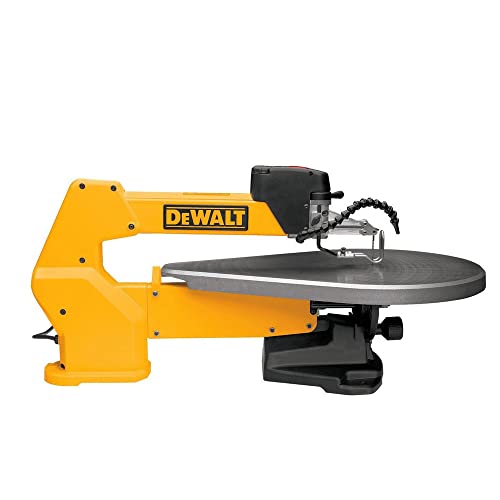
DEWALT DW788 20-Inch Scroll Saw
The DEWALT DW788 is the professional’s scroll saw and a long-standing benchmark for fine work. Its double parallel-link arm design dramatically reduces vibration and noise, so it runs smoothly and quietly for hours and produces exceptionally accurate cuts, the trait that matters most for demanding fretwork. Exclusive tool-free blade clamps let you change blades in seconds, essential when a complex piece has dozens of interior cutouts, and a generous 20-inch throat handles larger patterns and signs. The on-off switch, electronic variable speed, flexible dust blower, and blade-tensioning lever all sit on the front upper arm for easy reach. It is the premium pick by a wide margin, but for serious scrollers who want the best cut quality and the largest capacity, it earns its price.
Pros
- Parallel-link arm for very low vibration and noise
- Large 20-inch throat for bigger work
- Tool-free blade clamps for fast inside cuts
- Front-mounted controls and tensioning
Cons
- Highest price by a large margin
- Bigger and heavier to place
Best for: serious woodworkers who want the finest cut quality and the largest capacity.
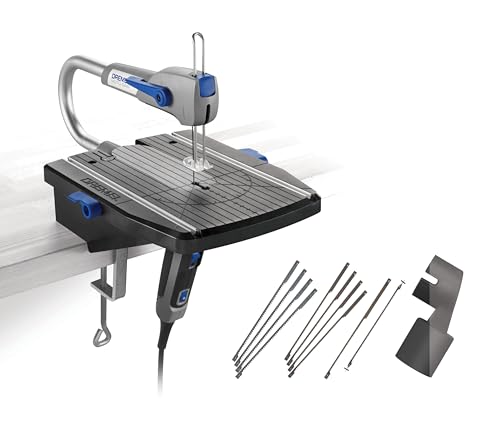
Dremel MS20-01 Moto-Saw
The Dremel Moto-Saw is the compact, space-saving option, and its party trick is versatility. It works as a benchtop scroll saw for detailed cutting, then detaches into a handheld coping mode so you can take the tool to a larger workpiece that will not fit on a table, a genuinely useful hybrid for small shops. An auto-tensioning quick-change mechanism makes swapping blades and setting tension easy, variable speed adapts to wood, plastic, and thin metal, and a fast-clamp base attaches to various benches and surfaces. A dust port keeps the line of sight clear. It cuts thinner and smaller stock than the full-size saws, so it is not for heavy fretwork, but for crafts, models, and tight spaces, its flexibility and small footprint make it a clever mid-range pick.
Pros
- Detaches for handheld coping use
- Very compact, clamps to any bench
- Auto-tensioning quick blade changes
- Variable speed for wood, plastic, and thin metal
Cons
- Smaller capacity than full-size saws
- Not suited to thick or heavy fretwork
Best for: crafters and modelers who want a compact, portable, versatile cutter.
PeakPursuit 16-Inch Scroll Saw
The PeakPursuit is the value pick that still bundles the features detail work benefits from. A large, stable steel worktable tilts 0 to 45 degrees for angled cuts without wobble, and an integrated LED light aimed directly at the blade contact point makes complex lines easier to follow, a feature the similarly priced WEN lacks. A 500 to 1600 stroke-per-minute variable speed handles everything from delicate balsa to hardwoods and plastics while helping avoid chipping, and a dust blower plus vacuum port keep the cut line visible and the bench tidy. It is the lowest-priced saw here, so build refinement trails the premium machines, but for a beginner or budget crafter who wants a lit, tilting scroll saw for the least money, it is a compelling value.
Pros
- Lowest price with a built-in LED light
- Stable tilting table for angled cuts
- Wide 500–1600 SPM variable speed
- Dust blower and vacuum port
Cons
- Less refined build than premium saws
- 16-inch throat and 2-inch capacity
Best for: beginners and budget crafters who want lighting and tilt for the least money.
The verdict
Best Overall: the WEN 3922. As the best-selling scroll saw here, it balances variable speed, a bevel table, a cast iron base, and fast flip-open blade changes at a low price, making it the right starting point for most crafters and hobbyists.
Best Value: the PeakPursuit 16-Inch. It adds an LED work light and a tilting table at the lowest price in the group, giving beginners the visibility and angle control that make detail cutting easier.
Best Premium: the DEWALT DW788. Its parallel-link arm delivers the lowest vibration and finest cut quality here, plus a large 20-inch throat and tool-free blade changes, which is exactly what serious fretwork demands.
FAQ
What can a scroll saw do that a jigsaw or band saw cannot? A scroll saw makes very tight interior cutouts and intricate curves by threading a thin blade through a drilled hole, then reattaching it. That lets you cut fretwork, puzzles, and detailed patterns from the inside of a board, which a jigsaw or band saw cannot do cleanly.
What is the difference between pinned and pinless blades? Pinned blades have cross-pins at each end that clip in easily but are thicker, limiting fine detail. Pinless, plain-end blades are thinner for intricate work and thread through smaller holes, but need a clamp system. Saws that accept pinless blades handle the most delicate fretwork.
How important is low vibration? Very. Vibration makes it hard to follow a line and tires your hands over long sessions. A heavy cast iron base helps, and premium arm designs like the DEWALT’s parallel-link system reduce it dramatically for smoother, more accurate cuts.
Is a coping saw the same as a scroll saw? No. A coping saw is a hand tool for occasional trim work and portable cuts. A powered scroll saw is far faster, more precise, and better for intricate patterns. For serious detail work, a bench scroll saw is the right tool.
What throat depth should I choose? A 16-inch throat suits most ornaments, puzzles, and craft patterns. Step up to a 20-inch machine like the DEWALT only if you cut larger signs or wide fretwork, since more reach adds size and cost you may not need.
Do I need variable speed? Yes. Different materials and cut tightness call for different speeds, and slowing down avoids chipping on detail and melting on plastics. Every saw here offers variable speed, which is a genuine necessity rather than a luxury.
This article may contain affiliate links; see our Affiliate Disclosure.