Sawdust drifts off the bench, a jar of screws tips into the shavings, and the finish you just laid down traps grit you never saw coming. A shop vac is the quiet workhorse that makes every other tool in the room usable again, pulling nails, drywall powder, and spilled coolant out of corners a broom only smears around.



A great workshop vac is not just the strongest one on the shelf. It matches the mess to the tank, filters fine dust without choking, drains a flooded bucket without a wrestling match, and stores in a footprint your bench can spare. The wrong one is either too small to finish a job or too heavy to bother dragging out for a quick spill, so the trick is honest sizing rather than chasing the biggest number. Whether you are a weekend woodworker, a hobbyist restoring a car, or someone who just wants the garage clean before winter, the five below span compact grab-and-go units through heavy 16-gallon haulers, and each leads a clear use case rather than trying to be everything at once.
At a glance
| Product | Standout feature | Price tier | Link |
|---|---|---|---|
| CRAFTSMAN 2.5 Gallon 2.5 Peak HP | Light, portable, doubles as a blower | Budget | |
| Vacmaster Professional Beast 5-Gallon 5.5 Peak HP | 1-micron filtration, 25 ft reach | Mid-range | |
| CRAFTSMAN 16 Gallon 6.5 Peak HP | Oversized drain, 2.5 in kink-resistant hose | Premium | |
| Shop-Vac 10 Gallon 4.5 Peak HP | Bottom drain, 22 ft cleaning reach | Mid-range | |
| Vacmaster 5-Gallon 4 Peak HP Stainless | Rust-proof stainless tank | Mid-range | |
How to choose a shop vac for the workshop
The strongest vac is rarely the right one. The right one fits the way you actually work, empties without a fuss, and keeps its suction as the drum fills. A few decisions sort the field quickly.
Tank size versus how much you clean
Tank capacity is a trade between run time and bulk. A 2 to 5 gallon drum is easy to carry up a ladder or into a car footwell and empties in seconds, but it fills fast during a demolition or a floor sanding. A 10 to 16 gallon drum swallows a whole project without a pause, at the cost of a bigger parking spot and more weight to roll. Pick the smallest tank that still covers your longest job, because an oversized vac gets left in the corner while the little one earns its keep.
Peak HP, air watts, and real suction
Peak horsepower is a headline number measured at stall, not what the motor delivers while cleaning, so treat it as a rough class rather than a promise. Air watts and water lift describe the pull you actually feel: air watts track how much dust the airflow carries, while water lift measures the strength that yanks debris up a clogged hose. When two vacs claim similar HP, the one that lists air watts or inches of water lift is telling you more.
Fine dust filtration
Drywall powder, MDF dust, and cold ash are the messes that expose a cheap filter. A standard cartridge stops chips and sand, but fine particles blow straight through and hang in the air you breathe. Look for a high-efficiency cartridge rated to a micron or two, paired with a disposable dust bag that traps the fine stuff before it reaches the pleats. That combination keeps suction steady and the filter clean far longer.
Wet pickup and draining
Sooner or later you flood a bucket, chase a leak, or vacuum a wet driveway. Every model here converts to wet pickup by swapping to a foam sleeve, but draining is where they differ. A built-in bottom drain lets you empty gallons of dirty water through a hose without lifting a sloshing drum, which matters more the bigger the tank gets.
Hose diameter, reach, and storage
A wider hose moves bulky debris, wood offcuts, and leaves without jamming; a narrow hose is nimbler for tool ports and crevices. Add hose length to cord length for true cleaning reach, so you are not unplugging every few minutes. Finally, onboard storage for the hose, cord, and nozzles decides whether the vac stays tidy or turns into a tangle behind the bench.
Noise, mobility, and the blower trick
Shop vacs are loud by nature, and a small drum spinning a high-strung motor often whines more than a larger, easier-breathing unit. If you run one for long stretches, hearing protection is worth keeping nearby. Mobility matters too: a compact vac you carry beats a heavy one you drag, but past about eight gallons you want smooth-rolling casters and a low center of gravity so it follows you instead of tipping on a cord. One feature quietly earns its place on every model here, the reverse blower port. Flip the hose to the exhaust side and the same tool clears leaves off a patio, blasts sawdust out of a router table, or dries a washed floor, which means a shop vac often replaces a separate blower on the shelf.
CRAFTSMAN 2.5 Gallon 2.5 Peak HP Wet Dry Vac
This is the vac people reach for without thinking, and its popularity is earned. At 2.5 gallons it weighs almost nothing, hangs off a shoulder, and tucks under a bench when the job is done. A carry handle and cord wrap keep it tidy, and it flips to a blower for clearing a driveway or a dusty engine bay. It will not tackle a whole room of demolition, but for car interiors, a quick bench sweep, or spills in the garage it is instantly ready.
Pros:
- Genuinely light and portable, easy to store and carry up a ladder
- Two-in-one vac and blower
- Ships with hose, crevice tool, utility nozzle, and a filter bag
- Compact 1-1/4 inch accessories reach into tight spaces
Cons:
- Small tank fills quickly on big jobs
- Short reach compared with larger units
Best for: quick cleanups, car detailing, and anyone tight on storage space.
Vacmaster Professional Beast 5-Gallon 5.5 Peak HP
The Beast is the pick for anyone who worries about fine dust. Its high-efficiency cartridge and dust bag are rated to capture particles down to a micron, so drywall and sanding dust land in the drum instead of drifting back into the shop. A 320 air-watt motor gives it real pull, and 25 feet of combined hose and cord reach covers a two-car garage without moving the base. Onboard storage keeps the nine included tools from wandering off.
Pros:
- 1-micron filtration for drywall and fine sanding dust
- Strong 320 air-watt motor
- Long 25 ft cleaning reach with a kink-resistant hose
- Nine accessories with tidy onboard storage
Cons:
- Mid-size tank still needs emptying on demolition jobs
- Heavier than a grab-and-go compact
Best for: woodworkers and remodelers who make a lot of fine dust.
CRAFTSMAN 16 Gallon 6.5 Peak HP Wet Dry Vac
When the job is a full renovation, this is the drum that keeps going. Sixteen gallons and a 6.5 peak HP motor mean you can strip a room, chase sawdust across a whole shop, or clear a flooded basement without stopping to empty. The 2.5-inch Dual-Flex hose resists kinking and swallows bulky offcuts, an oversized drain dumps liquids fast, and a rear blower port clears leaves outdoors. It is big and it rolls rather than carries, which is the honest cost of that capacity.
Pros:
- Huge 16-gallon capacity for long jobs
- Wide 2.5 in Dual-Flex hose handles bulky debris
- Oversized drain empties liquids quickly
- Built-in blower port and a 3-year limited warranty
Cons:
- Bulky footprint needs dedicated storage
- Overkill for small, frequent cleanups
Best for: renovations, large workshops, and wet cleanup jobs.
Shop-Vac 10 Gallon 4.5 Peak HP Wet/Dry Vacuum
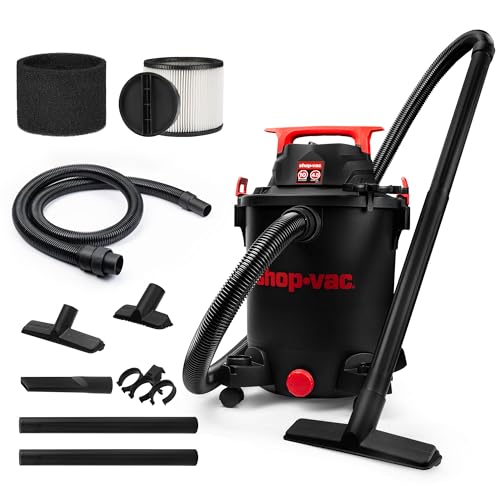
From the brand that gave the category its name, this 10-gallon model sits in the sweet spot between the tiny carriers and the giant haulers. A 4.5 peak HP motor and a 7-foot, 1-7/8 inch hose give 22 feet of reach, enough to work a garage from a single spot. The standout is a bottom drain outlet that empties dirty water without tipping the tank, plus built-in casters and a top handle that make an 18-pound vac easy to reposition. A full accessory kit rounds it out.
Pros:
- Balanced 10-gallon capacity for most home jobs
- Bottom drain empties liquids without lifting
- 22 ft cleaning reach on casters
- Complete nozzle, wand, and filter kit included
Cons:
- Standard cartridge filter is less fine than a micron-rated setup
- Larger hose is less nimble in tight crevices
Best for: a do-everything garage vac with easy wet draining.
Vacmaster 5-Gallon 4 Peak HP Stainless Steel Vacuum
A stainless tank is the quiet upgrade that pays off in a damp garage. Rust never gets a foothold, and the tank wipes clean after a wet job. This 5-gallon Vacmaster pairs that durable drum with a 135 air-watt motor and 16 feet of reach, landing it in the same nimble class as a compact but with a tougher body and easy blower conversion. Six accessories and onboard storage keep the setup simple, making it a sensible everyday vac that should outlast a plastic-drum rival.
Pros:
- Corrosion-proof stainless steel tank
- Solid 135 air-watt suction for its size
- Converts to a blower
- Compact and easy to carry
Cons:
- Modest 5-gallon capacity
- Fewer accessories than larger kits
Best for: a durable everyday vac in a humid garage or basement.
The verdict
Best Overall: the CRAFTSMAN 2.5 Gallon is the crowd favorite for good reason. It is the one you actually use, because it is light, ready, and cheap to keep filters for, and it handles the everyday messes that make up most workshop cleaning.
Best Value: the Shop-Vac 10 Gallon covers the widest range of jobs for a mid-range price, with a bottom drain and long reach that punch well above a compact unit while still rolling easily.
Best Premium: the CRAFTSMAN 16 Gallon is the one to buy if renovations and wet cleanup are on the calendar. The capacity, wide hose, and oversized drain turn hours of stop-and-empty into one continuous pass.
If your budget stretches to two, the honest answer for many workshops is a small vac for daily messes and a large one for projects. But if you buy just one, start from your longest, dirtiest job and size up from there, since a vac that finishes without stopping is the one you will keep using.
Frequently asked questions
What size shop vac do I need for a home workshop? For quick cleanups and car interiors, a 2 to 5 gallon vac is easiest to live with. If you do renovations, drywall, or floor sanding, a 10 to 16 gallon tank saves you constant emptying. Many people keep a small vac for daily use and a large one for projects.
Do peak HP numbers tell me how strong a vacuum is? Only loosely. Peak HP is measured at motor stall, not during cleaning, so it overstates real pull. Air watts and water lift are better guides to the suction you actually feel, and they let you compare models that quote the same horsepower.
Can a shop vac pick up fine drywall dust without clogging? Yes, if you set it up for it. Use a high-efficiency cartridge rated to a micron or two, and add a disposable dust bag so fine powder is trapped before it reaches the filter pleats. Without that, fine dust clogs the filter fast and drifts back into the air.
Can I connect a shop vac to my power tools for dust collection? Most sanders, saws, and routers have a dust port that accepts a standard vac hose or an adapter. Pairing a tool with a vac captures dust at the source, which keeps the shop cleaner and your filter working longer than sweeping afterward.
How do I stop a wet/dry vac from smelling? After any wet pickup, drain the tank fully, remove the foam filter, and let both air-dry before storing. Leaving standing water or a damp filter inside is what breeds the musty smell, so a few minutes of drying prevents it.
Should I use a dust bag or run the vac bagless? Bagless is fine for chips, sand, and general debris, and it saves the cost of consumables. A disposable bag earns its keep with fine, powdery messes: it captures the dust that would otherwise clog your cartridge, keeps emptying tidy, and lets the motor breathe. Many people run bagless day to day and drop in a bag before a drywall or sanding job.
Can one shop vac handle both wet and dry messes? Every model here is a true wet/dry vac, so yes. The routine is simple: use the cartridge or paper filter for dry debris, then switch to the foam sleeve and remove any dust bag before picking up liquids. Vacuuming water with a dry paper filter still installed is the most common mistake, and it ruins the filter, so make the swap first.
This article may contain affiliate links; see our Affiliate Disclosure.