A serrated blade is the one knife in your kitchen you cannot really sharpen. Every tooth is its own edge, and once they round over you buy another knife. One product here answers that: it is a bow saw whose blade unscrews, it ships with a spare, and its listing says the screws are embedded so the wood survives being changed forever.




At a glance
| Product | Edge, length and the useful detail | Price tier | Link |
|---|---|---|---|
| Wooden Bow Saw | 14.5 inches. A saw, and the longest cut here | Budget | |
| Omesata 8″ | Wavy, 304 steel, full tang. Cheapest real knife | Budget | |
| Orblue 8″ | Wavy, and the only listing explaining why that matters | Budget | |
| HENCKELS 8″ | Dishwasher safe, stamped, and worth the splurge, it says | Budget | |
| Uprichya Bow | Replaceable blades, spare included. Right-handed only | Mid-range | |
| Mercer 10″ | Wavy, 10 inches, and never the dishwasher | Mid-range | |
| imarku 10″ | The only hardness figure here, and two invented metrics | Premium | |
How to choose
You cannot sharpen a bread knife, so plan for that
A straight edge gets a few passes on a steel and comes back. A serrated edge is dozens of tiny edges in scallops, and putting an edge back on each one is a job for a specialist with a tapered rod and an afternoon. In practice, when a bread knife goes blunt, it goes in the bin. Two products here duck the problem entirely by being saws with a blade held in a wooden frame, and one of them makes the blade a wear part on purpose.
Wavy and serrated are different edges
Three knives here have a wavy edge, which is a continuous scalloped curve, and three have pointed serrations, which are individual teeth. Only one listing names the difference and takes a side, claiming its wavy edge maintains sharpness longer than traditional serrated edges. The mechanism is the same either way and one listing puts it well: the teeth grip and cut the crust without tearing the soft inside. But they are not the same edge, and only one seller thinks you should know.
Measure your loaf, not the knife
Five of these are 8 inches and three are 10, and a sourdough boule is often 8 to 10 inches across. An 8-inch blade on a 9-inch loaf means cutting from one side, turning the bread and meeting yourself in the middle, which is exactly how you get a wonky slice. The bow saw here is 14.5 inches and clears any loaf in one pass, which is the whole reason bow saws exist for bread.
Two brands disagree completely about the dishwasher
One listing says to wash by hand with warm water and mild soap, and specifically not to put the knife in the dishwasher or leave it submerged. Another says cleanup is no fuss, in the dishwasher or by hand, and that its blades are stain and rust free. Both are right about their own knife, and the reason is the steel: high-carbon blades hold an edge and rust, more stainless alloys resist rust and hold an edge less well. The care instruction is telling you which trade the maker took.
One listing publishes everything, including two things nobody can check
The most specified knife here gives you carbon at 0.26 to 0.35 percent, chromium at 12 to 14, a hardness of HRC 53 plus or minus one, a blade thickness of 2.3mm, a handle in 430 stainless at 16 to 18 percent chromium, a handle thickness of 1.2mm and a weight of 210 grams. It is the only hardness figure on this page. It also cites an ICP above 70 and a TCC above 280, with no units and no explanation anywhere in the listing.
Its handle is more stainless than its blade
Read those chromium figures again. The blade is 12 to 14 percent, the handle is 16 to 18. Chromium is what makes steel resist rust, and the handle has more of it than the part that touches wet bread. That is not a mistake, it is the correct trade: blade steel is chosen to harden, handle steel is chosen not to corrode. It is just unusual to see a listing publish both numbers and let you notice.
Check the handedness, because one knife raises it
One listing opens its first bullet with capital letters: only for a right-handed person. That is the only handedness warning on this page, and it comes from the cheapest end. Elsewhere a knife makes a point of suiting both left and right-handed users, and another describes a single-bevel design, which is ground on one side and is therefore handed by definition, without mentioning it at all.
Wooden Bow Saw
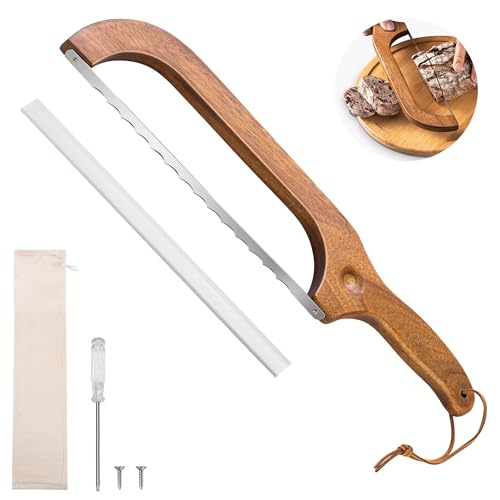
Not a knife but a saw, and at 14.5 inches it is the only thing here that will cross a large sourdough boule without you turning the loaf halfway. The pine bow holds the blade under tension in a curved frame, which is what keeps a thin serrated blade tracking straight instead of wandering, and the grooved handle gives you a proper two-handed grip. It comes with a protective cover for the blade. It is the joint cheapest product on this page.
Pros:
- 14.5 inches; crosses any loaf in one pass
- Bow frame holds the blade straight under tension
- Grooved handle for real control on a crust
- Protective blade cover; joint lowest price here
Cons:
- Pine; softer than the hardwood bow here
- Says nothing about replacing the blade
- A saw, so it does nothing else in the kitchen
Best for: big round loaves, cheaply.
Omesata 8″
The cheapest actual knife here and it names its steel, which several dearer ones do not: 304 stainless, a grade you can look up. It is a wavy edge rather than pointed teeth, built as one continuous piece so there is no join to loosen, and the listing describes the mechanism properly, with the teeth slicing through crust without tearing the soft interior. The handle is shaped rather than molded flat. Eight inches, which is short for a boule.
Pros:
- Names its steel grade as 304
- Wavy edge; full tang single-piece construction
- Describes how the edge actually works
- The cheapest knife on this page
Cons:
- Eight inches; short for a large loaf
- No thickness, weight or hardness published
- No care instructions of any kind
Best for: a tin loaf, at the lowest knife price here.
Orblue 8″
The only listing here that takes the edge as a decision rather than a given, claiming its wavy edge maintains sharpness longer than traditional serrated edges. That is the distinction the rest of this page walks past. It also publishes its blade and handle separately, at 8 inches and 5 inches, so you know the whole thing is 13, and it is one continuous piece of steel with no plastic, wood or screws to work loose. A rubber guard covers the tip. Its thickness bullet gives two different numbers.
Pros:
- The only listing arguing wavy against traditional serration
- Publishes blade and handle lengths separately
- One continuous piece; nothing to loosen
- Rubber safety guard on the tip
Cons:
- Its own bullet says 2.2mm and 0.1mm thick
- Eight inch blade; short for a boule
- Names no steel grade
Best for: an edge chosen on purpose, at a budget price.
HENCKELS 8″
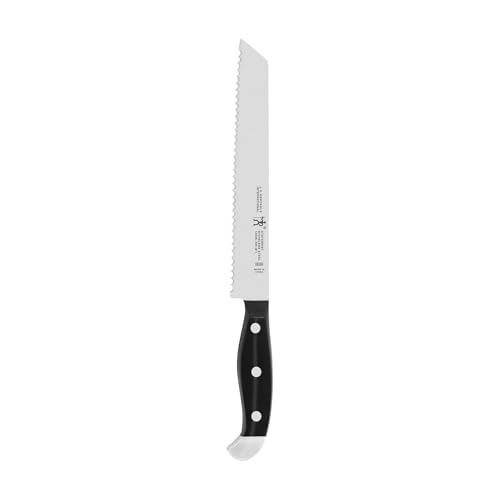
It calls itself worth the splurge and the last knife you will ever need to buy, and it is the third cheapest thing on this page, which is a sentence worth sitting with. The genuinely useful claims are the practical ones: stain and rust-free blades, and cleanup in the dishwasher or by hand, which directly contradicts another knife here that forbids the dishwasher. It is also real about its construction, describing a single-piece precision-stamped blade rather than implying it was forged.
Pros:
- Dishwasher safe, unlike others here
- Stain and rust-free blades; minimal care needed
- Real that the blade is stamped, not forged
- A long-established name at a budget price
Cons:
- Calls itself worth the splurge while undercutting five rivals
- Publishes no steel grade, hardness or thickness
- Eight inches; short for a big loaf
Best for: a knife you can put in the dishwasher.
Uprichya Bow
It solves the problem the whole category has. Screws are embedded at both ends of the frame, so blades change without chewing up the wood, and it says so in those words: unlimited blade changes, with a replacement blade already in the box. A serrated edge you cannot sharpen becomes a consumable you swap. The frame is solid sapele rather than pine, which is a proper hardwood, and the blade is thicker and wider with protruding serrations. Its first bullet, in capitals, says right-handed only.
Pros:
- Blades unscrew and change, forever; a spare included
- Embedded screws so the wood survives the changes
- Solid sapele hardwood frame, not pine
- The only handedness warning on this page
Cons:
- Right-handed only, by its own first bullet
- Publishes no length for the frame or blade
- A saw; it will not do anything else
Best for: never buying a blunt bread knife again.
Mercer 10″
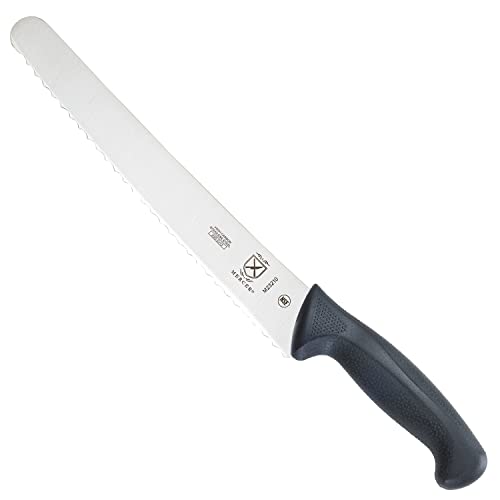
Ten inches of one-piece high-carbon Japanese steel with a wide wavy edge, from a line built for professional kitchens, and it tells you what that steel costs you: wash by hand, never the dishwasher, never leave it submerged. That instruction is the real companion to high-carbon steel, which takes a better edge and will rust if you neglect it. The handle has textured finger points for grip with wet hands, and the listing mentions the tang and its effect on balance, which nothing else here does.
Pros:
- Ten inches of one-piece high-carbon Japanese steel
- Real care instructions: hand wash only, no dishwasher
- Textured finger points for wet hands
- Mentions the tang and its effect on balance
Cons:
- High-carbon steel will rust if you neglect it
- Never the dishwasher; a real daily constraint
- No hardness, thickness or weight published
Best for: a professional line, if you will wash it by hand.
imarku 10″
The most measured knife on this page by a distance: carbon at 0.26 to 0.35 percent, chromium at 12 to 14, hardness at HRC 53 plus or minus one, blade at 2.3mm, handle in 430 stainless at 16 to 18 percent chromium and 1.2mm thick, weight 210 grams. That is the only hardness figure in this search and the only steel analysis. Its laser-etched finish reduces sticking and its serrations are single-bevel with a 1cm tip. It also cites an ICP above 70 and a TCC above 280 and defines neither.
Pros:
- The only hardness figure here: HRC 53
- Publishes carbon and chromium for blade and handle
- Blade thickness, handle thickness and weight all given
- Laser-etched finish reduces sticking; 10 inches
Cons:
- Cites ICP and TCC figures it never explains
- Single-bevel, and it never mentions handedness
- The highest price on this page
Best for: knowing exactly what steel you bought.
The verdict
A serrated edge is dozens of tiny edges and you will not be sharpening any of them, so the real question is what happens when it dulls. Then check the length against your loaf, because five of these are eight inches and a boule is often nine. And read the care bullet, because two brands here take opposite views of the dishwasher and both are right about their own steel.
Best overall: Uprichya Bow. It is the only product in this search that takes the blade as a wear part, which is what a serrated edge actually is. Screws embedded at both ends of the frame mean unlimited blade changes without wrecking the wood, and a spare blade is already in the box. The frame is solid sapele rather than pine. Note its first bullet before you order: in capitals, it says right-handed only, which is the only handedness warning on this page.
Best value: Orblue 8″. The only listing here that takes the edge as a choice, arguing that its wavy profile holds up longer than traditional pointed serration, which is a distinction the rest of the page does not acknowledge exists. It publishes its blade and handle separately so you know the real length, it is one continuous piece of steel with nothing to work loose, and there is a guard for the tip. Its thickness bullet gives two numbers, so ignore that one.
Best premium: imarku 10″. Nothing else here tells you what you are buying: carbon and chromium percentages for both the blade and the handle, a hardness of HRC 53, a blade at 2.3mm and a weight of 210 grams. Publishing both chromium figures also lets you notice that the handle resists rust better than the blade, which is the correct engineering trade stated by accident. Ignore its two unexplained acronyms and buy the numbers that mean something.
FAQ
Can a serrated bread knife be sharpened?
Barely. Every scallop is its own edge and needs a tapered rod and patience. In practice a blunt bread knife gets replaced, which is why one product here makes its blade a screw-out wear part with a spare in the box.
Wavy edge or pointed serrations?
Three knives here have each. One listing claims its wavy edge keeps its sharpness longer than traditional serrated edges, and it is the only one to raise the question. Both grip the crust and cut without crushing the crumb.
How long should the blade be?
Longer than your loaf is wide. Five knives here are eight inches and a sourdough boule is often nine or ten, which means cutting from both sides and meeting in the middle. The bow saw here is 14.5 inches.
Dishwasher or hand wash?
Depends on the steel, and two brands here say opposite things. One forbids the dishwasher and asks for warm water and a towel, because high-carbon steel rusts. Another says the dishwasher is fine and its blades are stain and rust free.
Does handedness matter on a bread knife?
One listing thinks so, opening in capitals with right-handed only. Another makes a point of suiting both hands. A third describes a single-bevel edge, which is ground on one side and therefore handed, without mentioning it.
This article may contain affiliate links; see our Affiliate Disclosure.