One listing here contains the sentence the whole page needed: it cannot be used independently, and must be used together with speakers, a mixer, or an amplifier system. That is true of seven of these ten microphones. They do not record. They feed a PA you do not own, in a hall you are not standing in.



At a glance
| Product | Can it record on its own? | Price tier | Link |
|---|---|---|---|
| Mini Mic Pro | Yes, into a phone. Claims to be number one, from nobody | Budget | |
| TONOR UHF 1-Pack | No. And its own bullet says so plainly | Budget | |
| DJI Mic Mini | Yes. 10g, and real that 48h counts the case | Budget | |
| Hollyland Lark M2 | Yes. The only one naming the body-blocking problem | Mid-range | |
| MELONARE 4-Channel | No. Omnidirectional, and it includes the batteries | Mid-range | |
| Phenyx Pro Dual | No. Unidirectional, and it argues against omni directly | Mid-range | |
| Shure BLX14/CVL | No. And it tells you to check the frequency is legal | Premium | |
How to choose
There are two products here and they share a name
Three of these clip to your shirt, pair with a dongle and record straight into a phone or a camera. Seven are UHF bodypack systems whose receiver has a quarter-inch jack on the back and expects a mixer. One listing spells out what that means: no Bluetooth, no soundbar, no TV, no built-in speaker, and it cannot be used independently. If you are making videos, that is seven results you can ignore. If you are miking a church hall, it is the other three.
The frequency may not be legal where you live
The most responsible sentence on this page belongs to the most expensive system: it operates in a named band, for use in regions where this spectrum is authorized, and it asks you to verify local compliance before ordering. UHF radio bands are regulated and they differ by country, and some have been sold off to mobile networks. One rival publishes its exact frequencies down to two decimal places without a word about legality. Four others just say UHF and leave you to find out.
Line of sight means nothing in the way, including you
Every range figure here carries those three words, and they matter more on a lavalier than on anything else, because the transmitter is clipped to a person and that person keeps turning round. One listing is the only one to say this out loud, describing an antenna designed to eliminate interference caused by the human body. That is the actual engineering problem in this category, named once, on a page full of numbers from 200 feet to a thousand.
Forty hours is not forty hours
One listing heads a bullet with 40-hour battery life and then explains, inside it, that the microphone runs up to 10 hours with noise canceling switched off, and that the 40 arrives via the charging case. Another quotes 48 hours and puts the condition in the same breath: with charging case. Both are accurate; only one is legible. And note the other condition: 10 hours is with the noise canceling off, and nobody says what it costs to turn on the feature you bought.
Two systems argue about the microphone pattern, and both are right
One listing says its unidirectional lapel mics capture sound from the intended direction and reject ambient noise that omnidirectional mics might pick up. Another says its omnidirectional lapel mics ensure clear sound even as you move. That is the trade, stated by two sellers who disagree. A lavalier sits on your chest while your head turns: unidirectional is quieter and punishes you for looking sideways, omnidirectional forgives the movement and hears the room.
Count the AA batteries before you count the microphones
One brand’s four systems all run their bodypacks on two AA batteries each and include none of them, so its four-microphone kit needs eight batteries you do not have on the day it arrives. Three rivals include them: one ships eight, one ships four and states they give sixteen hours, one ships two. On a system you are buying for an event next Saturday, that is not a footnote.
Number one, according to nobody
The cheapest microphone here puts number one in its title and the original in its first bullet, and supports both with the phrase trusted by thousands. There is no source, no metric and no measurement window. Elsewhere on this page you get 48kHz at 24-bit, a 70 decibel signal-to-noise ratio and a 115 decibel maximum sound pressure level, all of which are checkable. The gap between those two kinds of listing is the whole decision.
Mini Mic Pro
The cheapest way to get better audio than your phone’s own microphone, and it is clear about the mechanism: no apps, no Bluetooth, just a dongle in the port and a clip on your shirt, with both USB-C and Lightning adapters in the box. It weighs under an ounce, runs six hours, and comes with foam and a furry cover for wind. The genuinely good detail is that it passes power through, so you can charge your phone while recording. Its title claims to be the number one microphone, on the authority of nobody.
Pros:
- The lowest price here, by a wide margin
- USB-C and Lightning adapters both included
- Charges your phone while you record
- Foam and furry windshields included
Cons:
- Claims to be number one with no source at all
- Six hours; the shortest runtime of the recording mics
- Publishes no sample rate, bit depth or range
Best for: a phone, a shirt and the lowest possible price.
TONOR UHF 1-Pack
The most accurate listing in this search, and what it is clear about is its own limits: no Bluetooth, no connecting to soundbars or TVs, no built-in speaker, and it cannot be used independently. You need a mixer, a powered speaker or an amp. Within that, it is a proper little system: a bodypack with an LCD, its own volume and an on-mute-off switch, both a lapel and a headset mic in the box, 15 frequencies, 200 feet, and practical advice about mic placement and feedback. The bodypack needs two AA batteries it does not include.
Pros:
- States plainly that it cannot be used independently
- Lapel and headset mics both included
- Bodypack has an LCD, volume and a mute switch
- Gives real advice on placement and feedback
Cons:
- Useless without a mixer, amp or powered speaker
- Two AA batteries needed and not supplied
- Publishes no frequency band, only “UHF”
Best for: a hall with a PA already in it.
DJI Mic Mini
Ten grams, which is light enough that a shirt does not sag, and two transmitters plus a receiver and a case for less than one rival’s single kit. It publishes 48kHz sampling and a 120 decibel maximum sound pressure level, has a 400 meter range, automatic limiting so a shout does not clip, and it states its battery plainly: 48 hours with the charging case, in the same sentence rather than a bullet below. The clever part is the ecosystem trick, where a transmitter talks straight to several of the brand’s cameras with no receiver at all.
Pros:
- 10 grams; two transmitters, a receiver and a case
- States that 48 hours includes the charging case
- Connects to the brand’s cameras with no receiver
- 120 dB SPL and automatic limiting against clipping
Cons:
- 48kHz sampling with no bit depth published
- The no-receiver trick only works with one brand’s cameras
- Its footnote markers are not explained in the listing
Best for: two people on camera, packed small.
Hollyland Lark M2
The only listing that names the real problem with a body-worn transmitter, which is the body: it describes a high-gain antenna designed to eliminate interference caused by the human body, on a device clipped to a human body. That sentence is worth more than the thousand-foot figure next to it. Nine grams, 48kHz at 24-bit, a 70 decibel signal-to-noise ratio and 115 decibel maximum sound pressure, all published. Two transmitters, three receivers and a case, pre-paired at the factory, with noise canceling on one button and a plug-straight-into-a-computer mode.
Pros:
- The only listing naming body interference, and its antenna answer
- 48kHz/24-bit, 70dB SNR and 115dB SPL all published
- Two transmitters and three receivers; pre-paired out of the box
- Plugs straight into a computer with no sound card
Cons:
- Its 40-hour headline is 10 hours plus the case
- That 10 hours is with noise canceling switched off
- Costs more than the two-transmitter rival here
Best for: the mic that thought about being worn.
MELONARE 4-Channel
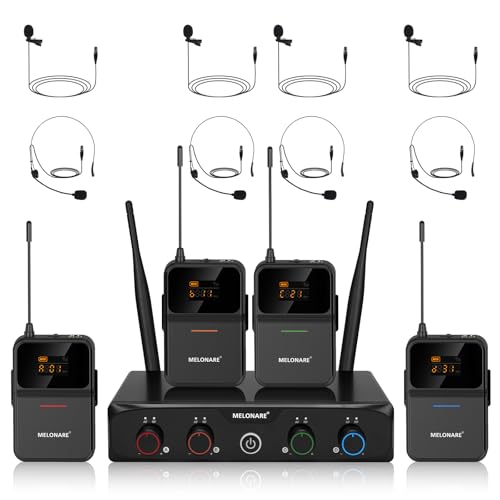
Four bodypacks, four headset-and-lapel combos, and eight AA batteries actually in the box, which is more thoughtful than it sounds when a rival’s four-mic kit ships with none. Its mics are omnidirectional, and its listing makes the case for that: clear sound even as you move, which is the plain answer to a lapel mic worn by a person who turns their head. It publishes 24-bit at 48kHz, runs frequency hopping across four groups of ten, and color-codes the bodypacks so nobody grabs the wrong channel.
Pros:
- Eight AA batteries included; nothing else to buy
- Omnidirectional mics survive a turning head
- 24-bit/48kHz published; frequency hopping
- Color-coded bodypacks; built-in receiver antenna
Cons:
- Needs a mixer or powered speaker to do anything
- Omnidirectional hears the room as well as you
- Its band is given only as UHF 500MHz
Best for: four speakers who move, batteries included.
Phenyx Pro Dual
The most technically forthcoming of the PA systems: it publishes its exact frequency ranges to two decimal places on both channels, runs auto-scan to find the cleanest frequency and then locks it, and uses infrared sync so the bodypack takes the setting without you typing it. Its mics are unidirectional and it argues the case against omni directly. The bodypack uses a three-pin mini XLR, which is a professional connector rather than a soldered lead, and four AA batteries come in the box for a stated sixteen hours.
Pros:
- Publishes both channels’ exact frequency ranges
- Auto-scan finds the clean frequency, then locks it
- Mini XLR bodypack connector; metal receiver
- Four AA batteries included, with a stated 16 hours
Cons:
- Publishes frequencies without a word about local legality
- Unidirectional punishes a turning head
- Needs a mixer or amp; cannot record alone
Best for: two speakers who stay facing forward.
Shure BLX14/CVL
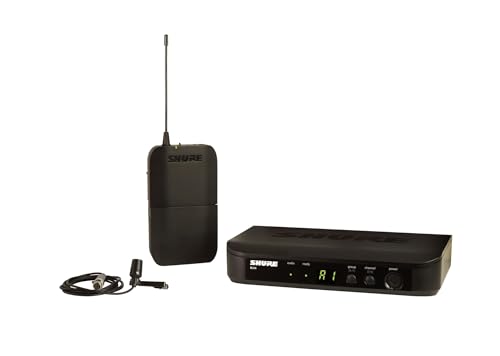
The only listing on this page that takes radio spectrum as a legal matter rather than a specification. It names its band, says it is for regions where that spectrum is authorized, and asks you to verify local compliance before ordering. Nobody else does, and some of these bands have been reallocated to mobile networks in some countries. Beyond that: 300 feet, a cardioid lavalier with clip and windshield, up to fourteen hours on two AA batteries that are in the box, and up to twelve compatible systems per band.
Pros:
- The only listing asking you to verify local compliance
- Names its exact frequency band
- 14 hours on two AAs, and the AAs are included
- Cardioid lavalier with clip and windshield; 12 systems per band
Cons:
- The highest price here, for one microphone
- Needs a mixer or amp; it does not record
- Cardioid means it wants you facing forward
Best for: one speaker, done properly and legally.
The verdict
Seven of these ten cannot record anything. They are UHF bodypack systems for a hall with a mixer in it, and one listing is straight enough to say it cannot be used independently. The other three clip to your shirt and go into a phone. Decide which room you are in, then read the battery figures twice, because forty hours usually means ten plus a case.
Best overall: Hollyland Lark M2. It is the only listing in this search that names the thing that actually degrades a lavalier signal, which is the human body the transmitter is clipped to, and describes the antenna built to get round it. Everything else it publishes is checkable too: 48kHz at 24-bit, a 70 decibel signal-to-noise ratio, 115 decibels of headroom, nine grams. Two transmitters and three receivers, pre-paired, and it plugs into a computer without a sound card.
Best value: DJI Mic Mini. Two transmitters, a receiver and a charging case at ten grams each, for less than one rival’s kit, with the battery claim stated the plain way: 48 hours with the charging case, in the same breath rather than buried a line down. It publishes 120 decibels of headroom and limits automatically so a sudden laugh does not clip. And a transmitter talks straight to several of the brand’s cameras with no receiver in the chain at all.
Best premium: Shure BLX14/CVL. Alone on this page, it takes its frequency as something that might not be legal where you are, naming the band and telling you to verify local compliance before you order. That is not pedantry, because some of these bands have been sold to mobile networks. It gives fourteen hours on two AA batteries that come with it, 300 feet of range, and a cardioid lavalier with the clip and windshield included.
FAQ
Will these work with my phone?
Three of them will. The other seven are UHF bodypack systems that feed a mixer or a powered speaker through a quarter-inch jack, and one listing states it cannot be used independently, has no speaker, and will not connect to a soundbar or TV.
Is the frequency legal where I live?
Worth checking, and only one listing raises it. It names its band and asks you to verify local compliance before ordering, because UHF allocations differ by country. Another publishes exact frequencies with no such note, and four say only UHF.
Does 40-hour battery life mean 40 hours?
No. One listing’s 40 is 10 hours of microphone plus the charging case, and that 10 is with noise canceling off. Another quotes 48 and says with charging case in the same sentence, which is the same arithmetic told plainly.
Omnidirectional or unidirectional?
Two systems here take opposite sides. Unidirectional rejects room noise and wants you facing forward. Omnidirectional keeps working when you turn your head and hears more of the room. A lavalier sits on a chest attached to a head that moves.
Do the batteries come with it?
Depends on the brand. One brand’s four systems all need two AAs per bodypack and include none, so its four-mic kit needs eight batteries on arrival. Three rivals include theirs, one of them stating a sixteen-hour life.
This article may contain affiliate links; see our Affiliate Disclosure.