You leave in the dark, come home in the dark, and somewhere in between a programmable slow cooker turned a pile of raw ingredients into dinner and quietly switched itself to keep-warm. That hands-off magic is the whole appeal, and a good timer is what makes it reliable.


A programmable slow cooker counts down the hours, then drops to warm on its own, so supper is ready when you are rather than overcooked by the time you walk in. This guide compares five strong models with timers and auto-warm, from a huge batch cooker to a do-everything multi-cooker. It suits busy households, meal-preppers filling a week of containers, potluck hosts, and anyone who wants a warm meal waiting without babysitting the pot.
| Product | Standout | Price tier | Link |
|---|---|---|---|
| Crock-Pot 8-Quart Programmable | Huge capacity, 20-hour timer, auto-warm | Mid-range | |
| Ninja 12-in-1 PossibleCooker PLUS | Slow cook, sear, sous vide, and more | Premium | |
| BELLA 6-Quart Programmable | PFAS-free ceramic, preset timers | Budget | |
| Hamilton Beach Set & Forget | Temperature probe and clip-tight lid | Mid-range | |
| GreenLife Ceramic Slow Cooker | Toxin-free coating, delay timer | Budget | |
How to choose a programmable slow cooker
The features that separate a great slow cooker from a frustrating one are easy to miss on a spec sheet. Weigh these before you buy.
Timer and auto-warm behavior
The whole point of a programmable model is the timer, so look closely at how it works. The best cookers let you set a precise cooking time, often up to twenty hours, then automatically shift to a keep-warm setting the moment it ends. That auto-warm hold is what saves dinner when you are running late, keeping food at a safe serving temperature without continuing to cook it. Some models add a delay start so you can load the pot in the morning and have cooking begin later, and a temperature probe that cooks to a target instead of a clock. Decide which of these matters most for your routine.
Capacity for your household
Size the pot to how you actually cook, not just how many you feed nightly. A six-quart cooker handles a whole chicken, a four-pound roast, or dinner for a family with leftovers, and it is the versatile default. An eight-quart model steps up for large families, holiday crowds, and serious batch cooking, while smaller four-quart pots suit couples and tight cabinets. Remember that slow cookers work best filled between half and three-quarters full, so a bigger pot is not automatically better if you often cook small. Match the capacity to your most common meal.
Pot material and coating
The removable inner pot is where your food actually cooks, and its material affects both results and peace of mind. Traditional stoneware crocks hold heat evenly and are naturally nonstick enough for easy release. Ceramic nonstick coatings make cleanup even simpler, and many are now made free of PFAS, PFOA, lead, and cadmium for those who prefer to avoid those materials. Whichever you choose, a removable, dishwasher-safe pot and lid turn cleanup from a chore into a quick rinse, which matters a lot when you use the cooker several times a week.
Extra cooking functions
Some cookers do far more than slow cook, and that versatility can replace other appliances. Multi-cookers add searing and sauteing right in the pot, so you can brown meat before slow cooking without dirtying a separate pan, plus functions like sous vide, proofing dough, braising, and keeping food warm. A pot that is also oven safe lets you crisp a top under the broiler to finish. If counter space is tight or you want one device to handle many jobs, these extra modes justify a higher price; if you only want classic set-and-forget cooking, a simpler model is plenty.
Portability and lid design
If you take dishes to gatherings, a travel-friendly design earns its keep. A lid that clips or locks securely avoids sloshing and spills on the drive to a potluck, tailgate, or family dinner, and sturdy handles make a full, heavy pot easier to carry. Some models are explicitly built as cook-and-carry units for exactly this. Even at home, a well-sealing lid helps retain heat and moisture for better results. Consider how often the cooker leaves your kitchen and choose a lid and handle setup that travels without drama.
Crock-Pot 8-Quart Programmable: the batch-cooking best-seller
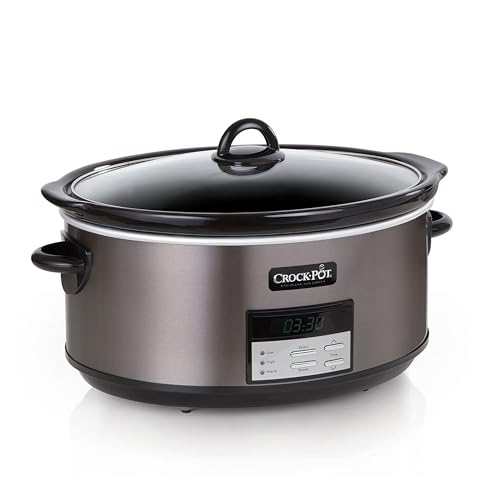
The top seller here is a generous, no-nonsense workhorse built for feeding a crowd. Its huge eight-quart stoneware pot prepares food for well over ten people, making it a genuine holiday-hosting essential and a meal-prepper’s friend. A digital timer counts down cooking time up to twenty hours for easy monitoring, then auto-warm takes over to keep everything at the right serving temperature until you are ready. The removable stoneware pot and lid are dishwasher safe, so cleanup stays painless even after a big cook. It sticks to the fundamentals of what a slow cooker should do and does them dependably at a fair price, which is exactly why it sells so well.
Pros
- Enormous eight-quart capacity
- Digital timer up to twenty hours
- Automatic keep-warm setting
- Dishwasher-safe stoneware and lid
- Best-selling, proven value
Cons
- Large footprint needs cabinet space
- Only slow cooks, no extra modes
- Overkill for one or two people
Best for: large families, holiday hosts, and serious batch cooks who feed a crowd.
Ninja 12-in-1 PossibleCooker PLUS: the do-everything multi-cooker
The Ninja is the ambitious one, a single 8.5-quart pot that replaces a whole shelf of gear by covering slow cooking, searing and sauteing, keeping warm, sous vide, braising, and proofing. Because you can brown proteins and sweat vegetables directly in the pot using the bottom heating elements, you skip the separate skillet and the extra washing up, which genuinely changes how a slow-cooked meal comes together. The removable pot is oven safe to a high temperature, so you can finish a dish with a crisp top. It costs more than a classic cooker, but for a compact kitchen or a cook who wants one flexible device, the range of functions is a real payoff.
Pros
- Twelve functions in one pot
- Sear and saute directly in the pot
- Includes sous vide, braise, and proof
- Large 8.5-quart capacity
- Oven safe for a crisp finish
Cons
- Highest price in this group
- More functions mean a learning curve
- Larger and heavier to store
Best for: cooks who want one versatile appliance to replace several kitchen tools.
BELLA 6-Quart Programmable: the value family cooker
BELLA covers the essentials that most households actually use, at a price that makes it an easy first slow cooker. The six-quart pot is sized for big batches of soup, chili, or a whole roast chicken, and four programmable presets of four, six, eight, and ten hours let you plan ahead before it switches to keep-warm. Its EverGood ceramic nonstick coating is free of PFAS, PFOA, PTFE, lead, and cadmium, appealing to anyone who prefers to avoid those materials, and it wipes clean easily. Low, medium, and high temperature settings add flexibility for different dishes. For dependable set-and-forget cooking without a premium price, it is a smart, straightforward pick.
Pros
- Affordable family-sized six quarts
- PFAS-free ceramic nonstick coating
- Four preset cooking times
- Auto keep-warm when done
- Easy to clean
Cons
- Preset times are fixed steps
- No searing or extra modes
- No temperature probe
Best for: value-minded households wanting simple, healthy-coating slow cooking.
Hamilton Beach Set & Forget: the precision traveler
Hamilton Beach’s Set & Forget adds a layer of smarts that home cooks quickly come to rely on. Beyond cooking to a set time, its patented temperature probe lets you cook large cuts of meat to a precise internal temperature, after which the cooker shifts to warm, so a roast comes out exactly as intended rather than guessed. A clip-tight gasket lid seals securely for spill-free trips to a party, potluck, or tailgate, and helps lock in heat and moisture at home. The removable crock and glass lid are dishwasher safe for simple cleanup. For cooks who value precision and take their dishes on the road, it is a thoughtfully designed six-quart choice.
Pros
- Cooks to time or to temperature
- Patented probe for precise meat
- Clip-tight lid for spill-free travel
- Dishwasher-safe crock and lid
- Auto-warm when finished
Cons
- No searing function
- Probe adds a step to setup
- Plainer styling
Best for: cooks who want precise results and frequently transport their meals.
GreenLife Ceramic Slow Cooker: the clean-cooking budget pick
GreenLife focuses on healthy, toxin-free cooking at an approachable price. Its extra-large six-quart pot fits a six-pound chicken, a four-pound roast, or enough to serve seven-plus, and the ceramic nonstick interior is free of PFAS, PFOA, lead, and cadmium so you can cook with confidence. An easy control panel offers low, medium, and high modes, a delay timer to start later, and keep-warm to serve when you are ready, with cooking spans from thirty minutes up to twenty hours. That flexibility makes it a natural for meal prep and make-ahead meals. For buyers who prioritize a clean coating and simple operation without spending much, it is a tidy, capable option.
Pros
- Toxin-free ceramic nonstick interior
- Roomy six-quart capacity
- Delay timer and keep-warm
- Wide thirty-minute to twenty-hour range
- Affordable and simple to use
Cons
- Basic three-mode control
- No searing or probe
- Removable pot needs gentle handling
Best for: meal-preppers who want a clean-coating cooker on a budget.
The verdict
Each of these will have dinner waiting when you get home. The best one depends on how much you cook, how far it travels, and how many jobs you want it to do.
Best Overall: Crock-Pot 8-Quart Programmable – the best-selling batch cooker that nails the essentials, with huge capacity, a twenty-hour timer, and reliable auto-warm at a fair price.
Best Value: BELLA 6-Quart Programmable – family-sized capacity, a PFAS-free coating, and handy preset timers for the least outlay, covering everything most households need.
Best Premium: Ninja 12-in-1 PossibleCooker PLUS – twelve functions in one pot, including searing and sous vide, for cooks who want a single versatile appliance to do it all.
Frequently asked questions
What does the auto-warm setting actually do?
When the programmed cooking time ends, auto-warm automatically drops the cooker to a low holding temperature that keeps food safely hot without continuing to cook it. This is what avoids a meal from overcooking if you are delayed, so dinner stays ready and at a good serving temperature until you arrive. It is one of the most useful features on a programmable model and a big reason to choose one over a simple manual cooker.
How full should I fill a slow cooker?
Aim to fill the pot between half and three-quarters full for the best results. Too little food can overcook or dry out, while overfilling can avoid food from cooking evenly and may bubble over. This is why matching the pot size to your usual portions matters: a large cooker used for tiny meals will not perform as well as a right-sized one. Adjust recipes to keep the fill level in that sweet spot.
Can I cook to a temperature instead of a time?
With some models, yes. A cooker with a temperature probe lets you set a target internal temperature for large cuts of meat, and it switches to warm once the food reaches it, rather than relying on the clock alone. This gives more precise, repeatable results for roasts and whole cuts. If exact doneness matters to you, look specifically for a probe-equipped model, since not every programmable cooker includes one.
Are ceramic nonstick slow cooker pots safe?
Modern ceramic nonstick coatings are widely used and many are now made free of PFAS, PFOA, lead, and cadmium, which appeals to cooks who prefer to avoid those materials. They also make cleanup easier thanks to good food release. To keep any coating in good shape, use gentle utensils, avoid harsh abrasives, and follow the care instructions. Traditional stoneware crocks are another dependable, naturally easy-release option if you prefer no coating at all.
Can I use a slow cooker to sear meat first?
Only if it has a sear or saute function, which multi-cookers provide by heating the pot directly. Searing meat before slow cooking adds color and flavor, and being able to do it in the same pot saves a pan and cleanup. A classic slow cooker cannot brown food, so you would sear in a separate skillet first. If browning in one vessel appeals to you, choose a multi-cooker with a dedicated sear setting.
This article may contain affiliate links; see our Affiliate Disclosure.