It is two in the morning, the room has turned stuffy, and the fan chain is somewhere in the dark above your head. Either you get up and grope for it, or you say six words out loud and go back to sleep.


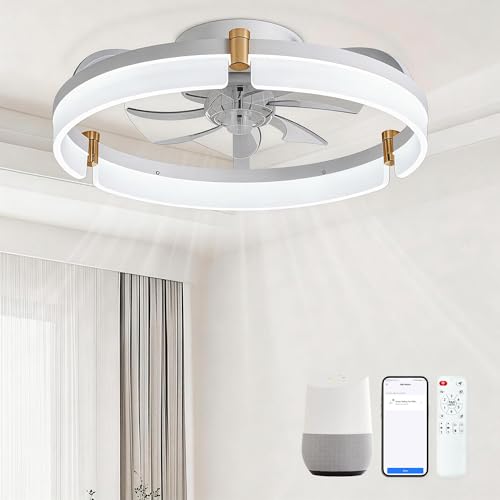

There are two real routes to a voice-controlled ceiling fan, and they cost very different amounts of money and effort. You can replace the whole fan with one that has WiFi built in, or you can leave a perfectly good fan alone and make it smart with a switch or a receiver kit. This comparison covers both routes, because the best answer depends far more on your wiring and your ceiling than on any spec sheet.
At a glance
| Product | Standout feature | Price tier | Link |
|---|---|---|---|
| Amazon Basics Smart Ceiling Fan Control Switch | Wall-switch retrofit, no hub, Alexa routines | Mid-range | |
| Amico 52 Inch Smart Ceiling Fan with Lights | Full fan, Alexa and Google, quiet DC motor | Mid-range | |
| CINOTON 52” RGBCW Smart Ceiling Fan | RGB accent lighting, high airflow, reversible blades | Premium | |
| 20” WiFi Flush Mount Low Profile Fan | Low ceilings, high-CRI flicker-free light | Mid-range | |
| 53T Smart Wi-Fi Ceiling Fan Remote Control Kit | In-canopy receiver, fits most existing fans | Budget | |
How to choose a smart ceiling fan setup
Decide whether you are replacing the fan or just the brain
This is the fork in the road, and everything else follows from it. If the fan itself is fine and you only resent the pull chain, a control switch or a receiver kit gets you voice control for a fraction of the price of a new fan, and you keep the blades and finish you already chose. If the fan is loud, wobbly, ugly, or has a burnt-out light module, replacing it is the better spend, because a modern DC-motor fan solves the noise and the smarts in one go.
Check for a neutral wire before you buy a switch
Smart wall switches need constant power to keep their radio alive, and they get it from a neutral wire in the switch box. Older homes frequently do not have one. Kill the breaker, pull the switch out, and look for a bundle of white wires capped together at the back of the box. No neutral bundle usually means a wall switch is off the table, and an in-canopy receiver kit becomes the sensible path, since it taps power up at the fan where the neutral always lives.
Single pole versus three-way
If the fan is controlled from two different switches at two doorways, that is a three-way circuit, and most inexpensive smart fan switches will not handle it. Read the compatibility line carefully. A one-way or single-pole rating means one switch, one location, no exceptions.
Alexa only, or Alexa and Google
Not every smart fan device speaks both languages. Some are locked to a single voice platform by design, which keeps setup simple but strands you if you ever switch ecosystems or if the household is split between an Echo in the kitchen and a Nest speaker in the bedroom. If you are not certain which assistant you will be using in five years, favor the products that list both.
Motor type and noise
DC motors are the reason modern fans can run at a whisper. They draw less power, offer more speed steps, and reverse direction electronically rather than with a physical slider on the housing. Quoted noise figures around the mid-twenty decibel range put a fan somewhere near a quiet library at low speed, which matters enormously in a bedroom and not at all on a covered patio.
Blade span and ceiling height
A 52-inch fan suits a medium to large room, roughly twelve by twelve feet up to about eighteen by eighteen. Anything smaller than that room size and a big fan just moves furniture-ruffling air with nowhere to go. Ceiling height matters just as much: a downrod mount needs headroom, while a flush-mount fan is built for rooms where a hanging fan would be a hazard. Measure before you fall in love with a photograph.
Light quality, not just brightness
Lumens tell you how bright, color temperature tells you how warm, and color rendering index tells you whether skin and food look right underneath it. A fan light that offers a range from around 3000K to 6500K covers cozy evenings through to task lighting. Flicker-free drivers and a high rendering index are the details that separate a light you enjoy from one that quietly gives you a headache.
Amazon Basics Smart Ceiling Fan Control Switch
This is the most-bought product in the group, and the reason is not glamor. It is a plain white switch that replaces the plain white switch already in your wall, and afterwards the fan answers to your voice and to schedules. Four speed settings sit behind small LED indicators, so the wall still tells you what the fan is doing at a glance, which is something a pure app-controlled fan never quite manages. Setup lives entirely inside the Alexa app, with no separate account, no bridge, and no third-party software to keep updated. That simplicity is the whole pitch, and it is a strong one.
Pros
- Adds voice control without touching the fan itself
- Four speeds with LED indicators on the switch face
- Works with Alexa routines and remote control from the app
- No hub, no bridge, no third-party app
- Guided step-by-step installation in the manual
Cons
- Alexa only, with no Google Assistant support
- Requires a neutral wire and 2.4 GHz WiFi
- Single pole only, so no three-way circuits
- Does not add smarts to the fan’s light separately
Best for: an Alexa household with a good existing fan and a neutral wire in the switch box.
Amico 52 Inch Smart Ceiling Fan with Lights
If you want the whole problem solved in one purchase, this is the fan that does it without asking for a premium. A reversible DC motor gives six speeds and a quoted 25 decibels, the light dims steplessly from ten to one hundred percent and slides between 3000K and 6500K, and you get four separate ways to drive it: remote, app, voice through either Alexa or Google, and the wall switch. The memory function is the quiet hero here, restoring your last speed and light setting so the fan does not blast you at full tilt every time power returns. The 52-inch span suits medium to large rooms, and the downrod mount wants a ceiling with some height to give.
Pros
- Works with both Alexa and Google Home
- Reversible DC motor with six speeds, quoted at 25 decibels
- Dimmable light from 3000K to 6500K, up to 2500 lumens
- Remote doubles as a wall switch once mounted
- Memory function restores your last settings
- Timer options via remote and app
- Two-year product and ten-year motor warranty
Cons
- Downrod mount needs ceiling height
- Not rated for direct exposure to rain
- Full installation job, not a switch swap
Best for: a bedroom or living room that needs a genuinely quiet fan and voice control on either major platform.
CINOTON 52” RGBCW Smart Ceiling Fan with Lights
This one is aimed at a room that does more than sleep. Alongside a 2600-lumen main light with three color temperatures, there is an RGB accent ring for movie nights and gaming, which is either exactly what you want or completely beside the point. The airflow claim is the serious part: up to 4500 CFM from a pure copper DC motor running at a quoted 24 decibels, with six speeds plus a simulated natural wind mode. The dual-sided blades are a clever touch, matte black on one face and walnut on the other, so the same fan suits a modern room or a farmhouse one depending on which way you fit them. Downrods for five and eight inches are included, and it handles sloped ceilings up to about fifteen degrees.
Pros
- RGB accent lighting plus a dimmable 2600-lumen main light
- High quoted airflow, up to 4500 CFM
- Whisper-quiet reversible DC motor at a quoted 24 decibels
- Dual-sided blades in black or walnut
- Works with Alexa and Google Assistant
- Five and eight inch downrods included, suits sloped ceilings
Cons
- Priciest option here
- RGB lighting is wasted money if you will never use it
- Wants a room from about twelve by twelve feet upward
Best for: a larger living room or media space where the fan is also part of the atmosphere.
20” WiFi Flush Mount Low Profile Smart Ceiling Fan
Low ceilings are where most fan shopping falls apart, and this is the answer to that specific problem. At twenty inches across and mounted flush, it tucks into rooms where a downrod fan would be an actual head hazard. The light is the surprise: a color rendering index above 95 and up to 4320 lumens, with stepless color temperature from 3000K to 6500K and a memory function that brings your setting back. A seven-blade pure copper DC motor gives six speeds and reverses for winter circulation, and fan and light are controlled independently, so you can run air without light or light without air. Alexa and Google Home are both supported, with a physical remote included.
Pros
- Flush mount design suits low ceilings and small rooms
- High color rendering index above 95, flicker-free
- Bright, up to 4320 lumens, stepless color temperature
- Seven-blade reversible DC motor, six speeds
- Fan and light controlled independently
- Alexa and Google Home compatible, remote included
- Two-year warranty
Cons
- Twenty inches moves far less air than a 52-inch fan
- Not suited to large open rooms
Best for: bedrooms, kitchens, and any room where ceiling height rules out a hanging fan.
53T Smart Wi-Fi Ceiling Fan Remote Control Kit
When the switch box has no neutral wire, this is how you win anyway. A small receiver hides inside the fan canopy and wires in up at the fan, where power and neutral both exist, and from there it answers to an RF remote, the app, or your voice. The receiver is deliberately compact, which matters more than it sounds, because canopy space on an older fan is measured in millimeters. It handles four fan speeds, dimmable light control, and timers at one, two, four, and eight hours. Alexa and Google Assistant are both supported. The trade-off is that you are working above your head with the breaker off, rather than at chest height in a switch box.
Pros
- Cheapest route to a voice-controlled fan
- Fits inside the canopy of most standard ceiling fans
- No neutral wire needed at the wall switch
- Works with Alexa and Google Assistant
- Four speeds, light dimming, and four timer presets
- RF remote works at range, independent of WiFi
Cons
- Install means overhead work inside the fan canopy
- Tight canopies can make fitting the receiver awkward
- No wall indicator of fan state
Best for: older homes with no neutral wire, or anyone keeping a fan they already like.
The verdict
Best Overall: Amazon Basics Smart Ceiling Fan Control Switch. It is the clear best seller in this group, and that popularity reflects something real. Most people do not need a new fan; they need the fan they have to listen to them. This switch does that with no hub, no extra app, and a wall control that still shows the speed. The neutral wire and Alexa-only limits are real, so check both before you order.
Best Value: 53T Smart Wi-Fi Ceiling Fan Remote Control Kit. It is the least expensive way in, it works with both major assistants, and it sidesteps the neutral wire problem entirely by living in the canopy. If your switch box came up short, this is the one that still gets you there.
Best Premium: CINOTON 52” RGBCW Smart Ceiling Fan. The highest airflow claim, the quietest quoted motor, ambient RGB lighting, and blades that flip to match your room. It costs the most and earns it in a large living space, though the RGB is dead weight in a bedroom.
For a straight fan replacement without the light show, the Amico 52-inch is the balanced middle, and the 20-inch flush mount is the only sensible pick if your ceiling is low.
Frequently asked questions
Do I need a hub for any of these?
No. Every product here connects over 2.4 GHz WiFi directly, using either the Alexa app or a companion app. None of them require a separate bridge or hub.
What happens if my internet goes down?
Voice commands and app control stop working, because those round-trip through the cloud. Physical controls keep working: the wall switch still switches, and the RF remote on a receiver kit still talks to the fan directly, since radio frequency control does not depend on your network.
Can I use a smart fan switch with a fan that has its own remote?
Usually not well. If the fan already has a receiver in the canopy, cutting power at the wall just resets it, and the two systems fight each other. In that situation, replace the existing receiver with a smart one rather than stacking a smart switch on top.
Why does a fan need to reverse in winter?
Warm air collects at the ceiling. Running the blades in updraft mode pushes that trapped warm air down the walls and back into the room without blowing a draft on anyone, which lets you run the heating a little lower.
Is a DC motor really worth it?
In a bedroom, yes. DC motors run quieter, use less power, offer more speed steps, and reverse from the remote instead of a slider on the housing. In a garage or patio where noise does not matter, the advantage shrinks considerably.
This article may contain affiliate links; see our Affiliate Disclosure.