A window air conditioner hums along fine until the day it trips the outlet, and a shop heater with a fat 20-amp plug simply will not fit the wall socket in the garage. High-draw gear lives in an awkward gap: you either need a plug rated to switch that load remotely, or an adapter that safely bridges a 20-amp plug to the 15-amp outlet you actually have.


Heavy-duty power gear splits into two camps that people often shop for together. Smart plugs add scheduling, remote control, and voice commands to appliances drawing close to the limit of a circuit. Plug adapters solve a purely physical problem: connecting equipment with a 20-amp (NEMA 5-20) plug to a standard 15-amp wall receptacle. This guide compares the best-selling options in both camps so a homeowner running a garage AC, a renter with a space heater, or a small-shop owner powering a saw can find the safe fit.
At a glance
| Product | Standout feature | Price tier | Link |
|---|---|---|---|
| Plugrand 4-in-1 Adapter | One block adapts to four NEMA outlet types | Budget | |
| GHome Smart 15A Plug (4-Pack) | Dual-band WiFi, 1800W rated, four in a box | Mid-range | |
| Minoston Matter Outdoor Plug | IP65 weatherproof, works with every major app | Mid-range | |
| Cable Matters Adapter (3-Pack) | ETL-listed, three spares for the tool bag | Budget | |
| CRST Adapter with Breaker | Built-in 15A trip switch for overload safety | Budget | |
How to choose heavy-duty plugs and adapters
Match the amperage, then respect the wattage limit
Every plug and adapter carries a rating, and the number that matters is the continuous load. Household circuits in the United States are typically wired for 15 or 20 amps at 120 volts, which caps out near 1800 watts of steady draw. A device labeled 15A/1875W handles a coffee maker, a space heater on medium, or a small window AC, but sits close to the edge with a large air conditioner or a shop compressor. The safe habit is to add up the wattage of whatever you plug in and stay comfortably below the rating rather than nudging it. A plug or adapter never raises the capacity of the wiring behind the wall; it only lets you connect to the amperage that already exists.
Adapter or smart plug: what problem are you solving
An adapter answers a shape problem. Equipment with a NEMA 5-20 plug (the one blade turned sideways into a T) will not enter a standard 5-15 outlet, and an adapter bridges the two so a treadmill, UPS, or shop tool can run where no 20-amp receptacle exists. A smart plug answers a control problem. It sits between the outlet and the appliance and lets a phone app, a schedule, or a voice assistant switch the load on and off. If your only need is to make a 20-amp cord fit, an adapter is cheaper and simpler. If you want the heater to shut off at bedtime or the AC to start before you get home, the smart plug earns its place.
Certification is not optional at this load
Look for an ETL or UL listing on anything carrying serious current. That mark means an independent lab tested the product against North American safety standards, and it is the single clearest signal separating a trustworthy adapter from a mystery import. Flame-retardant housings, heavy 12 or 14 AWG copper, and a listed certification are worth more than a low price when heat and fire are the failure modes.
Indoor, outdoor, and the network it needs
Placement changes the requirement. An outdoor smart plug should carry an IP64 or IP65 weather rating so rain and dust do not reach the contacts, and it should tolerate the temperature swings of a porch or yard. For smart plugs, check the network: many connect only to 2.4GHz WiFi, which reaches farther through walls, while a few add 5GHz for speed near the router. Newer plugs built on the Matter standard link to several ecosystems at once, so the same device answers to more than one voice assistant without locking you into a single brand.
Startup surge versus running load
Motor-driven equipment tells a trickier story than a heater. An air conditioner compressor, a shop vac, or a power tool pulls a brief surge well above its running current at the instant it starts, sometimes double the steady figure for a fraction of a second. That inrush is why a device rated below the outlet limit can still trip a breaker or an adapter’s protection switch on start-up. When the gear has a motor, leave more headroom than the running wattage alone suggests, and favor an adapter or plug with robust internal conductors. Resistive loads like heaters and coffee makers draw steadily and are far easier to size, since the wattage on the label is close to what the device actually pulls the whole time it runs.
Build quality you can feel
Two adapters can share a rating and still differ where it counts. Heavier copper gauge, a molded rather than clipped-together body, and a housing that stays cool after an hour under load all point to a product that will last. A plug or adapter that grows warm to the touch during normal use is warning you, and the fix is a better-built unit rather than a habit of unplugging it to cool. The listed options here all use substantial copper and certified housings, which is the baseline worth insisting on for anything near 1800 watts.
Plugrand 4-in-1 15A-to-20A Adapter
The best-selling item in this group is not a smart plug at all, and that tells you what most shoppers are really after: a small, cheap block that makes an awkward plug fit. This Plugrand adapter takes a standard 15-amp household plug and converts it to four different outlet types in one piece, covering 5-15R, 5-20R, 6-15R, and 6-20R receptacles. That flexibility is why it outsells the rest by a wide margin. It uses heavy 14 AWG copper inside a molded PVC body, and it stays cool through long charging or appliance sessions. The one caution the maker repeats matters: the 6-series outlets carry 250 volts, so only connect devices that accept that wider voltage range.
Pros
- Adapts to four common NEMA outlet types from one plug
- Heavy 14 AWG copper conductors for steady loads
- Compact molded body with no cord to manage
- Lowest price tier and the proven best-seller
Cons
- Passive adapter with no switching or safety cutoff
- 250-volt outlets require voltage-compatible devices
Best for: anyone who just needs a 20-amp plug to fit a standard outlet without buying five separate adapters.
GHome Smart 15A WiFi Plug (4-Pack)
When the job is control rather than shape, this GHome four-pack is the value leader. Each plug is rated 120V/15A, or 1800 watts, and carries both ETL and FCC certification, so it handles a coffee maker, a fan heater, or a mid-size appliance without drama. The dual-band radio is the standout: connect on 5GHz for a fast response near the router, or fall back to 2.4GHz for range through walls and across the house. Setup runs through the GHome app over Bluetooth, and once linked you get timers, schedules, group control, and voice commands through Alexa or Google Home. Four in a box makes it easy to automate a whole room or a bank of shop tools at once.
Pros
- 1800W rating with ETL and FCC certification
- Dual-band 2.4GHz and 5GHz WiFi for reach or speed
- Timers, schedules, and group control in the app
- Four plugs cover a whole room affordably
Cons
- Must link through the GHome app before Alexa or Google
- Indoor design, not weather-rated
Best for: a household or workshop automating several near-1800-watt appliances on a schedule.
Minoston Matter Outdoor Smart Plug
Move the load outside and this Minoston plug becomes the natural pick. Its IP65 housing shrugs off rain and dust, which suits a garden pump, a sprinkler, landscape lighting, or a patio heater, and it works indoors in a damp garage or basement just as well. The headline is Matter support: the plug connects directly to Apple Home, Alexa, Google Home, and SmartThings, so it is not chained to one brand’s app. It runs on 2.4GHz WiFi with no hub required for basic Smart Life setup, and it adds the extras heavy users want, including child lock, device sharing, scene triggers, and dusk-to-sunset scheduling based on real daylight.
Pros
- IP65 weatherproof housing for outdoor use
- Matter compatibility across all major ecosystems
- Child lock, sharing, and astronomical timers
- No hub needed for basic app control
Cons
- 2.4GHz WiFi only, no 5GHz option
- Direct hub link needs an updated Matter controller
Best for: outdoor gear or a mixed smart-home setup that spans several assistant apps.
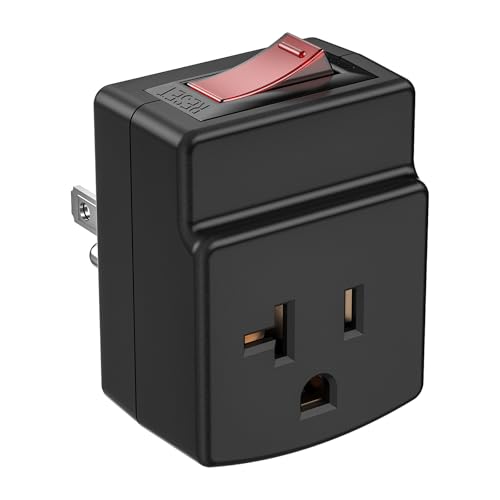
Cable Matters 15A-to-20A Adapter (3-Pack)
This is the adapter to buy when you want one in the garage, one in the workshop, and one in the tool bag. Cable Matters ships three T-blade adapters that convert a standard 125V 15-amp outlet into a NEMA 5-20R receptacle, supporting equipment up to 1875 watts. Each is ETL listed, which is the reassurance you want before running exercise equipment, a UPS, or an electric saw through it. The plug-style body sits flat against the wall and can serve as a semi-permanent fixture or a floor outlet extender. The maker is clear about the ceiling: do not exceed 1875 watts, and take it as a bridge, not a capacity upgrade.
Pros
- Three ETL-listed adapters in one budget pack
- Supports 20-amp T-blade cords up to 1875W
- Flat body works as a semi-permanent fixture
- Handy spares for multiple work locations
Cons
- Single conversion type, less versatile than a 4-in-1
- No overload protection built in
Best for: a workshop or garage that needs several dependable 20-to-15 adapters at once.
CRST 15A-to-20A Adapter with Overload Breaker
The safety-minded choice in this group builds a circuit breaker into the adapter itself. Where a plain adapter simply passes current through, the CRST carries an integrated 15-amp overload switch that trips and cuts power if a 20-amp device tries to pull more than the wiring can take. That single feature addresses the real hazard of these adapters, which is a high-draw appliance overheating a 15-amp circuit. It is ETL listed, built from high-temperature flame-retardant material, and shaped to leave the second outlet on a duplex receptacle free. A visible reset switch restores power in seconds after a trip, making it the sensible pick for treadmills, shop vacs, or commercial gear on an unknown circuit.
Pros
- Built-in 15A breaker trips on overload
- ETL listed with flame-retardant housing
- Compact profile leaves the second outlet usable
- Fast manual reset after a trip
Cons
- Single 5-15P to 5-20R conversion only
- Frequent tripping if the device runs above 15 amps
Best for: running a high-draw 20-amp appliance on a circuit you are not sure about.
The verdict
Best Overall: the Plugrand 4-in-1 Adapter. It is the proven best-seller here for a reason: one inexpensive block solves the most common heavy-duty plug problem across four outlet types, with heavy copper and a cool-running body. For the largest share of shoppers, that is the pick.
Best Value: the GHome Smart 15A Plug 4-Pack. If you need control rather than a shape change, four certified 1800-watt plugs with dual-band WiFi and full scheduling cost little per outlet and automate a whole room.
Best Premium: the Minoston Matter Outdoor Plug. Its weatherproof housing and cross-ecosystem Matter support make it the most capable and flexible option, ready for outdoor loads and any assistant you already run.
Frequently asked questions
Does a 15A-to-20A adapter give my outlet more power? No. An adapter only changes the plug shape so a 20-amp cord fits a 15-amp outlet. The wiring behind the wall still limits the current, so keep the load under the outlet’s rating.
Can a smart plug handle a space heater or window AC? Many are rated 15A/1800W, which covers a small heater or window unit that stays under that draw. Add up the appliance wattage first, and choose a certified plug rather than an unrated one.
What does ETL or UL listed mean? It means an independent lab tested the product against North American safety standards. At these current levels, an ETL or UL mark is the clearest sign a plug or adapter is safe to trust.
Do I need an outdoor-rated plug for a covered porch? Anywhere rain, snow, or hose spray can reach the contacts, use an IP64 or IP65 weatherproof plug. A covered but open porch still sees blown rain, so the weather rating is worth it.
Will a smart plug work with both Alexa and Apple Home? A Matter plug like the Minoston connects to several ecosystems at once. Older plugs usually pick one or two, so check the listed compatibility before buying if you mix assistants.
This article may contain affiliate links; see our Affiliate Disclosure.