Most trekking poles are built for a six-foot frame and simply shortened as an afterthought — grips too fat, straps too long, and a collapsed length that still pokes out of a smaller pack. The right pole for a smaller hiker starts shorter, grips slimmer, and weighs less, and knees feel the difference on every descent.



Fit is the whole game with poles. A pole that adjusts low enough for a shorter hiker, folds small enough for a smaller pack, and weighs under ten ounces per side serves the people the big-and-tall defaults ignore — and serves everyone else just as well. The nine below lead with the category’s proven sellers and cover every grip material, folding style, and budget in between.
| Poles | Standout features | Price | Link |
|---|---|---|---|
| Cascade Mountain Tech | 26–54" quick-lock range, cork grips, full basket kit, 10 oz | Budget | |
| TrailBuddy | 7075 aluminum, 24.5–54", one-hand lever locks, 9.7 oz | Mid-range | |
| TheFitLife | Antishock springs, twist-lock, packs to 21.5", full tip kit | Budget | |
| TREKOLOGY Trek-Z | Tri-fold to 15", sized 100–120cm option, metal flip locks | Mid-range | |
| Trek-Z Cork Grip | Same tri-fold frame with moisture-wicking cork handles | Mid-range | |
| Montana Foldable | Two sized versions (100–120 / 115–135cm), 9.95 oz short | Mid-range | |
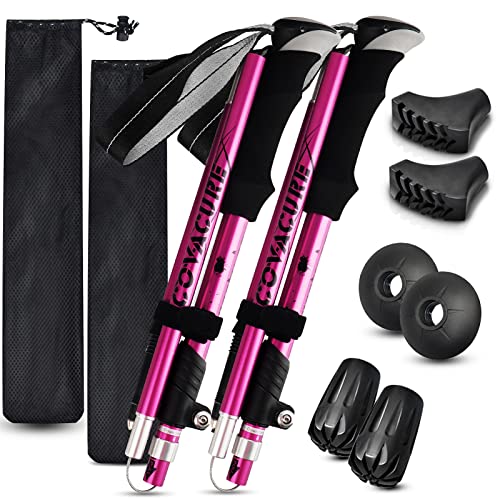
| Covacure | 7075 aluminum tri-fold, EVA grips, lowest fold-price entry | Budget | |
| Carbon Fiber USA | 7.6 oz full carbon, cork grips, 24–55" flip locks | Premium | |
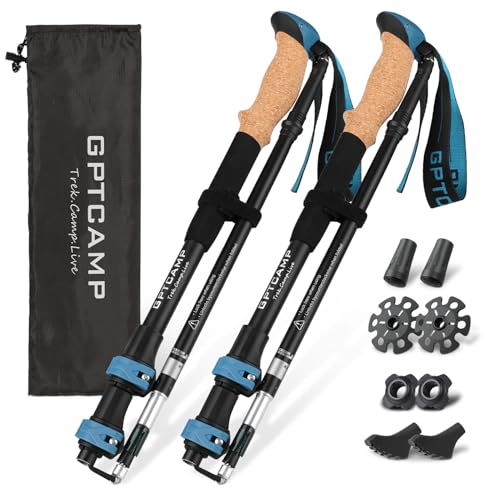
| GPTCAMP | 31–51" range fits from 4’4" up, folds to 17.3" | Budget | |
How to choose trekking poles that actually fit
Pole marketing leads with material; fit does the work. Start with length, then grips, then decide how the poles should pack.
Get the length range right first
The rule: elbow at ninety degrees with the tip on the ground. For hikers between about 4’11" and 5’7" that lands between 100 and 120cm (39 to 47 inches), and the pole must adjust comfortably below that for climbs. Every set here reaches short enough; the standouts are GPTCAMP’s 31-inch minimum — low enough for hikers under five feet — and the Montana brand’s two discrete sizes, where the 100–120cm version is built for people 5’8" and under rather than adapted from a taller pole.
Grip material matters more on small hands
Cork molds to your hand over trips, wicks sweat, and dampens trail vibration — the reason it dominates the better poles here (Cascade, TrailBuddy, Trek-Z Cork, both USA-brand sets). EVA foam is softer, lighter, and stays warmer in cold weather; rubber is cheapest and fine under gloves. Slimmer grip diameter is the quiet spec for smaller hands: a fat grip forces a claw hold that tires forearms. The extended foam sleeve below the main grip on most of these lets you choke down on traverses without re-adjusting length.
Telescoping or tri-fold
Telescoping poles (Cascade, TrailBuddy, TheFitLife) slide into themselves — simple, strong, and adjustable across the widest range, but 24-to-26-inch collapsed lengths ride awkwardly on small daypacks. Tri-fold designs (Trek-Z, Montana, Covacure, GPTCAMP) break into three linked segments and drop to 15-to-17 inches, disappearing inside a pack or carry-on. Fold-style poles cost slightly more per ounce and adjust over a narrower band, so verify the band covers your number.
Locks: levers beat twists
Lever (flip) locks adjust one-handed, work with gloves, and show at a glance whether they are closed — TrailBuddy, Trek-Z, Montana, and the carbon set all use them. Twist locks like TheFitLife’s are slimmer and snag-free but need two hands and periodic re-tightening. If cold fingers or arthritis are part of your hiking reality, levers are worth insisting on.
Aluminum or carbon
Aircraft-grade aluminum (6061 or the stronger 7075) bends before it breaks and shrugs off rock strikes — the sane default at 9.7 to 10.4 ounces per pole here. Carbon fiber cuts that to 7.6 ounces, a difference your shoulders notice around mile ten, but carbon fails by cracking rather than bending when badly pinched between rocks. Weight-sensitive long-distance hikers go carbon; everyone else saves the money.
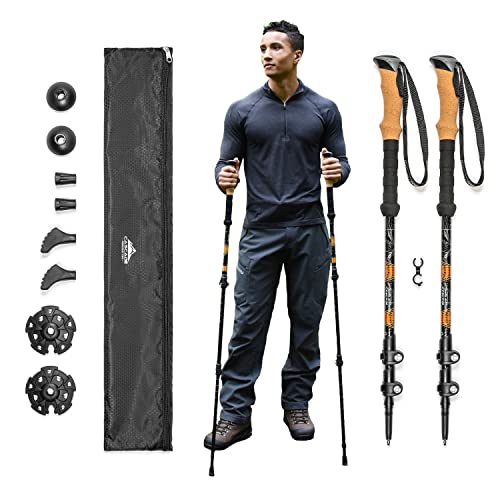
Cascade Mountain Tech Cork-Grip Poles
The category’s best seller earns it with range: 26 to 54 inches of quick-lock adjustment covers a child and a tall adult with the same set, and the 10-ounce 6061 aluminum shafts take real abuse. Cork grips over an extended EVA lower section handle sweaty climbs and quick choke-downs, and the accessory kit — carbide tips, rubber boots, snow and mud baskets, travel bag — is the most complete at this price.
Pros:
- Widest adjustment range in the group
- Cork-over-EVA grip combination at a budget price
- Complete four-season basket and tip kit included
- Proven durability record across huge sales volume
Cons:
- Collapses to 26 inches — long for small packs
- A shade heavier than the 7075 and carbon options
Best for: the default first poles — any height, any season, minimal spend.
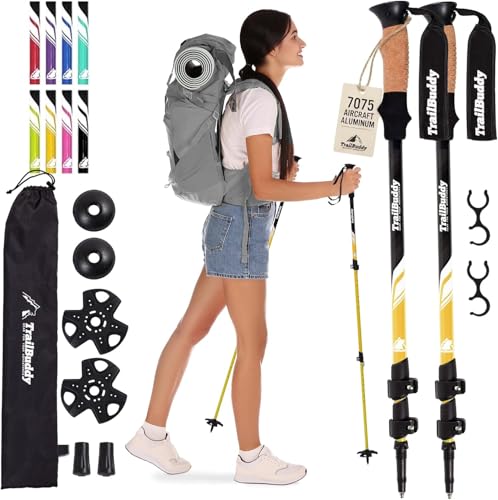
TrailBuddy Trekking Poles
TrailBuddy upgrades the metal: 7075 aluminum — the alloy used in aircraft structures — brings each pole to 9.7 ounces while staying tougher than standard 6061. The lever locks run one-handed, the padded straps and cork handles mold to shape, and the 24.5-inch collapsed length (21 inches disassembled) squeezes into a carry-on. The adjustment tops out at 54 inches, with plenty of room at the short end.
Pros:
- Stronger 7075 alloy at under ten ounces per pole
- One-hand lever locks, glove-friendly
- Cork grips with well-padded straps
- Packs shorter than most telescoping rivals
Cons:
- Costs a step above the entry poles
- Still longer folded than the tri-fold designs
Best for: regular hikers wanting lighter, stronger telescoping poles that travel well.
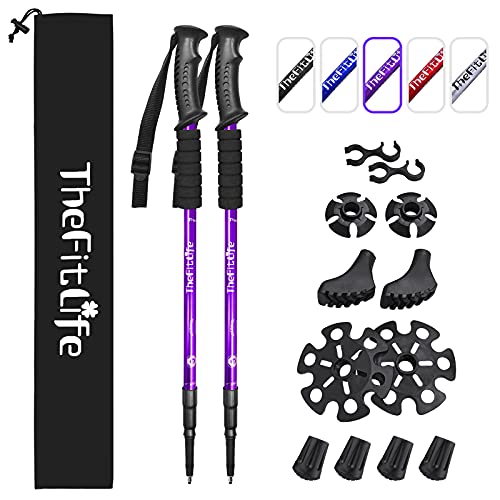
TheFitLife Antishock Poles
TheFitLife adds a spring: an antishock mechanism in each shaft absorbs impact before it reaches wrists and elbows, a genuine comfort feature on long rocky descents and for anyone with sensitive joints. The glove-friendly twist locks keep the shaft snag-free, each pole weighs 9.92 ounces, and the set extends to 51.2 inches, collapses to 25.6, and breaks down to 21.5 for packing. The full tip-and-basket kit comes along.
Pros:
- Spring antishock eases impact on wrists and elbows
- Clean shaft profile with no lever snag points
- Complete accessory kit at the lowest price here
- Under ten ounces per pole
Cons:
- Twist locks need two hands and occasional re-tightening
- Rubber grips run warm on sweaty summer climbs
Best for: joint-conscious hikers who want cushioning on a tight budget.
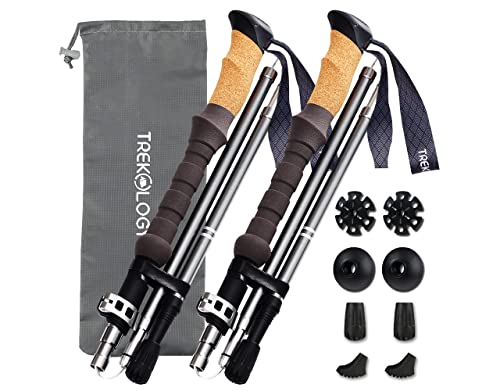
TREKOLOGY Trek-Z Tri-Fold Poles
The Trek-Z’s trick is disappearing: its tri-fold shafts collapse to 15 inches, small enough for a daypack side pocket or an airline personal item. It sells in two size bands, and the 100–120cm version weighs 10.4 ounces and is genuinely proportioned for shorter hikers rather than cut down. Metal flip locks with a secure stopper handle the fine adjustment.
Pros:
- Folds to 15 inches — smallest packed size in the group
- Dedicated 100–120cm size for shorter hikers
- Metal flip locks with positive stopper
- Aircraft-grade aluminum shafts
Cons:
- Adjustment band is narrower than telescoping designs
- Slightly heavier than the best telescoping poles
Best for: travelers and small-pack hikers who need poles to vanish when stowed.
TREKOLOGY Trek-Z Cork Grip
Same fold-to-15-inches frame, upgraded contact points: moisture-wicking cork replaces the standard handles, molding to your grip over the first few trips and staying dry where foam soaks through. At 11.5 ounces per pole it carries a small weight penalty for the nicer hands-on feel — a trade sweaty-palmed hikers make gladly.
Pros:
- Cork grips wick moisture and conform over time
- Same ultra-compact 15-inch fold as the standard Trek-Z
- Metal flip-lock adjustment
- Handles stay comfortable on multi-hour climbs
Cons:
- Heaviest poles in this comparison at 11.5 oz each
- Small premium over the standard grips
Best for: Trek-Z portability with the grip material serious hikers prefer.
Montana-Brand Foldable Poles
This Montana company solves sizing the plain way — two versions instead of one compromise: 100–120cm for hikers 5’8" and under at 9.95 ounces, 115–135cm for taller frames. Both fold to 15 inches on aircraft aluminum with metal flip locks and reinforced joints, in a choice of cork or EVA grips, tested in the Rockies by a team with a decade of customer history behind it.
Pros:
- True short version built for 5’8"-and-under hikers
- Choice of cork or EVA grips at purchase
- Folds to 15 inches with reinforced joints
- Long-established US-based support
Cons:
- Must pick the right size band up front
- Mid-range price for aluminum poles
Best for: shorter hikers who want poles proportioned for them, not shortened for them.
Covacure Tri-Fold Poles
Covacure delivers the 7075-alloy, tri-fold formula at the lowest price on this list. The telescopic-plus-foldable design adjusts freely within its band, EVA foam grips with sweat-absorbing texture keep hands planted, and the wrist straps hold the pole through slips. It skips the boutique touches, keeps the structural essentials.
Pros:
- Strongest-alloy shafts at an entry price
- Folding design at a telescoping-pole cost
- Grippy EVA foam handles
- Light enough for all-day carry
Cons:
- Hardware needs a tightness check before each hike
- Fewer included accessories than rivals
Best for: a first pair of folding poles without committing real money.
100% Carbon Fiber Poles
From the same Montana team, the weight-obsessed option: full 3K carbon-fiber shafts at 7.6 ounces per pole — roughly a quarter lighter than anything else here. The 24-to-55-inch flip-lock range covers short and tall hikers alike, cork grips with EVA extensions handle the sweat, and the weight savings compound with every one of the day’s thousand pole plants.
Pros:
- Lightest poles in the group by a wide margin
- Huge 24–55" adjustment range
- Cork grips with choke-down EVA extensions
- Established maker with responsive support
Cons:
- Carbon cracks rather than bends under hard pinching
- Highest price on the list
Best for: long-mileage hikers counting ounces across all-day pole swings.
GPTCAMP Folding Poles
GPTCAMP’s claim to a place here is its floor: the 31-inch minimum height suits hikers from 4’4" up, the shortest reach in the lineup and one of the few that genuinely fits shorter teens and petite adults. The poles fold to 17.3 inches, weigh 10.05 ounces each on aviation-grade aluminum, and carry a one-year warranty.
Pros:
- Fits hikers from 4’4" — rare in this market
- Compact 17.3-inch fold
- Aviation-grade aluminum at a budget price
- Backed by a one-year warranty
Cons:
- 51-inch maximum is short for tall hikers
- Less-known brand with a shorter record
Best for: the shortest hikers in the household, where other poles never go low enough.
Verdict
Best Overall: Cascade Mountain Tech. The most-bought poles in the category fit nearly every height, include every basket and tip you will ever need, and wear cork grips at a price the competition cannot argue with.
Best Value: TheFitLife Antishock. Spring cushioning, a complete accessory kit, and sub-ten-ounce poles for the least money here — the joint-friendly bargain.
Best Premium: 100% Carbon Fiber by the Montana brand. At 7.6 ounces per pole with cork grips and a 24-to-55-inch range, it is the set that makes every other pair feel heavy the moment you pick it up.
FAQ
What length trekking pole do I need for my height?
Hold the pole with the tip on the ground: your elbow should sit at ninety degrees. Roughly, hikers 5’1" and under want about 100cm, 5’2" to 5’7" about 110cm, 5’8" to 6’0" about 120cm. Set a few centimeters shorter for sustained climbs and longer for descents.
Are women-specific poles really different?
The real differences are shorter minimum lengths, slimmer grip diameters, and lighter shafts — all fit factors, not marketing colors. Any pole delivering those three fits a smaller hiker regardless of the label, which is how this list was chosen.
Cork, foam, or rubber grips?
Cork wicks sweat, molds to your hand, and damps vibration — best all-around. EVA foam is lighter and warmer in cold weather but absorbs sweat. Rubber insulates in winter and costs least, but runs hot and slick in summer heat.
Do I really need two poles?
For load-carrying, descents, and stream crossings, two poles balance the body and can shift meaningful load off the knees on downhills. A single pole helps balance but concentrates the work on one side. All the sets here ship as pairs.
One pole snapped its tip — are replacements available?
Carbide tips and rubber accessories on these poles are standard sizes and replaceable; several makers here include full spare kits and offer parts support. Keep the rubber boots on for pavement and rock slabs to save the carbide for dirt and snow.
This article may contain affiliate links; see our Affiliate Disclosure.