One product here is titled a small UPS for your router and modem. Its own bullet calls routers low-power equipment, and then gives you exactly one runtime figure: 15 minutes at 100 watts. A router draws about ten. The listing knows what a router is, says so in the same sentence, and still declines to tell you how long it will run one. Meanwhile the cheapest thing on this page promises several hours.


At a glance
| Product | What it publishes | Price tier | Link |
|---|---|---|---|
| Mini DC UPS | Several hours, and no battery capacity at all | Budget | |
| CHINTE Mini UPS | The only one naming its battery chemistry | Budget | |
| Shanqiu Mini UPS | 37Wh. The only watt-hour figure on this page | Budget | |
| CyberPower ST425 | UL listed, and a warranty that covers the battery | Mid-range | |
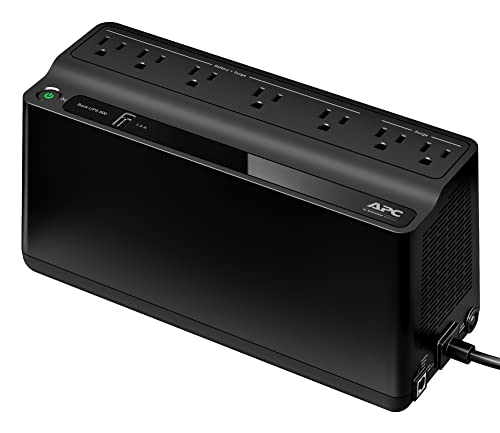
| APC BE425M | 15 minutes at 100W, on a router UPS | Mid-range | |
| SKE DC20000 | The biggest mAh here, with no voltage attached | Mid-range | |
| APC BE600M1 | Names its replacement battery part number | Premium | |
How to choose
An AC UPS converts your power twice for nothing
This is the fact that reorders the whole page. Your router runs on 12 volts DC, which is why it has a black brick on its cable turning your wall’s AC into DC. A traditional UPS holds a DC battery, and to power that brick it must invert its DC back up to AC, so the brick can drop it to DC again. Two conversions, both lossy, and the inverter burns power simply being switched on. A mini DC unit skips all of it and hands 12 volts straight to the router. That is why the big-brand boxes here talk in minutes and the small cheap ones talk in hours, and it is not because the small ones have bigger batteries.
mAh is not a measure of energy
The biggest battery number on this page is 20,000mAh, and it is meaningless on its own. Milliamp-hours only become energy when multiplied by voltage, so 20,000mAh at 3.7 volts is 74 watt-hours and the same figure at 1.2 volts is 24. Exactly one listing here publishes watt-hours, quoting 37Wh alongside its 10,000mAh, which incidentally tells you its cells run at 3.7 volts. Everyone else gives you the big number and keeps the multiplier. Divide watt-hours by your router’s wattage and you have your runtime in hours. There is no other way to work it out.
Check runtime at your load, not theirs
Both AC units here quote runtime at 100 watts, which is a desktop computer, not a router. Neither publishes a figure at 10 watts, which is what their titles are selling. Their own numbers are still useful though: 15 minutes at 100 watts works out to about 25 watt-hours of delivered energy, and 23 minutes gives roughly 38. Now compare that to a mini DC unit publishing 37 watt-hours for less money, and remember it delivers that without an inverter in the way.
The chemistry matters because a UPS never discharges
A backup sits plugged in at full charge, permanently, for years. That is the single worst way to work on a lithium-ion cell and the entirely normal way to work on a lithium iron phosphate one, which tolerates sitting full and survives far more cycles. One listing on this page names its chemistry as LiFePO4. Every other battery here is described as so many milliamp-hours, or in one case just as built-in batteries. On a device whose whole life is spent at 100%, the chemistry is not a detail.
Replaceable battery, or a disposable box
Every UPS battery dies, usually in three to five years, and then you find out whether you bought a product or a consumable. One listing here names the exact replacement part you will need and says the swap takes minutes, which is the most useful sentence on the AC side of this page. One rival warranties the battery itself for three years, which is unusual, because the battery is the part that wears out and therefore the part normally excluded. Not one mini DC unit mentions replacement at all.
Simulated sine wave, and who admits it
Cheaper AC units do not output a smooth sine wave; they output a stepped approximation. For a router’s switching adapter that is completely fine, and for some motors and audio gear it is not. Two listings here say simulated sine wave plainly. The two best-known brands on this page do not mention their waveform at all. The ones using the real word are telling you more.
Power over Ethernet is the quiet advantage
Two mini units here output PoE at 15 or 24 volts, sending power and data down a single Ethernet cable. If a security camera is part of what you are keeping alive, that means one cable to the camera instead of a cable and a power run. Neither AC unit can do it at any price, because an AC outlet is all they have to offer.
Mini DC UPS
The cheapest thing here by a distance and the only one to say plainly that it delivers several hours to a router, which is the right order of magnitude and the plain shape of the answer. Five outputs cover USB 5V, DC at 5, 9 and 12 volts, and PoE at 15 or 24, so most home network gear plugs in without an adapter. It takes anything from 85 to 265 volts in, which means it works anywhere in the world. The catch is large: it publishes no battery capacity in any unit, so several hours is a claim you cannot check.
Pros:
- Around half the price of any rival here
- Five outputs including PoE at 15 or 24 volts
- Wide 85 to 265 volt input; works on any mains
- LED capacity indicator; full protection set
Cons:
- No battery capacity published, in mAh or watt-hours
- No chemistry named; just built-in batteries
- PoE limited to 0.6A; DC 9V and 12V to 1A
Best for: the cheapest way to skip the inverter.
CHINTE Mini UPS
The only listing on this page that names its battery chemistry, and it names the right one. LiFePO4 is what you want in a box that will sit at full charge for the next five years, because that is the condition that quietly kills ordinary lithium-ion. Around that: PoE at 15 or 24 volts, DC at 5, 9 and 12, USB and USB-C, a red indicator so you can see at a glance that you are on battery, dimensions published to the hundredth of an inch, and a 12-month warranty. It gives capacity in mAh only, so you are left to work out the watt-hours.
Pros:
- LiFePO4 named; the right chemistry for permanent float charge
- PoE at 15 or 24 volts, plus DC, USB and USB-C
- Status light turns red on battery; capacity indicator
- Publishes its dimensions; 12-month warranty and cables included
Cons:
- Capacity in mAh only; no watt-hours
- Describes its battery as 10400mAh 18W, mixing two different things
- Supports devices to 2A; no replaceable battery mentioned
Best for: the only chemistry named on this page, and it is the right one.
Shanqiu Mini UPS
It publishes watt-hours. That sounds small and it is the single most useful number on this page, because 37Wh divided by a router’s ten watts is your runtime in hours, and no other listing here lets you do that sum. Printing both 10,000mAh and 37Wh also quietly tells you the cells are 3.7 volts. An aluminum housing helps it shed heat where rivals use plastic, output tops out at 60W across USB and DC at 5, 9 and 12 volts, and it works as an ordinary power bank too. Its opening bullet, about no standalone lithium batteries being sold with it, is a shipping notice that reads alarmingly on a battery backup.
Pros:
- Publishes 37Wh; the only watt-hour figure here
- Both mAh and Wh, so the cell voltage is derivable
- Aluminum housing; 60W maximum output
- Doubles as an ordinary USB power bank
Cons:
- Its first bullet appears to say no battery is included
- No chemistry named; no PoE output
- No warranty stated; no replaceable battery
Best for: the only listing you can do arithmetic with.
CyberPower ST425
The best-documented AC unit here and the cheapest of them. Its three-year warranty explicitly includes the battery, which is remarkable, because the battery is the component that wears out and therefore the component normally carved out of the cover. It is the only product on this page claiming UL listing and saying what that means, it names its output as a simulated sine wave rather than staying quiet about it, it publishes its plug type and cord length, and it splits its eight outlets four and four with transformer spacing. It never publishes a runtime figure at any load.
Pros:
- Three-year warranty that includes the battery
- The only UL listing claim here, with an explanation
- Names its simulated sine wave output plainly
- Eight outlets, transformer-spaced; plug type and cord length given
- 75,000 dollar connected equipment promise
Cons:
- Publishes no runtime at any load
- An inverter in the path; minutes, not hours, for a router
- Only four of the eight outlets have battery backup
Best for: the AC unit with the fewest gaps in its listing.
APC BE425M
A well-made box from the brand that defined the category, and a listing at war with its own title. It is sold as a small UPS for a router and modem; its one runtime figure is 15 minutes at 100 watts; and the same bullet calls routers low-power equipment. Work backwards and that figure implies roughly 25 watt-hours of delivered energy, which is less than a mini DC unit costing a third less. What you do get is six well-spaced outlets, wall mounting, a three-year warranty and 75,000 dollars of equipment protection, stated with the number attached.
Pros:
- Six well-spaced outlets; four with battery backup
- Wall-mountable and genuinely compact
- Three-year warranty; 75,000 dollar equipment protection, quantified
- Handles a desktop as well as network gear
Cons:
- Runtime given only at 100W, on a product sold for routers
- Its own bullet calls routers low-power in the same breath
- No replaceable battery mentioned; no waveform named
- Roughly 25 watt-hours implied; less than cheaper DC rivals
Best for: a desk, rather than the router in its title.
SKE DC20000 Plus Altair
The largest battery number on this page, 20,000mAh, published without the one thing that would make it mean something. No voltage, no watt-hours, so the figure could describe anything from about 24 to about 74 watt-hours depending on cells nobody names. It is a proper DC unit, so it skips the inverter and should genuinely run for hours, with 5, 9 and 12 volt DC outputs plus USB and Type-C, automatic voltage regulation, and an LED showing remaining capacity. It is also the most expensive mini unit here, and the only one whose headline spec cannot be converted into time.
Pros:
- The largest published capacity among the DC units
- DC out at 5, 9 and 12 volts, plus USB and Type-C
- Automatic voltage regulation built in
- LED capacity indicator; slim enough for a network cabinet
Cons:
- 20,000mAh with no voltage or watt-hours; unconvertible to runtime
- No chemistry named; no PoE output
- The dearest mini unit here; no warranty stated
Best for: the biggest number, if you accept you cannot read it.
APC BE600M1
It names the replacement battery by part number and tells you the swap takes minutes, which turns a disposable box into a product you keep. That is the best thing any AC unit here does, because every UPS battery dies eventually and most listings leave you to discover what happens next. Twenty-three minutes at 100 watts is the longest AC runtime here, seven outlets with five on battery, and a 1.5A USB port that keeps working through an outage. Curiously, its equipment protection is mentioned without the dollar figure its cheaper sibling prints.
Pros:
- Names the replacement battery part; swap takes minutes
- 23 minutes at 100W; the longest AC runtime here
- Seven outlets, five with battery backup
- 1.5A USB port that works during an outage
Cons:
- Runtime given only at 100W, on a listing naming routers
- Its equipment protection drops the figure its cheaper sibling gives
- An inverter in the path; minutes for a router, not hours
- The highest price here
Best for: anything that genuinely needs a mains socket.
The verdict
This page is two products under one name. If all you want is the internet staying up, an AC unit converts DC to AC so your router’s adapter can convert it back, and you pay for that in minutes of runtime. A DC unit hands the router its 12 volts directly. That is the whole decision, and it happens to favor the cheap end.
Best overall: CHINTE Mini UPS. It is the only product on this page that names its battery chemistry, and LiFePO4 is exactly right for a box that will sit at full charge for years, which is the condition that quietly destroys ordinary lithium-ion. It hands your router 12 volts with no inverter in the way, adds PoE at 15 or 24 volts so a camera runs off one cable, publishes its own dimensions, and comes with a year of warranty. Cheaper than every AC unit here and it will outlast all of them on a router by hours.
Best value: Mini DC UPS. Half the price of anything else and built on the same sound principle: no inverter, straight DC to the router. Five outputs including PoE cover almost any home network device without an adapter, and the 85 to 265 volt input means it works on any mains anywhere. Be clear about what you are accepting: it publishes no capacity in any unit, so its several hours claim is the one thing here you cannot verify.
Best premium: APC BE600M1. Buy it if you actually need mains sockets, for a desktop, a NAS or a safe shutdown, because that is a real job and no DC unit does it. It is the only AC unit here that names its replacement battery by part number, which is what stops a UPS becoming landfill in four years, and its 23 minutes at 100 watts is the longest on the page. For a router by itself, it is the wrong tool at the highest price.
FAQ
Why do the cheap ones last longer?
Because they skip the inverter. Your router wants 12 volts DC and a mini UPS gives it 12 volts DC. An AC unit converts its battery up to mains so your adapter can convert it back down, losing power both ways and burning more just being on.
How do I work out my runtime?
Divide watt-hours by your device’s wattage. A 37Wh unit runs a 10W router for a bit under four hours. Only one listing here publishes watt-hours, which is why only one can be checked.
Is 20,000mAh better than 10,000mAh?
Unknowable without the voltage. Milliamp-hours only become energy when multiplied by volts, so 20,000mAh could be 24 watt-hours or 74. The listing with the biggest number gives you no voltage at all.
Does battery chemistry matter?
More here than almost anywhere, because a backup sits at 100% charge permanently, which is the worst case for lithium-ion and unremarkable for lithium iron phosphate. One listing names LiFePO4. The rest name nothing.
When should I buy an AC unit instead?
When something genuinely needs a mains socket: a desktop, a NAS, or a safe shutdown. Those are real jobs a DC unit cannot do. Just do not buy one for a router alone and expect hours.
This article may contain affiliate links; see our Affiliate Disclosure.