Four chargers here quote how full a Samsung Galaxy S26 Ultra gets in thirty minutes. The answers are 65 percent, 70, 75 and 80. Same phone, same half hour, four numbers. And the two claiming the least are the 65 watt chargers, while the two claiming the most are 60 watt. That is not a measurement error. It is what happens when the phone, not the charger, is deciding.


At a glance
| Product | Is it a cable? | Price tier | Link |
|---|---|---|---|
| 6FT USB C Cable | Yes. The only one, and it names its E-marker chip | Budget | |
| 65W 3-Port GaN | No. A charger, with no cable at all | Budget | |
| 65W + 6FT Cord | Charger plus cable. “6X faster than 5W” | Budget | |
| 60W 2-Pack | Charger plus cable. 80% in 30 min, it claims | Mid-range | |
| Belkin 65W | Charger plus cable. Names the device for every claim | Mid-range | |
| 65W Retractable | The cable is built in and winds away | Mid-range | |
| 65W 3-Port Kit | Charger plus four cables. Its arithmetic is off | Premium | |
How to choose
One result in this cable search is a cable
The search says USB-C cable. Nine of the ten results are wall chargers, most with a cable thrown in and two with no cable at all. Exactly one product here is what was asked for: a cord, on its own, and it happens to be the cheapest thing on the page. If you have a charger already and you need a lead, this page is nine-tenths noise.
Your phone decides the speed, not the charger
Look again at those thirty-minute claims. 65 percent, 70, 75, 80, all for the same Galaxy S26 Ultra, and the higher-wattage chargers come out lower. Every phone has its own ceiling and it will not draw a watt above it no matter what you plug in. Once you are past that ceiling, extra wattage buys you nothing on the phone and only matters if you also want to charge a laptop. That is the real reason to go past 45 watts, and it is not speed.
Five amps needs a chip, and only one listing mentions one
A USB-C cable carries 3 amps by default. To carry 5, it has to contain a small identifying chip that tells the charger it can take the current, and without that chip the charger stays at 3 whatever the packaging says. Three listings here advertise 5 amp, 100 watt cables. None of them mentions the chip. The one product that names an E-marker chip is the standalone cable, rated at a sober 65 watts.
480 megabits is the confession, not the boast
Three listings proudly publish a data speed of 480 megabits per second. That is USB 2.0, the speed of a cable from a quarter of a century ago, and it tells you these cords carry power plus the two oldest data wires and nothing else. For charging that is completely fine and arguably better, since fewer wires means a thinner, more flexible cable. For moving a video off your phone it is close to useless. The impressive-sounding number is the floor.
Check the multiplier against the two wattages
One 65 watt charger here says it is six times faster than the original 25 watt charger. Sixty-five divided by twenty-five is 2.6. Another 65 watt charger on this same page says it is six times faster than a 5 watt charger, which is understating it, since that ratio is thirteen. Same claimed multiple, two different baselines, one of them arithmetically impossible. Whenever you see a multiplier, find the number it is multiplying.
A time claim needs a device attached
Charging speed depends entirely on which phone is plugged in, so a time with no device named is not a specification. One brand here does it properly throughout, naming the exact phone for each figure and going as far as naming the specific Chromebook model behind its laptop claim. Others name the phone and its battery size, which is better still. The listings to distrust are the ones offering a percentage and a stopwatch with nothing attached.
Read past the first word of the title
One charger here opens its title with Samsung and then never mentions Samsung again except as a device it can charge. It is a perfectly decent three-port GaN charger at the lowest charger price on this page. The word at the front of the title is doing compatibility work rather than telling you who made it, which is worth a second look before you assume you are buying a first-party accessory.
6FT USB C Cable
The only cable in a cable search, and the only listing on this page that names the component that makes fast charging legal: an E-MARK chip, the identifier that tells a charger how much current the cord can take. It is rated at 65 watts, which is a sober number that its chip can actually support, where three bundled cables here claim 100 watts and 5 amps without mentioning any chip at all. TPE jacket, six feet, and the connector is tested to 6,000 plug cycles.
Pros:
- The only actual cable in this search
- Names its E-MARK chip; nothing else here does
- 65W rating it can genuinely support
- 6,000 plug cycles tested; the lowest price here
Cons:
- No charger; you need one already
- TPE rather than braided
- Publishes no data speed
Best for: the thing this search actually asked for.
65W 3-Port GaN
Sixty-five watts across three ports in a folding gallium nitride block, at the lowest charger price on this page by a distance. It supports PD 3.0 with PPS, which is the protocol Samsung’s fastest charging actually uses, and it will run a phone, a tablet and a laptop off one socket. Its listing is clear about the compatibility tiers, noting which older Galaxy models cap at 25 watts. Its title starts with Samsung; its bullets never mention Samsung as the maker, and no cable comes in the box.
Pros:
- 65W across three ports; the cheapest charger here
- GaN, foldable prongs, genuinely pocketable
- PD 3.0 with PPS; the protocol that matters for Samsung
- Lists which older models cap at 25W
Cons:
- No cable at all, in a cable search
- Title leads with Samsung; the bullets do not
- Three ports share the 65W between them
Best for: a cheap three-port block, if you own cables.
65W + 6FT Cord
A 65 watt block with a six foot cable, and the cable is the real part of the listing: 60 watts, reversible, tested to more than 20,000 bends, with 480 megabit data. The charger claims to take an S26 Ultra to 70 percent in half an hour and describes itself as six times faster than a 5 watt charger, which is the one multiplier on this page that understates rather than overstates. Note the mismatch: a 65 watt charger paired with a 60 watt cable, so the cable is the ceiling.
Pros:
- Its multiplier understates rather than exaggerates
- Cable tested to 20,000+ bends
- Names the phone behind its time claim
- 12-month warranty; charger and cable together
Cons:
- 65W charger with a 60W cable; the cable caps it
- 480Mbps data; a charging cable, not a data one
- Single port
Best for: one phone, one socket, real numbers.
60W 2-Pack
Two chargers and two cables, so one lives by the bed and one in the bag, and it is the only listing here naming three certification bodies rather than describing safety in adjectives. It uses PPS, which is the protocol Samsung’s fastest charging depends on, and claims 80 percent in thirty minutes on an S26 Ultra with the battery size published. That is the highest of the four thirty-minute claims on this page, from one of the two lowest wattages, which tells you plenty about all four.
Pros:
- Names FCC, CE and UL certifications
- Two chargers and two 6.6ft cables
- PPS support; publishes the phone’s battery size
- Stops charging automatically at full
Cons:
- Claims 5A cables without naming an E-marker chip
- 60W; below the 65W blocks here
- Single port per charger
Best for: two sockets covered, with the certifications named.
Belkin 65W
The only listing here that attaches a device to every single time claim, and does it to an unusual degree: an iPhone 16 to 50 percent in 28 minutes, a Samsung S25 in 33, and for the laptop figure it names the exact Chromebook model and generation. That is what a charging claim looks like when someone measured it. Sixty-five watts is enough for a MacBook, the prongs fold for travel, and a cable is included. The listing also tells you that cable is PVC rather than dressing it up as braided.
Pros:
- Names the exact device for every time claim
- Names the specific laptop model and generation
- Foldable prongs; compact and travel ready
- Real that the included cable is PVC
Cons:
- Single port; no simultaneous charging
- PVC cable rather than braided
- Costs more than two-charger kits here
Best for: numbers with a device attached to them.
65W Retractable
The cable is built in and winds back into the block, which solves the actual problem with travel chargers: the cable, which lives somewhere else and is never there. It is 31.5 inches, enough for a nightstand, and two more ports let you charge three things at once. Gallium nitride keeps it small, the prongs fold, and there is a display on the front showing live total wattage, so you can see what is actually being drawn rather than what the box claims.
Pros:
- Cable retracts into the block; nothing to lose
- Live wattage display; see what is really drawn
- Three devices at once; GaN 3 and folding prongs
- Supports PD, QC and PPS
Cons:
- 31.5 inches; short if the socket is behind furniture
- A built-in cable cannot be replaced when it wears
- 65W shared across three outputs
Best for: travel, and never packing a cable again.
65W 3-Port Kit
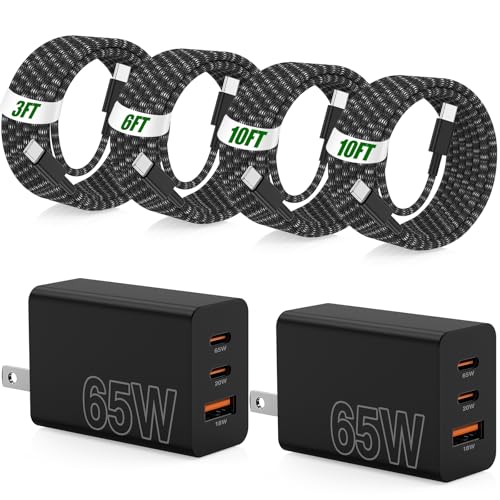
The most hardware here by a distance: two three-port blocks and four braided cables at 3, 6, 10 and 10 feet, with an 18 month warranty, supporting PD 3.1 and PPS. If you want to wire a whole house in one purchase, this is the box. The trouble is the maths. It claims to be six times faster than the original 25 watt charger, and sixty-five divided by twenty-five is 2.6. It also quotes 65 percent in thirty minutes, the lowest figure on this page, from the highest wattage on this page.
Pros:
- Two blocks and four braided cables at four lengths
- Three ports each; PD 3.1 and PPS supported
- 18 month warranty; up to six devices at once
- A 10 foot braided cable is genuinely useful
Cons:
- Claims six times faster than 25W; the ratio is 2.6
- Its 30-minute figure is the lowest here
- 480Mbps data on a 100W cable claim
Best for: equipping every room at once.
The verdict
One of these ten is a cable. The rest are chargers, and the four that time themselves against the same phone disagree by fifteen percentage points with the higher wattages losing, because the phone sets its own ceiling. Then the specs invert: 100 watts and 5 amps are claimed without the chip that permits them, while 480 megabits is published as a feature when it is the floor.
Best overall: 6FT USB C Cable. It is the only cable on a page of chargers, and it is the only product here that names an E-marker chip, which is the component that tells a charger how much current a cord can safely carry. Its 65 watt rating is sober enough that the chip can back it, where three bundled cables here claim 5 amps and 100 watts and mention no chip at all. Six feet, TPE, 6,000 plug cycles, and the lowest price on the page.
Best value: Belkin 65W. Every time claim comes with the device attached: an iPhone 16 to half in 28 minutes, a Samsung S25 in 33, and a named Chromebook model and generation for the laptop figure. Nobody else on this page is that specific, and it is the difference between a measurement and a slogan. Sixty-five watts handles a laptop, the prongs fold, a cable is included, and the listing tells you that cable is PVC rather than pretending.
Best premium: 65W Retractable. The cable is inside the charger and winds away, which fixes the one thing that actually goes wrong with travel charging. Two more ports mean three devices at once, gallium nitride keeps it pocket-sized, and a display on the front shows the live total wattage, which on a page this loose about numbers is a genuinely useful thing to be able to see for yourself.
FAQ
Why do the 30-minute claims disagree?
Because the phone sets the limit. Four chargers here quote the same Galaxy S26 Ultra over the same half hour and give 65, 70, 75 and 80 percent, with the 65 watt chargers coming out below the 60 watt ones. Past your phone’s ceiling, extra watts do nothing.
Do I need a 100W or 5A cable?
Not for a phone, and be careful what you are buying. USB-C carries 3 amps unless the cable holds a chip that says otherwise. Three listings here claim 5 amps and never mention that chip. The one that names an E-marker is rated at a sober 65 watts.
Is 480Mbps good?
It is the minimum. That figure is USB 2.0 speed and means the cord carries power and the two oldest data wires. Perfectly good for charging, close to useless for moving a video, and three listings here publish it as though it were an achievement.
How many watts do I actually need?
Enough for your phone’s ceiling, which most modern Samsung phones reach at 45. Going higher only helps if a laptop shares the charger. The evidence is on this page: the 60 watt chargers claim faster phone charging than the 65 watt ones.
Should I trust a “6X faster” claim?
Find the baseline. One 65 watt charger here claims six times faster than 25 watts, which works out at 2.6. Another claims six times faster than 5 watts, which is actually thirteen. Same multiplier, opposite clarity.
This article may contain affiliate links; see our Affiliate Disclosure.