A channel strip is three things in one box: a preamp, a compressor and an EQ. Two of the five results in this search are that. One is a twelve-input mixer, one is a four-channel preamp with no EQ anywhere, and one is a metal tube the size of your thumb with a single fixed gain setting and no knobs at all.


At a glance
| Product | Preamp, compressor, EQ? | Price tier | Link |
|---|---|---|---|
| TEYUN Q2 | Preamp only, at one fixed gain. Cheapest here | Budget | |
| Behringer XENYX 1204USB | All three, twelve times over. It is a mixer | Budget | |
| Presonus StudioChannel | All three. Tube preamp, VCA compressor | Mid-range | |
| ART Pro Channel II | All three, and all three are tube | Mid-range | |
| Universal Audio 4-710d | Preamp and compressor. No EQ at all | Premium | |
How to choose
Three stages, in that order, or it is not a strip
The preamp brings a microphone up to a usable level. The compressor evens out the difference between a whisper and a shout. The EQ shapes the tone. A channel strip is those three in one signal path, arranged deliberately, and that is why people buy them instead of three separate boxes. Two products here have all three. One has a preamp and a compressor and simply no EQ, at the highest price on this page. One has a preamp and nothing else.
Where the tubes are is the whole sound
Two real channel strips here and they are built on opposite philosophies. One puts a tube in all three stages: tube preamp, tube compressor, tube EQ. The other puts a tube in the preamp only, with separate gain and drive controls so you can push it, and then hands the compression to a solid-state circuit. Those are two entirely different signals. Tube throughout is warm and colored everywhere. Tube at the front and clean afterwards colors the source and then controls it accurately.
Optical and VCA compressors do not do the same job
One strip here offers a compressor you can switch between optical and tube modes. The other gives you a VCA compressor and names every control it has: threshold, ratio, attack, release, makeup gain, plus auto and soft settings. Optical compression is slow and rounded and forgiving, which flatters a vocal. VCA is fast and precise and does exactly what you set. The listing that names seven controls is telling you it expects you to use them.
The unglamorous controls are the ones you will use daily
One strip here lists the things nobody puts on a box front and everyone needs on a vocal: an 80Hz high pass filter to remove rumble and the thud of plosives before anything else touches them, a 20dB pad for when a singer is loud, and phase invert. Better still, it has a switch to put the EQ before or after the compressor, which changes what the compressor is reacting to. That is a genuinely professional decision offered on a switch.
A mixer is twelve channel strips and a compromise
The mixer in this search has a preamp, a compressor and an EQ on every one of its channels, plus a USB interface, for less than a single boutique channel costs. That is real and it is the real cheap answer. What you give up is depth: the compressors are simplified, the EQ is a fixed three-band rather than parametric, and there is no tube anywhere in it. Twelve adequate channels or one deep one. For a single voice, the deep one wins; for a podcast with four guests, it does not.
Watch a listing count its own specs twice
That mixer runs to two bullets, and the second one states a maximum input level of plus 12 dBu and then, in the same sentence, a maximum input level of 30 dBu. Both figures cannot describe the same thing. Elsewhere on this page, the most expensive product in the search has two bullets total, one of which describes four channels of preamp feeding eight channels of conversion. At these prices the listing should be doing more work than this.
A booster is not a preamp stage
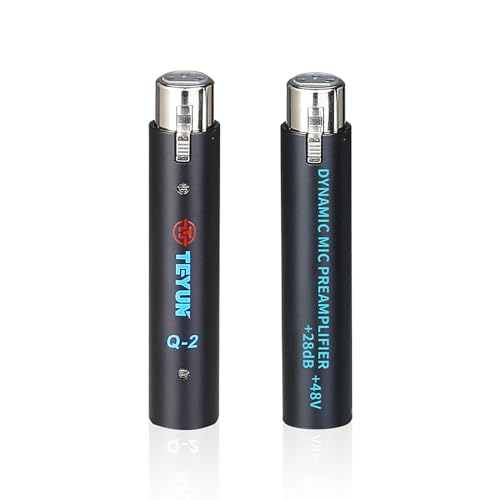
The cheapest thing here is an inline booster: a metal barrel that sits between a quiet dynamic or ribbon microphone and your interface and adds a fixed 28dB. It has no knob, because there is nothing to set. It solves one specific problem very well, which is that dynamic mics need more gain than cheap interfaces can give without hissing, and it does that by adding clean gain before the noisy stage. It is a useful thing to own. It is not a channel and it is not shaping anything.
TEYUN Q2
A thumb-sized metal barrel that plugs between your microphone and your interface and adds a fixed 28dB of clean gain, powered by the 48V phantom your interface already supplies. That is the entire product and it addresses a real, common frustration: a dynamic or ribbon mic that is too quiet, forcing you to wind an interface’s preamp to the top where it starts hissing. This adds the gain before that stage instead. There is no knob, no compressor and no EQ.
Pros:
- Fixes quiet dynamic and ribbon mics properly
- Adds gain before your interface’s noisy stage
- Runs on phantom power you already have
- Pocketable metal build; a fraction of everything here
Cons:
- No compressor and no EQ; not a channel strip
- Fixed 28dB; nothing to adjust
- Needs 48V phantom to work at all
Best for: a quiet dynamic mic, not a channel.
Behringer XENYX 1204USB
Not a channel strip, but twelve of them at once and cheaper than any single strip here. Every channel gets a mic preamp, a compressor and a three-band EQ the maker calls British-voiced, and a USB interface is built in so the whole thing is also your soundcard. For anyone recording more than one voice, that arithmetic is hard to argue with. The compromises are depth rather than function: simplified compressors, fixed EQ bands, no tube. Its two bullets manage to state a maximum input level twice, at two different figures.
Pros:
- Preamp, compressor and EQ on all twelve channels
- USB interface built in; it is your soundcard too
- Cheaper than any single strip on this page
- Low noise, high headroom analog design
Cons:
- States two different maximum input levels in one sentence
- Fixed three-band EQ; simplified compressors
- No tube anywhere; two bullets in the whole listing
Best for: several voices at once, on a budget.
Presonus StudioChannel
A real channel strip that tells you everything it has. A Class A vacuum tube preamp with separate tube gain and tube drive, so you choose how hard to push the valve rather than getting whatever it gives you. Then a variable VCA compressor with threshold, ratio, attack, release, makeup gain and auto and soft options, all named. Then a three-band parametric EQ, with a switch to put it before or after the compressor. An 80Hz high pass, a 20dB pad, phase invert, and an analog VU meter reading gain reduction or output.
Pros:
- Names all seven compressor controls
- Separate tube gain and tube drive; you choose the push
- EQ switchable before or after the compressor
- 80Hz high pass, 20dB pad, phase invert, VU meter
Cons:
- Tube in the preamp only; the compressor is solid state
- Three-band EQ rather than four
- One channel; nothing here scales
Best for: one voice, with every control on the front.
ART Pro Channel II
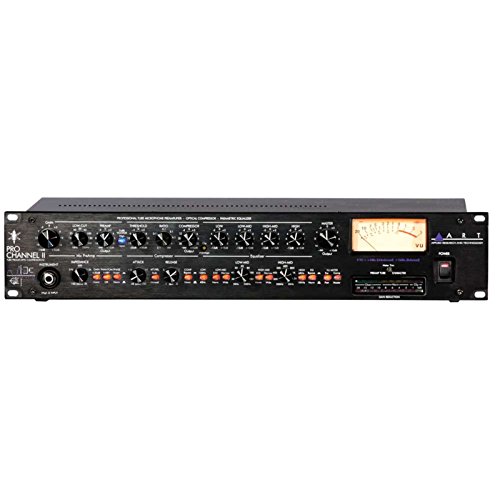
Tube in all three stages, which makes it the only genuinely all-valve signal path in this search: tube mic pre, tube EQ, and a compressor you can switch between optical and tube modes. That switch is the interesting one, because optical and tube compression behave differently and having both in one box is a real choice rather than a setting. Precision detented pots mean you can return to a setting exactly, and the VU meter reads at the preamp output, the compressor output or the main out, so you can see where your level went.
Pros:
- Tube in all three stages; a full valve path
- Compressor switches between optical and tube
- Detented pots; settings are repeatable exactly
- VU meter selectable across three points
Cons:
- Names none of its compressor controls
- Four bullets; the listing tells you very little
- No high pass, pad or phase invert mentioned
Best for: a valve sound at every stage.
Universal Audio 4-710d
Four channels of preamp and compressor with a tone blending knob that sweeps between tube and solid-state character rather than making you choose, which is a genuinely elegant answer to the argument the rest of this page is having. Add 24-bit, 192kHz conversion across eight channels and it is a front end for a whole session, not a voice. Two things to weigh: there is no EQ anywhere in it, so it is not a channel strip, and its listing runs to two bullets at ten times the price of a full strip here.
Pros:
- Tone blending knob sweeps between tube and solid state
- Four channels of preamp with compression
- 24-bit/192kHz conversion across eight channels
- A complete front end for a live session
Cons:
- No EQ at all; not a channel strip
- Two bullets, at the highest price in the search
- Four channels of things you may not need
Best for: tracking a band, not shaping a vocal.
The verdict
Preamp, compressor, EQ. Two of these five have all three, one has all three twelve times over inside a mixer, one is missing the EQ at the highest price here, and one is a booster with no controls. Among the two real strips, the question is simply where you want the valve: in every stage, or only at the front.
Best overall: Presonus StudioChannel. It is a complete strip and it tells you so: a Class A tube preamp with separate gain and drive, a VCA compressor with all seven of its controls named, and a three-band parametric EQ. The details are what sell it. An 80Hz high pass kills rumble and plosives before anything else touches them, a 20dB pad handles a loud singer, and a switch puts the EQ before or after the compressor, which changes what the compressor hears.
Best value: Behringer XENYX 1204USB. Twelve channels of preamp, compressor and EQ, plus a USB interface so it is your soundcard as well, for less than one boutique channel. That is the real cheap answer and it is a good one, particularly for more than one voice. Accept what you are trading: simplified compressors, a fixed three-band EQ, no valve anywhere, and a listing careless enough to publish two different maximum input levels in one sentence.
Best premium: ART Pro Channel II. The only fully valve path in this search, with a tube in the preamp, the EQ and the compressor, and that compressor switches between optical and tube modes, which is two different characters in one box rather than one opinion. Detented pots mean you can find a setting again exactly, and the VU meter reads at three points so you can see where your level went. Its listing tells you almost nothing; the box tells you plenty.
FAQ
What actually is a channel strip?
A preamp, a compressor and an EQ in one signal path, in that order. Two of the five results here are that. One is missing the EQ, one is a mixer, and one is an inline booster with no controls.
Tube or solid state?
Both real strips here answer differently. One has a valve in all three stages, so the color is everywhere. The other has a valve in the preamp with separate gain and drive, then a clean VCA compressor, so it colors the source and then controls it accurately.
Optical or VCA compression?
Optical is slow and rounded and forgiving, which suits vocals. VCA is fast and precise and does what you set. One strip here switches between optical and tube modes; the other gives you a VCA with threshold, ratio, attack, release and makeup all named.
Is a mixer good enough?
For several voices, often yes. The mixer here has a preamp, compressor and EQ on twelve channels plus a USB interface for less than one strip. You lose depth: simplified compressors, fixed EQ bands, no valve.
What does an inline booster do?
Adds fixed clean gain in front of your interface, so a quiet dynamic or ribbon mic does not force you to wind the interface’s preamp up into its hiss. It runs on phantom power, has no knob, and shapes nothing.
This article may contain affiliate links; see our Affiliate Disclosure.