One crate here says Airline Approved in its title and Airline Friendly in its first bullet, where it adds that it meets most airline cargo specifications. Most. Another says Airline Approved in the title and most airline cargo specifications in the bullet underneath. That word is doing an enormous amount of work, and it is there because no airline approves a crate.


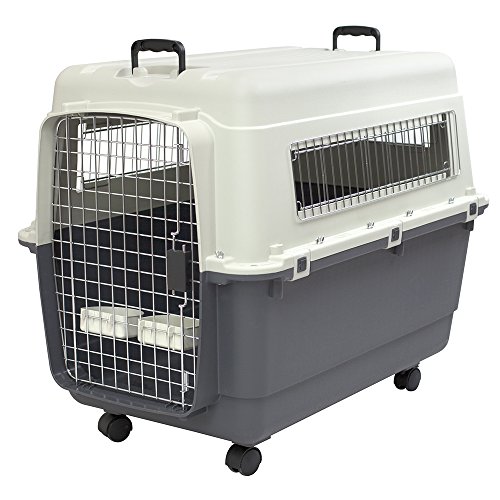


At a glance
| Product | What it actually claims | Price tier | Link |
|---|---|---|---|
| Petmate Vari 28″ | “Airline-friendly.” Same interior as the Sky, for less | Budget | |
| Elevon L | “Approved” in the title, “friendly” in the bullet | Budget | |
| SportPet Medium | Cites the 51st Edition. The only versioned standard here | Budget | |
| Petmate Sky 28″ | IATA, plus the paperwork kit. Calls a Pomeranian 20-30 lbs | Budget | |
| SportPet X-Large | Its own numbers leave a quarter inch of length | Mid-range | |
| SportPet XXX-Large | A 44 inch dog in a 44 inch crate. No margin at all | Premium | |
| Petmate Ultra Vari 48″ | 90-125 lbs, and only an exterior measurement | Premium | |
How to choose
No airline approves a crate
Read what these listings actually say rather than what their titles promise. Airline-friendly. Meets most airline cargo specifications. Airline compliant. Not one of them says a named airline has approved anything, because airlines publish their own requirements and check the crate at the counter on the day. The word most is an admission that some airlines will say no. Your airline’s own page is the only document that matters, and it is free to read before you spend anything.
One seller cites the actual document
The claim worth having appears on three crates from one brand, and it is specific: compliant with the standards specified in the 51st Edition of the IATA Live Animal Regulation. That is a named document with an edition number, which means somebody can check it. Everything else here offers IATA requirements without a version, or airline specifications without an airline. A standard you can look up is a different kind of claim from a standard you cannot.
The requirement is that your dog can stand and turn round
Every airline asks the same question and it is about geometry, not weight: can the animal stand up, turn around and lie down naturally. That is why the useful listings give you two sets of numbers, the dog’s dimensions and the crate’s interior, so you can subtract one from the other. One brand does exactly that on every size. The other sizes its crates by pounds, which does not tell you whether a long low dog can turn round in one.
Do the subtraction, because the margin disappears
Take the brand that publishes both figures and work through its range. Its medium crate takes a dog up to 23 inches long in a 24.25 inch interior, so there is an inch and a quarter spare. Its X-large takes a 32 inch dog in a 32.25 inch interior, which is a quarter of an inch. Its XXX-large takes a 44 inch dog in a 44 inch interior, which is nothing at all. The bigger the crate, the tighter its own arithmetic gets, and turning round needs room the numbers no longer have.
Weight is the wrong unit, and one listing proves it
A crate on this page has a bullet headed spacious interior for medium dogs, then calls itself a small dog kennel in the same sentence, then says it suits a Pomeranian or similar, then gives a range of 20 to 30 pounds. A Pomeranian weighs a handful of pounds. Four size signals, one bullet, and the breed example is out by a factor of four. Measure your dog standing: nose to tail, and floor to the top of the head or ears.
The stickers and the bowl are requirements, not extras
Airlines want Live Animal labels on the crate, a water dish reachable from outside, and usually absorbent bedding. Two brands here include that kit and one does not. One ships four Live Animal labels and two dishes; another ships two stickers, a food and water cup, ID stickers and an absorbent pad. The crates without them are cheaper and you will be buying the difference separately, in a hurry, the week before you fly.
The same box costs less without the paperwork
One brand sells two 28 inch crates here. Their interiors are 24.2 by 18.2 by 19.5 and 24.25 by 18.25 by 19.5, which is the same box within a rounding error, and both are rated 20 to 30 pounds. The cheaper one is called airline-friendly and comes with nothing. The dearer one says it meets IATA requirements, is made in the USA from 90 percent recycled plastic, and includes the sticker and bowl kit. That gap is what you are actually paying for.
Petmate Vari 28″
The same box as the brand’s dearer 28 inch kennel, with an interior of 24.2 by 18.2 by 19.5 against the other’s 24.25 by 18.25 by 19.5 and the identical 20 to 30 pound rating, for meaningfully less. It has four-sided ventilation, tamper-proof holes for the zip ties airlines want on the door, and a stay-dry moat that pulls accidents away from the dog. What it does not have is the IATA wording its sibling carries, the Live Animal stickers, the bowl, the pad, or a country of manufacture.
Pros:
- Same interior as the dearer 28 inch kennel, for less
- Tamper-proof zip tie holes; four-sided ventilation
- Stay-dry moat pulls accidents away from the dog
- Publishes its interior dimensions
Cons:
- Airline-friendly, where its sibling says IATA
- No Live Animal stickers, bowl or absorbent pad
- Sized by weight; no country of manufacture given
Best for: the same crate at home, without the flying kit.
Elevon L
A perfectly serviceable plastic crate with reinforced steel wire, fold-down handles, four-sided ventilation, a stay-dry moat and built-in storage for identification, in three sizes with all their dimensions published. It is the clearest example of the language problem on this page: its title says Airline Approved and its own second bullet says Airline Friendly, meets most airline cargo specifications. Those are two different promises about the same crate, one on top of the other.
Pros:
- Publishes dimensions for all three sizes
- Reinforced steel wire; fold-down handles
- Built-in storage for identification papers
- Stay-dry moat and four-sided ventilation
Cons:
- Title says Approved; the bullet says Friendly, and most
- No IATA claim of any kind
- No Live Animal labels, bowls or pad included
Best for: car travel and the vet, where the wording does not matter.
SportPet Medium
The cheapest crate here citing a specific edition of a specific standard, and the size where its own arithmetic is comfortable: a dog up to 23 inches long and 15 high, in an interior of 24.25 by 18 by 17, which leaves real room to turn. It has wheels for the terminal, a carry handle, four Live Animal labels, two dishes, tie-down holes and reinforced metal hardware, and it splits into two pieces for storage. A French Bulldog is its example, which is a breed that matches its numbers.
Pros:
- Cites the 51st Edition of the IATA regulation
- Publishes dog dimensions and interior dimensions both
- An inch and a quarter of length margin; room to turn
- Four Live Animal labels, two dishes, wheels, collapsible
Cons:
- Medium only; 23 inches of dog is the ceiling
- Wheels are removable, which is a step before you fly
- Assembly needs the supplied bolts and nuts
Best for: a medium dog, with the standard named.
Petmate Sky 28″
The crate that arrives ready to check in. It comes with two Live Animal stickers, a food and water cup, ID stickers and an absorbent pad, which are the things airlines ask for and you would otherwise be sourcing separately the night before. It claims IATA requirements rather than airline friendliness, has 360-degree ventilation and tie-down holes, and is made in the USA from plastic with at least 90 percent recycled content. Its size bullet calls itself both medium and small and offers a Pomeranian as an example of a 20 to 30 pound dog.
Pros:
- Live Animal stickers, cup, ID stickers and pad included
- Claims IATA requirements, not just airline friendliness
- 360-degree ventilation; tie-down strap holes
- Made in the USA from 90 percent recycled plastic
Cons:
- Calls itself medium and small in the same bullet
- Offers a Pomeranian as a 20-30 lb example
- Sized by weight, with no dog dimensions given
Best for: flying, with the paperwork already in the box.
SportPet X-Large
The best-documented crate on this page: it cites the 51st Edition of the IATA Live Animal Regulation, publishes both the dog size it takes and the interior it offers, and ships the four Live Animal labels and two dishes the airline will want. Wheels and two top handles make an XL crate movable through a terminal, and it splits in half for storage. Read its own numbers before ordering, though: a dog up to 32 inches long, in a 32.25 inch interior, is a quarter of an inch of margin.
Pros:
- Cites the specific edition of the IATA regulation
- Publishes both dog dimensions and interior dimensions
- Wheels and two top handles; splits in half to store
- Four Live Animal labels, two dishes, tie-down holes
Cons:
- Its stated dog length leaves a quarter inch of interior
- Size down a rung if your dog is near the top of the range
- Wheels come off before it flies
Best for: a large dog, sized by measuring rather than weighing.
SportPet XXX-Large
The biggest crate here, with the same genuinely good documentation as its smaller siblings: the 51st Edition cited, both sets of dimensions published, four Live Animal labels, two dishes, wheels and handles, and it splits into two pieces so a 48 inch crate can be stored. Then its own figures: a dog up to 44 inches long, in an interior measuring 44 inches long. That is no margin whatsoever, on a crate whose bullet says a Great Dane can stand, turn and rest in it.
Pros:
- Cites the 51st Edition; publishes both dimension sets
- 44 inches of interior; the largest here
- Wheels, two handles, and it splits in half to store
- Four Live Animal labels and two dishes included
Cons:
- A 44 inch dog in a 44 inch interior; zero margin
- Turning round needs room its own numbers do not leave
- Its stated ceiling is optimistic; measure and size up
Best for: a very large dog, well under its stated maximum.
Petmate Ultra Vari 48″
The heaviest-built crate here, made in the USA from plastic with at least 90 percent recycled content, with covered door posts, an easy-open latch, a raised interior and tamper-proof holes for the zip ties airlines want. It assembles tool-free with metal screws and fasteners. It is fair in an unusual way, saying pets should have just enough room to walk inside, turn around and lie comfortably, which is the actual standard. Its 48 by 32 by 35 figure is the outside, and it gives no interior at all.
Pros:
- Heavy-duty shell; covered door posts; raised interior
- Made in the USA from 90 percent recycled plastic
- Tamper-proof zip tie holes; tool-free assembly
- States the real standard: stand, turn, lie down
Cons:
- Publishes exterior dimensions only
- Sized by weight at 90-125 lbs; no dog dimensions
- No Live Animal labels, bowls or pad; highest price here
Best for: a very big dog, if you measure it yourself.
The verdict
Airline approved is not a status anything on this page holds, and the bullets admit it: friendly, compliant, meets most specifications. One brand cites the actual edition of the actual regulation, which is the only checkable claim here. Then size it by measuring your dog rather than weighing it, and do the subtraction yourself, because the published margins get tighter as the crates get bigger.
Best overall: SportPet X-Large. It is the only crate family here that names the specific edition of the IATA Live Animal Regulation rather than gesturing at requirements, and the only one that publishes both the dog it takes and the interior it offers, so you can check the fit before you buy rather than at the counter. It ships four Live Animal labels and two dishes, rolls through a terminal on wheels, and splits in half to store. Size down if your dog is near its stated ceiling.
Best value: Petmate Sky 28″. It arrives ready to fly, with two Live Animal stickers, a food and water cup, ID stickers and an absorbent pad in the box, and those are requirements rather than extras. It claims IATA requirements where the same brand’s near-identical cheaper crate says only airline-friendly, and it is made in the USA from at least 90 percent recycled plastic. Ignore its size bullet, which calls itself medium and small and thinks a Pomeranian weighs 20 pounds, and measure your dog.
Best premium: Petmate Ultra Vari 48″. The most solidly built thing here for a genuinely large dog: covered door posts, a raised interior, tamper-proof holes for the zip ties, and a shell made in the USA from mostly recycled plastic that assembles without tools. Its listing is also the only one that states the real standard in plain words, that a pet should have just enough room to walk in, turn around and lie down. It publishes only its outside, so measure the inside on arrival.
FAQ
Is any crate actually airline approved?
No, and the listings say so if you read past the titles. Airline-friendly, airline compliant, meets most airline cargo specifications. Airlines publish their own rules and check at the counter, so their page is the only document that decides your flight.
What does IATA compliant mean here?
It varies. One brand cites the 51st Edition of the IATA Live Animal Regulation, a named document with a version you can look up. Others say IATA requirements with no edition, or airline specifications with no airline.
How do I size the crate?
Measure your dog standing, nose to tail and floor to the top of the head, then find a crate whose published interior clears both with room to turn. Weight tells you nothing about whether a long low dog can turn round.
Do the published sizes leave enough room?
Check the arithmetic. The one brand publishing both figures leaves an inch and a quarter of length on its medium, a quarter inch on its X-large, and nothing at all on its XXX-large, where a 44 inch dog goes in a 44 inch interior.
What else do I need to fly?
Live Animal labels, a water dish reachable from outside, absorbent bedding and zip ties for the door. Two crates here include most of that; the rest leave you buying it separately the week you travel.
This article may contain affiliate links; see our Affiliate Disclosure.